
JP Morgan Advancing Cities White Paper#1
Co-City Baton Rouge Case Study – Plank Road EcoPark
Manny Patole, Co-City Fellow January 21, 2022
Summary
The Plank Road “EcoPark” (PREP) project is part of a larger collaborative of Co-City Baton Rouge (CCBR)- an effort between Build Baton Rouge (BBR) and Co-City (an applied research partnership developed by the Marron Institute of Urban Management at New York University and LabGov at Georgetown University) to co-create economic revitalization and urban regeneration projects along the Plank Road Corridor in North Baton Rouge. The PREP concept addresses two needs: community green space and climate mitigation. The park will incorporate community-based designs to mitigate flooding, increase access to green spaces, and improve community health outcomes. The project has faced some challenges since June 2019 that have served as learning moments for future reference. The Plank Road EcoPark site is one of the first BBR properties to be developed as part of the partnership with CCBR and is an implementation project of the Imagine Plank Road Plan for Equitable Development.
Background
Urban resilience, both environmental and socio-economic, requires looking at a city holistically and realistically to determine the capacity of its individuals, neighborhoods, institutions and businesses to survive, adapt and grow in the face of chronic stresses and acute shocks. In places like North Baton Rouge, the stratification of wealth and vulnerability to flooding impose costs on neighborhoods like Plank Road.
Many cities similar to Baton Rouge are exploring innovative ways through which urban parks can help achieve their goals of wellness, conservation, resilience and social equity. New public works projects incorporate measures to address multiple needs such as resilience and sense of place.
Major cities like Chicago, New York City and Portland have implemented green infrastructure programs that convert vacant traffic islands and road medians into green spaces filled with trees, shrubs and groundcover in an effort to capture stormwater and other resiliency gains. Failure to invest in urban resilience can have significantly adverse impacts on the urban poor. Implementing natural and traditional stormwater management solutions such as Sustainable Urban Drainage Systems (SUDS), Water Sensitive Urban Designs (WSUD) and Low Impact Developments (LID) provide opportunities for increased amenity/community value and placemaking, reduce flood risk, and mitigate surface water run-off volume and velocity. Flooding disasters and the effects of climate change reverse development gains and have the ability to force large numbers of urban residents back into poverty in the course of one catastrophic event.
Community gardens, pocket parks and other innovative green spaces help to grow a sense of place and pride among neighboring residents. For example, Washington D.C. is planning a Bridge Park, based on an equitable development model to “bridge” the divide between the neighborhoods of Navy Yard and Capitol Hill on the west side of the Anacostia River and Anacostia and Congress Heights on the east side of the Anacostia River. The model prioritizes meeting the needs of underserved communities through a combination of policies, community programs and placemaking – all values shared by Co-City and Build Baton Rouge.
Project Concept
Flooding is a concern in the Plank Road neighborhood, posing both ecological and socioeconomic risks to the community. Additionally, residential access to green space is limited and few opportunities exist for recreation and activity across diverse age groups. The creation of public spaces and ecological infrastructure along the Plank Road corridor will be crucial in improving community health outcomes. The Plank Road “EcoPark” (PREP) project seeks to provide resilient infrastructure that is economically and socially inclusive.
The availability of vacant land in this corridor makes it a good location for implementing low-tech solutions that utilize natural urban features to provide the community with environmental benefits. The PREP concept will address community green space and climate mitigation needs, thus benefiting the community in several ways. The benefits of an Eco-Park include but are not limited to:
- Improved Public Realm and Sense of Place
- Climate Change Mitigation
- Increased Biodiversity
- Stormwater Management
- Urban Heat Island Effect Mitigation
- Improved Health Outcomes
- Reduced cost to public and private sectors: costs of water treatment, flood damage
Climate mitigation and adaptation efforts are more effective when achieved through a proactive and holistic planning approach, in partnership with residents and communities. CCBR was designed to create an environment that pools the resources and expertise of multiple stakeholders and supports residents as the central actors in neighborhood revitalization, thereby empowering them as long-term stewards of their own community.
CCBR established a Steering Committee to guide the design phase of the PREP project (PREPSC).
Looking ahead, PREP will serve as a model for community engagement and project development of pocket parks in neighborhoods with limited access to green space in Baton Rouge. These projects aim to activate vacant, abandoned, or deteriorated properties within the BBR Land Bank (and in the future, the BBR Community Land Bank and Trust) for public use, led by local community leaders. Local stakeholders will provide financial resources and subject matter expertise to plan, design, and construct future parks.
Project Timeline and Challenges
PREP leveraged the Co-City Protocol in the project implementation process. The iterative design of the protocol was instrumental in keeping the project moving forward in the face of various challenges, from the traditional to the extraordinary.
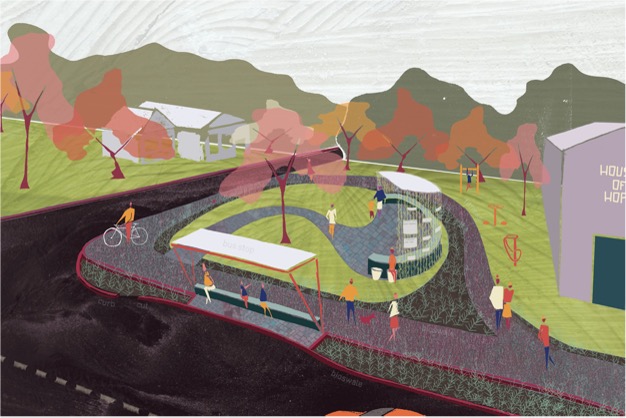 Image 1: Initial artistic rendering of the first project site at Myrtlelawn St and Plank Rd
Cheap Talking and Mapping
The “cheap talk” phase helps re-engage the community, rebuild trust, and re-orient redevelopment, contrary to what the term and process has historically meant for communities like this. It is built on the idea that one has to lay the groundwork, or rather rebuild the groundwork, for true collaboration to occur. This is particularly challenging, but crucial, in communities that are chronically under-served and under-represented in traditional local government and planning processes, and even more so in communities with deep distrust of those processes and those suffering from planning fatigue.
Next, in the “mapping” phase, it is important to involve different communities or sectors in the process as a way to deeply engage the five primary actors—public authorities, businesses, civil society organizations (NGOs), local social innovators, and academic/knowledge institutions—in the co-creation project. Given the imbalance of resources, voices, knowledge and capacity among these actors, it is important that the community of residents, the unorganized public, emerges as a strong presence before the practicing and prototyping phases begin.
“Cheap talking” began informally in April 2019 at the BBR Food Truck Round-Up, the second community event for the Imagine Plank Road planning process. CCBR was a part of many informal conversations with various members of the community who all expressed the need for more accessible green space. Subsequent conversations at various BBR events were had until November 2019 with many community members and other stakeholders that reiterated this need, each with their own required amenities.
In June 2019, the CCBR Project Manager and BBR Community Engagement Specialist sat down to discuss two options for the composition of the PREPSC: 1. a group of local residents from a specific community within, or 2. a group of community members from various communities across the Plank Road corridor. The latter option was ultimately chosen because it was unclear at the time where PREP would be constructed, to be more inclusive of the different communities in the PRC and to develop the capacity in different communities to replicate the process in the development and implementation of similar projects in their communities.
CCBR, in collaboration with BBR’s Community Engagement Specialist, selected key community advocates in July 2019 and established the PREPSC. The PREPSC established the norms, values and mission of the pilot project, along with the amenities that the community around the project site(s) would want in their green spaces. Once level setting and priorities were determined with the PREPSC, CCBR and BBR convened a meeting in August 2019 with local stakeholders such as ExxonMobil, BREC, LSU’s Landscape Architecture (BLA) Program and Coastal Sustainability Studio (CSS), BR Audubon Society, Baton Rouge Green, and Southern university’s Urban Forestry Program in conjunction with one of the planning process activities. The convening was a “project kickoff” to develop the vision created by the Steering Committee to provide adaptable greenspace and climate mitigation amenities.


Image 2: LSU student finalist renderings of the first project site at Myrtlelawn St and Plank Rd
Although this phase officially started in July 2019 and ended in December 2020, it never really ends. The PREPSC were the only members of the community that have remained involved. As the project moves between phases, various constituents in and around the Plank Road Corridor have been and will continue to be engaged, such as members of the community associated with other projects related to the Advancing Cities collaborative or the Imagine Plank Road plan.
Practicing and Prototyping
Practicing is designed to identify and create possible synergies and alignment between projects and relevant actors. In Prototyping, participants and policymakers (local officials) reflect on the mapping and practicing phases and begin to extract the specific characteristics and needs of the community that will be served. The project is currently (Spring 2022) in this phase and has been since November 2019, when the Imagine Plank Road Master Plan was presented at Southern University. The PREPSC, BBR and CCBR engaged with many stakeholders as part of the process, as described below.
The Practicing and Prototyping phases, although distinct, work in tandem to move concepts from ideation towards implementation. For example, Southern University’s Urban Forestry Program, led by the late Professor Kamran Abdollahi, provided soil, hydrologic and storm water data for the Plank Road Corridor. In addition, Baton Rouge Green provided a list of native species for pollinator gardens and stormwater mitigation for project sites. The LSU School of Architecture, Coastal Sustainability Studio and Inland from the Coast projects were integral in conceptualizing the community needs into tangible amenities for the project site.

Image 3: Selection of Myrtlelawn Ecopark Community Webinar Flyer
CCBR saw an opportunity to collaborate with LSU SLA, which had a prior working relationship with BBR to develop PREP into a robust community endeavor. Starting in Fall 2019 an informal student cohort would work alongside CCBR and PREPSC to adapt the vision of the community into visual plans for the park. The students gained valuable community engagement experience working with the PREPSC on understanding and developing the required design amenities for PREP. In addition, BREC (a project partner since the initial convening) provided subject matter expertise for both PREPSC and the student cohort on managing a park project that grounded our work and made it a more robust project. This all culminated in December 2020 with the Myrtlelawn Ecopark Community Webinar, a virtual presentation of the final four designs created by the students for PREP for the greater Plank Road community to see the fruits of their labor. The experiential learning environment established proved to be both collaborative and mutually beneficial for all parties involved. Furthermore, it was a successful example of the Co-City protocol creating local ownership and establishing co-governance of a community asset.
The practicing and prototyping phases of the project have been prolonged due to a few ongoing challenges that impacted progress. Those challenges are discussed below.
Testing and Modeling
The Testing phase occurs when the prototype from the previous phase is tested and evaluated through implementation, monitoring, and assessment. The Modeling phase focuses on adapting and tailoring the prototype and nesting it within the legal and institutional framework of the city or local government. CCBR envisions the PREP to begin the Testing phase as part year three of this collaborative endeavor. The project timeline experienced a few challenges since March 2020 that impacted progress towards this phase. These have delayed the project timeline a bit and will be incorporated in these phases as we look at both qualitative and quantitative metrics employed to assess PREP and the Co-City protocol in the process. However, with some ingenuity of project partners and a few strategic opportunities, the project is closer to being on schedule.
The Challenges
During the first project convening in August 2019, CCBR envisioned groundbreaking by December of 2019 and construction to be completed by Summer of 2020. The initial timeline was ambitious and aggressive but overall feasible.
Covid-19 became a far-reaching problem in early 2020. The team had to adapt the community engagement, communication and project management strategies to a virtual environment. This would be difficult under normal circumstances, but it was even more difficult considering the digital divide impact in the PRC. Working from home, virtual classrooms, childcare, recurring pandemic surges and related issues became ongoing considerations for anything related to the project. The pandemic posed challenges across the board but it wasn’t the only one faced during the process.
Like many development projects, there are a number of variables at play that take time to resolve. In September 2020, we discovered that the site could no longer accommodate the project vision as developed. In March 2021, CCBR communicated the issue to our stakeholders with the PREPSC and many others in the community expressing their frustration. The major concern could be summed up in the following statement, “ We’re not okay with wasting funds earmarked for projects that are just talk.” Out of respect for that vision, we set out to identify an alternative site that would allow it to be fully realized. The next several months were spent on identifying and working to acquire a new site for the project. It was important for CCBR and BBR to communicate to the community their commitment to remaining good stewards- that no funds were “wasted” during the process and that the funds earmarked for this project remain available. A new site was selected in June 2021 and work on adapting the new site to align with the overall project commenced in July 2021. Furthermore, the work done by the collaborative partners of BBR, CCBR, BREC and the LSU student cohort was adapted to the new project site.

Image 4: Renderings of PREP at Erie St and Plank Rd Site. Courtesy of BREC
Additionally, in the Summer of 2021, BBR experienced pandemic-related staff turnover, and the loss of institutional knowledge related to the project. As new BBR staff onboarded, Hurricane Ida hit the region, and attention and resources were shifted to rebuilding efforts and essential public services. The PREP project budgeting included contingencies,however, rising construction costs related to the pandemic and supply chain issues continue to be an issue.
Lastly, the delayed remittance of deliverables from sub-contracted parties continues to delay project progress. In spite of all the aforementioned challenges, CCBR and BBR are committed to moving PREP forward.
Next Steps
The PREP project, including the process and challenges discussed, illustrates the perseverance of the Plank Road community and the dedication of the collaborative project partners. The work performed on the Myrtlelawn site was not lost and will be used on the new site. The new project site, located on the corner of Erie St and Plank Road, is in closer proximity to other Imagine Plank Road catalytic project locations and will share in the positive externalities generated by them. In addition, the research, design and planning work done for the previous project site is adaptable to the new site with some modifications. Looking forward, project groundbreaking is envisioned for Q22022 with completion in Q4 2022. BBR, CCBR and BREC have divided PREP into construction phases to reflect community needs and available budgets to manage current expectations and future growth. In parallel, BBR and BREC are entering into a Cooperative Endeavor Agreement for the future management and operations of PREP and for future park projects. We look forward to continued momentum, collaborations and progress in 2022 and the opportunities that lie ahead.