With the 2030 deadline approaching and persistent gaps in trust and social legitimacy hindering sustainability transitions, a recent JRC (European Commission) report by Christian F. Iaione and Cecilia Bertozzi examines how commons-based co-governance and joint management of common goods can facilitate and accelerate the localization of Sustainable Development Goals (SDGs) within urban environments.
The report identifies three principal findings: co-governance extends beyond the conventional top-down versus bottom-up dichotomy; it offers evidence-based recommendations that support SDG localization across EU territories, noting that most SDG targets require local action, and contributes to the development of a shared, consensual framework through imposed directives aimed solely at achieving uniformity.
The report grounds its analysis in five case studies ranging from Reggio Emilia to Amsterdam, which demonstrate the use of legal and financial instruments, the role of institutional facilitators such as city science offices, and the common challenges faced across regions, including bureaucratic silos, long-term funding constraints, and the need for inclusive co-design.
A key takeaway is well documented: co-governance can serve as a significant accelerator of sustainability transformations in urban contexts. However, further scaling is required to understand better the contexts in which these models are effective and to assess the long-term sustainability of the supporting institutional capacities.
The City
Science Initiative aims to strengthen how science and research can help address
the urban challenges and to develop a structured approach to evidence-informed
policy-making at cities’ level.
Recently,
the report reflecting on the CSI pilot phase has been finalized and published,
by the name of ‘City Science for Urban Challenges’. The report of the mission
board for climate-neutral and smart cities is accessible through this link.
“The
introduction of a Climate City Mission is a radical new way of achieving
climate neutrality – and of doing so faster, by 2030. The Mission aims to
promote system innovation across the value chain of city investment, targeting
multiple sectors such as governance, transport, energy, construction and
recycling, with support from powerful digital technologies. As such, it
requires a change in regulations, approaches and instruments combined with the
willingness to go beyond existing schemes and habits. The Mission also demands
a change of attitude towards practical aspects of implementation, but also as
concerns people and organisations working together: citizens, local
governments, central and regional governments, and European institutions. We
expect citizens, city administrations and political leaders to show commitment,
imagination and determination. We expect you to implement this Mission with the
same determination as the Americans did with their Moonshot. The climate minded
transformation of cities goes far beyond the idea of the Man on the Moon. This
is The Mission of our times!” (Hanna Gronkiewicz-Waltz, Chair of the Mission
Board for Climate Neutral and Smart Cities)
Food
policy has not usually represented a mainstream domain for urban planning.
However, as Professor Kevin Morgan argued now ten years ago, this “puzzling
omission” is not justifiable anymore given the multifunctional character of the
food system with his effects on different policy sectors and the now recognized
belief that it cannot be automatically relegated to the rural policy domain
(2010: 341). Accordingly, Thomas Forster et Al. collected best practices from
cities around the world to demonstrate the breadth of food policy and programmatic
work that is occurring in urban areas, proposing a wide range of solutions for
Mayors (2015). Their collection of policy solutions showed how “cities are
moving towards an integrated approach to food systems and there are wide
interest and experimentation in inter-departmental institutional mechanisms”
(Forster et Al. 2015:17)
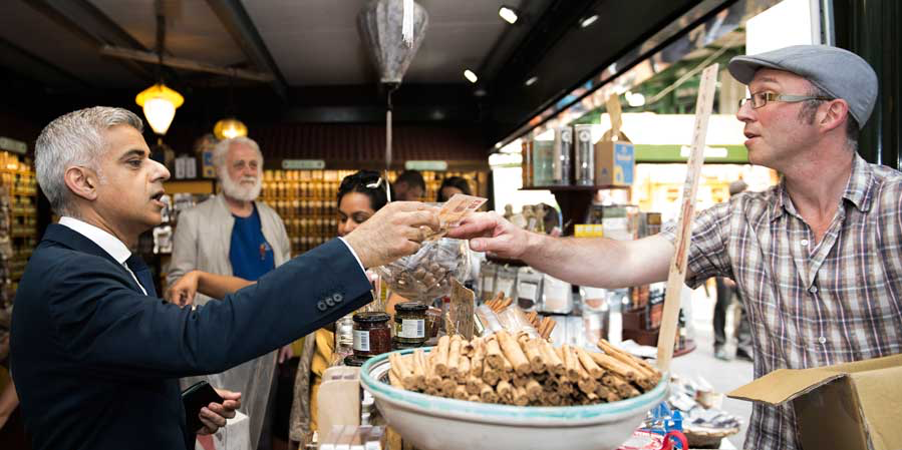
London Mayor Sadiq Khan buying food in a London Market (source Sustain)
In
this context, the city of London shows a complex governance system (Travers
2002: 787) which at a first sight does not seem to leave much space to food
policy. Thus, London has a two-tier structure with 32 boroughs plus the City of
London representing local interests and the Greater London Authority (GLA),
consisting of the Mayor and the Assembly, in charge of the London region
(Travers 2018: 340). The London boroughs are responsible for local services
delivery. In terms of policy competences, they run social care, environmental
policies, road management, public health, social housing, waste management and
they can supervise local schools (Travers 2018: 348). Whilst the Mayor
establishes the strategic framework for the boroughs and the London plan, he
also holds executive powers over transport – chairing the executive board of
Transport for London – policing, fire, emergency services, London’s growth and
economy. He even has a shared competence in housing and regeneration policy
(Burdett and Rode 2015). By contrast, food policy in the UK appears fragmented
amongst different policy sectors and layers. In particular, the multilevel
nature of the food sector led food to be considered a “wicked issue” for
policymaking and apparently unable to fit the policy system (Parsons, Barling
and Lang 2018: 212). Consequently, an evident policy opportunity emerged for
urban food policy, with the city of London experimenting new policy structures
and promoting policy change.
In
the last years, the city of London has strengthened its commitment to food
policy. The increased powers of the Mayor and the GLA enabled them to find new
policy opportunities and address relevant issues for the capital, even in
absence of strategic responsibilities. And food is one of these cases. Indeed,
the Mayor and the GLA “consult widely and work closely with London
organizations – boroughs, the private sector and voluntary bodies, in a new
inclusive style of politics” (Pilgrim 2006: 226). Moreover, the Mayor has to
enhance residents’ health and wellbeing, by also promoting social and economic
development (Halliday and Barling 2018: 186). Hence, food policymaking can be
enlisted within this duty. However, the creativity of Mayors in using their
powers (Blick and Dunleavy 2017: 4) explicitly manifested concerning food. In
fact, the current Mayor Sadiq Khan promoted a very interventionist policy
campaign banning junk food advertisements from Transport for London, relying on
its strategic direction over transport policy (Hawkes and Parsons 2019: 5).
This policy action was firstly developed on-the-ground knowledge released by
London boroughs (Hawkes and Parsons 2019: 5) and it showed how the complexity
of London governance provides several policy opportunities encouraging the
emergence of a complex urban food governance system. Additionally, the current
London Plan provides support for food growing, local food production,
encourages food waste management, aims to improve Londoners’ access to quality
and healthy food (GLA 2016). Moreover, the plan intends to tackle food poverty
by increasing the provision of land for food growing in London (GLA 2016: 323).
Finally, it calls for the implementation of a new London Food Strategy (GLA
2016: 323). This strategy exemplifies the pan London commitment to food
policymaking. The most recent – promoted by Mayor Sadiq Khan – was finally
approved in 2018 (Hawkes and Parsons 2019: 4). It openly aims to guarantee that
“all Londoners have access to healthy and sustainable food” (GLA 2018: 9) and
“highlights how food is connected to everything we do as a society: it affects
the environment, it drives our economy, affects our health and it is a central
part of our cultural life” (GLA 2018: 7). Among its policy objectives, it
differs from past food strategies in its promises to “tackle food poverty,
child obesity and unhealthy food environments” (Hawkes and Parsons 2019: 4).
The
implementation of the London Food Strategy has been supported by the London
Food Programme, which is part of the GLA Regeneration and Economic Development
Policy Unit. The Food Programme team also cooperates with food partners in the
private, public and third sectors to deliver and monitor a wide range of
projects which may concern public health, social welfare and environmental
policy issues. It also works closely with the London Food Board. The board
counsels the Mayor on food priorities for London and it is composed of experts
from academia, the third and the private sector. Finally, London boroughs’
voice is heard through the Borough Food Sub-Group of the London Food Board
(BFSG), which is primarily composed of officials from London boroughs’ public
health teams (Hawkes and Parsons 2019: 5). It aims to strengthen the
relationship between the GLA and London boroughs as regards food policymaking
and reduce policy fragmentation. Since the Mayor has limited powers on
food-related issues and boroughs have no obligation to follow his
recommendations, the subgroup offers a more democratic arena for discussion
(Halliday and Barling 2018). Moreover, the London Food Programme works in
partnership with Sustain, an alliance of food and farming organizations, which
supports London boroughs developing Food Poverty Action Plans (GLA n.d.). Sustain
also releases every year the report “Beyond the Food Bank” to assess boroughs’
signs of progress in meeting food objectives over the year. The report shares
every year what each London borough is doing on food to generate positive competition
among each other.
In
this context, London Boroughs – like other local authorities in the UK – have a
wide range of policy levers to produce long-term food policy change, and
address social, economic and environmental issues as well (Marceau 2018: 3). Food
Poverty Action Plans represent one of these levers through which local
authorities can work with local partners to tackle food poverty at the local
level (Marceau 2018: 3). Here, the limited Mayoral powers and resources as
regards food policymaking explain how several food policy networks and
partnerships emerged, especially in London, to fill the gaps that neither city
nor local politics managed to compensate. Thus, a food partnership represents a
consortium of organizations, ideally from the public, voluntary, faith and
community sectors, who locally commit to working together and tackling food
poverty (Sustain 2020). In 2017 around 50 cross-sector food partnerships have
been set up in the UK as part of the Sustainable Food Cities movement (Davies
2017: 3). Once established, they are generally constituted by cross-sector
bodies. Davies reports that food partnerships may take different shapes,
relying on a more formalized or more informal structure. Some are directly
housed by public sector organizations and are generally staffed by government’s
employees. Others may be staffed and funded by third sector organizations or
even fully independent, with minimal available resources and mostly composed by
volunteers (Davies 2017: 3).
Ultimately,
the complexity of London’s urban governance represented a fertile environment
for food policymaking, especially considering the policy vacuum left by the UK
central Government as regards food. Thus, food policies have been recently
added to London’s local and city-region agendas. Firstly, the Mayor made food a
relevant component of its London Plan and launched the third London Food
Strategy. Then, London boroughs started implementing local food policies as
food poverty action plans and cooperating with local food partnerships.
Evidently, if urban planning neglected food policy for a long time, the case of
London shows how an increasing number of local actors from the public, private
and third sector have finally recognized the strategic significance of the food
system for urban areas and, more in general, of food for communities’ health
and wellbeing
References
Blick,
A. and Dunleavy, P. (2017), Audit 2017: How democratic is the devolved
government of London? London: Democratic Audit UK.
Forster,
T. et Al. (2015), Milan Urban Food Policy Pact: Selected Good Practices from
Cities, Utopie/29 Globalizzazione, Milan: Giangiacomo Feltrinelli Foundation.
Halliday,
J. and Barling D. (2018), The Role and Engagement of Mayors in Local Food
Policy, In Rethinking Food Policy: A Fresh Approach to Policy and Practice.
London: Centre for Food Policy.
Morgan,
K. (2010), Feeding the City: The Challenges of Urban Food Planning,
International Planning Studies, 14: 4, pp. 341-348.
Parsons,
K. and Hawkes, C. (2019), Brief 4: Embedding Food in All Policies, In
Rethinking Food Policy: A Fresh Approach to Policy and Practice, London: Centre
for Food Policy, pp: 1-8.
Parsons,
K., Barling, D. and Lang, T. (2018), UK Policymaking Institutions and their
implications for integrated Food Policy (Chapter 7), Advances in Food Security
and Sustainability, Volume 3, pp. 211-251.
Pilgrim,
M. (2006), London Regional Governance and the London Boroughs, Local Government
Studies, 32:3, pp.223-238.
Travers,
T. (2002), Decentralization London-style: The GLA and London Governance,
Regional Studies, 36:7, pp. 779-788.
Travers,
T. (2018), London: government and politics in the boroughs, in Dunleavy, P et
al (Eds.), The UK’s Changing Democracy: The 2018 Democratic Audit. London: LSE
Press.
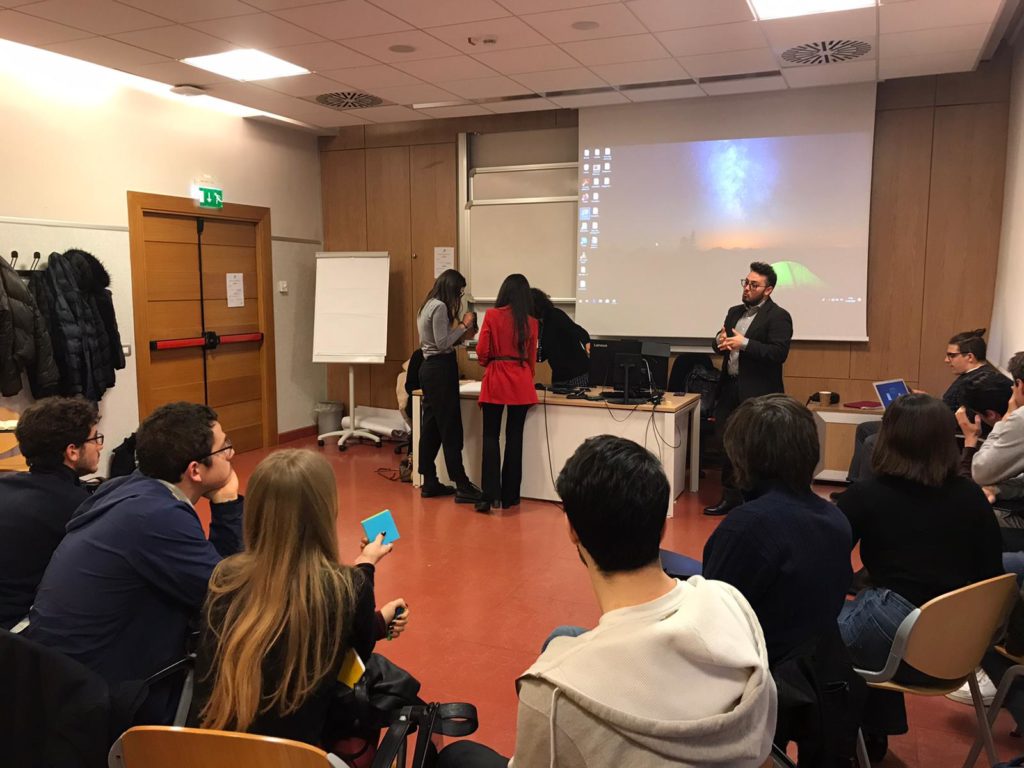
On Friday 21th and Saturday 22th the students of the Urban Clinic Edu LabGov 2020 participated to the first workshop and co-working. The main goal of the meeting was to deepen the knowledge about an “Open and Collaborative Innovation” methodology that is lately gaining popularity.
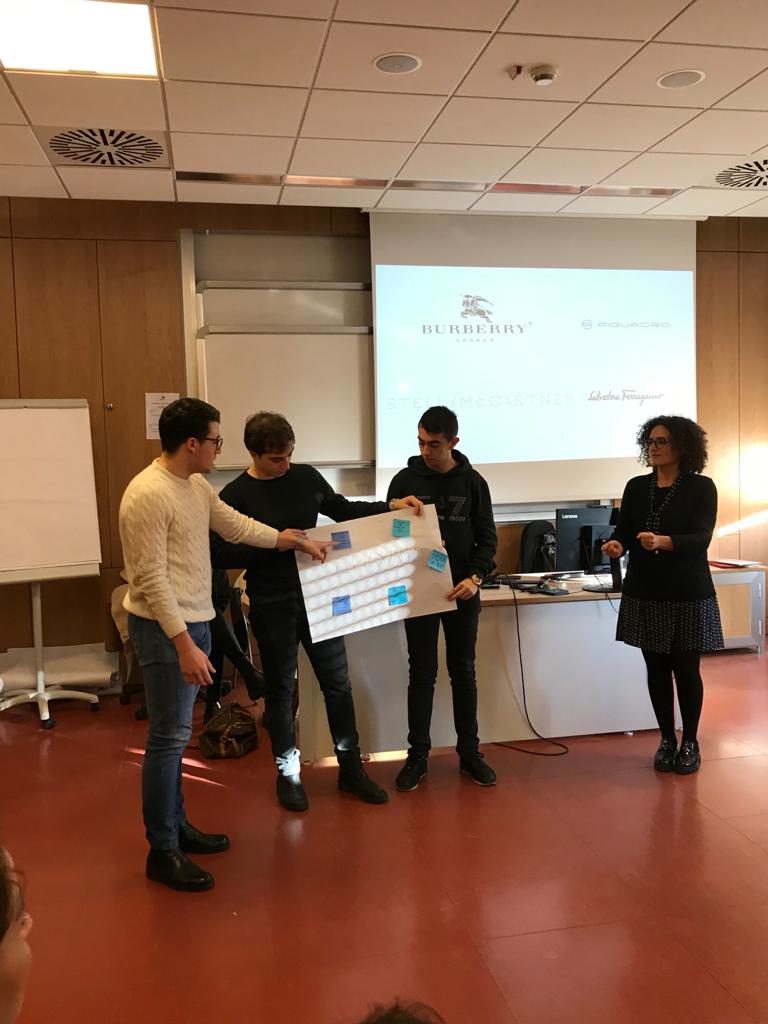
On Friday, Professor Maria Isabella Leone, Director of the master in Open Innovation and IP at Luiss Business School, carried an interactive lesson, successfully involving students in a reasoning process, instead of flooding them with theoretical knowledge which hardly manages to capture students’ interest. The laboratory was based on the analysis of the innovative aspects and strategies of noted fashion brands, namely Ferragamo, Burberry, Piquadro and Stella McCartney and than investigate for business models of companies whose main scope is to revolutionize their activity and differentiate themselves from competitors. The students brought out interesting elements that were a source of reflection for the work they carried out the following day.
What emerged as a common trend is the transformation of waste materials into renewable resources so to create new fibres at low environmental impact. What has been stressed even more is that “Open Innovation” implies collaboration with actors coming from different realities, namely stat-ups, universities, customers, tech industries, incubators, consortia, spin-offs, industries and so on. This means there has to be trust in partnerships but whenever there is a common scope, the collaboration is more prone to be successful and consequentially improve the revenues of all participating actors.
The following day, Alessandro Piperno, PhD student in management at Luiss, exposed what a social enterprises is and how to help communities grow and develop in an urban context. After a brief talk about some important social enterprises like 4ocean, Made in Carcere, Patagonia, and Progetto Quid, students were inspired enough to propose some of their ideas in a process of brainstorming so to come up with three specific ideas to analyse more in detail for the next meeting. The laboratory’s outcome was an important step forward to understand new trends based on upcycle sustainable fashion and circular economy.
Next meeting will be on Friday 28th with the workshop “Entrepreneurship” held by prof. Alessandro Cavallo and Saturday 29th with the co-working “Building a social enterprise” in which EDU 2020 tutors together with a jury of experts will listen to LabGovers’ pitch on their design idea. The laboratory will be an occasion for students to test their ideas and get a feedback from experts in the field so to continue shaping their ideas and let the project evolve throughout the laboratory.
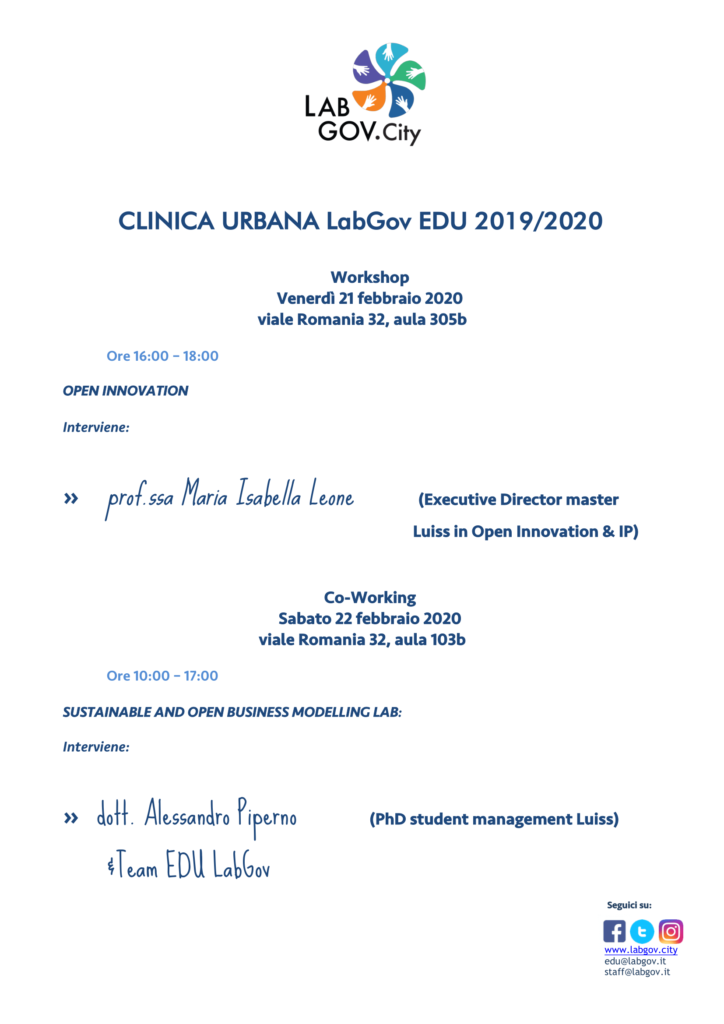
The first module will be dedicated to Open Innovation and Open Business modeling.
On Friday the 21st the
first workshop will take place in classroom 305b from 4pm to 6pm in the Luiss
campus located at Viale Romania 32.
The Urban Clinic will host Maria Isabella Leone, professor at the
department of Business and Management and executive director of the master in
Open Innovation and Intellectual Property. As an expert in open innovation she
will analyze some examples of firms that successfully adopted approaches based
on open innovation. This workshop will provide students many insights to
stimulate their creativity so to come up with some ideas to tackle our
challenge.
On Saturday the 22nd the firs co-working session will take place in classroom 103b from 10am to 5pm at the Luiss campus located in Viale Romania 32.
The Urban Clinic will host Alessandro Piperno, Luiss PhD student in Management. During the co-working session, the students will be divided into three groups, each group has to develop an idea’s proposal able to overcome our challenge. Every group will then present its idea to the rest of the students and work on a power point presentation to redefine it and analyze in depth the topic. Once the idea generation process will be gone underway, Alessendro Piperno will explain to students the basic notions to carry out a business model so to provide students with practical skills that will help them turn their ideas into reality.