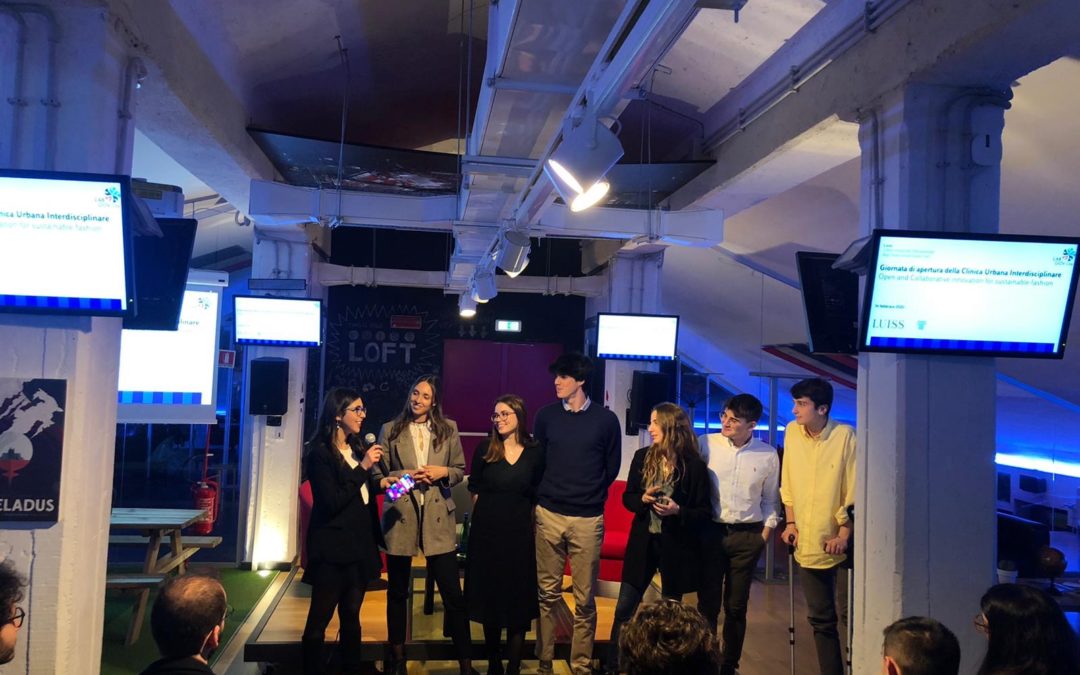
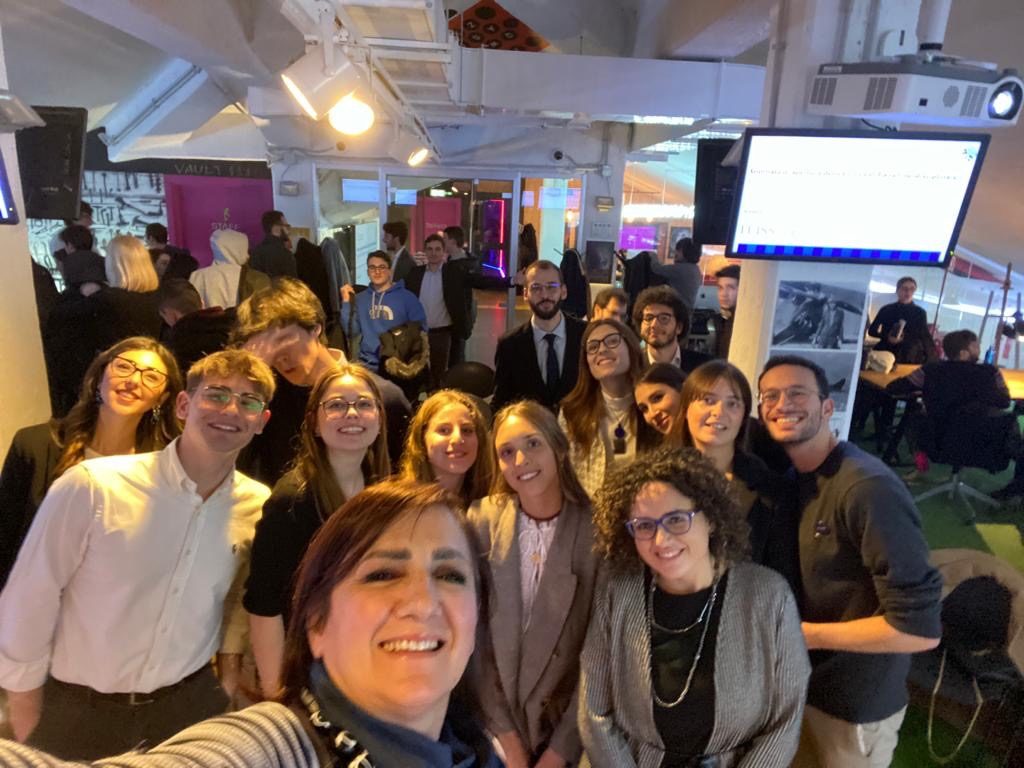
On Friday, February 14th, the opening meeting of the LabGov 2020 Interdisciplinary Urban Clinic took place at the LOFT of the Luiss Guido Carli University .
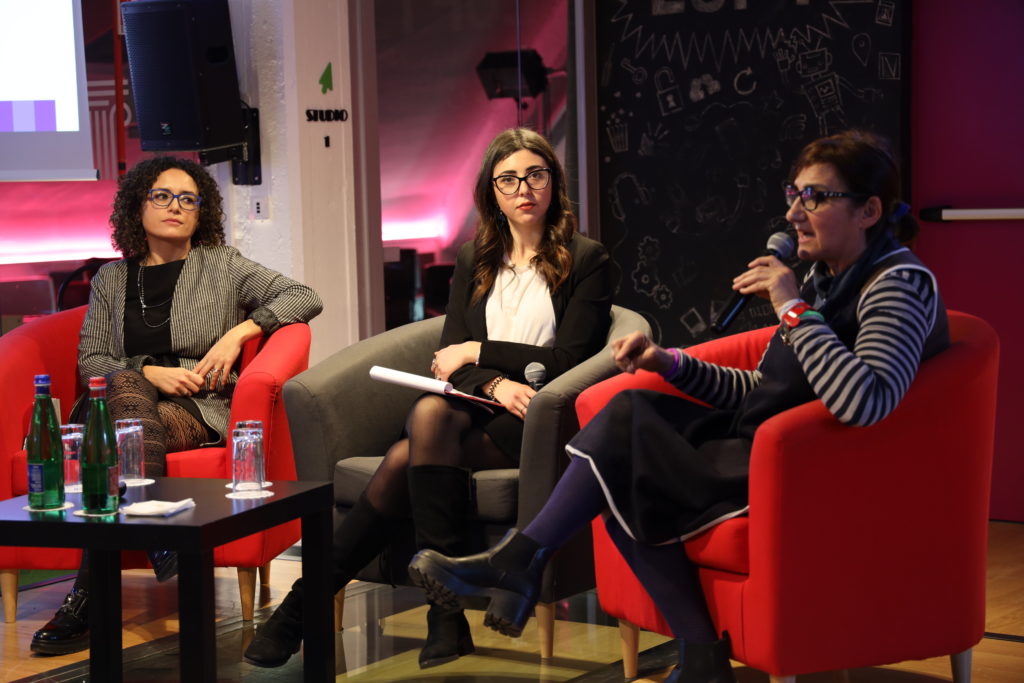
The theme of the meeting was the Open and Collaborative Innovation for Sustainable Fashion and we had the honor to host the Luiss General Manager, Giovanni Lo Storto, Professor Maria Isabella Leone, Executive Director of the Master in Open Innovation & Intellectual Property at Luiss Business School and Dr. Luciana Delle Donne, founder and CEO of Made in Carcere.
Credits to Luiss Loft
The first part of the meeting was dedicated to the LabGov.City team presentation to the students with a focus on the projects carried out so far and the future goals that will see them involved. It was Dr. Lo Storto who welcomed the new LabGovers (the students of the Urban Clinic) and recalled the true meaning of the word “sustainability” that means awareness and coherence and sustain in the sense of creating and sustaining long lasting beauty. LabGov represents this kind of support as well as the exact edge of the role that a university and a training place should have in empowering students to the value of preserving the planet, the value of physical work, the respect for the city and the maintenance of public heritage with the final scope to train not only technicians but good citizens.
The meeting continued with an informal talk between Professor Maria Isabella Leone and Dr Luciana Delle Donne: with them we have combined both the theoretical and practical approach. In particular, Prof Leone highlighted the importance for a company to adopt Open Innovation’s methodology to be competitive in the market and improve the resilience of an enterprise. The real challenge, prof Leone points out, is to transform an Open Innovation methodology into concrete results by creating new business models that have a positive economic and social impact. Together with Dr. Luciana Delle Donne, we observed how innovative and sustainable social enterprises can be generated, involving fragile communities. Luciana told us her story, in particular her “second life” when after twenty years of employment in the world of finance she decided to devote herself to social entrepreneurship: in 2007 the brand “Made In Carcere” was born. The project aims to generate awareness and responsibility by including the inmates of Lecce prison in a dynamic process that gives them a job, a salary and above all the ability to face the world once their detention is over. The real challenge in social innovation is to go against the general trend because habits and mentality are the hardest thing to change.
The second phase of the meeting witnessed the presentation of numerous initiatives that will be invited to cooperate in the Urban Clinic, including the project of Francesco Malitesta and Edoardo Croce creators of the Artwear Lab “X-novo”, a roman start-up based on the exchange and reuse of garments that involves the participation of roman street artists. Flavia Romei told us about her atelier at Pigneto “Cheap Lobster” which creates tailor-made skirts with a mix of fabrics from textile scraps coming from fashion industries.
Finally, during the Magic City, the Christmas market promoted by Luiss, LabGov collaborated with Viving, a local NGO, and Young Ethos, a group of students of the Luiss Business School, to create a collection point of used clothes in order to donate them, regenerate and reuse them.
Claudia Chimenti, President of Viving and Beatrice Signoretti and Jacopo Ventura representing Young Ethos, told us about the evolution of Magic City. A part of these garments will be regenerated during the Urban Clinic thanks to the collaboration of several actors.
Next appointment on February 21st with the first module “Idea Generation Lab” and the workshop on the theme of “Open Innovation” presented by Prof. Leone, and the co-working with Dr. Alessandro Piperno on “Sustainable and Open Business Modelling Lab”. It will be a key moment to pique students’ interest, unite the Edu LabGov 2020 community and find the starting point from which to start a co-design process.
Nella giornata di Venerdì 14 Febbraio si è svolto l’incontro di apertura della Clinica Urbana Interdisciplinare di LabGov 2020 presso il LOFT dell’Università Luiss Guido Carli.
Durante l’apertura dell’ottava edizione della Clinica Urbana abbiamo approfondito il tema dell’Open and Collaborative Innovation for Sustainable Fashion. Abbiamo avuto l’onore di ospitare non solo il Direttore Generale, Giovanni Lo Storto ma anche la professoressa Maria Isabella Leone, Executive Directore del Master in Open Innovation & Intellectual Property presso la Luiss Business School e la dottoressa Luciana Delle Donne, fondatrice e CEO di Made in Carcere.
Credits to Luiss Loft
La prima parte dell’incontro è stata dedicata alla presentazione di LabGov.City agli studenti della Clinica Urbana 2020 con un focus sui progetti svolti sin ora e gli obiettivi futuri che li vedranno coinvolti. Ma a dare il benvenuto ai nuovi LabGovers (gli studenti della Clinica Urbana) è stato proprio il dottor Lo Storto che ha ricordato il vero significato della parola “sostenibilità” che, sottintendendo i requisiti di consapevolezza e di coerenza, aggiunge l’elemento di “sostegno” e della durevolezza che crea bellezza. LabGov rappresenta tale sostegno nonché la punta esatta del ruolo avanzato che una università e un luogo di formazione dovrebbero avere per responsabilizzare i ragazzi al valore del rispetto dei luoghi in cui si vive. Il valore del lavoro fisico e del rimboccarsi le maniche, il rispetto della città e il mantenimento del patrimonio pubblico, se assunti anche nei luoghi di formazione, aiutano a formare non solo tecnici ma anche buoni cittadini..
Dopodiché l’incontro è proseguito con una discussione informale tra la professoressa Maria Isabella Leone e la dottoressa Luciana Delle Donne: con loro abbiamo coniugato sia l’approccio teorico e di ricerca sia un’approccio pratico con l’esempio di Made in Carcere. In particolare, la professoressa Leone ha fatto emergere l’importanza per un’azienda di utilizzare la metodologia di Open Innovation per essere competitivi sul mercato e per migliorare la resilienza dell’impresa stessa. La vera sfida, ha sottolineato la professoressa Leone, è trasformare una metodologia di Open Innovation in risultati concreti creando nuovi modelli di business che abbiano un impatto positivo sia economico che sociale. Insieme alla dottoressa Luciana Delle Donne abbiamo visto come si possono generare imprese sociali innovative e sostenibili, coinvolgendo e rendendo protagoniste comunità con fragilità. Luciana ci ha raccontato la sua storia, in particolare la sua “seconda vita” quando dopo venti anni di impiego nel mondo della finanza ha deciso di dedicarsi all’imprenditorialità sociale: nasce così il brand “Made In Carcere”. Il progetto mira a generare consapevolezza e responsabilità, inserendo le detenute del carcere di Lecce in un processo dinamico che conferisce loro un lavoro, uno stipendio e soprattutto la capacità di affrontare il mondo una volta terminata la loro detenzione. La vera sfida nell’innovazione sociale è andare controcorrente perché le abitudini e la mentalità sono la cosa più difficile da cambiare.
La seconda fase dell’incontro ha visto la presentazione di numerose iniziative che potranno creare sinergie con gli studenti della Clinica Urbana, tra cui il progetto di Francesco Malitesta e Edoardo Croce creatori del Artwear Lab X Novo, una startup romana sullo scambio e riutilizzo di capi che conta la collaborazione di street artist romani. Flavia Romei ci ha raccontato del suo atelier al Pigneto “Cheap Lobster” che crea gonne su misura con mix di stoffe provenienti da scarti tessili di aziende di moda.
Infine, durante la Magic City, il mercatino promosso dalla Luiss nel periodo di Natale, LabGov ha collaborato con l’Associazione Viving del II Municipio e Young Ethos, un gruppo di studenti della Luiss Business School, per creare un punto di raccolta di abiti usati col fine di donarli, rigenerarli e riutilizzarli. Sono dunque intervenute Claudia Chimenti presidente dell’associazione Viving e Beatrice Signoretti e Jacopo Ventura in rappresentanza di Young Ethos per raccontarci l’evoluzione della Magic City e come parte di questi capi verranno rigenerati durante la Clinica Urbana grazie alla collaborazione di diversi attori e professionalità.
Prossimo appuntamento Venerdì 21 Febbraio con il primo modulo “Idea Generation Lab” e il workshop sul tema dell’Open Innovation curato dalla Professoressa Leone, e il 22 Febbraio per il co-working “Sustainable and Open Business Modelling Lab” con il dottor Alessandro Piperno, PhD Student di Management Luiss. Sarà un momento fondamentale per suscitare l’interesse degli studenti e unire la community Edu LabGov 2020 nonché trovare il punto di partenza da cui avviare un processo di co-progettazione.
According to Rakesh Kaul, Partner at PwC, “a smart city is an implementation of an advanced and modern urbanization vision”.
So, smart cities are structured to allow operational efficiencies, maximize
environmental sustainability efforts and deal with citizen services such as:
citizen identities management and
citizen participation;
payment system between people and
organization;
employment;
health;
culture;
transportation;
environment and space;
energy and waste;
land management;
clean habitat;
infrastructure.
In this economic, social, technological and
political context, these shifts are
reshaping the world and new challenges arise for countries and particularly
for cities. As governments are seeking to incorporate innovations within their smart
cities, blockchain can offer something
more.
So, blockchain’s role is quickly increasing
because it brings decentralization,
erases intermediaries, brings security
among the systems and interoperability
among users. To be clear, blockchain is a trusted distributed ledger
system across a network of users. It is a system, where the parties cooperate
to ease the transaction process, make it more anonymous and yet more secure.
According to Tom Zilavy,
IBM Blockchain and Cloud solutions,
blockchain can be utilized for smart cities in different ways: first of
all, blockchain can push citizens to smart
choices motivating their behavior: for example, thanks to a smart contract, public authority will
be able to automatically give you a reward
for a conscious good behavior such
as using public transport in your city; then, blockchain could increase effectivity offering the possibility
to have all the information in one database with participants having predefined
permissions to view or change (transact) the information they need (in the case
of a smart trashbin); finally, blockchain can make energetics efficient: for example, citizens
with solar panels on their houses could, thanks to smart contracts,
automatically trade their unused electricity with their neighbours and others
that are connected to the grid. These transactions would be executed
automatically, with the help of smart contracts and therefore effectiveness
would be achieved.
City worldwide are implementing blockchain
projects: Estonia has catapulted itself on the global stage as a
digital nation by proactively supporting blockchain
startups and embracing blockchain in its own operations. In this context, Tallin hosts, for example, e-residency program that allows anyone
to incorporate a digital enterprise in Estonia, without ever having set foot
there; the Estonian Cryptocurrency
Association, a nonprofit in Tallinn, has taken up the charge to help
promote the ecosystem locally and globally. In Singapore, Smart Nation
strategy seeks to transform former fishing villages into living laboratory
of innovation, and that type of proactive thinking is one reason it’s 2018 year’s world leader in blockchain. Singapore GovTech office is exploring a handful of
blockchain use cases, while the Monetary Authority of Singapore has pioneered a
decentralized inter-bank payment and settlements solution. Finally, the city of Austin in Texas is currently piloting a program in
which its 2,000 homeless residents will be given a unique identifier that’s
safely and securely recorded on the blockchain
Blockchain brings a lot of pros but there are a
great number of challenges still open. There is lack of coherent regulation, many players want to centralize blockchain and there is a need to increase performance, interoperability and reducecomplexity and cost.
Recreating the urban territory as a commons means reconsidering the way citizens absorb and engender all the elements that can support human development – including learning, as a broader way to refer to education. Urban territories can offer unique learning opportunities on different levels, an important one being that of stimulating people to recognise themselves as citizens and as part of a community, or different communities (from the street, to the neighbourhood, to the city layer). Moreover, the experiencing of the urban territory exposes people to social diversity, which is crucial to cultivate empathy and tolerance, much needed qualities especially in present times.
The understanding of the city as a fertile learning environment presents itself as an invitation to consider what children can learn in the urban territory that cannot be taught at school, and what are the urban qualities that can be cultivated to create social connection and empowerment. Initiatives, worldwide, that explore this invitation are growing in power and number. One of them, TaMaLaCá1 (Tutta Mia La Città, meaning, All The City is Mine, a collective of woman based in Sardinia, Italy) has been working in collaboration with primary schools to instigate children in the creative occupation of the urban environment. TaMaLaCa’s projects reverse the situation that life on the street has been replaced by cars on the streets, and that many cities are not placing an invitation for children to play in the outdoor urban environment as they used to in old times.
Image: http://www.tamalaca.com/
Another approach to the city as a learning environment is the concept of Bairro-Escola (meaning Neighbouhood-School, in Portuguese), an alternative education model prototyped by Cidade Escola Aprendiz2, a Brazilian NGO that advocates for integrated learning opportunities for communities. Bairro-Escola is a model of networked learning that articulates different stakeholders such as communities, community organisations, local schools, private institutions, and the public sector, aiming at an integrated development of people and territory based on learning opportunities that exceed the formal school curriculum, and a set territory to expand the notion of learning. It aims at developing richer community relationships and integrated human beings that express different kinds of intelligence (including cognitive, social, physical, affective, and psychological abilities), capacitating students to become active in society through personal and collective autonomy.
Bairro-Escola place schools as a reference point for articulating public policies, community resources and, mainly, community knowledge, being much attentive to local identity and its richness in relationship to human integrity. Schools, thus, become responsible for the articulation of democratic political-pedagogic projects, always committed with collective decision-making processes involving different stakeholders for managing the school itself and its wider community. In this process, students are apt to see themselves as part of networked-systems and to trust their ability to influence the development of their communities, and their cities, also understanding their role and power within a wider network of people.
How can cities be redesigned in such a way that, as emphasised by these two case studies, stimulates learning processes in the urban environment that allow children to grow into citizens that understand they are part of networked systems, thus becoming active citizens?
Italian pedagogist Francesco Tonnucci3 reinforces the idea that it is crucial to stimulate children’s participation in the urban if we are to have cities that, instead of disconnection, stimulate stronger ties and more resilient systems. That said, to recreate cities where children’s experiences are valued is an idea worth expanding both through design, learning curriculums, and policy development – after all, the children of today represent the active societies of tomorrow.
Come possiamo pensare la città come uno spazio in cui le opportunità per imparare fuori delle scuole esistono in abbondanza? Esistono innumeri progetti di design e politiche pubbliche che stimolano questa idea, guardando a come i bambini si possano tornare cittadini più coscienti e autonomi per essere attive e presenti nelle società di domani.
The Co-Cities Open Book is the result of years of research and experimentations on the field to investigate new forms of collaborative city-making that are pushing urban areas towards new frontiers of participatory urban governance, inclusive economic growth and social innovation.
This open book has roots in our conceptualization of the ‘City as a Commons,’ the emerging academic field of urban commons studies, and the work developed in 5 years of remarkable urban experimentations in Italy and around the world. Structured around three main pillars, the Co-Cities open book will first provide scholars, practitioners and policy-makers with an overview of the theory and methodology of the Co-City with the “Co-Cities Protocol”.
The open book also presents the “Co-Cities report”, the results of an extensive research project in which we extracted from, and measured the existence of, Co-City design principles in a database of 400+ case studies in 130+ cities around the world. Ultimately, thanks to the Co-cities report we were able to create the first index able to measure how cities are implementing the right to the city through co-governance. Thus, the Co-Cities index serves as a fundamental tool for the international community in order to measure the implementation of some of the objectives that have been set by the New Urban Agenda and the Sustainable Development Goals.
The last section of the book presents a collection, or annex, of articles of some of the most important researchers and practitioners studying the urban commons. These essays were conceived and offered as part of “The City as a Commons” conference, the first IASC (International Association for the Study of the Commons) conference on urban commons, co-chaired by Christian Iaione and Sheila Foster that took place in Bologna on November 6 and 7, 2015.