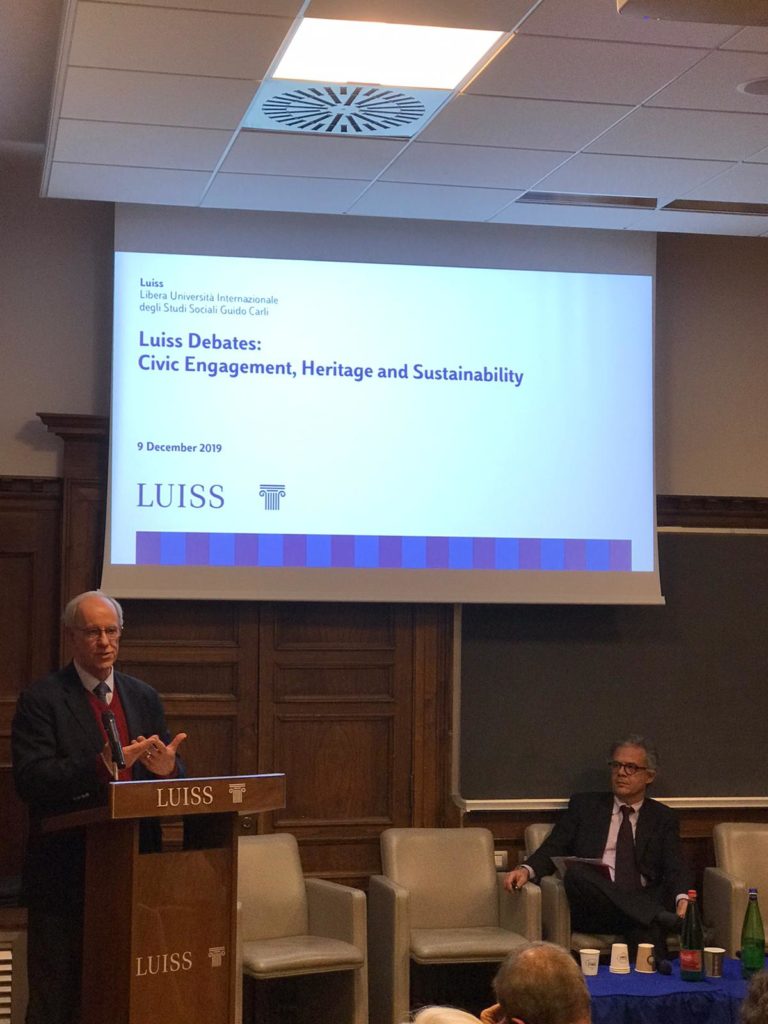
The Luiss viale Romania Campus hosted the Luiss Debate “Civic Engagement, Heritage and Sustainability” organized by the Luiss School of Law and Luiss LabGov.City in collaboration with the Roma Tre University Architecture Department and Eutropian.Org. The Debate was organized in the framework of the Third Consortium Meeting of the Horizon 2020 project “Open Heritage” (https://openheritage.eu/ ), that aims at creating sustainable models of heritage asset management by putting the idea of inclusive governance of cultural heritage sites together with development of heritage communities at its center (it involves an open definition of heritage, not limited to listed assets but also involving those buildings, complexes, and spaces that have a symbolic or practical significance for local or trans-local heritage communities). This means empowering the community in the processes of adaptive reuse. LabGov – Luiss is part of the project, thanks to its engaged research conducted in Rome.
Luiss Rector, Andrea Prencipe, opened the meeting underlining the importance of the three key words: Sustainability, a crucial theme in these days; Heritage, as Rome is the homeland of cultural heritage; and Civicness, as Luiss students must be Engaged and good Citizens before being professionals.
The Vice Dean of the Department of Law Antonio Punzi continued exposing how relevant are civic engagement, heritage and sustainability in innovating and updating the academic curricula of the Luiss Law Department, through the creation of a master degree in Law, Digital innovation and Sustainability.
The debate, moderated by Raffaele Bifulco (Professor of Constitutional law – Department of Law Luiss University) continued following the keynote speeches from national and international scholars and members of European institutions, an interesting discussion on civil engagement and sustainability as cross-cutting principles for the governance of cultural heritage. Among the participants, Erminia Sciacchitano, Eu Commision DG Culture Policy Officier and Chief Scientific Advisor EYCH 2018, exposed the new EU cultural policy framework underlining the crucial role of an Open Governance through the Urban Innovative Actions, an initiative of the EU that englobes all the pilot projects for sustainable urban development, launching the 5th call for proposals that will expire on December the 12th.
Mark Thatcher, Luiss Professor of Political Science, has deal with the link between identity and markets within the Eu Cultural Heritage. What he stated is that the “EU can create a cultural identity through markets, but markets are too technical and therefore lack of political participation and support”. In addition, he highlighted that, even though Europe is a young Union, this does not mean that a cohesive identity cannot be created. It is thus necessary to create a link between political identity and markets so to create a parallel european citizenship that does not overcome the national one.
Luisella Pavan Woolfe, on behalf of the Council of Europe, exposed “the role of the Faro Convention for the promotion of equality, inclusion, and development of local communities and minorities trough heritage”. The focus was on the relevance of the role played by a community itself. As a consequence, it is essential to work together in order to preserve and protect the Cultural Heritage for the present and future generations.
Moreoever, as underlined by Sandra Gizdulich, member of the Urban Agenda Partnership for Culture and Cultural Heritage and Italy Territorial Cohesion Agency, one cannot left behind the importance of preserving the quality of landscape. To do so, it is necessary to build a stronger environmental heritage. This is not an objective itself, but the greatest aim necessary to achieve social and ecological cohesion. She in facts added that as Urban Partnership on heritage they will launch an action on better regulation to apply the legal approach used by Turin, Bologna and Naples on commons.
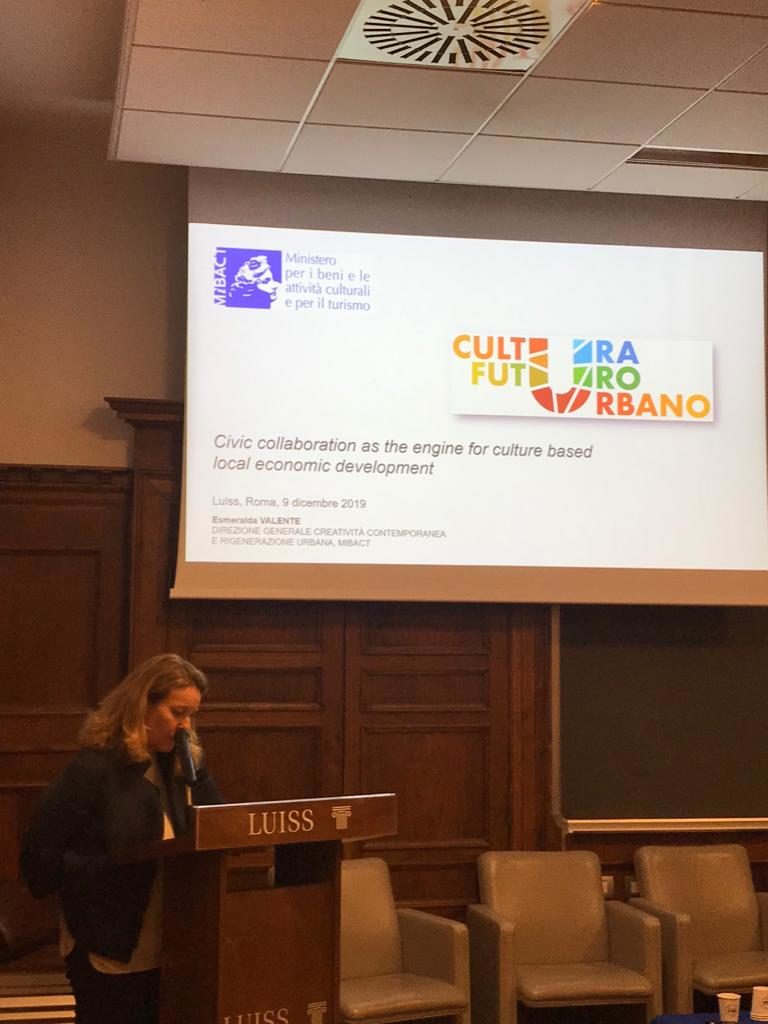
The debate continued with Esmeralda Valente (Contemporary creativity and Urban Regeneration Directorate – Italian Ministry of Culture) presenting “Cultura Futuro Urbano”, an innovative public policy based on promoting the adequate conditions for citizens to improve their creativity and human talent. This is, in her words, one of the most ambitious projects launched by MiBact and it has been created with the scientific support of LabGov.City and the Luiss Business School.
Not to leave behind the Cultural Heritage’s role when dealing with Archaeology, Peter G. Gould, from the University of Pennsylvania Museum of Archaeology and Anthropology and Professor of Archaeology at the American University of Rome, explained the success factors associated with economic development projects within communities adjacent to archaeological and heritage sites. Under his view, the success of community projects is linked to the mechanism community members use to govern their projects activities. He also cited the work of Elinor Ostrom and her attention to the polycentricity principle.
The Luiss Debate was concluded with the intervention of Giovanni Caudo, from the Roma Tre University’s Architecture Department and Elena De Nictolis post doc of the Department of Political Science. The Open Heritage project and the whole debate has shown that there is possible room for improving, thought the commons approach, trough better regulations, institutions and communities’ inclusion. All these realities are fundamental in creating a new regulatory framework, new policies, and in general an higher awareness and knowledge in managing the Cultural Heritage. The Debated ended with the greetings of Professor Iaione.
Chiara Prevete (LabGov researcher and legal team) has published an article about foreigners’ access to public management on the journal “Observatory of the Italian Association of Constitutional Law scholars”, “Osservatorio AIC”[1]. This question had a key turning point with the Plenary Session of the Italian Council of State decision in June 2018. The question refers in particular to museum directors. In this respect, changes have been recently made in the legal framework by Minister Franceschini’s reform (legislative decree 31 May 2014, No. 83). The heart of the sentence is linked to the well-known question about the ‘reservation of citizenship’ connected to the nature and functions of public management in the Italian legal system. In fact, this issue refers to the Nineteenth Century distinction between ‘acts of imperio’, the expression of the puissance publique, and iure gestionis (the private, merchant-like, commercial acts of the government of a state), where the possession of Italian citizenship is traditionally necessary for the exercise of public functions. The case law moves in particular from a hermeneutic diatribe on 1994 rule, the D.P.C.M. 7 February 1994, n. 174, which provides the exclusion for people without Italian citizenship from managers of public administrations roles. However, this topic can only be tackled considering the European principle of freedom of movement for workers, by art. 45 T.F.U.E. and its interpretation by the European Court of Justice.
The Author in particular emphasizes the role of museums’ immaterial and digital resources. In this way the Italian cultural heritage was opened for foreign museum directors. Above all, the administrative decision contributes to social development and the integration of different cultures according to art. 1 of the Faro Convention[2]. Indeed, also the concept of ‘Nation’, by art. 9 of the Italian Constitution, peacefully referred to the Community-State and not to the State-Apparatus, is nowadays interpreted as a ‘heritage clause’. As clarified by Häberle[3], the concept of an identity and inheritance clause is identified as ‘a characteristic element of developing countries’. He has highlighted the fact that the link to the cultural heritage would be unsuccessful if only the status quo is guaranteed and not the aspect of the multiplicity of past and future cultures. In this sense the term ‘Nation’, in the second paragraph of art. 9 of the Constitution, alludes to an ‘intergenerational pact’ or ‘synthesis of past, present and future generations’. Furthermore, this judgment demonstrates the importance of the judges’ interpretation also in civil law. In this sense, the legal system seems more authentic[4] because it observes changes in society.
[3] P. Häberle, Potere Costituente (teoria generale), in Enc. Giur. Treccani, IX, 2000, 32.
[4] P. Grossi, Le comunità intermedie tra moderno e post-moderno, Genova, 2017, 66.
—-
La complessa vicenda sull’accesso degli stranieri alla dirigenza pubblica trova un importante punto di svolta nella pronuncia dell’Adunanza Plenaria del giugno 2018. La questione affrontata si riferisce segnatamente ai direttori dei musei, la cui disciplina è stata di recente oggetto della riforma c.d. Franceschini, di cui al d.l. n. 31 maggio 2014, n. 83, attuata con numerosi decreti. Il cuore della controversia dinanzi all’Adunanza Plenaria è legato alla oramai nota questione sulla ‘riserva di cittadinanza’ connessa alla natura e alle funzioni della dirigenza pubblica nell’ordinamento italiano. Si legge nella sentenza, infatti, il richiamo all’ottocentesca distinzione tra atti di imperio, espressione questi della puissance publique, e atti di gestione, ove per l’esercizio dei primi è tradizionalmente necessario il possesso della cittadinanza italiana. La vicenda processuale muove in particolare da una diatriba ermeneutica su una disposizione del 1994, il D.P.C.M. 7 febbraio 1994, n. 174, la quale prevede l’esclusione dai posti dirigenziali delle amministrazioni pubbliche di soggetti privi della cittadinanza italiana.
Culture is driving regeneration, creating the jobs of the future and diverting young people from crime. Culture makes us healthier, facilitates civic engagement and gives tourists a reason to visit. It continues to shape the heritage and identity of our cities. In short, culture addresses all the major city challenges we face today – it has moved definitively from niche to mainstream. (…) While there remain serious challenges in all our cities, there has never been a better moment to unlock the potential for culture to transform them. (Justine Simons, p.5)
“How do cities use culture to provide solutions to our contemporary urban challenges?”. This is the question underpinning the World Cities Culture Report, a compendium of the most innovative programmes, policies, key trends and infrastructure projects in culture developed by 35 cities[1] across the world. The Report is the annual document of the World Cities Culture Forum, a collaborative network made up of 38 members from local governments and cultural sector of leading cities around the world, whose activities are delivered by BOP Consulting, on behalf of the Greater London Authority and the members of the Forum. The network was founded in London in 2012 by eight cities (London, New York City, Tokyo, Shanghai, Paris, Istanbul, Sydney and Johannesburg) convened by the Mayor of London, for the purpose of “advancing the case for culture across all areas of urban policy” and “sharing ideas and knowledge about the role of culture in building sustainable cities”. Beyond the annual Summit and Report, the network provides themed symposia, regional summits, policy workshops, collaborative publications and a Knowledge exchange programme.
Two major trends emerge from the 2018 Report, supported by Bloomberg Philanthropies: the “critical role for culture in addressing the inclusion of all citizens and a new definition of how, where and by whom culture is experienced”.
As for the first trend, there seems to be a shared commitment across the cities in increasing participation to “culture for all citizens”, by means of different tools and programmes, recognizing Article 27 of the Universal Declaration of Human Rights stating that “Everyone has the right freely to participate in the cultural life of the community”. The report thus contains some examples of urban practices in access and inclusion, among which the TURN Project in Tokyo, Kulturpass in Vienna, the Agreement to Promote Reading in Milan, Neighbourhood Lives and Memories in Lisbon and many others.
As for the second trend, that is the “opening out of culture”, we assist to a change in both cultural spaces, places and forms and in the approach to support programmes and policies at the urban level. For instance, the Culture Minnesota Street Project in San Francisco, the Bronx Creative District in Bogotá, as well as the Opera Camion in Rome, the Cultural Hotspots in Toronto and so on. At the same time, new governance and policy solutions have been envisaged, such as the Cultural Matching Fund in Singapore, the Mayor’s Grant for Cultural Impact in New York, the Citizen participation shaping public art in Paris etc.
By providing “a city profile” containing data (45 indicators), trends and innovative programmes, the Report refers to more than 200 cultural programmes and practices (considered as the most innovative from the responding member cities), classified into 9 different categories:
Cultural Diversity and Representation
Cultural Access and Inclusion
Culture in the Outskirts
Citizen-Led Cultural Policies And Programmes
Making Space for Culture
Culture and Climate Change
21st Century Cultural Infrastructure
21st Century Cultural Event and Formats
21st Century Cultural Governance and Strategy
Already in 2017, within the World Cities Culture Summit, the 27 participating cities signed the “Seoul Declaration”, with the following commitment: “To ensure that culture is a golden thread in all aspects of city policy (…); To make culture available to and empowering for all citizens (…); To generate and learn from evidence and research, in pursuit of an enlightened and progressive approach to policy development and implementation; To act as leaders in our field and to continue to collaborate in the face of shared challenges and shared opportunities (…)”.
A shift is ongoing in urban culture-related policy across the world, a valuable phenomenon as demonstrated in the Report, especially in a time where “The resilience of world cities resides in their capacity to envision a different future, one rooted in interdependency that reflects and supports all the people they represent. An open culture builds that capacity” (Richard Naylor, p.17).
[1] Amsterdam, Austin, Bogotá, Brussels, Buenos Aires, Cape Town, Chengdu, Dublin, Edinburgh, Helsinki, Hong Kong, Lagos, Lisbon, London, Los Angeles, Melbourne, Milan, Montréal, Moscow, New York, Oslo, Paris, Rome, San Francisco, Seoul, Shenzhen, Singapore, Stockholm, Sydney, Taipei, Tokyo, Toronto, Vienna, Warsaw, Zürich
The Institute for Cultural Heritage – Istituto per i beni artistici, culturali e naturali (IBC) – of the Emilia Romagna Region, founded in 1974, operates as an advising body for the regional government and local authorities in policy making related to cultural heritage. It promotes projects in the field of architectural and environmental heritage, museums, libraries and hierarchies, for different purposes: restoration, protection, enhancement and enjoyment of cultural heritage.
The IBC Emilia Romagna has been developing best practices in youth engagement to the enhancement and management of cultural heritage goods, involving both schools and young associations.
We interviewed Valentina Galloni, coordinator of the pioneering project “I love cultural heritage”.
How the project “I love cultural heritage” works and how does it fit with the IBC’s activities
In Emilia Romagna, The Institute for Cultural Heritage has adopted a new policy to actively engage youth to their local cultural heritage. This policy is realized through two already consolidated initiatives: one devolved to youth cultural agencies of the region – the “Youth for the Region” contest – and the other – the contest “I love cultural heritage” – aimed at targeting students in schools.
The “I love cultural heritage” starts in 2011 to ensure the regional reach to a European project, where at the time IBC was a partner, called “Acqueduct”. The aim of the project was to train teachers and cultural institutions’ operators to understand the value and the importance of cultural heritage as a vital tool to spread key transversal competences to students. Those competences, as established by the Panel of Reference adopted by the European Parliament and the Council in 2006, are: learn to learn, social and civic competences, initiative and entrepreneurial spirit, and cultural expressions and consciousness. In order to effectively meet those goals, several pilot projects started in partner countries in collaboration with schools and cultural institutions actively involving students. Given the effective methodology employed and the successful results achieved by students, a new regional initiative has been envisioned by IBC. This is how “I love cultural heritage” came to life, encouraging every year new schools to join the partnership together with museums, libraries and archives, and to present a project adding value to local institutions and/or cultural assets. The active students’ involvement and the development of transversal competences are themselves two key goals of the project.
Which are the projects’ evaluation criteria? Which supporting activities IBC offered in addition to funding, if any?
For the projects’ evaluation we use the following criteria: innovation and originality of the project proposal and communication; clarity and coherence in its articulation; the active participation of students in its implementation; the capacity and modality of schools and other local stakeholders’ engagement; the proposal reproducibility in other scholastic contexts or museums, and libraries. Thus, we support the project not only financially but also in terms of training, documenting and promotion. The referents take part in meetings with initiative’s coordinators, with those who previously implemented projects and with the MOdE’s – Museo Officina dell’Educazione dell’Università di Bologna – professors, for what concerns the documentation and the evaluation of the projects. At the end of every year, results are collected, published, and spread in affiliated websites, in as much they can inspire future projects; they will be further presented by the same students in the final conference.
Which are the main innovations introduced by students in the project’s partners institutions?
During these years, students have achieved extremely original and innovative projects: board games, eBooks, audio guides, videos, interactive and emotional maps, bas-reliefs, design objects, xylographies, didactical routes, web sites, promotional projects for tourism, virtual reconstructions, catalogues and exhibitions, monitoring attentively every phase of the process.
Many projects connect students coming from different schools linking their different competences to reach a shared goal. For example, in a recent project students made a short film to highlight the value of some paintings hosted in a museum: students from high school not only acquired knowledge in various disciples (e.g. art, history, cinema etc.) but also developed the new competences like film-making, writing and acting. Older students from a cinematographic institute helped and guided them in this venture; students from fashion school crafted their costumes while students from art school helped with the scenography of the movie.
Which are project’s main objectives achieved? And which the main criticisms?
The different editions of the contest involved thousands of students who have worked with hundreds of cultural institutions, organizations and associations from all over the region. Museums, archives and libraries are the institutions where students work as a group, learn, create, play and make use of their learned competencies and their talents; each one of them is given the possibility to have an active role in the achievements of a cultural project; each one understands the role he or she can have in taking care of a cultural asset and how this can impact future generations. Students have the possibility to actively experiment the museum, the archive and the library as areas for active learning. Here they can develop new forms of communication to enhance their cultural heritage’s value. Now other cultural institutions are involved as well: initially the project was designed only for museum, later on archives and libraries were involved too. The funded projects have increased (currently 20) as well as the funds allocated for each project (at the moment 4000 euros: 2000 for the school and 2000 to the cultural institution).
Some criticisms are due to the fact that these activities are extremely challenging, since they develop through the whole academic year. Therefore, they require commitment and energy in task accomplishment and organization between the different involved actors. Nevertheless, the overall evaluation is very positive and enthusiastic from the part of the students.
Over the years, also a project called “Youth for the Region” has been developed. What are the objectives and results obtained up to date?
In this case as well, the main objective lies in the active involvement of the youth, in order to create new forms of management and communication of cultural assets. Youth associations are invited to partner up with agency, possibly owner of a cultural good, to present an innovative project with regard to the governance of the asset.
Each year, several projects compete in the contest and, in order to select the 10 best projects, the criteria employed are among inventiveness, active participation and capacity to involve the entire local community. Moreover, a necessary condition for the admission is to receive either from the respective agency or from a third subject, a contribution of at least 2000 euros. As a matter of fact, the capacity to attract new resources is ultimately considered a further the criteria. Each project financed with a 10.000 euros funding, is further monitored and followed up by the Institute for Cultural Heritage becoming example for next projects.
These projects represents occasions to research and to collect historic material, to learn how to use new technologies, to strengthen the link between cultural assets and the surrounding landscape, to give new inputs and awareness to the local community about the importance of cultural heritage. They foster civic engagement in cultural heritage commons’ management, fostering social inclusion and job retrieval.
The participation to the contest can constitute an impulse for some associations, evolving them from start-ups into concrete realities; for others, it has been an occasion to value and acquire recognition for their own work while enlarging the local partners.
As demonstrated with these projects, Culture & Participation are key part of the IBC mission and activities at the cutting edge of in the current debate. Which are the main obstacles encountered? And which the potentialities still to experiment?
Unfortunately, students are often committed to other activities which obstacles the possibility to make a real job from these projects. They should be supported more and for a longer period. A public – private partnership should be promoted to create a financial system to support their activity.
Today June 7th, a small event, highly symbolic however for all of Europe’s historic centres being turned into Disneylands for tourism, will take place in Florence, when the children of the Oltrarno district will plant forty rhizomes of iris about one hundred metres from the Brancacci Chapel, where Masaccio unwittingly unleashed the Renaissance (and also painted an extraordinary allegory of the Commons).
Whatever is bureaucratic and artificial, is easy to understand. Whatever is real is unique and complex, so it will take some explaining, but the fun lies precisely in putting the strands together.
The first strand lies just behind the Carmine church, in Florence’s Oltrarno district: a garden hidden behind a high wall called the “Nidiaci”, a gift by the American Red Cross, in 1920 to the children of what was then the poorest district of the city, riddled with TBC and crime, yet the scene of extraordinary human passions and solidarity.
Today the inhabitants of the centre of Florence are being driven out by an Airbnb economy based on evictions, empty houses, craftsmen overwhelmed by taxes losing their workplaces to pubs.
Flats are filled by people who have no contact with the area they sleep in for a night or two, while bartenders and cooks – largely from remote parts of the world – commute every night for miles, to reach their zoned homes, leaving a trail of burnt fossil fuel behind them.
Metaphorically, we could say that a certain number of Florentines make money by gluing their ancestors’ bones to clothes hangers and putting them up in their shop windows. As an exceptionally kind hearted landowner put it to a single mother and her child before evicting them, “I’m so sorry, but if you leave, I can earn 90 euros a night from this flat!”
To make way for tourists yearning to see the “Oltrarno, district of craftsmen”, the last shoemaker was evicted too: he held out bravely for several months in his tiny shop, with no running water, before finally leaving the city.
The hidden Nidiaci garden has become a rallying point for old and new residents – Florentine carpenters and bakers alongside Macedonian hotel cleaners, Egyptian pizza cooks and Irish artists – who keep it open as a Commons: arts, music, crafts, a vegetable garden, a football school, set up by the legendary Lebowski team (the only soccer club owned by fans in Italy) and guided tours for local children, to remind them that they are the guardians of the rich history of Florence, wherever their parents may have been born.
Children’s concert at the Nidiaci
The second strand concerns the name of Florence, supposedly derived from the Latin flos, “flower”: a city founded, according to legend, during the Roman festival of Floralia, an image which immediately brings to mind Flora in Botticelli’s Primavera, so beautifully thinned out in Evelyn De Morgan’s painting Flora, sold to a Scottish patron.
Evelyn De Morgan, Flora
On the bottom right of the painting, the small tag, written in rhymed medieval Italian, says,
“I come down from Florence and am Flora,
This city takes its name from flower
Among the flowers I was born and now by a change of home
I have my dwelling among the mountains of Scotia
Welcome me, and let my treasure amid northern mists be dear to you.”
The heraldic symbol of the city-state of Florence, since before Dante, has always been the fleur-de-lys, as it appears on the town banners. Here you can see it in one of those ambiguous events where true Florentines wear, with enormous commitment, authentically fake Renaissance costumes, partly to attract tourists, but mainly because they have a tremendous desire to express a deeply felt identity.
People all over Italy do similar things, like the Chivalry Joust of Sulmona, which has no spectators because nearly everybody in town is an actor and nobody knows where Sulmona is.
The fleur-de-lys of Florence is actually an iris, the humble giaggiolowhich until not so many years ago used to grow everywhere along the banks of the Arno, but has now nearly disappeared.
Next to Piazzale Michelangelo, where tourists enjoy a splendid view over the city, there is another little known garden, kept open only a few weeks a year by a group of enthusiasts and dedicated exclusively to the iris.
The third strand is the University of Florence, where Professor Stefano Mancuso has opened a new field of research, that of plant sensitivity, establishing the International Laboratory of Plant Neurobiology.
Mancuso is also the inventor of the fascinating and somewhat frightening Jellyfish Barge, a kind of Noah’s Ark to help us survive the Anthropocene we have created.
Right now, probably the most prominent cultural event in town is an unlikely experiment set up by Mancuso and a German artist, in the courtyard of the Renaissance Palazzo Strozzi, on the relations between plant and human psychology.
The Florence Experiment is a research project where visitors slide down a structure from a height of 20 metres; their emotional reactions will be recorded and compared with those of plants to examine the empathetic possibilities between humans and plant organisms.
The issue of relations between plants and us, is of course enormous, quite simply because without plants, we would cease to exist; and our future therefore depends on how we relate to them.
This takes us to the fourth strand. Professor Mancuso has launched an interdisciplinary master’s degree, called “Plant Future” – Futuro Vegetale, – bringing together scholars from very different fields (biology, sociology, architecture, political science) who are seeking a way out of the suicidal course we are currently engaged in.
Then there is the fifth strand, Florence’s Calcio fiorentino, a no-holds-barred form of football developed in Florence in Renaissance times, played between the four historic districts of the old part of Florence,
Though it is a rediscovered tradition (dating back to the 1930s), it is firmly rooted in local culture, and is the strongest source of identity of the Oltrarno district, which is of the “White” colour, and where a hardy group of unpaid bar keepers, electricians and carpenters risk their lives every year for this match dedicated to Saint John, the city patron.
The official matches are a municipal institution, so fans and players have set up an independent organisation, recreating the fourteenth-century fraternity of the “Whites”, the Compagnia dei Bianchi, one of the countless lively community organisations of medieval Italy, to develop local solidarity and help the countless people whose very survival is in doubt in these hard times.
The scholars of Plant Future decided that the most symbolic place in all Florence to launch a new idea of how to found a city was the Nidiaci garden, its plants, trees and human community.
The first irises would be there, then they would be gradually planted wherever people took care of community gardens.
So they went to the Iris Garden, where the organisers immediately understood, and gave forty of their best rhizomes, kept for international competitions, to plant in the Nidiaci, recreating the original Florentia or flowering.
The minute beginning of a renewal of a whole city, based on commoning.
The Plant Future scholars came over to visit the garden.
An Albanian mother, who sells shirts in the market at San Lorenzo and teaches the children how to grow tomatoes and melons in the Nidiaci garden, decided where the rhizomes should be planted.
Then the organisers got in touch with the Compagnia dei Bianchi, because it was fundamental for them to be present in such a special moment.
All of this is very small, and very concentrated.
And smallness, and concentration, is exactly what we all need.