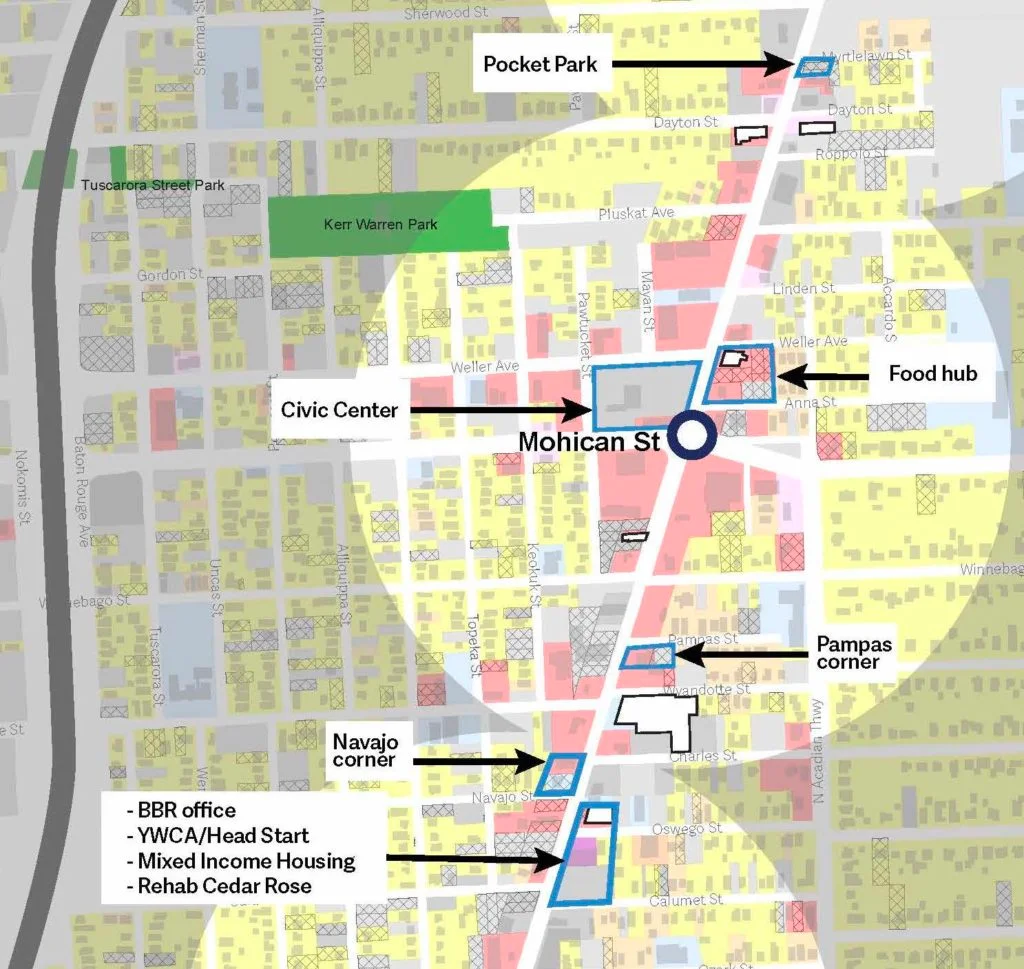
Build Baton Rouge Plank Road Master Plan Map Section
I started with Co-City Baton Rouge on April 1 2019 and April 6 I was on the ground in Baton Rouge. I knew from that point that this project intended to making a lasting, sustainable, positive impact for the local community. Over the course of the year I would make several visits to Baton Rouge, primarily scheduled around events where I could engage the local community. Inclusive and meaningful public participation is an essential component of this project and the foundation of the Co-City process. My visits coincided with events associated with the Plank Road Master Plan planning process, including the Food Truck Round up in April, Blight Boot Camp in June, ReActivateBR: Plank Road Street Festival and community clean up, Master Plan Steering Committee meeting in August and the Plank Road Master Plan presentation in November. I was fortunate to work with the planning team throughout this process, collaborating with BBR and other stakeholders to inform and educate Corridor residents and businesses about the planning process and to collect their ideas, hopes and concerns, which I did using numerous methods.
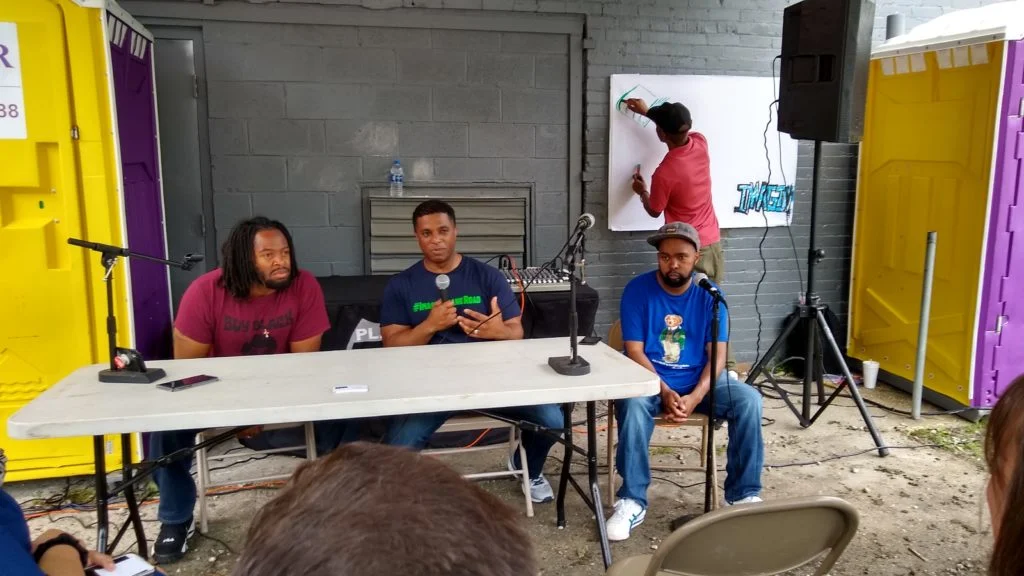
(L-R) Byron Washington, Chris Tyson, Donney Rose discussing development along Plank Road during April 2019 Food Truck Round Up
Each visit allowed me to meet someone new, people with potentially different perspectives of Baton Rouge. From Casey Phillips (Walls Project) to Byron Washington to Donney Rose, all had visions of a bright future for the Corridor but were realistic about the many obstacles that we will face. Ms. Lois Dorsey, a long-time resident of Plank Road and a BBR Community Ambassador, also talked about the need for street lighting and sidewalk repair, which she argued, would reduce crime while increasing pedestrian safety. I learned first-hand about the strong sense of community in Plank Road when after the Food Truck Round-up, Edwin Baker (partner of Ms. Lois) showed me around. We drove in his “run-around” pick-up that he uses for his general contracting business for about an hour before we broke bread over dinner. He told me about the dire need for more employment opportunities and affordable housing options in his community. It was a great and informative ending to an eye-opening day.
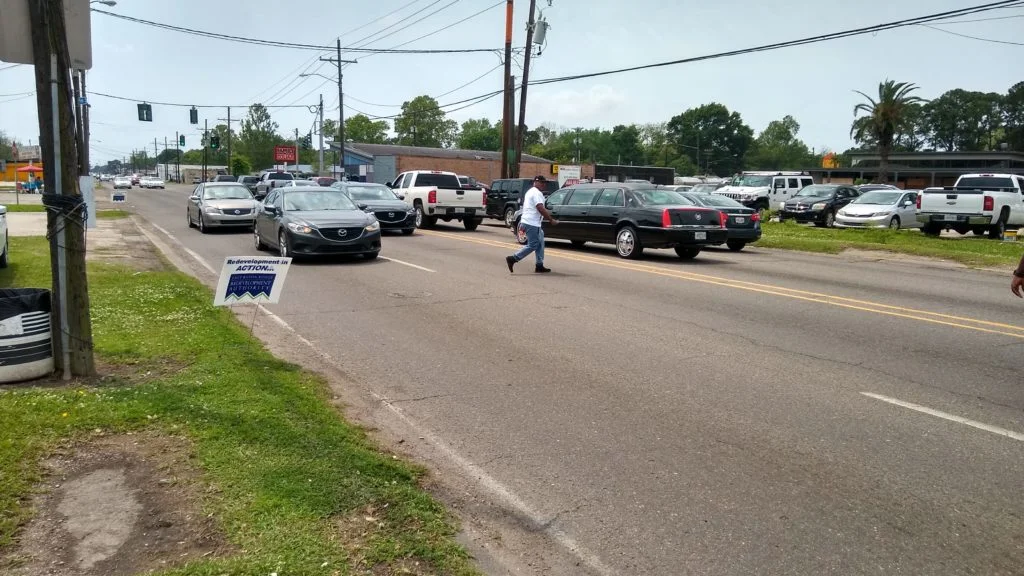
Resident Crossing Plank Road
During my August visit, I had the opportunity to meet Sharon Napollioun, a community leader and local resident, while driving a moving truck to all the local community centers that loaned tables and chairs for the Plank Road Street Festival. After unloading, Ms. Sharon invited Geno, the Community Engagement Specialist with Build Baton Rouge and my liaison on the project, and I to have some red beans and rice and roasted chicken with some other seniors who were having lunch after their senior center board meeting. She explained how young families are “chasing rent” and many school-age children have lived in more than a dozen homes by the time they enter Kindergarten. Moreover, she and others around the table talked about the need for recreational and green spaces for both children and the elderly within walking distance of their homes.
Food Truck Round-Up
Walls Project Baton Roots Program
Prof. Foster speaking at BBR Co-City Kick-Off Luncheon
Re-Activate Plank Street Festival
Plank Road Master Plan Ceremony: Chris Introducing EcoPark
LSU CSS and CO-City BR Crowdsourcing Community Data
A year in review
These stories and others like them helped me to better understand the mosaic that is Baton Rouge. Through organic conversations, formal meetings, brown-bag lunches, impromptu coffees, and FaceTime, I have already built strong ties and relationships with the community. Consequently, the Co-City team has been able to identify some strategic projects in response to the expressed desires of the community. Some of these projects, such as the Community Land Bank and Community EcoParks, are on the horizon for 2020 whereas others have a longer runway. Over the coming year I will introduce you to the friends I have made and the work we plan on doing together.
The Co-City Baton Rouge project started with Professor Foster speaking with the Build Baton Rouge President/CEO Chris Tyson for many hours over the course of 2-3 months with Chris Tyson and his team. As ideas began to percolate, Professor Iaione was looped in then Professor Gillette before formalizing the project. During these calls we learned about the community, its history, what Chris was trying to do down there and how we could effectively intervene. The project then hired me to be the Co-City Fellow and Project Manager in April 2019. During our visit in May 2019 BBR officially kicked off its Co-Cities partnership with the Marron Institute for Urban Management at New York University and the LabGov Project at Georgetown University during a luncheon held at East Baton Rouge Parish Library Main Branch. After the event local stakeholders and residents wanted to know more about us and our interests. So, who is the Co-City Baton Rouge Project team?
Sheila Foster
Sheila R. Foster is a Professor of Law and Public Policy at Georgetown University. Foster writes in the areas of property, environmental policy, land use law, and state and local government. Foster co directs LabGov, an international applied research project working with cities here and abroad. Over the last decade, she and her LabGov colleagues have developed the idea of the Co-City through their body of scholarship and applying its protocol in European, Latin American and now American cities. Foster oversees the Co-City Baton Rouge project, working closely with the Co-City Fellow and the Director of Marron on project scope, protocol adaptation to local conditions, development of project prototypes, and evaluation mechanisms. A more in-depth bio can be found here.
Clayton Gillette
Professor Clayton Gillette is the Director of the Marron Institute of Urban Management and the Max E. Greenberg Professor of Contract Law at the New York University School of Law. The Marron Institute of Urban Management is an applied research unit of New York University. Faculty and researchers from Marron work directly with cities and other governments to improve the delivery of municipal services. Gillette has served as a consultant to municipalities on matters of finance and litigation. He headed the Marron Institute’s work with the Emergency Financial Manager of Detroit concerning the effects of city institutions on fiscal stability. A more in-depth bio can be found here.
Manny Patole
Manohar “Manny” Patole is the Co-City Fellow and Project Manager for the Co-City BBR project and is responsible for day to day operations, community engagement, and portfolio management. He is a former Excelsior Fellow with the Office of the Governor of the State of New York as a Data and Policy Analyst with the Office of Parks, Recreation, and Historic Preservation Division of Planning. His research interests include localization and innovation to better serve their communities, urban water and sanitation management, and data for development. He holds a Master of Urban Planning degree from NYU Wagner Graduate School of Public Service and UNESCO’s Institute for Water Education and University of Dundee’s Centre for Energy, Petroleum and Mineral Law and Policy with a LLm ME specializing in Water Governance and Conflict Resolution and Water Conflict Management.
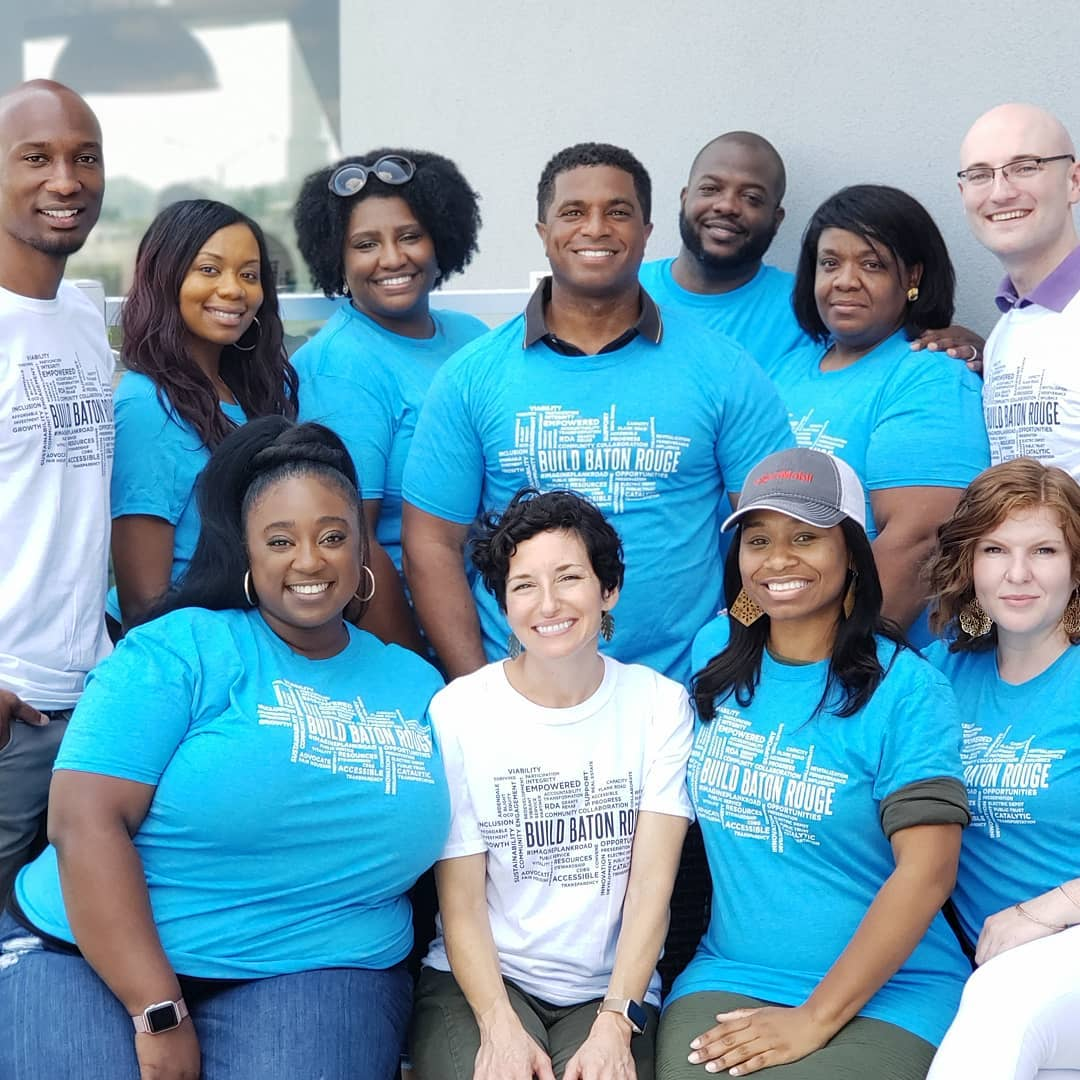
Build Baton Rouge Team: Geno McLaughlin (Top left) and Chris Tyson (Top center).
We are not in this alone. In addition to the various stakeholders and residents we have engaged (who you will get to know soon enough) we could not forget about our local partner, Build Baton Rouge. Formerly known as East Baton Rouge Redevelopment Authority, BBR was created by the 2007 Louisiana Legislature, governed by a five-member Board of Commissioners and appointed by the Mayor-President, Baton Rouge Area Foundation, and Baton Rouge Area Chamber. Their mission is to transform the quality of life for all citizens who live, work and play in East Baton Rouge Parish by returning blighted properties to productive use, fostering redevelopment through facilitating partnerships, and creating a vibrant, globally competitive community while preserving character of place. To learn more about BBR visit their website.
Our project staff and principals work with the entire team but work closely with BBR’s President/CEO Chris Tyson and Community Engagement Specialist Walter “Geno” McLaughlin to oversee a highly localized, diverse array of public engagement activities and tools that are essential for the planning effort and to address widespread suspicion and distrust of top-down planning processes in a historically African American community. A core commitment of the project is to incorporate equitable principles into the planning effort by engaging local community members as consultants and partners in whatever planning and revitalization efforts will take place, including at every step of the Co-City process.
Chris Tyson
Christopher J. Tyson is the President and Chief Executive Officer of Build Baton Rouge, which works to bring people and resources together to promote equitable investment, innovative development, and thriving communities across all of Baton Rouge. Chris is currently on leave from his position as the Newman Trowbridge Distinguished Professor of Law at the LSU Law Center. He has published numerous academic and editorial works that have appeared in the New York Times and the Harvard Journal on Racial & Ethnic Justice. He holds degrees from Howard University, the Harvard Kennedy School, and the Georgetown University Law Center.
Geno McLaughlin
Geno McLaughlin is the Community Engagement Specialist of Build Baton Rouge. He has been an invaluable partner, helping me and the rest of the Co-City team to establish local relationships, understand the local landscape, and provide valuable insight that is not found in any social media or text book. He has worked with BBR for just over a year but has been a local activist on equality issues for many years. He holds a degree from Southern University and A & M College, (Baton Rouge, LA) and was recently recognized as a member of 2019’s Greater Baton Rouge Business Report Forty Under 40 class!
The success of the project is based on the interconnectivity with the local community. In addition to our primary project partner, Build Baton Rouge, Co-City BR is partnering with public authorities, civic organizations, and universities regionally and nationally with experts in the fields of our project concepts. In so doing, we aim to create a network of collaborators who can be called upon as the project is scaled up as well as applied in other cities. In future posts we will feature our partners and their stories.
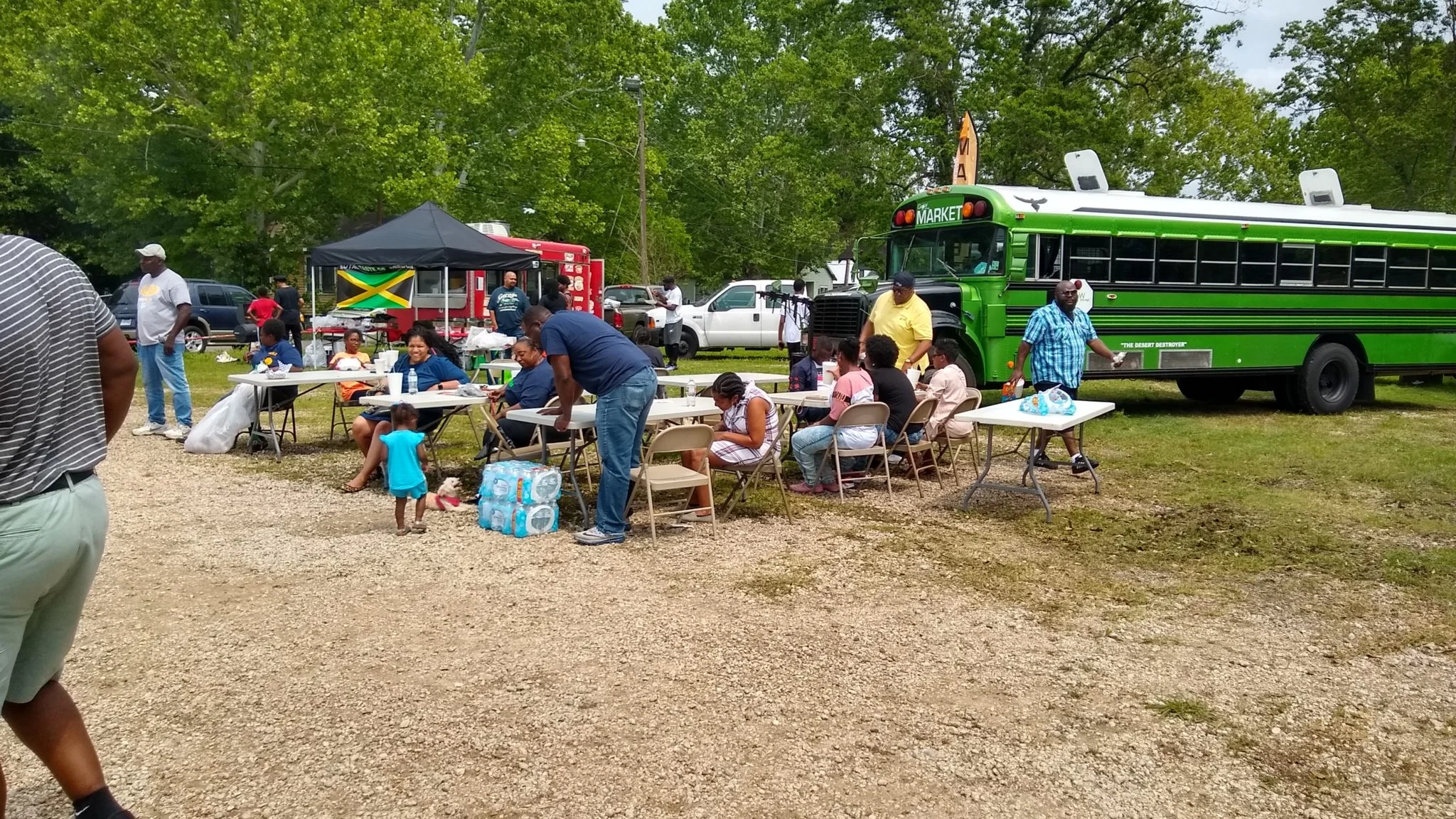
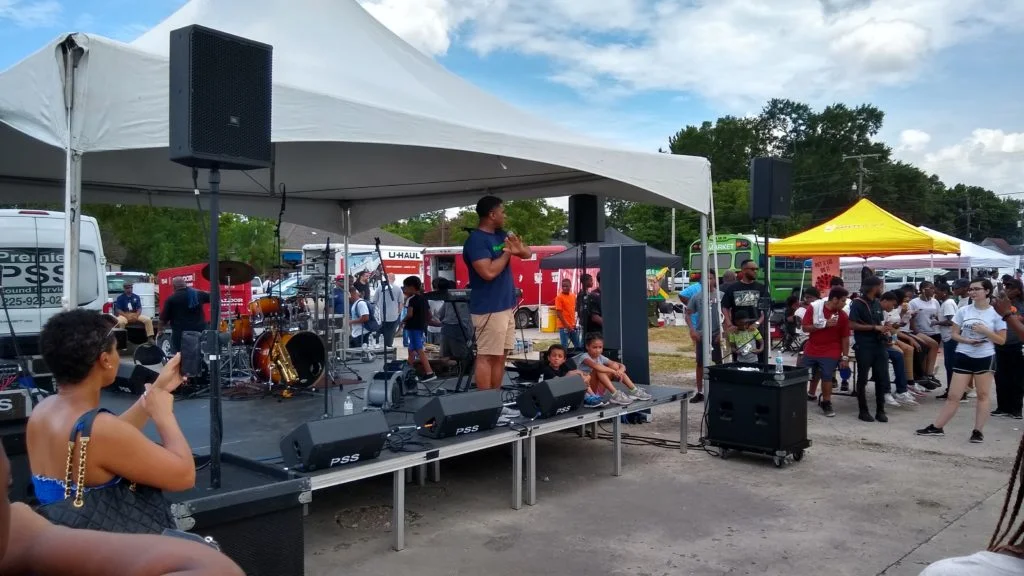
Residents enjoying food and festivities at the Food Truck Round-Up on April 7, 2019
I made my first visit down to Baton Rouge at the end of my first week on the job in April 2019. I flew down Friday night to attend a community event called Food Truck Round-Up that was put on by BBR. This and other events were put on during the master planning process to inform and educate residents and businesses about the planning process and collected their ideas, hopes and concerns about their community. I was fortunate enough to attend and participate in some of these events where I learned about the community from local residents, businesses and other stakeholders. Through these convenings, events, and informal gatherings I have developed a better understanding of Plank Road and their suspicion of the development of this area.
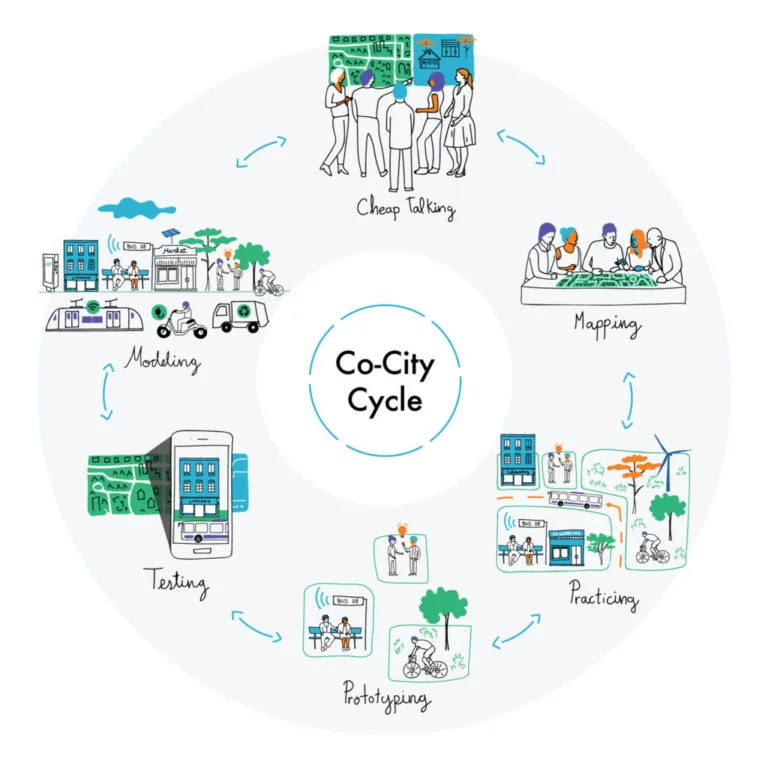
Their distrust stems from other efforts in the community that have been the traditional top-down planning processes. More often than not my conversations with residents led down the path of how many have come and gone but never asked us what we needed or wanted. Communities are too often left with little to show for their efforts engaging in these processes. For these reasons, the Co-City team is working closely with BBR’s Community Outreach Director Geno McLaughlin to oversee a highly localized, diverse array of public engagement activities and tools that are not only essential for the planning effort but also for the broader process of community relations and healing. In our efforts to build trust and confidence with the Plank Road community, the early phases of the cycle (cheap talking and mapping) are largely being devoted to developing interpersonal relationships, creating feedback mechanisms and assurances that our goal is to facilitate development in accordance with the capacities and desires of the community, not to impose “solutions” on an unwilling public.
For these reasons, the Co-City team is working closely with BBR’s Community Outreach Director Geno McLaughlin to oversee a highly localized, diverse array of public engagement activities and tools that are not only essential for the planning effort but also for the broader process of community relations and healing. In our efforts to build trust and confidence with the Plank Road community, the early phases of the Co-City Cycle (cheap talking and mapping) are largely being devoted to developing interpersonal relationships, creating feedback mechanisms and assurances that our goal is to facilitate development in accordance with the capacities and desires of the community, and not to impose “solutions” on an unwilling public.
The Co-City Cycle
The “cheap talk” phase of the Co-City Baton Rouge project is a means to re-engage the community, rebuild trust, and re-orient redevelopment away from what that term and process has historically meant for communities like this, and the legacy it has left. The cheap talk phase is premised on the idea that one has to lay the ground, or rather rebuild the ground, for true collaboration to occur. This is particularly challenging, but crucial, in communities that are chronically under-served and under-represented in traditional local government and planning processes, and even more so in communities with deep distrust of those processes.
Similarly, in the “mapping” phase it is important to bring or call different communities or sectors to the process as a way to deeply engage the five actors—public authorities, businesses, civil society organizations (NGOs), local social innovators, and academic/knowledge institutions—in the co-creation project. Given the imbalance of resources, voice, knowledge and capacity among these actors it is important that the community of residents, the unorganized public, emerge as a strong presence before the practicing and prototyping phases begin.
For both phases, it is necessary to identify pathways to build trust and engage the community beyond the usual community engagement strategies. Outreach to anchor institutions, such as local churches, is a necessary but insufficient step given the distrust and historical relationship between the community and government institutions. Instead, the Co-City team is applying a highly local, adaptive approach to engagement that includes building on local culture and norms, building capacity among residents, cultivating leaders, and supporting their collaboration with other actors and sectors working on the Plank Road Project. For instance, our participation in various master plan process events where the convening provided an open atmosphere for residents who normally would not be engaged in the development process to participate and be heard. These kinds of events over the course of many months are important to rebuilding trust enough for the community to be a strong presence in the cheap talk and mapping phases.
Chris Tyson, CEO of Build Baton Rouge, speaking to attendees at an event.
In addition to building interconnectivity with the local community, Co-City BR is partnering with public authorities, civic organizations, and universities regionally and nationally with experts in the fields of our project concepts. In so doing, Co-City BR aims to create a network of collaborators who can be called upon as the project is scaled up as well as applied in other cities. In the latter phases of the cycle, adaptability is focused on co-designing neighborhood and community level institutions that can enable residents to become stewards in economic revitalization so that they are able to reap the benefits of that revitalization without being displaced. This requires capacity-building and training, a critical part of Co-City Baton Rouge. The next few posts will highlight the partnerships we have made and project concepts that have come out of the process.
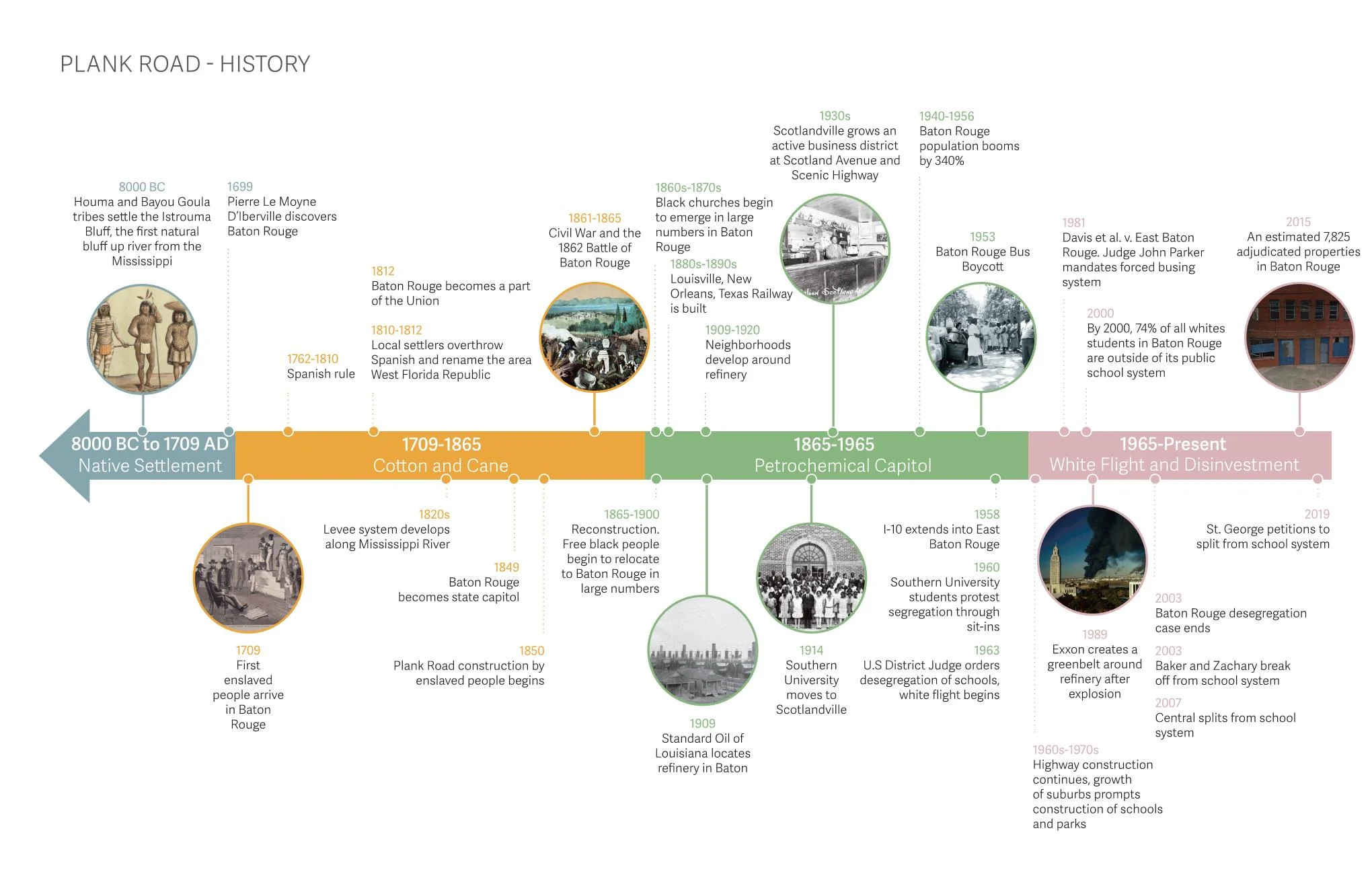
Plank Road Historical Timeline Courtesy of Studio Zewde
Co-City Baton Rouge is developing and implementing innovative institutions to transform the Plank Road Corridor (Corridor) of North Baton Rouge into a community of opportunity. By focusing on neighborhood scale governance innovation, the Co-City Baton Rouge project outcome is centered on the needs and interests of the residents of the Corridor. However, desk research alone is not enough to fully understand a city, let alone a neighborhood. Given the history of urban renewal and other planning efforts in this community, there is widespread suspicion and distrust of top-down planning processes. The Co-City protocol is the opposite, to work with residents and stakeholders to identify what they think is best for revitalizing their neighborhood and to increase their capacity to be full collaborators, not just bystanders, in their economic development. The success of the Co-City BR is grounded in the first two phases of the Co-City cycle: Cheap Talking and Mapping. The Cheap Talk phase involves face-to-face, informal and pressure-free communication among key local actors (experts, practitioners, activists, residents) to activate the community of stakeholders that will be involved in the collaborative project. The second phase, Mapping, involves understanding the characteristics of the urban or neighborhood context through surveys and exploratory interviews, fieldwork activities, and ethnographic work. Over the last nine months the project team has been cheap talking and mapping in Plank Road to develop community redevelopment ideas into actualized projects. The next two posts will provide context for Co-City Baton Rouge with a brief history and demographics of the area which lays the foundation to understand the historic structural and institutional barriers for development in the Corridor.
A History in Brief
Baton Rouge has been inhabited since at least 8000 BC. The history of modern-day Baton Rouge goes back to 1699 during an expedition up the Mississippi River a French explorer named Sieur d’Iberville found a red-colored cypress pole (baton rouge) with bloody animals marking the boundary between tribal hunting grounds. In 1719, Baton Rouge was established as a French military outpost, then lost to the British in 1736, followed by Spanish in 1779 until 1810 to the Republic of West Florida. It was an independent republic for 74 days until the Americans in New Orleans raised the American flag, was incorporated in 1817 and became the capital of the state in 1849.
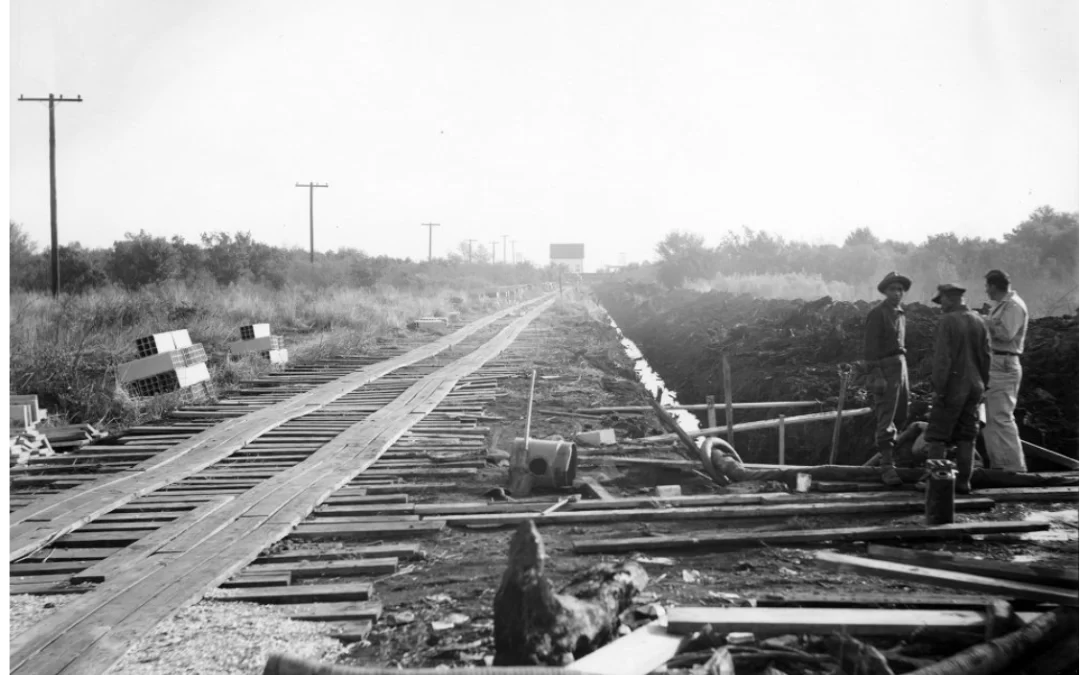
Plank Road’s history starts around 1709 when the first enslaved Africans were brought to Louisiana to transform the region to grow cotton and sugar cane. To increase productivity and profits, plantation owners decided to construct a road to connect Baton Rouge to a train depot north of the city in Clinton, Louisiana. The path was constructed of wooden planks, lending itself to being called Plank Road. A more detailed history of the growth and development of Plank Road and Baton Rouge can be seen here.
Plank Road Today
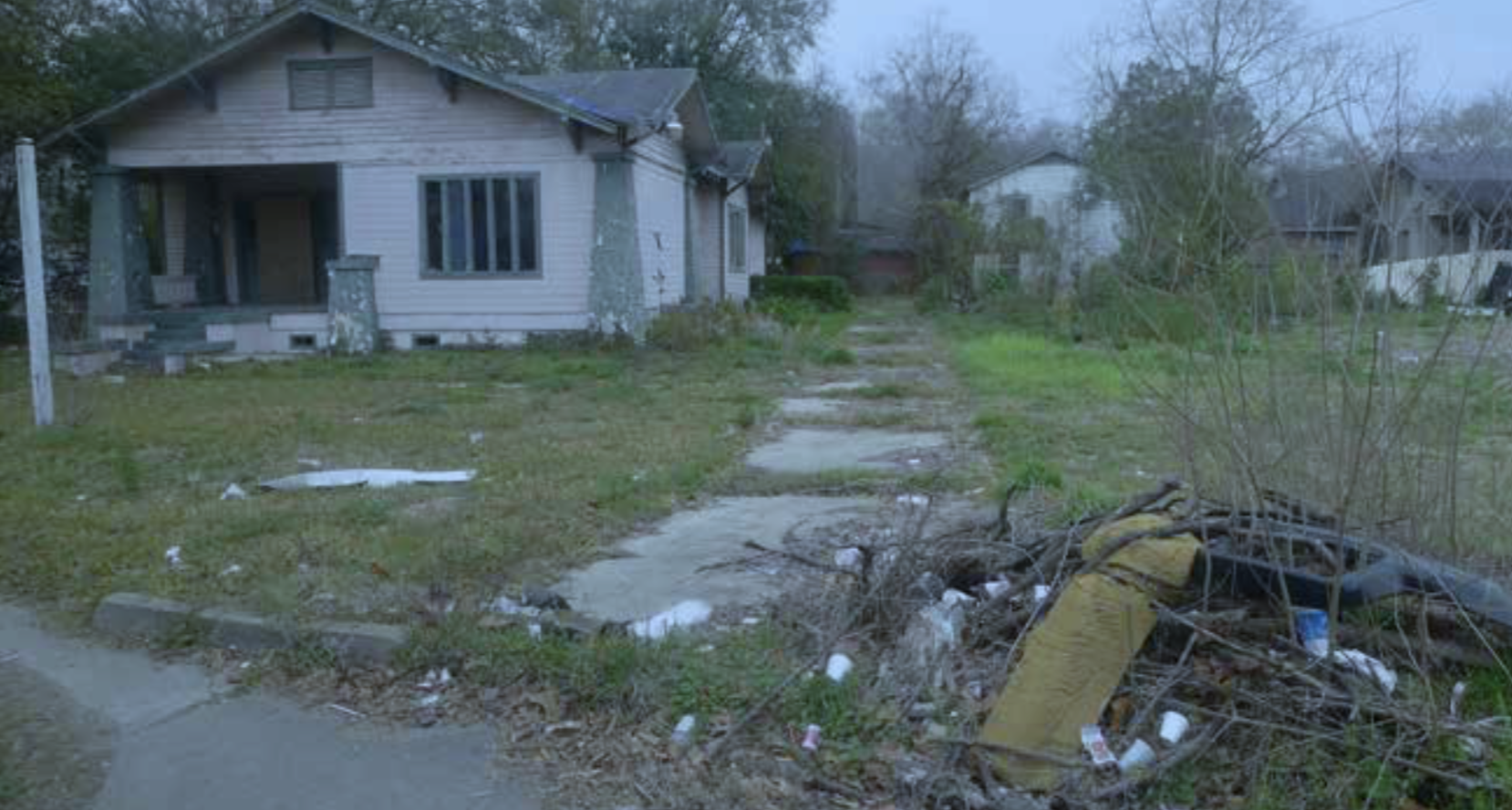
A blighted property on Plank Road
Plank Road is located in the northern area Baton Rouge, East Baton Rouge Parish, Louisiana. The Co-City Baton Rouge project area is a 4.3 mile area along Plank Road bound by 22nd Street and the Harding Boulevard/Hooper Road intersection (the “Corridor”) but extends into the neighboring town of Zachary, LA. The Corridor oscillates between four to five lanes and has a diverse built environment. The Corridor is bordered by mostly commercial land uses and has residential lots along the intersecting side streets that extend for several blocks in either direction. It is one of the most blighted corridors in Baton Rouge yet remains a significant anchor for the neighborhoods of North Baton Rouge. The heart of Plank Road runs through the 70805 zip code, where many of Baton Rouge’s social and economic challenges are concentrated with respect to transit, crime, and income.
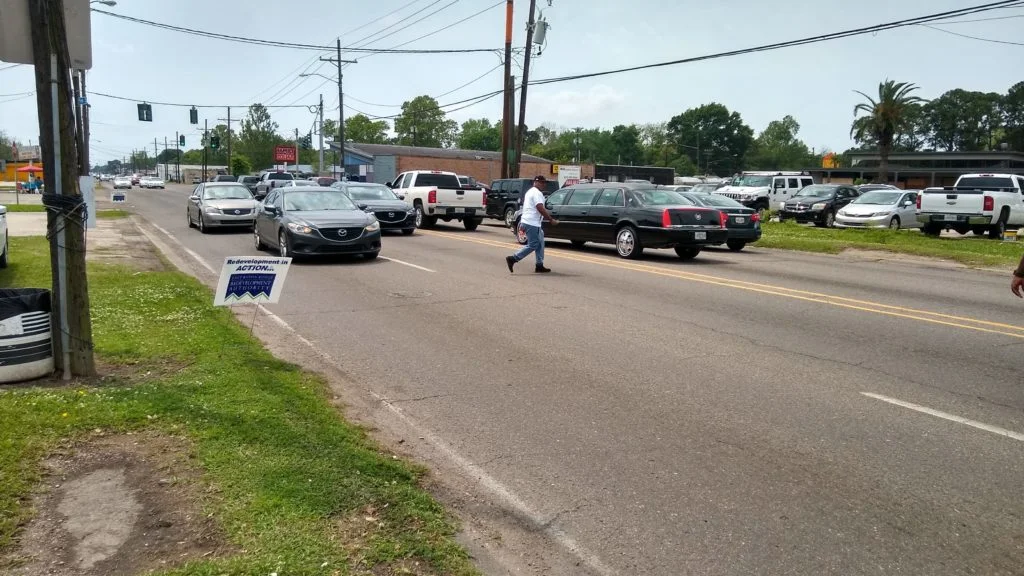
Local resident crossing Plank Road
The Corridor has the highest concentration of zero-car households and the second highest transit ridership in Baton Rouge. Although there are sidewalks, they are inconsistent and not continuous.The combination of high vehicle speeds, limited or no provisions for pedestrian or bicycle access (like crosswalks, consistent sidewalks, etc), and minimal amounts of landscaping, have contributed to the rise in pedestrian and bicycle accidents in the area and the Louisiana overall (see here and here). During my visits to the area I have seen first hand how dangerous it is to be a pedestrian trying to cross a street.
The neighborhoods around Plank Road are predominately black and poor, a reflection of Baton Rouge’s deeply entrenched racial and spatial stratification. 70805 is 93% black and reflects the consequences of historical patterns of racial segregation and racialized poverty. The area underperforms state averages in many categories. Its 2016 median household income is roughly $27,000 compared to $45,146 statewide. 36% of households in 70805 live below the poverty line, with almost 20% living below 50% of the poverty line (as compared statewide of 20% and 12%, respectively). The median home value in the zip code is $86,240, well below the state average of $158,000. 55% of the residents in 70805 rent their homes, compared to 36% statewide.
In 2014 a British Broadcasting Company (BBC) documentary titled, BBC Pop Up: Life in Baton Rouge’s most dangerous neighbourhood, profiled 70805 as one of the deadliest zip codes in America. In 2016 Baton Rouge was ranked as the number 22 murder capital on 24/7 Wall St.’s list of America’s 25 Murder Capitals. That year, 943 violent crimes violent crimes occurred in 70805, and almost half of them occurred within 100 feet of a blighted property.
Over the past many years there has been a growing awareness of the spatial dimensions of the city’s long-standing racial divide. Growing concerns that Baton Rouge has become a “tale of two cities” are validated by the stark divergence in the quality of place, racial composition, and social value attached to neighborhoods on either side of Florida Boulevard, the corridor considered by many to be the city’s “Mason-Dixon line.” All these factors present an unsafe and unappealing aesthetic environment for residents, visitors and merchants and where Co-City Baton Rouge intends to be part of the spiral up.
LabGov Georgetown (LabGov) and the Marron Institute of Urban Management at NYU (Marron) have partnered with Build Baton Rouge (BBR), the redevelopment authority of Baton Rouge, Louisiana, to apply the Co-City methodology to economically revitalize the Plank Road Corridor of Baton Rouge. The project (called Co-City Baton Rouge) is part of the larger Plank Road Project being driven by BBR. The Plank Road Project envisions a transit-oriented approach for the overall revitalization of a 4.3-mile segment of Plank Road and consists of three components:
Planning for a proposed bus rapid transit (BRT) installation
Land banking of adjudicated and blighted parcels to support catalytic development projects
Creating a comprehensive revitalization master plan
Although all of the components are interrelated, Co-City Baton Rouge is leading the effort on the second component and building on the third component. The Plank Road Project represents an unprecedented level of investment targeted at one of Baton Rouge’s most disinvested and embattled neighborhoods.
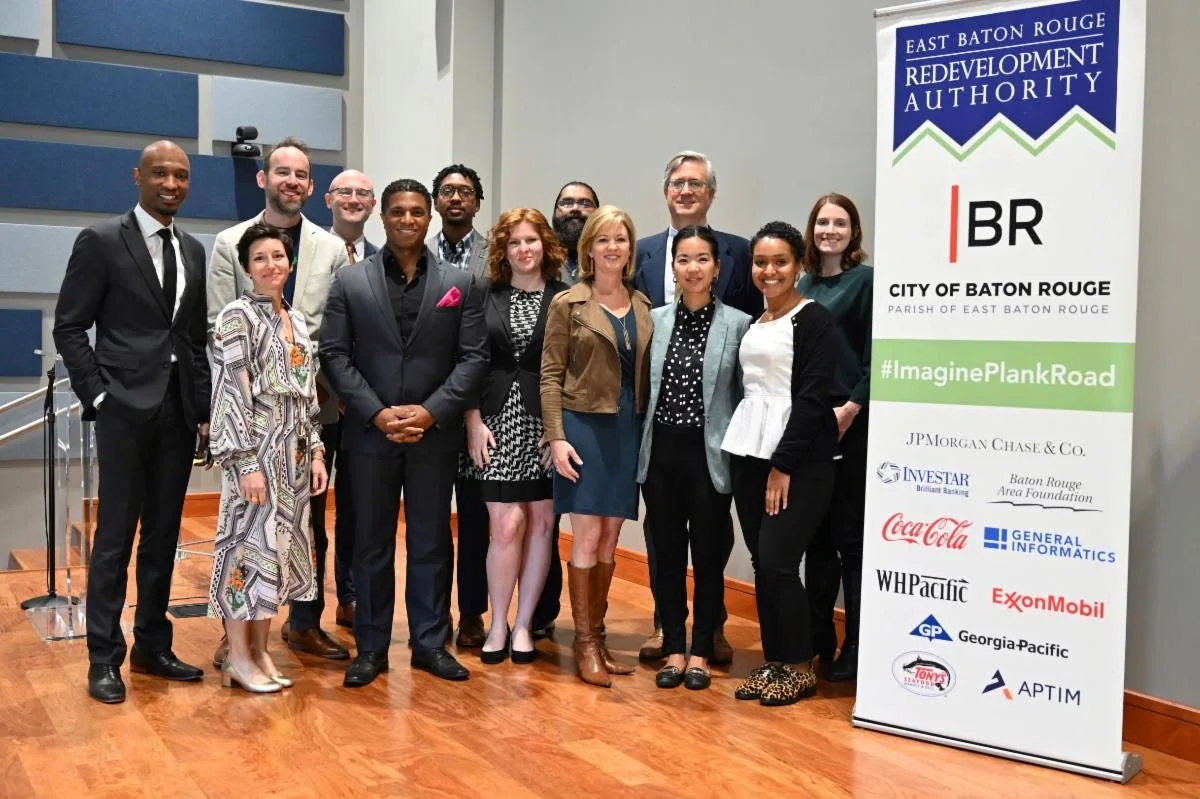
The Plank Road Master Plan was presented to a packed, standing-room only crown on Tuesday, November 5, 2019 during a public event at the Valdry Center for Philanthropy at Southern University. The East Baton Rouge Parish Mayor, President Sharon Weston-Broome, along with the master plan team, various stakeholders involved in the process, and many community residents were all in attendance. The master planning process evolved over the last year and aims to revitalize a 4.3-mile section of Plank Road, stretching from 22nd Street to Harding Boulevard/Hooper Road in Baton Rouge. BBR produced a docu-short chronicling the planning process and its proposed policies, programs, and developments, which can be accessed here.
Plank Road Master Plan Team (Source BBR)
Co-City Baton Rouge has started to develop project concepts based on meetings during the master plan process since the project started in April 2019. One of the aims of Co-City Baton Rouge is to promote community building while engaging a wide set of stakeholders who, in the end, will produce projects in joint collaboration with end users to overcome social inequalities and enhance the participation of underrepresented social groups. Toward this end, the concepts that Co-City Baton Rouge in conjunction with BBR and local stakeholders identified through the course of our many community engagements include: Community EcoParks, Food Truck Incubator, Community Land Bank, Neighborhood Improvement District, and a Public History Interpretive Program.
Over the coming weeks this blog will include more information on the project and its core concepts, updates on how the project is progressing, including the hurdles and challenges we face, and the many lessons learned along the way. This blog will document project milestones and celebrate our victories, but also thoughtfully and carefully map when and how things go awry, which is always part of the learning process.


 Food Truck Round-Up
 Walls Project Baton Roots Program
 Prof. Foster speaking at BBR Co-City Kick-Off Luncheon
 Re-Activate Plank Street Festival
 Plank Road Master Plan Ceremony: Chris Introducing EcoPark
 LSU CSS and CO-City BR Crowdsourcing Community Data