
In Bremerhaven, the AQUAPONICS FROM WASTEWATER RECLAMATION project (AWARE, Project number: 101084245) held its 5th General Assembly on 17–18 June 2026.
Adriano Contardi (Luiss Guido Carli University), Fabrizio Maria Bertusi (Luiss Guido Carli University), and Guenda Esposito (LabGov ETS) presented their work on WP4 “Pathways to Impact Demonstration” and WP5 “Engagement and Outreach”. Prof. Christian Iaione (Principal Investigator, Luiss Guido Carli University) joined the meeting online.
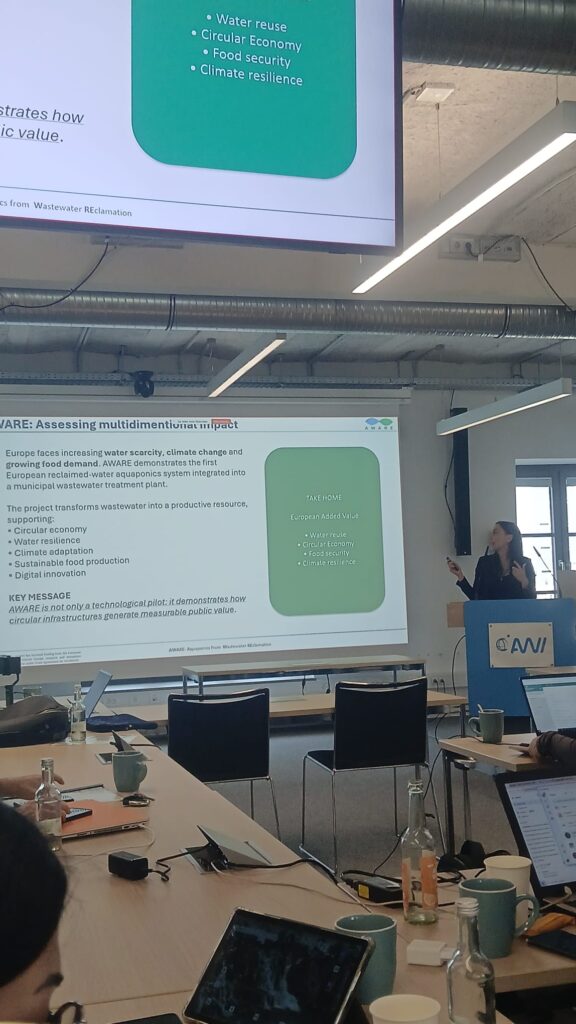
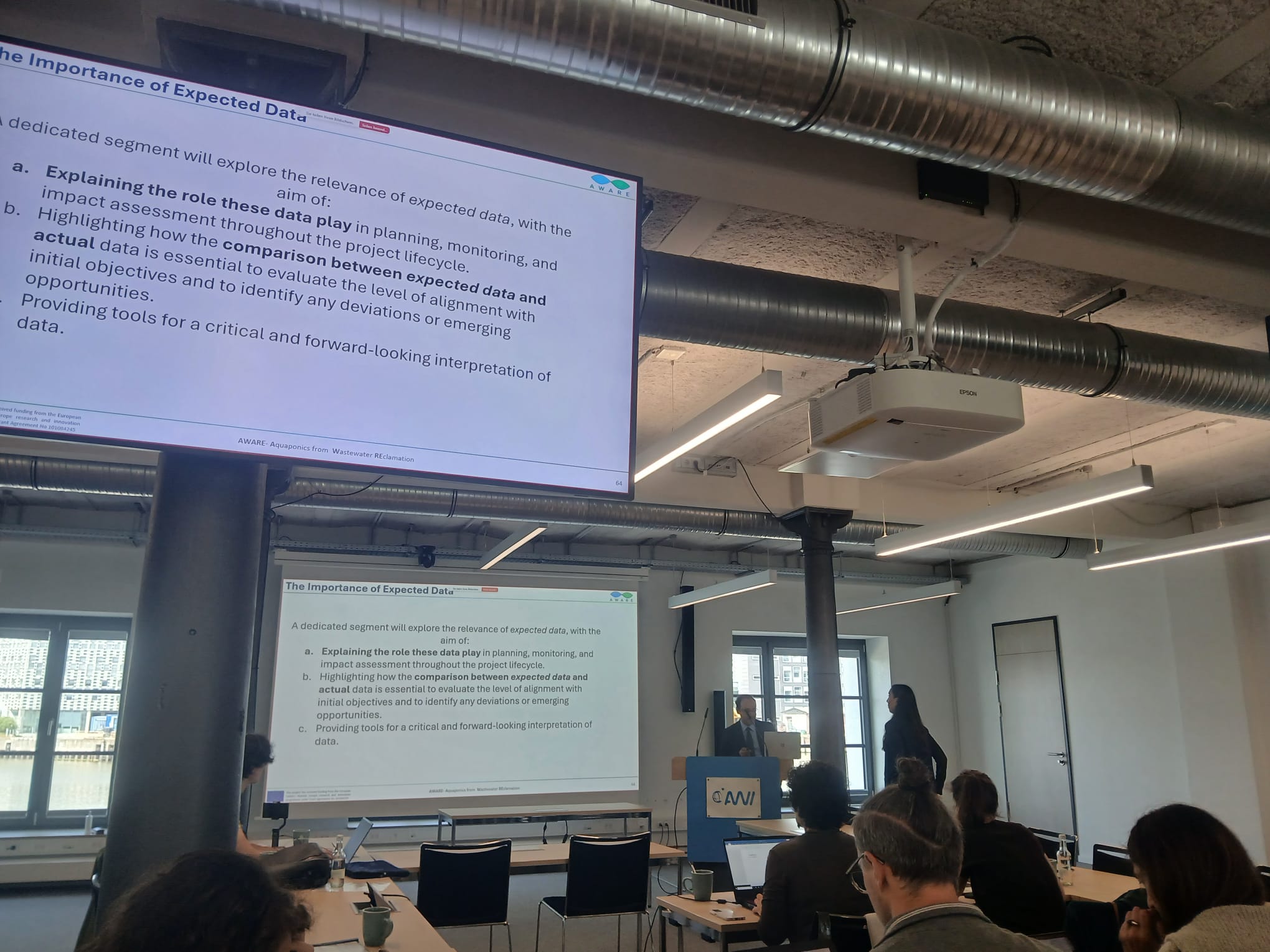
The WP4 presentation, delivered by the Luiss & LabGov team (Fabrizio Maria Bertusi, Guenda Esposito, Prof. Christian Iaione), outlines the project’s pathway to impact demonstration. AWARE is Europe’s first reclaimed-water aquaponics system integrated into a municipal wastewater treatment plant, transforming wastewater into a resource that supports the circular economy, water resilience, climate adaptation, sustainable food production and digital innovation.
To capture value beyond conventional economic indicators, the project adopts the JuSIIIIA tool, a ten-dimension assessment framework (economic, financial, health, environmental, technological, social/civil rights, institutional, territorial, educational/cognitive, and generational) that scores impact on a 1–5 scale and accounts for short-, medium-, and long-term effects.
The presentation concludes with JuSIIIIA 2.0, an evolution of the tool into an Infrastructure Impact Investment framework designed to support replication and evidence-based investment decisions across Europe.
The WP5 presentation, delivered by Adriano Contardi and Prof. Christian Iaione (Luiss Law School & LabGov), covers the work on Stakeholder Engagement and Regulatory Analysis.
On the stakeholder engagement side, it describes preparatory meetings in Bari and Castellana Grotte with Acquedotto Pugliese, Autorità Idrica Pugliese, local schools, and the Municipality, which led to AWARE consortium’s participation in the Science Fair in Castellana Grotte, and outlines next steps toward making Castellana Grotte part of the City Science Initiative— an EU Joint Research Centre’s initiative to build research–policy bridges in municipalities.
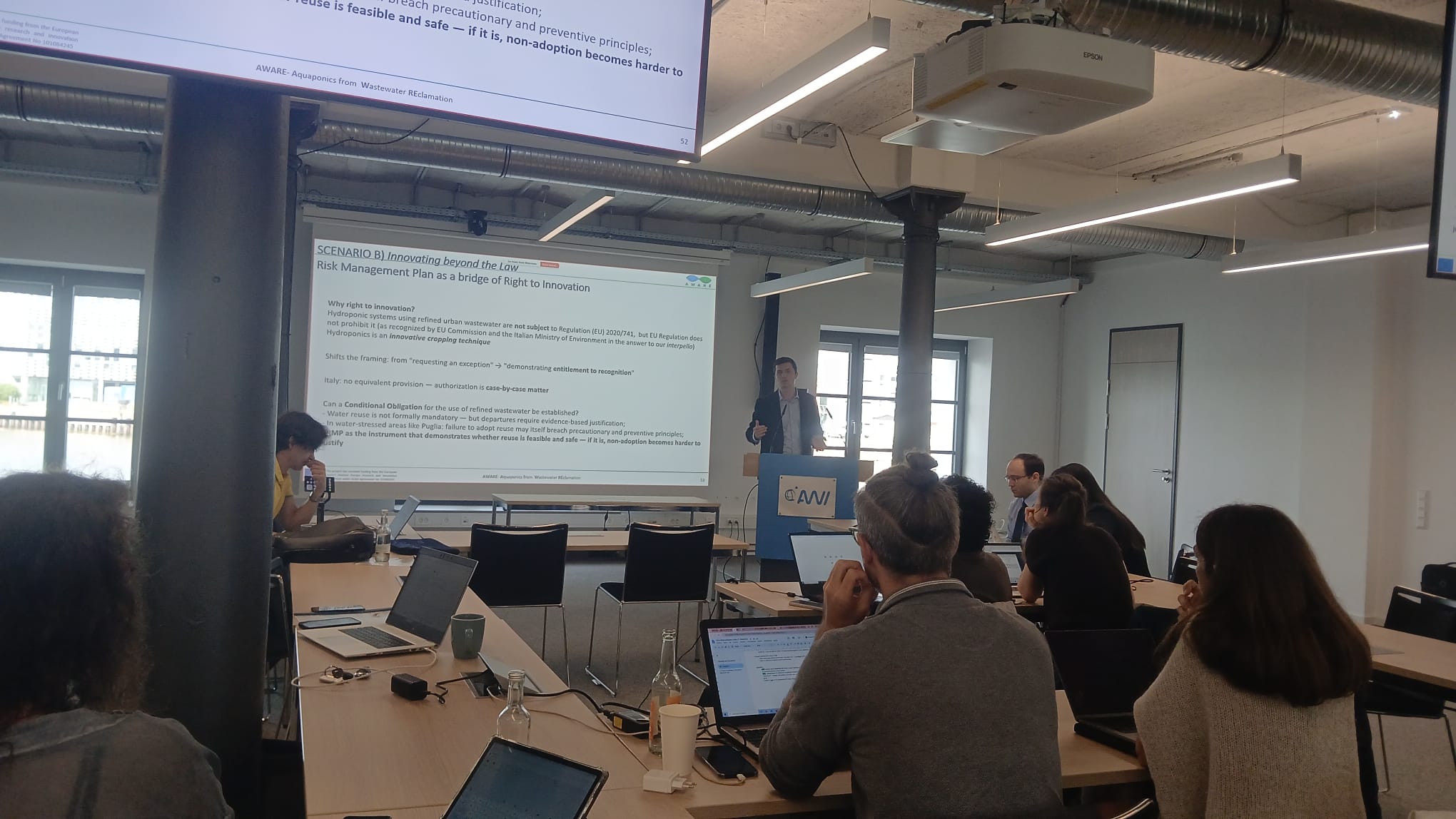
On the regulatory side, the presentation details an official inquiry (interpello) submitted to the Italian Ministry of Environment concerning whether hydroponic systems using refined wastewater qualify as agricultural irrigation reuse under EU Regulation 2020/741; the Ministry concluded, in line with the EU Commission, that such systems fall outside the Regulation’s scope. In any case, this “innovative cropping technique” is not prohibited. Starting from this answer, the presentation outlines two regulatory pathways for Italy: Scenario A, adapting the Spanish model, which allows reclaimed water for unlisted uses meeting authority-set quality standards, to the Italian context; and Scenario B, using a Risk Management Plan to support a “right to innovation” approach, arguing that in water-stressed regions like Puglia, failing to adopt water reuse could itself raise concerns under precautionary principles.
Thanks to Fabio Ugolini (Principal Investigator, AWARE) for the organization, and to the Alfred-Wegener-Institut, Helmholtz-Zentrum für Polar- und Meeresforschung, for the hospitality.