
by Chiara De Angelis | Oct 5, 2017 | Luiss LabGov 2017-2018
The fifth edition of LUISS LabGov Educational Lab (workshops, co-design sessions, community gardening and fieldwork) will re-start on October 6th, 2017!
The meeting will be held in Viale Romania, 32 at 4.00 PM.
EDU_LabGov 2017-2018 will explore the principles, techniques, instruments and practices of the urban commons’ management. The experience, as every year, will begin from LUISS community garden, intended as a gym for collaboration, cooperation and auto-organization. Students will learn to build and develop concrete projects of social innovation, sharing economy and collaborative urban development for the city, and will co-design together the future of the lab.
More info about the Laboratory here: http://www.luiss.it/studenti/soft-skills-and-training-opportunities/soft-skills-con-cfu/corsi-di-laurea-triennale-e-ma-1
The calendar is available here: http://www.luiss.it/sites/www.luiss.it/files/LabGov_3.pdf
Il percorso di educazione non formale del LABoratorio per la GOVernance dei beni comuni (di seguito “EDU_LabGov“) è una clinica urbana transdisciplinare (economica, politologica, legale) che realizza la terza missione dell’università, contribuendo a svolgere “attività di produzione di beni pubblici sociali e culturali (public engagement, patrimonio culturale, formazione continua, sperimentazione clinica)”.
Al via il sesto anno di laboratorio. Appuntamento il 6 ottobre alle ore 16.00!

by Chiara De Angelis | Oct 2, 2017 | The Urban Media Lab
The ERSCP Conference (see: www.erscp.eu) is the annual european convenings of scholars and policy makers addressing the issue of Sustainability in both industrial production and consumption, taking place since 1994.
The 2017 edition of the Conference is taking place in Skiathos Island, Greece, from 1st to 5th of October 2017 and is organized by the Environmental Economics and Sustainability Unit, Sector of Industrial Management & Operational Research, and the School of Mechanical Engeneering of the National Technical University of Athens. This year, the conference addresses the issue of green production and green consumption challenges in the framework of the circular economy, with a special attention to smart cities. The main themes of the conference can be summarized in the following categories: circular economy; zero-waste management; eco-innovation; eco-design; eco-efficiency; advances in sustainable consumption; sustainability in production and design; food waste prevention; challenges for making progress in cross-cutting themes such as green and inlcusive entrepreneurship and sustainability; ethical investments.
The Sessions number 3 is focused on sustainable/smart cities and smart communities. It includes contributions on the enterpreneurship in urban areas, case studies of political ecology and socio-environmental conflicts in Germany and social innovation and practicing of sustainability transitions in Dutch eco-villages, cooperative urban development with a focus on a case study of the Smart City Project of Graaz and an analysis of urban spatial scenarios for local energy and transport systems with regional integrated models. In this Session, Enea and LabGov will present a paper titled “Empowering Urban Community Towards Smart district co-governance”, introducing the theoretical framework and the first results of the three-years research program on Smart City and Smart Community funded by the Ministry of Economic Development that ENEA (the National Agency for Research on Renewable Energy) is carrying out at the national level, with the collaboration of LabGov for the part related to the urban co-governance at the district level and to an applied experimentation in the city of Rome.
The paper introduces the national strategic projects for energy transition funded through the Fund for Research into Electrical Systems (RSE), that covered the following aspects: technical, economic, organizational and institutional aspects associated with the sustainable development of the Italian electrical power network and related infrastructures (safe and effective use of primary sources of energy and of hydrogen as energy vector; power generation, transport and distribution, and end-use energy efficiency). The paper than introduces the Three-Years Plan (2016-2018), a part of this program that provides a specific task devoted to the empowerment of urban communities for the development of Smart solutions and Smart district co-governance. This task consists of two main activities: the development of technological infrastructure named SUN (Social urban Network) and the implementation of collaborative processes applying the urban co-governance methodology to the district level and thecircular economy approach with the involvement of urban inhabitants and local stakeholders. In the final part, the paper then develops a reasoning over the connection between urban co-governance at the district level and the issue of circular economy and collaborative economy.
Thanks to a cooperative approach and to resource sharing solutions it is possible to reach a mutual competitive advantage. In particular, the implementation of collaborative processes intends to strengthen the capacity of citizens and local stakeholders to participate in the decisions and to the local government. The engagement in the design and the implementation of community services has the ambition to reduce the energy-related environmental impact of the urban community. Example of co-designed solutions could be: sharing/collaborative/pooling economy and co-production of services initiatives/platforms (i.e. re-use centers, cohousing or shared use of spaces in housing complexes, co-working spaces, community gardens, foodbank, etc.) and experiences of smart waste-management. The paper than explains the design of the field-work to be realized in the city of Rome where, following an urban-living-lab approach based on circular economy principle and on a Quintuple Helix Model of urban co-governance, urban inhabitants and local stakeholders will be engaged in co-designing different solutions to transform the current “linear” system into a circular economy models at a district scale. This phase will be realized in the Fifth District of the City of Rome, where in the framework of the Smart City and Smart Community project and with the involvement of young students from the Soft Skills program of LUISS University, LabGov, a two years mapping, practicing and co-design phase was already implemented in the context of the Co-Rome process (see: www.co-roma.it).
The conference has a rich program, including keynotes speeches from international scholars and policy makers. Among the keynotes, Dr. Paolo Taticchi from Imperical College of London on the bssiness case for sustainability; the Ministry of Infrastructures and the Environment of the Netherlands, Robbert Droop, will explain how the process and policies towards a circular economy lead to major knowledge questions; Anna Davies, Principal Investigator of the SHARECITY: Assessing the practice and sustainability potential of city-based food sharing economies. The research project, funded by the European Research Council (ERC) program, investigates the landscape of ICT-mediated urban food sharing and provided a database with information for over 4000 cases available in an open access format here: http://sharecity.ie/sharecity100-database-use/; Nancy Bocken, who will talk about sustainable business models and sustainable consumption, exploring the role of business experimentation.
Information and material of the conference are available here: erscp2017.eu.
ENEA e LabGov presenteranno il paper “Empowering Urban Community Towards Smart district co-governance” alla conferenza ERSCP 2017, che avrà luogo nell’isola di Skiathos, Grecia, dal primo al 5 ottobre 2017. La conferenza è interamente dedicata alla “green production” e alle sfide della “green consumption” nell’ambito dell’economia circolare, con particolare riguardo all’argomento Smart Cities.
by Chiara De Angelis | Aug 12, 2017 | The Urban Media Lab
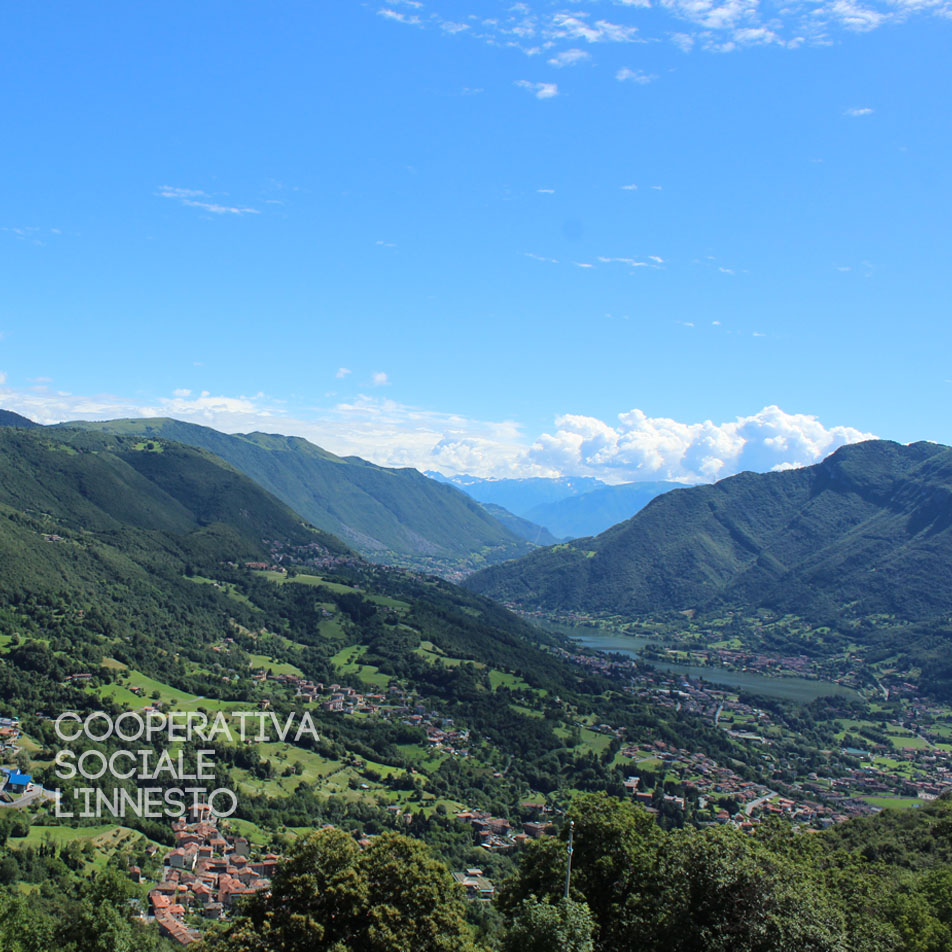
Credits: picture from http://www.innesto.org
On the sides of the Endine Lake there is a real estate called “la Casa del Pescatore”, one of the access points to the Cavallina Valley providing services to tourists wanting to visit the area. The Casa has been managed for 16 years by a social cooperative, L’Innesto, on behalf of the Mountain Community of Laghi Bergamaschi: since 2001 the Cooperative has been offering the possibility of enjoying the lake in a sustainable way, and has participated to the local development practices and to the touristic acceptance in the area.
On June 21st, 2017 the Province of Bergamo communicated to the social cooperative L’Innesto the publication of an alienation announcement referred to the Casa del Pescatore. The local government has offered to the cooperative the right of first refusal (to be exercised within August, 19th) at the entry price of 865K euros.
The Innesto cooperative is of course well interested to the civic acquisition of this common good, in order to be able to carry on with the activities through all these years have allowed a sustainable fruition of the lake by the valley community and its hosts. The cooperative’s own financial sources, however, do not allow the accomplishment of the process of acquisition as prescribed by the local government.
That is why L’Innesto cooperative, in order to maintain the Casa del Pescatore as an open space for everyone, as well as to pursue non-profit, civic, solidaristic and social activities, has decided to:
This campaign is hopefully going to allow to the social cooperative to acquire the common good, as well as to renovate it and activate new services and activities to generate new jobs and to develop a new incisive promotion of the territory.
As Professor Christian Iaione stated in the article Città e beni comuni, “the urban spaces and services of common interest […] do satisfy many needs of living in the city because they are functional to the community’s health as well as to the individual exercise of citizenship’s rights: the quality of life and of work, sociality, mobility, amusement, sharing, sense of community, the possibility of growing new capacities and passions…all those things are immediately affected by the major or minor quality of collectively used infrastructures that a city can make available to its inhabitants” (click here to read the full article). That is why he suggested that in some the right strategy is to buy back the commons and create self-sustaining collective institutions that manage them.
Those spaces of common interest are fundamental and vital for the development of communities, and that’s why they are conceived as urban commons. Other similar experiences of civic acquisition are carried out in Rome by the Community for the Public Park of Centocelle (www.co-roma.it) and in Milan by the Macao experience (http://www.macaomilano.org).
—> Click here to read the open letter
—> Click here to download the donation form
La Cooperativa Sociale L’Innesto ha lanciato un appello per allargare la propria base associativa e una campagna di crowdfunding per raccogliere fondi destinati all’acquisizione della Casa del Pescatore e mantenerlo come luogo aperto e fruibile da tutti.
–> Clicca qui per leggere la lettera aperta alla cittadinanza
–> Clicca qui per scaricare il modulo di raccolta fondi

by Chiara De Angelis | Jun 26, 2017 | The Urban Media Lab
The University of
Perugia’s Department of Law is hosting the
2017 Summer School, from June 28th to July 1st. The school is organized by the PHD Program in Legal Science, coordinated by the Director
Prof. Tamara Pitch and with the scientific supervision of
Prof. Maria Rosaria Marella.
The program is entirely focused on the theme of inequalities, which will be approached by scholars and researches from a variety of diverse point of view: from the equality of distribution to human rights, from environmental justice to criminal law.
Prof. Christian Iaione, LabGov’s co-founder, is going to attend the Summer School with a lecture on
Social Inequalities and urban segregation, on June 29th at 5.30 PM.
Dal 28 giugno al 1 luglio l’Università di Perugia ospiterà la 2017 Summer School, organizzata dal PHD Program in Legal Science, a tema inequalities.

by Chiara De Angelis | Jun 15, 2017 | The Urban Media Lab
Rijeka is going to host, from November 22nd to 24th, the “Participatory Governance in Culture: exploring Practices, Theories and Policies. Do It Together” Conference, organized by Kultura Nova Foundation, in partnership with Rijeka 2020 LLC and collaboration with European Cultural Foundation as a part of the “Approaches to Participatory Governance of Cultural Institutions” project supported by UNESCO’s International Fund for Cultural Diversity. The Conference is part of the “Approaches to Participatory Governance of Cultural Institutions” project, which is supported by UNESCO’s International Fund for Cultural Diversity.
Scholars, researchers, practitioners, decision-makers, activists and artists are invited to submit papers, presentations or panel proposal for this international conference. The text of the call for papers is available at this link.
The aim of the conference is to explore the new perspectives that are being introduced by many cultural initiatives all around the globe in order to challenge the traditional governance models, and to experiment with innovative approaches to governance. Culture is being understood as a shared resource, and the practicing of culture is being placed in a commons-oriented perspective.
The deadline for submitting presentations and panel proposals is 15th July 2017.
More information on the Conference’s official website: http://www.participatory-governance-in-culture.net/


