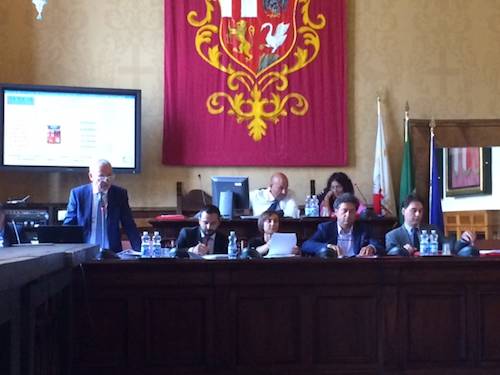
The city of Orvieto approves the regulation on urban commons

Ever since the City of Bologna approved in May ’14 the Regulation on Collaboration Between the Citizens and the City for the Care and Regeneration of the Urban Commons, twenty municipalities have approved the Regulation and fourth-three more are examining it. In this sense, the city of Orvieto has numerous predecessors, but this does not change the fact that it should be considered a success in itself.
Every little, medium and big city that voted in favor of a collaborative governance of the urban commons represents an important achievement along the way towards the end of the practice of devolving power. Active citizens have the chance to take care by themselves of the place they live and to do it hand in hand with the public administration, in a constructive cooperation that brings benefits to the whole community.
On December 29th, 2014, thus, Orvieto joined the list of the cities that decided to completely revolutionize the way of thinking about the commons, and in particular about the urban ones. The Municipal Council endorsed the Regulation by a unanimous decision. A fact, this, which highlights that behind themes like this, there is a common background able to eliminate the differences between the various political factions in favor of a shared agreement. Furthermore, the approval in itself helps avoiding all those cases in which the active citizenship is blocked and even punished (e.g. the emblematic case of Mrs. Ilaria Montis who was fined for having cleaned the seaside of Is Solinas (CI) and for throwing the garbages in dumpsters far away from her house). To regulate a phenomenon does not mean to block it or to establish boundaries and limits, but rather to let it flow according to its characteristics and according to the different realities it takes place in.
The Regulation found its origin in the work carried out also by LabGov experts in Bologna and is centered upon the principle of horizontal/circular subsidiarity enshrined in the Italian Constitution (Art. 118) in an innovative way. Article 118 should not be interpreted as a way of merely dividing the responsibilities between the private sector and the public one, but rather as a shared background on which a new model of society shall be built. A society where active citizens can practically contribute to the renewal of the reality they live in. Obviously, this implies that the Regulation cannot be applied everywhere in the same form. Changes are firmly supported in order to adapt the goals to the concrete situation and to the history and values of the city at issue.
The analogies and differences between the four different versions of the Regulation approved in the cities of Bologna, Ivrea, Siena and Chieri were already analyzed, through seven parameters. Now, with the same methodology, it has come the moment to present the vision that the city of Orvieto decided to offer with the approval of the Regulation, in comparison to the original version of Bologna.
- Principles. The Municipality of Orvieto maintained all the original principles that constitute the foundations of the original version of the regulation. However, an interesting voice was added by the City Council of Orvieto during the drafting phase: art. 10 makes an explicit reference to the Framework Convention on the Value of Cultural Heritage for Society, approved in Faro in 2005. In the words of Paolo Maurizio Talanti, the Democratic Party councilman of Orvieto “a city with such an artistic and cultural heritage like ours shall know that the knowledge and use of the cultural heritage is an individual right […]”.
- Subjects. For both Bologna and Orvieto, the subjects taken into consideration are the active citizens, namely “all subjects, single or associated, anyhow gathered in social formations, also of entrepreneurial type or with social vocation, which are active for the care and regeneration of urban commons”.
- Organizational aspects. Unlike the case of Bologna, Orvieto does not explicitly provide a unique office for the evaluation of the proposals of the active citizens, thus provoking an organizational gap that risks to provoke overlapping procedures and ambiguity during the implementation. In fact, according to the topic, each proposal will be submitted to the competent office.
- Type of administration. The kind of administration that takes shape in Orvieto is based on the authorization by the public offices, which are competent to technically evaluate the feasibility of the projects.
- Relevance of the private assets. The Regulation of Orvieto puts a particular emphasis on the public spaces as objects of the care of the active citizens, leaving however the possibility for a shared management of the private spaces for public use. Worth mentioning is the fact that the regulation merges the provision about the public spaces with the one about private ones in a unique norm.
- Forms of support. This is probably the most interesting aspect of the whole Regulation of Orvieto. In fact, the text completely eliminate all forms of exemption and relief from levies and local taxes and of administrative facilities, such as in obtaining permits. The Municipality may contribute to the reimbursement of costs only in those cases where an in-kind support is not possible.
- Disputes. Contrary to the Bologna Regulation, which provided for the creation of a Conciliation Board in order to solve future disputes, the City Council of Orvieto did not, thus leaving open the possibility to submit the arising cases to the ordinary jurisdiction instruments.
Strongly adapted to the local situation, the Regulation of Orvieto, with its strengths and weaknesses, constitutes a remarkable example of how much our society is changing and how well the Regulation fits in this challenging and stimulating environment.
_________________________________
Il Comune di Orvieto approva il Regolamento sulla collaborazione fra cittadini e amministrazione per la cura e la rigenerazione dei beni comuni urbani!
Il Comune di Orvieto ha due settimane fa approvato il Regolamento sulla Collaborazione tra Cittadini e Amministrazione per la Cura e la Rigenerazione dei Beni Comuni Urbani. Seppur con un testo adattato alla realtà della città, l’approvazione del Regolamento dimostra un rinnovato modo di pensare sui beni comuni urbani che si sta diffondendo velocemente in tutta Italia.