
by Maria Elena Santagati | Mar 8, 2016 | The Urban Media Lab
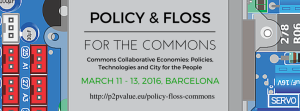 On the 11th, 12th and 13th of March, Barcelona will host the International Workshop on Commons Collaborative Economies: Policies, Technologies and City for the People, promoted by the Municipality in collaboration with the P2P Value European project, a techno-social platform for sustainable models and value generation in commons-based peer production in the Future Internet.
The aim of the workshop is “to highlight the relevance of the commons-oriented approach of peer production and collaborative economy” by producing two specific outcomes: proposing policy recommendations and providing technical guidelines to build free and open software and decentralized technologies.
The increasing importance of commons-based peer production raises questions also with regards to the role of public administration. Focusing on policy, the event will thus be an important opportunity for policy makers to exchange and interact with the technical teams of FLOSS (Free/Libre/Open Source Software) platforms for commons-based peer production communities (which were the subject of a previous workshop held on March 2015), and also to provide useful contents as regards the European Commission’s activity on collaborative economy.
The program will mix working groups and plenaries, which will focus on:
- Public policies for commons collaborative economy
- Commons and the city
- Importance of decentralized technologies
- Peer cooperativism: collaborative economy, feminist economy & social and solidarity economy
- Value and collaborative production.
Among the speakers of this interdisciplinary workshop, many scholars, experts and practitioners from Europe and beyond. Professor Christian Iaione will chair the plenary on “Commons and the city” together with Joan Subirats i Humet, Institute of Government and Public Policy (IGOP), Autonomous University of Barcelona.
—–
Appuntamento a Barcellona dall’11 al 13 marzo per “Commons Collaborative Economies: Policies, Technologies and City for the People”, incontro promosso da P2P Value e dalla Municipalità di Barcellona con l’intento di evidenziare l’approccio commons-oriented nell’ambito della collaborative economy. Obiettivo: elaborare indicazioni di policy e strumenti operativi. Tra i relatori, il professor Christian Iaione.
by Elena De Nictolis | Mar 5, 2016 | The Urban Media Lab
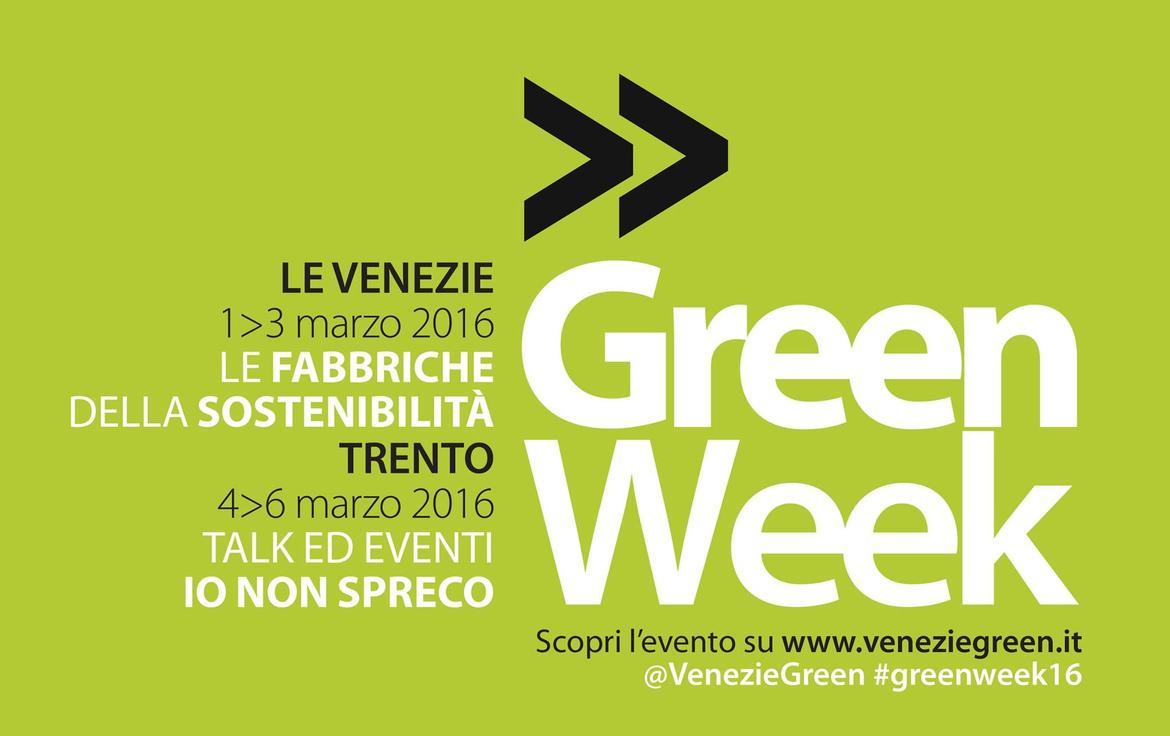
LabGov will participate at the Trento Green Week, a forum for discussion on the major issues of the green economy. The three-day festival, that will take place from the 4th to the 6th of March, includes several sessions, debates, meetings and events on sustainability.
 LabGov will intervene during the panel on “The collaborative economy in the city (and beyond)”, organized by the ENI Enrico Mattei Foundation. It will gather noteworthy speakers among the most notable leaders of innovative researches and projects about the collaborative economy in Italy. After an introduction by Flaviano Zandonai, from Iris Network and an intervention by Matthew Bina, from the Manager Incubator Fabri, LabGov will present CO-Bologna. The forward-looking significance of the collaborative economy is indeed one of the most important issues of the CO-Bologna program, which aims to prototype – through a process of experimentation in urban collaborative living labs moderated by LabGov experts – collaborative/polycentric governance devices at the neighborhood level. This process will contribute in turning neighborhoods in collaborative ecosystems that enable the proliferation of innovations such as the pooling economy. The panel discussion that will follow immediately after those intervention will see Francesco Gabbi, founder of Abito and Ilaria Lenzi, coordinator of the research program “Sustainability and Social Innovation”, at the Eni Enrico Mattei Foundation and Angelo Rindone, founder of “Produzioni dal basso”.
—–
Non solo green – LabGov parla di economia collaborativa alla Green Week di Trento.
LabGov parteciperà alla Green Week, forum di discussione sui grandi temi della green economy. La manifestazione, organizzata dall’Università di Trento, sarà suddivisa in due percorsi differenti: dall’ 1 al 3 marzo un tour porterà i partecipanti alla scoperta delle aziende d’eccellenza delle Venezie; dal 4 al 6 marzo, un festival di tre giorni sarà animato da una ricca serie dibattiti, incontri, eventi, sul tema della sostenibilità ospitati dalla città di Trento.
LabGov prenderà parte alla sessione dedicata a “L’economia collaborativa nelle città (e non solo)”, curata dalla Fondazione ENI Enrico Mattei, che vedrà il contributo dei protagonisti delle più rilevanti ricerche e sperimentazioni dell’economia collaborativa in Italia. Dopo l’introduzione di Flaviano Zandonai, segretario Iris di Network e gli interventi di Matteo Bina, Incubation Manager Fabri, LabGov racconterà i successi di CO-Bologna. Il tema dell’economia collaborativa è infatti uno dei temi più importanti del programma CO-Bologna, che ha l’obiettivo di prototipare, a valle di un processo di sperimentazione in laboratori urbani collaborativi, dei dispositivi di governance collaborativa/policentrica a livello di quartiere che contribuiscano a rendere le città degli ecosistemi collaborativi che abilitano il proliferare delle innovazioni come la pooling economy. La tavola rotonda che seguirà subito dopo prevede la partecipazione di Francesco Gabbi, fondatore di Abito e Ilaria Lenzi, coordinatrice del programma di ricerca “Sostenibilità e Innovazione Sociale”, Fondazione Eni Enrico Mattei ed infine Angelo Rindone, fondatore di Produzioni dal Basso.

by Ornella Martinello | Feb 17, 2016 | The Urban Media Lab
Today, almost three quarters of Europeans live in urban areas. Cities are at the core of institutional relations and economic growth. Yet, they are facing unprecedented social and environmental challenges that curb their rational development. It is time to think about the need to overcome these obstacles and plan a way to create fertile conditions to foster urban development, engaging citizens and communities in the process.
Experts, scholars and city-makers will explore this issue on February 25th in Amsterdam during the ECF’s event “New Democracy, Co-creating the City”. It will be a welcome opportunity to dialogue about urban poverty, affordable housing, sustainable use of land, exploring the already rich European landscape of public-civil partnerships and participatory governance practices. The event is organized by the European Cultural Foundation – in collaboration with Europe by People, Kunsten ’92, Leeuwarden – Fryslân 2018 European Capital of Cultural, Netwerk Democratie and Pakhuis de Zwijger . It is part of “New Democracy”, a series of events on democratic and cultural renewal in Europe from a citizens’ perspective.
The event has the clear aim to contribute to the forthcoming EU Urban Agenda, a cornerstone of the Dutch Presidency of the Council, which will be adopted by EU Heads of state and government during the ad hoc Ministerial Conference that will take place on May 30th. Experts, scholars, academics and city-makers will gather in Amsterdam to discuss and formulate creative and innovative solutions to urban challenges, in order to encourage cultural change and stimulate the development of good governance practices.
Eminent figures – leading the process towards urban, social and institutional innovation in the cities of Bologna, Solin and Leeuwarden – will intervene as speakers. Among them: Christian Iaione, professor of Public Law, Director of the Laboratory for the Governance of the Commons, LUISS Roma and member of the International Association for the Study of the Commons; Antonija Eremut, Manager of the EU funded projects in cultural tourism and sustainable urban development; Pedro Campos Ponce, Beleidsadviseur Europees stedenbeleid, BZK; Sjoerd Feitsma, Councillor of Culture Leeuwarden.
You can find the program of the event here.

Commonspoly, a hacked version of the Monopoly ©Julio-Albarrán
———
Circa tre quarti dei cittadini Europei vive oggi in aree urbane. Le città sono ormai il cuore pulsante dell’Europa. Tuttavia, esse sono costrette a confrontarsi con sfide sociali, ambientali e istituzionali senza precedenti. E’ tempo di superare questi ostacoli e contribuire allo sviluppo urbano in modo creativo ed innovativo, partecipando attivamente in quanto cittadini e comunità, con l’obiettivo di ricreare e co-creare le nostre città, insieme. Lo faremo ad Amsterdam, il 25 febbraio, in occasione dell’evento “New Democracy: Co-Creating the City” organizzato dell’European Cultural Foundation.

 On the 11th, 12th and 13th of March, Barcelona will host the International Workshop on Commons Collaborative Economies: Policies, Technologies and City for the People, promoted by the Municipality in collaboration with the P2P Value European project, a techno-social platform for sustainable models and value generation in commons-based peer production in the Future Internet.
