
by Marina Bassi | Feb 7, 2015 | The Urban Media Lab
The City of Bologna launched a participative process for the definition of the guidelines on school meals services. For the first time all the aspects concerning the school meals program, such as quality of meals, priority on investments, monitoring system and customer needs, will be defined through a participatory process. In fact, the opinions and comments expressed by citizens during the online consultation will be integrated in the Guidelines for the development of the school canteen service.
The City School Meals Commission, established in 2013 thanks to the alliance between families, the City, the Health Local Service and SE.Ri.BO (the mixed-capital local school meals food service company), drafted a document titled “Guidelines for the development of the school meals service”. The document announces that “school age is the time when the child sets up and consolidates the eating habits. It is in this stage of life that collaboration between institutions, family and school can contribute to the development of a healthy eating style which continues and persists into adulthood. Proper nutrition combined with regular physical activity can prevent excess weight and reduce the risk of developing adult chronic diseases”.
Therefore, there is full awareness that the Municipality of Bologna has an important role in the determination of quality food and educating the younger generation and their families to proper nutrition, preventing the risks of chronic diseases. Now, the process is open to all citizens who can express their ideas and introduce any additions to the document.
To participate:
- Join the community “Comunità” of Rete Civica > Access to “Comunità”
- Express your preferences in each section of the document.
Particularly, it is possible to send contributions about six main topics:
- Quality of alimentation
- Staff employed
- Investments
- Environmental Sustainability
- Customer services
- Monitoring and evaluation
For more information: openscuola@comune.bologna.it
Link to consultation: Linee di indirizzo per lo sviluppo del servizio di refezione scolastica
_______________________________________________________________
Servizio di mensa scolastica: è online la consultazione per definire le linee guida
Il Comune di Bologna ha avviato un percorso partecipato per la definizione delle linee guida del servizio di refezione nelle scuole bolognesi.
Grazie al lavoro realizzato dalla Commissione Mensa Cittadina (CMC), istituita dal Comune a marzo 2013, che riunisce formalmente Comune, genitori, AUSL, SE.Ri.BO (società mista attualmente incaricata del servizio), per la prima volta vengono definite alcune specifiche indicazioni sul servizio di refezione dei prossimi anni, in particolare sulla qualità dei pasti, sugli investimenti necessari, sul sistema di monitoraggio e controllo e sulla partecipazione degli utenti
La Commissione Mensa, composta da Comune, genitori e Se.Ri.Bo, ha realizzato il documento “Linee d’indirizzo per lo sviluppo del servizio di refezione scolastica“, articolato in 6 punti, in base al quale verrà poi elaborato il capitolato di gara per la selezione del nuovo gestore del servizio. Il documento specifica che “L’età scolare rappresenta il periodo in cui s’impostano e si consolidano le abitudini alimentari del bambino ed è proprio in questa fase della vita che una migliore collaborazione tra istituzioni, famiglia e scuola può contribuire allo sviluppo di uno stile alimentare salutare, che si protragga e permanga anche nell’età adulta. Attraverso una corretta alimentazione associata a un’attività fisica regolare si può prevenire il sovrappeso e ridurre il rischio di sviluppare in età adulta malattie cronico-degenerative (malattie cardiovascolari, diabete, ipertensione, ecc…). Vi è la piena consapevolezza, quindi, che il Comune di Bologna quando eroga il servizio di ristorazione ha un ruolo importante nella determinazione di un’alimentazione di qualità e nell’educare le giovani generazioni e le loro famiglie a una corretta alimentazione, volta a prevenire l’insorgenza di malattie croniche.
Ora il processo è aperto a tutti i cittadini, che potranno esprimere le proprie idee ed introdurre eventuali integrazioni al documento.
Come fare per partecipare?
Per esprimere le proprie osservazioni è sufficiente:
- iscriversi alla sezione “Comunità” della Rete Civica
- esprimere la propria preferenza sotto ad ogni singola sezione del documento (tramite “VOTA” o “FAI UNA PROPOSTA”).
In particolare, è possibile inviare i contributi in merito ai 6 argomenti principali:
- qualità dell’alimentazione (derrate alimentari, qualità nutrizionale, sicurezza alimentare, gradibilità)
- personale impiegato
- investimenti
- sostenibilità ambientale
- rapporto con l’utenza e gli stakeholder del servizio
- controlli (misurazioni)
Tutti i contributi e le domande che arriveranno saranno analizzati dal Settore Istruzione e, in base alla pertinenza degli stessi, eventualmente recepiti nelle “Linee di indirizzo”.
La consultazione è a questo link > Linee di indirizzo
by Edoardo De Stefani | Jan 28, 2015 | The Urban Media Lab

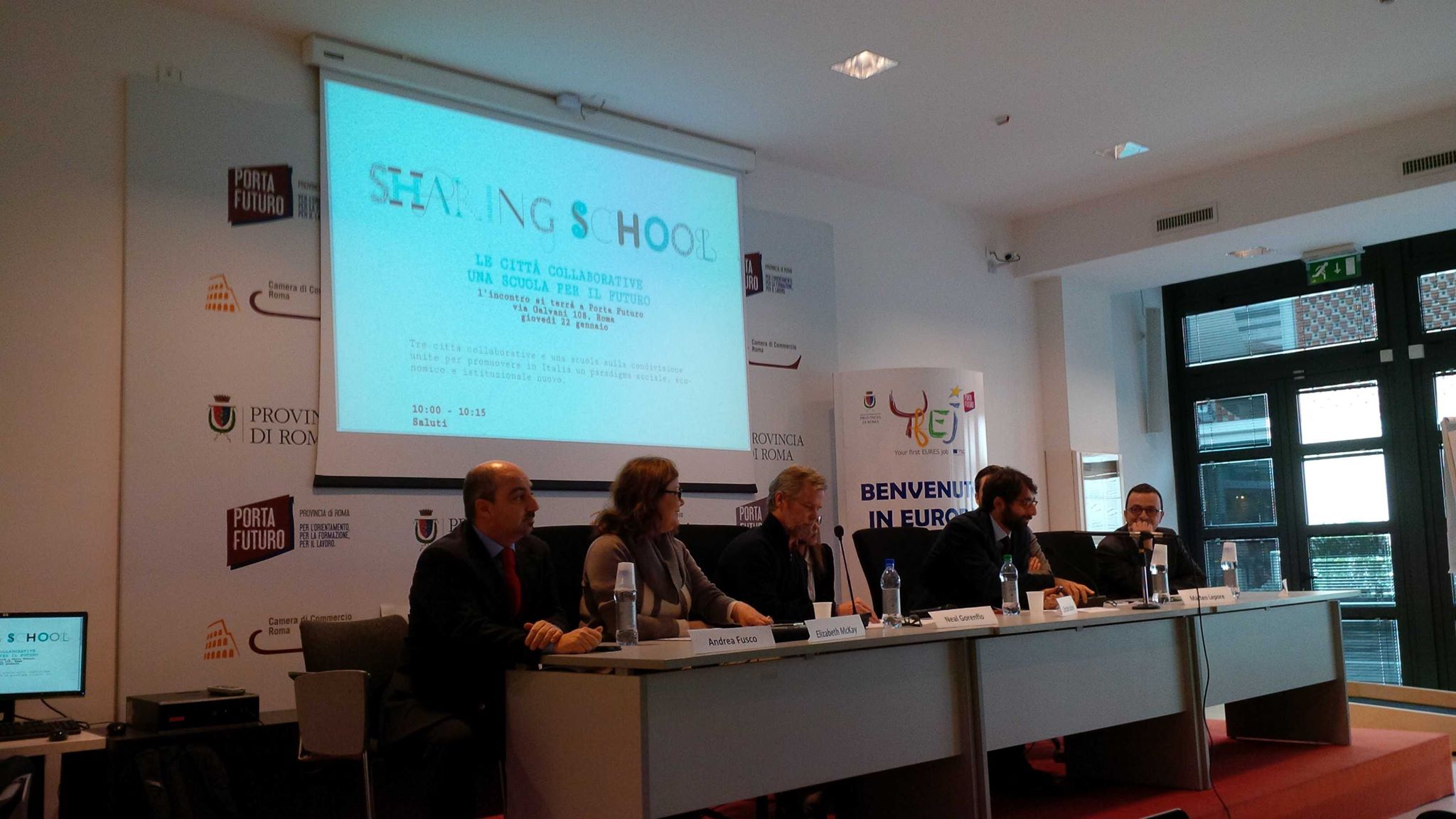
The sharing economy is growing faster than ever and becoming a hot policy issue these days. Casa Netural, Collaboriamo, RENA and LabGov have for this reason decided to launch the “Sharing School”. Thanks to the collaboration between these organizations and with the support of Ouishare, Avanzi and Societing, the School has been able to host highly qualified professionals and experienced innovators. The guest star of the event has been Neal Gorenflo from Shareable, an American leading organization in the field of sharing economy and collaborative practices.
The event held in Rome at Porta Futuro, had the main objective of dealing with the mainstream tendency of sharing economy and to understand if such trend can become the leading paradigm of the new economy. Andrea Fusco, Director of Department III – Services for placement and quality of life of the Province of Rome, the future Metropolitan City, was very happy to host the Sharing School initiative.
Minister Counselor for Public Affairs of the US Embassy in Italy Elizabeth McKay, reminded how the sharing economy has already changed things; it is no longer a new phenomenon and thanks to technological interactions and social media, we are exploring a potential that can disrupt traditional forces. Customers become service providers themselves, acting as catalysts for phasing into the system resources and goods that are normally not exploited.
We were used to think about sharing economy as some “nerd stuffs”, while nowadays there is a sort of “media bulimia” that affect the topic of sharing economy – says Francesco Russo, President of RENA. It is undeniable that we are assisting to a growing tendency of the concept of collaboration, as we simply trust strangers. However, the problem is that we shall distinguish what sharing is really about, and that is the aim of the Sharing School. There is a paradigmatic change of society and in the next future, 40% of the online staffing will be served through services provided by the sharing economy. Then, the approach of the initiative is not only about telling the story of a new economic trend.
As Neal Gorenflo recognizes, we are all here to learn how to gather people and create a common homogeneous vision about the sharing economy. But here we encounter obstacles, since we need to dissolve the gap between trans-formational economy and trans-action sharing, which basically maintains social hierarchies. Neal Gorenflo talked about making a choice between the red pill and blue pill like in The Matrix movie. The blue pill is a story about the re-adaptation of the old capitalist paradigm to the new economic trends, where Uber and AirBnB are the concrete examples of how initiatives of such strand of the sharing economy can still create monopolies. On the other hand, the red pill is the one that inspired our research. It is about the resurgent collaborative experimentation and it is what can wake up reality. We need to open cities, to make them available for use and to activate citizens by creating an economy “by and for” the people. We need to invest on transformational sharing much rather than transactional sharing.
However, as Matteo Lepore – Commissioner to Economy, Development of the City, Tourism, International Relations and Digital Agenda of the City of Bologna – underlined, if we talk about social order and sharing economy, we are inevitably bound to themes such as politics, democracy and participation. In fact, even taking the red pill has the risk of initiating a debate between citizens and the political representation. It is all about a systemic change, otherwise there would be no way back from the loss of collaboration between citizens and institutions. Step by step, we are loosing the sense of citizenship, by projecting a vision of citizens as the residual assets of society. Fortunately, the City of Bologna was able to initiate a process of human capital reactivation, thanks to the implementation of the “Bologna Regulation on public collaboration for urban commons” that seeks to transform the Public Administration in an enabling factor. The City of Bologna is thus a starting point for understanding how collaborative practices can rehabilitate citizens and regenerate urban networks, for instance with the instrument of the “pact of collaboration“. The underlying idea is that important results can only be achieved through effective practices of co-working, which involve citizens and professionals through a platform of mutual exchange of skills and knowledge.
Starting from the community to build competences and deliver effective results on the territory is also the strategy of the City of Milan , says Renato Galliano, Director of Smart City Service in Milan. We have to recognize that it exists a network of collaborative urban cities, which is itself a new form of infrastructure. This is the confirmation that collaborative economy is not only about isolated and scattered projects of mobility sharing, start-ups and civic crowdfunding. The social innovation entails a renaissance of the cities in a wider context, whereas citizens are the locomotives of change and public administrations are the habilitating infrastructure.
As Christian Iaione, Coordinator of LabGov, reminded we have to reinforce the processes of active citizenship and active entrepreneurship, to foster a steady dialogue between the five actors of collaborative governance and to create an “Italian way” to sharing. Indeed, the real sharing is centered on the restitution of value to the community. This is a good opportunity also for the City of Rome. Daniela Patti – from the staff of the Comminisioner to the Urban Transformation in Rome – affirmed that we need to create a network of collaborative cities, to develop instruments to regenerate abandoned urban spaces and to consolidate practices for exploiting the latent potential of the great cultural heritage.
Alex Giordano (Societing and Rural Hub) warned against the dysfunctions that an incorrect practice of sharing economy can create. In this sense, we should not only focus on the quantitative approach and upon capitalist mechanisms. It is in fact essential to reason on communities and social impact. If we have a look at territorial distributions, it is possible to notice how people are divided by interests and have lost the sense and ethic of community building. Fortunately there are breeding grounds of innovation that create value, even if their outreach is limited by disabling institutional leaderships. The problem is that those who have the courage to produce social innovation are constantly marginalized, as Simone Cicero of Ouishare, noticed. Even Enrico Parisio, of Coworking Millepiani says that we need to express such new exigency, as a pedagogic stimulus for social innovation. When we started talking about sharing economy, nobody believed it could be real, reminds Ivan Fadini of Impact Hub Roma. For this reason we are strongly committed today on avoiding the reiteration of traditional economic capitalism.
The commoners will be the heroes of social innovation.
Stay united!
– – – – – – – – – – – – – – – – – – – – – – –
Presentata a Roma la prima edizione della Sharing School.
Si è tenuto il 22 gennaio 2015 l’evento di presentazione della Sharing School di Matera, la prima scuola sulla sharing economy e sulla condivisione per promuovere in Italia un nuovo paradigma sociale, economico e istituzionale. L’incontro, ospitato da Porta Futuro e reso possibile grazie alla collaborazione tra Casa Netural, RENA, Collaboriamo e LabGov, con il supporto di Avanzi, OuiShare e Societing, ha visto la partecipazione, grazie al supporto dell’Ambasciata americana in Italia, di Neal Gorenflo co-fondatore di Shareable.
L’evento, incentrato su temi dell’ economia collaborativa e innovazione sociale, ha rappresentato un importante punto d’incontro tra ospiti internazionali, attori istituzionali, accademici e società civile. Se si vuole sviluppare un nuovo concetto di economia, è necessario rivedere gli orizzonti sociali e promuovere spazi innovativi di collaborazione. E’ in un contesto di inclusione sociale e di promozione della cittadinanza attiva che la sharing economy deve prendere piede perché, come ricorda Neal Gorenflo, le persone devono rappresentare lo snodo per un’economia collaborativa.
Dobbiamo cominciare a comprendere come l’implementazione di un modello di governance condivisa non ruba potere alle amministrazioni, semmai ne rinvigorisce la struttura e la riempie di nuovi contenuti. Per questo il prof. Christian Iaione, coordinatore di LabGov, invita a pensare all’economia come un bene comune che possa essere curato e messo a punto con interventi di animazione da parte di tutti quei soggetti coinvolti nell’ambito della sharing economy, inclusi i cittadini.
by Giulia Spinaci | Jan 13, 2015 | The Urban Media Lab

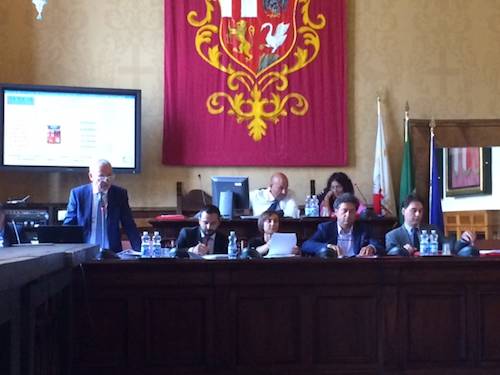
Ever since the City of Bologna approved in May ’14 the Regulation on Collaboration Between the Citizens and the City for the Care and Regeneration of the Urban Commons, twenty municipalities have approved the Regulation and fourth-three more are examining it. In this sense, the city of Orvieto has numerous predecessors, but this does not change the fact that it should be considered a success in itself.
Every little, medium and big city that voted in favor of a collaborative governance of the urban commons represents an important achievement along the way towards the end of the practice of devolving power. Active citizens have the chance to take care by themselves of the place they live and to do it hand in hand with the public administration, in a constructive cooperation that brings benefits to the whole community.
On December 29th, 2014, thus, Orvieto joined the list of the cities that decided to completely revolutionize the way of thinking about the commons, and in particular about the urban ones. The Municipal Council endorsed the Regulation by a unanimous decision. A fact, this, which highlights that behind themes like this, there is a common background able to eliminate the differences between the various political factions in favor of a shared agreement. Furthermore, the approval in itself helps avoiding all those cases in which the active citizenship is blocked and even punished (e.g. the emblematic case of Mrs. Ilaria Montis who was fined for having cleaned the seaside of Is Solinas (CI) and for throwing the garbages in dumpsters far away from her house). To regulate a phenomenon does not mean to block it or to establish boundaries and limits, but rather to let it flow according to its characteristics and according to the different realities it takes place in.
The Regulation found its origin in the work carried out also by LabGov experts in Bologna and is centered upon the principle of horizontal/circular subsidiarity enshrined in the Italian Constitution (Art. 118) in an innovative way. Article 118 should not be interpreted as a way of merely dividing the responsibilities between the private sector and the public one, but rather as a shared background on which a new model of society shall be built. A society where active citizens can practically contribute to the renewal of the reality they live in. Obviously, this implies that the Regulation cannot be applied everywhere in the same form. Changes are firmly supported in order to adapt the goals to the concrete situation and to the history and values of the city at issue.
The analogies and differences between the four different versions of the Regulation approved in the cities of Bologna, Ivrea, Siena and Chieri were already analyzed, through seven parameters. Now, with the same methodology, it has come the moment to present the vision that the city of Orvieto decided to offer with the approval of the Regulation, in comparison to the original version of Bologna.
- Principles. The Municipality of Orvieto maintained all the original principles that constitute the foundations of the original version of the regulation. However, an interesting voice was added by the City Council of Orvieto during the drafting phase: art. 10 makes an explicit reference to the Framework Convention on the Value of Cultural Heritage for Society, approved in Faro in 2005. In the words of Paolo Maurizio Talanti, the Democratic Party councilman of Orvieto “a city with such an artistic and cultural heritage like ours shall know that the knowledge and use of the cultural heritage is an individual right […]”.
- Subjects. For both Bologna and Orvieto, the subjects taken into consideration are the active citizens, namely “all subjects, single or associated, anyhow gathered in social formations, also of entrepreneurial type or with social vocation, which are active for the care and regeneration of urban commons”.
- Organizational aspects. Unlike the case of Bologna, Orvieto does not explicitly provide a unique office for the evaluation of the proposals of the active citizens, thus provoking an organizational gap that risks to provoke overlapping procedures and ambiguity during the implementation. In fact, according to the topic, each proposal will be submitted to the competent office.
- Type of administration. The kind of administration that takes shape in Orvieto is based on the authorization by the public offices, which are competent to technically evaluate the feasibility of the projects.
- Relevance of the private assets. The Regulation of Orvieto puts a particular emphasis on the public spaces as objects of the care of the active citizens, leaving however the possibility for a shared management of the private spaces for public use. Worth mentioning is the fact that the regulation merges the provision about the public spaces with the one about private ones in a unique norm.
- Forms of support. This is probably the most interesting aspect of the whole Regulation of Orvieto. In fact, the text completely eliminate all forms of exemption and relief from levies and local taxes and of administrative facilities, such as in obtaining permits. The Municipality may contribute to the reimbursement of costs only in those cases where an in-kind support is not possible.
- Disputes. Contrary to the Bologna Regulation, which provided for the creation of a Conciliation Board in order to solve future disputes, the City Council of Orvieto did not, thus leaving open the possibility to submit the arising cases to the ordinary jurisdiction instruments.
Strongly adapted to the local situation, the Regulation of Orvieto, with its strengths and weaknesses, constitutes a remarkable example of how much our society is changing and how well the Regulation fits in this challenging and stimulating environment.
_________________________________
Il Comune di Orvieto approva il Regolamento sulla collaborazione fra cittadini e amministrazione per la cura e la rigenerazione dei beni comuni urbani!
Il Comune di Orvieto ha due settimane fa approvato il Regolamento sulla Collaborazione tra Cittadini e Amministrazione per la Cura e la Rigenerazione dei Beni Comuni Urbani. Seppur con un testo adattato alla realtà della città, l’approvazione del Regolamento dimostra un rinnovato modo di pensare sui beni comuni urbani che si sta diffondendo velocemente in tutta Italia.
by Staff | Oct 31, 2014 | The Urban Media Lab
The Bologna Regulation on public collaboration for urban commons is part of the “The City as a Commons” project that started in 2011 in Bologna with the support of Fondazione del Monte di Bologna e Ravenna and the City of Bologna. It ultimately led to the adoption of the “Regolamento sulla collaborazione per la cura e rigenerazione dei beni comuni urbani“. LabGov interns prepared and edited the translation of the Bologna Regulation which is now the official version adopted by the City of Bologna (see “Regulation on collaboration between citizens and the city for the care and regeneration of urban commons“).
The Bologna Regulation was drafted after two years of field work and three “urban commons governance labs” run also by LabGov Coordinator, Professor Christian Iaione. The Bologna Regulation is a 30 page regulatory framework outlining how local authorities, citizens and the community at large (SMEs, non profits, knowledge institutions) can manage public and private spaces and assets together. As such, it’s a sort of handbook for civic and public collaboration, and also a new vision for government. It reflects the strong belief that we need a cultural shift in terms of how we think about government, moving away from the Leviathan State or Welfare State toward collaborative or polycentric urban/local governance. This calls for new regulatory and governmental tools, namely public collaboration, nudge regulation, and citytelling.
Christian Iaione, participated actively to the design and implementation activities of “La città come bene comune” (i.e. “The city as a commons“) project in Bologna. Iaione developed the theoretical fraework, carried out and coordinated the research activities, training programs and co-design sessions and was also one of the most active members on the committee appointed by the Comune di Bologna to draft the regulation.
Iaione has been researching the topic of urban commons for quite a long time, and at some point realized that the city could actually be interpreted as a collaborative commons. Iaione’s research on urban commons is synthesized in the “City as a Commons” paper presented at a conference in Utrecht in 2012 and later published on the Indiana University Digital Library of the Commons. Earlier studies were published in Italian as “La città come bene comune” and “Città e beni comuni“. Iaione had the opportunity to work and develop his academic studies as a research fellow at New York University School of Law. While at NYU he developed the theoretical framework for local public entrepreneurship, which is the basis of the CO-Mantova project and the idea of the city as a commons. His study on the tragedy of urban roads is the prequel of the Bologna experiment and the first conceptualization of urban infrastructure and assets as commons.
The City as a Commons project recently entered a new phase and evolved into the CO-Bologna project. The turning point is the 1st IASC Conference on urban commons “The City as a Commons“.

