
by Alessandra Pirera | Apr 19, 2018 | The Urban Media Lab
A discussion about Principles and Practices for Urban Commons Law and Regeneration in the framework of URBACT 2nd Chance Network
Today, 19 April 2018, LabGov will participate to the Final Event of the URBACT 2nd Chance – Waking up the “sleeping giants” project in Naples.
The URBACT 2nd Chance project aim at defining actions, strategies and ideas for the reactivation vacant large buildings and building complexes that are in decay, derelict and losing their original purpose, through a participatory urban governance approach, in order to awake their potential to provide space for needed functions in the city and to support a sustainable city and neighbourhood development.
The project created a large European Network of Local group members, local authorities and urban partners that tested and applied, in the last 3 years, a new collaborative approach resulted in the Integrated Action Plans of the 11 cities of Europe that will be presented and discussed with a wider audience of urban professionals, decision-and change-makers from 18 to 20 April in Naples.
https://vimeo.com/258964435
In this framework, Professor Christian Iaione, LabGov Faculty Director and URBACT Expert, will contribute to the discussion by sharing concepts, methodology and experiences of urban governance and economy based on years of researches and practices of applying and adapting Elinor Ostrom principles of collaborative management for economic and environmental sustainability to commons in urban contexts.
Ostrom in the City: Design Principles and Practices for the Urban Commons
The integrated and participatory urban renewal strategies experienced by the URBACT 2nd Chance projects involving cooperatives, builders’ groups, associations or foundations as well as self-organised citizens and communities to give new social and ecological sustainability to vacant large buildings are in line with the thinking and experimentation of LabGov that to achieve social, economic and institutional regeneration of urban areas, it is necessary to experiment “urban co-governance“, according to which public authorities shall enable the collective action of city inhabitants and invest on the creation of collaborative partnerships with and/or between city inhabitants, knowledge institutions, NGOs and businesses.
LabGov will be thus in the event in Naples looking forward to get new inputs, to share knowledge and best practices and to network with active urban actors from all Europe.
More info about the event here:

by Margherita Valle | Feb 23, 2018 | The Urban Media Lab, ULCR San José Lab 2018
[…]the concentration of people and events in time and space is a prerequisite to make anything happen, but more importantly are what activities are allowed to develop […]
In Life between buildings[1] are outlined the applications that must exist in the architectural proposals, so that human being begins to appropriate them. By extrapolating this analysis and relying on the concept established in The Right to the City[2], where it is considered that the gentrification caused by urban processes implies an impact on the present and the future of humanity[3]. The construction and strengthening of social structures that complement the dynamics of interaction of the different actors begins to make sense.
This concept of change of social structure is broad and, at the same time, complicated to define by different actors involved in the subject[4] Therefore, related processes that can be articulated from the academy result in the proposal of systematic variables that, far from wanting to intercede to achieve the purpose of a change of structure, what they seek is to detonate a collective process which add to the existing.

Proposal of social integration.
In this search to promote the use of space and social interaction, the approach to the community Barrio Pinto and its surroundings is proposed in the South of the canton of San Pedro de Montes de Oca, in the province of San Jose, Costa Rica; whose radius of action is located between the kilometer close to the Campus of Universidad Latina. This context contains many different realities. On the one hand, the central avenue has an established structure of commerce and services, in addition is the road that connects the center of the country with the Inter-American route, therefore, highly charged with vehicular flow.
This situation disappears entering avenue 2, 4 and 6. Residential use is giving space to the commerce and offices, but that still encloses a residential range that gives life to the parks of his around. This mutation of the space is reflected in the offer of related services between traditional commercial systems, such as tailors, sodas and informal commerce, as well as other emerging elements (biodegradable cleaning products).
Is under these dynamics – between the behavior of the inhabitants of the sector and the users of the services that are beginning to develop in the area – that the interaction between students of the area and the institutions (who are unaware of the processes, routes, services) arises. For example, there is a coffee shop that offers bike rental per hour and per day, as well as the organization of recreational circuits in the sector.
Then, the question arisen is: how to provide a tool to citizenship that allows articulation in the public space between the collective memory of a specific place and emerging uses that change the image of the city?
It is at this point, where the definition of common goods[5] and Collaborative Economy[6] (Cañigueral, 2014), together with the use of the technological tool Agora PIC (Plataforma de Integración Ciudadana, 2017) developed by the NGO team PIC, that these are taken as the basis of the research, to identify the possible elements to be taken into account, and to define a path that provides information on tangible and intangible variables. Trying to unify the social processes of the inhabitants of the sector, with visitors and users of the different activities in the radio, near to the community of Barrio Pinto.
Within the concrete analysis of the peculiarities of the community, the gap that exists between space of the Square Máximo Fernández- on the north side of Franklin D. Roosevelt School – and El Retiro Park (650 meters Southwest of Máximo Fernández Square) -, as a hub that makes possible the social connection of a situation different from the current, whose goal is immersed, as Gehl points out[7] – is taken into account, to generate not only the space of transition, but of interaction.
Citizen participation has been necessary for the construction of this project. Across workshops and interviews, as well as different visits to the community to establish collaborative and individual services[8], the rescue of collective memory, stories and accounts of the citizen for the visibility of the human and sensory part of the area began, as well as the delimitation of the emerging uses that change the dynamic preset in the area, and generate a social movement toward the appropriation of common space[9].

Conclusion of a job, start of a route.
In conclusion, it is possible to counteract the thinking and analysis of Gehl[10], about the dynamics of use of public spaces, with the contributions of Zaida Muxí and Joseph María Montaner[11] on the substantial changes that surround the phenomenology of the city for the adequate enjoyment and use of the various variables of the Commons. Processes that lead to interpret the change of the image of the city must occur in an intrapersonal way, understanding that this isolated element is part of an articulated social system[12].
On this premise, it is part of this personal relationship, of collective memory and the individual task, for the strengthening of pre-existing social layers. It may not induce a community to take a change in its structure, but it strengthens when an external user can deviate from their daily life to rediscover its immediate context. For this reason, and waiting for the use of the technological tool (Ágora PIC[13]) to boost social skills to community, this intervention has been completed with the start of a journey raised with the student community of the Universidad Latina.
On this basis, we should start from this relationship between the collective memory and the individual task, to strengthen the pre-existing social layers. It is not possible to induce a community to adopt a modification in its structure, but it can be strengthened, when an external user can get away from their everyday life to rediscover their immediate context. For this reason, the use of the Ágora PIC technological tool was envisaged so that it could stimulate the social capacities of community making, ending this intervention with the beginning of a journey through the community.
A circuit that seeks, every four months, that is to say with the opening of the academic semester, to offer the newly admitted student the possibility of knowing their immediate context, and at the same time generate interaction with the dynamics of their area and with its inhabitants. This wants to contribute to the creation of a collective memory and local participatory networks that bring the academy closer to its own territory.
Il progetto pilota del LabGov Costa Rica comincia da esercizi accademici mirati che hanno l’intenzione de rispondere alla domanda: come facilitare uno strumento alla cittadinanza che permetta l’articolazione tra i beni comuni spaziali e la memoria collettiva di un determinato luogo; con una particolare attenzione agli usi emergenti che mutano rapidamente il volto frenetico della capitale e il ricordo di un passato, non troppo passato, campestre e bucolico? Come possiamo conservare la memoria dei beni comuni intangibili promuovendo contemporanemente l’hic et nunc dei commons tangibili attuali?
[1] Gehl, J. (2011). Life between buildings: using public space. Washington, DC: Island Press.
[2] Lefebvre, H. (1973). Le Droit à la ville. Paris: Ed. Anthropos.
[3] Costes, L. (2012). Del ‘derecho a la ciudad’ de Henri Lefebvre a la universalidad. Urban, 1-12.
[4] Lucas, M.A. (2006). Estructura social. La realidad de las sociedades avanzadas. Madrid: Pearson Education.
[5] Fundación Heinrich Böll (2008). Genes, bytes y emisiones: Bienes comunes y ciudadanía. Ciudad de México: Ediciones Böll.
[6] Cañigueral, A. (2014). Vivir mejor con menos. Barcelona: Penguin Random House Grupo Editorial.
[7] Gehl, J. op.cit.
[8] Cañigueral, A. op.cit.
[9] Fundación Heinrich Böll, op.cit.
[10] Gehl, J. op.cit.
[11] Muxí, Z., Montaner, J.M. (2011). Arquitectura y política. Barcelona: Editorial Gustavo Gili.
[12] Lucas, M.A. op. cit.
[13] https://agora.picapp.org
by Elena De Nictolis | Dec 29, 2017 | The Urban Media Lab
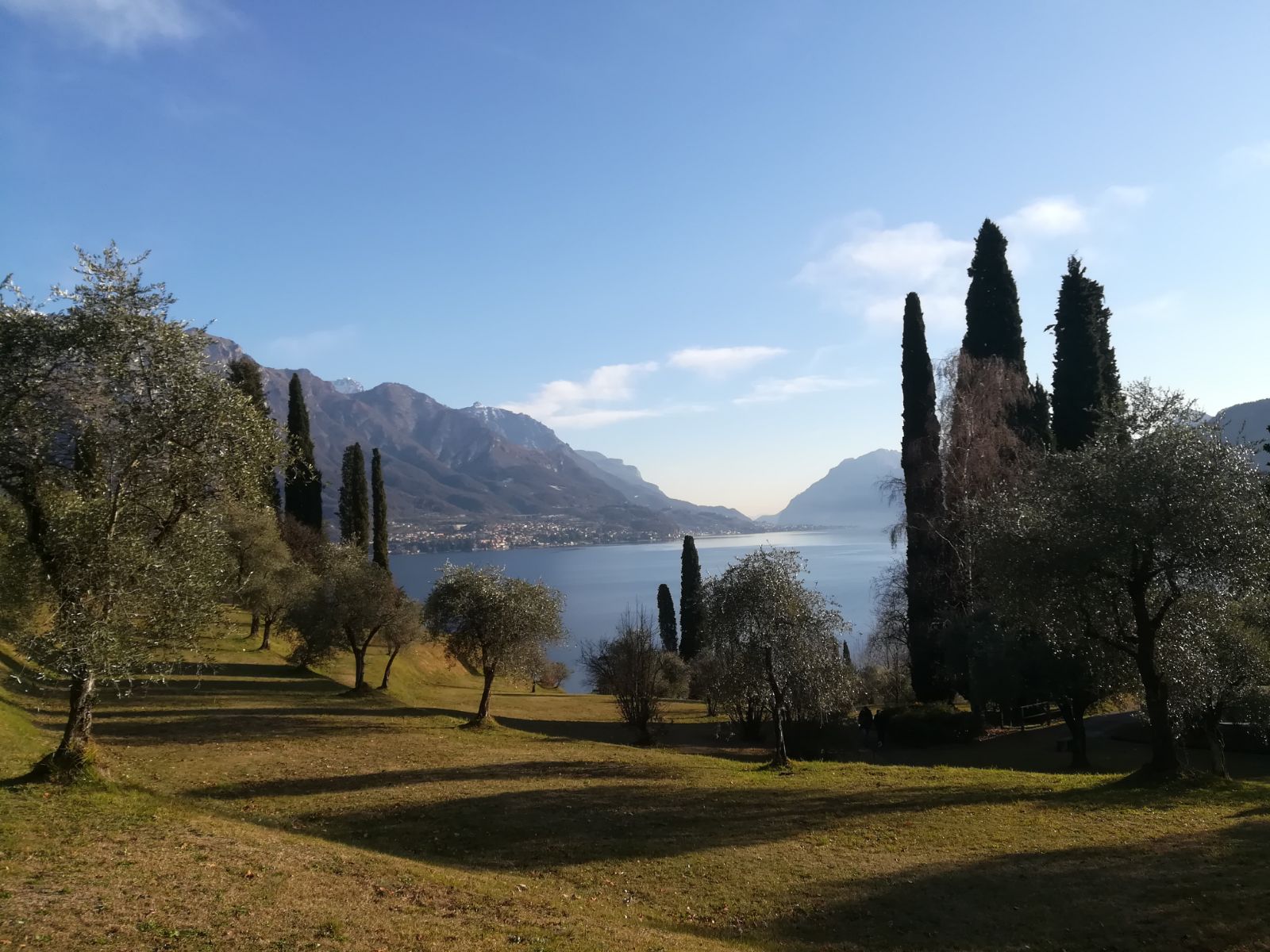
The Rockefeller Foundation Bellagio Conference Program hosted a retreat: “Accelerating Citywide Civic Entrepreneurship: An Exercise in the Co-City Approach” from December 11-15, 2017. The retreat is hosted by the LABoratory for the GOVernance of the Commons (“LabGov“), with the aim of providing a first methodological trans-geographical test of the Co-City algorithm, a new mode of civic entrepreneurship that empowers the public, private, and social sectors to govern urban commons collaboratively for the public good and better meet the needs of city residents through an experimentalist approach.

The retreat brought together leaders in urban innovation and civic entrepreneurship, with representatives from the City of Amsterdam (the Netherlands; urban innovation officer); the city of Barcelona (Regidoria de Participaciò i territorio) the City of Boulder (Colorado,Chief Resilience Officer (CRO); the city of Turin (Italy, the Co-City project funded by the EU Urban Innovative Action program as part of the Regional Development Fund); the city of Madison (Wisconsin, which dedicated capital funds to support a worker cooperative development initiative aimed at supporting people of color and others with barriers to formal employment to create worker cooperative businesses); the City of New York (NY, NYCx Co-labs program of the Mayor’s office of New York City, participating via Skype); Habitat International Coalition; the National Association of Italian Cities (ANCI) as National Contact Point of the EU Urbact program; Cooperation Jackson (network of cooperatives and worker-owned enterprises; Archiafrika (NGO based in Accra, Ghana, that promotes both the built and cultural spaces on the African continent and aims at contributing to the understanding and development of design within the continent and encourage the investigation and education of African architectural history); the German Marshall Fund of the United States (the Urban and Regional Policy Unit); the Brookings Institution ( the Project on 21st Century City Governance); the Laboratory for the City, Laboratorio para la Ciudad (experimental arm and creative think tank of the Mexico City government); SPUR (an NGO operating in the San Francisco Bay area). The retreat was facilitated and co-chaired by Alicia Bonner Ness, Sheila Foster, Christian Iaione and Simone D’Antonio.
During the five days in Bellagio, the participants were introduced to the last research output of LabGov, the Co-City process/cycle and the five design principles developed by Sheila Foster and Christian Iaione for the design and implementation of a co-city. The participants were involved in a simulation of the Co-City process and engaged in an exchange of experiences and mutual learning exercises. As recalled by Simone D’Antonio 1 in a recent article on the Rockefeller LabGov Bellagio retreat, the fruittul exchange of experiences showed the variety and richness of approached embraced by cities in different parts of the world to develop an innovative way of implementing urban governance; from the case of Turin, which through the Co-City project funded by the EU program UIA is experimenting with urban commons as a platform to tackle the issue of urban poverty, to the case of Mexico City where representatives of different urban stakeholders such as representatives of creative economy and urban planners are coming together to contribute to the re-design or the city or the city of Wisconsin, which which dedicated capital funds to support a worker cooperative development initiative aimed at supporting people of color and others with barriers to formal employment to create worker cooperative businesses, or the experience of international public institutions such as UN Habitat with the Safer cities program, launched in 1996 at the request of African Mayors seeking to tackle urban crime and violence in their cities and has evolved towards time is an integrated, multi-level government and multi-sectoral approach to improving the livability of cities and quality of urban life.
The aim of the Rockefeller Bellagio Retreat organized by LabGov was to gather representatives of different actors of what was called the Quintuple Helix governance of urban innovation at the global level in order to explore potential applications of the Co-city/city as a commons 2 model to co-create and sustain more just and inclusive cities. Among the potential outputs of a global experimental application of the Co-City process is the development a set of tools to design urban justice and democracy and thereby also measure the implementation of some of the New Urban Agenda goals, such as those i 13 and 91, or the Sustainable development goals (SDGs) 16 and 17, in particular the subgoal 16.7, 17.17 and 17.19.
(1) Simone D’Antonio, Co-City. Esperienze globali di cura dei beni comuni a confronto a Bellagio, Il Sole 24 ore Enti locali e PA, December 19, 2017.
(2) Sheila Foster & Christian Iaione, Ostrom in the city: design principles for the urban commons, The Nature of Cities, August 20 2017.
…………………………………………………….
L’algoritmo #CoCity è stato sottoposto a un primo test metodologico trans-nazionale nell’ambito del Rockefeller Foundation Bellagio Retreat organizzato da LabGov dall’11 al 15 Dicembre 2017 “Accelerating Citywide Civic Entrepreneurship: An Exercise in the Co-City Approach”. Nel corso del retreat rappresentanti di città americane, africane, europee e latino americane, movimenti sociali, grandi società tech e ONG pubbliche internazionali si sono confrontate e sono state coinvolte in una simulazione del protocollo Co-City per discutere insieme di soluzioni collaborative per affrontare le nuove sfide delle città nel mondo.
by Chiara De Angelis | Nov 30, 2017 | The Urban Media Lab
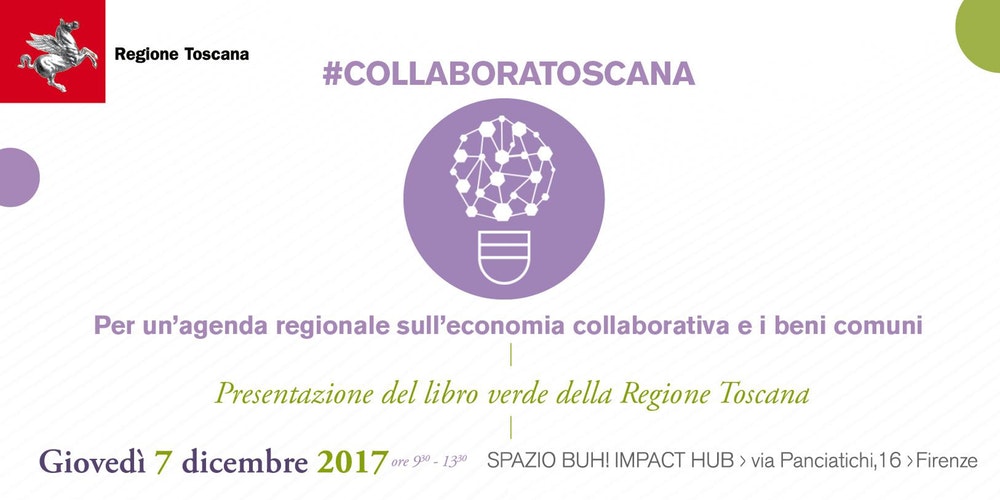
On Thursday, December 7th, Florence will host the presentation of the Green Paper of Regione Toscana for a Regional Agenda on collaborative economy and commons.
#COLLABORATOSCANA is the process led by the Tuscany Region with the support of LabGov and SocioLab, to build a regional public policy on sharing economy and collaborative economy.
The process consisted in co-design sessions and workshop that involved different sectors of the regional structure and a variety of local stakeholders coming from different areas (entreprises, startups, third sector, NGOs, active citizenship) with the aim of defining a Green Paper containing a mapping of regional public policies to be put together, and a series of proposals on objectives, actions and measures spotted to the co-design path.
The #COLLABORATOSCANA Green Paper will be presented in collaboration with ANCI Toscana on December 7th from 9.30 AM to 1.30 PM in BUH Circolo Culturale Urbano (Via Panciatichi 16, Florence).
The process is developd with the scientific support of the international research project “Co-Cities and Co-Territories” within LUISS LabGov, directed by prof Christian Iaione, and its methodology is cured by Sociolab cooperative, and supported by Collaboriamo.org.
Tickets are available on https://www.eventbrite.it/e/biglietti-collaboratoscana-39213191712
Giovedì 17 dicembre sarà presentato presso BUH Circolo Culturale Urbano (Via Panciatichi 16) a Firenze il Libro Verde della Regione Toscana per un’agenda regionale sull’economia collaborativa e i beni comuni.
by Chiara De Angelis | Nov 24, 2017 | The Urban Media Lab
Matera Design Evolution is a project designed and organized by Associazione Casa Netural that will take place on November 25th and 26th in Matera, European Culture Capital for 2019. Design becomes a tool to think and invent new ways to regenerate the old historical center of Grottole (Matera).
A community composed by designers, artisans and practitioners will reunite for two days of workshops to elaborate and build together all the different aspects of #WonderGrottole. It will be a design network, a community aggregator, a unique experience to meet, know each other, share experiences, work together for a magical territory: Matera, Grottole and Basilicata.
The community of Wonder Grottole is looking for someone to co-design together: the crowdfunding strategy for the project, the architectural concept, the IA, the mobility, the web platform, the manifesto, the governance.
The program will be structured as following:
– On the first day the project will be introduced to the participants through a walk in and out of Grottole;
– On the first and second day participants will be divided into work groups, and each of them will be developing an aspect of the project. Then everybody will reunite for lunch and dinner, to update each other on the process.
At the end of the two days, the output will be the definitive choice of the house, and the definition of:
– the Manifesto;
– the web platform;
– the economic plan;
– the timeline
– homeworks (!);
– dates for the next meetings;
Moreover, the project supporters are going to subscribe the Foundation document of the project.
Chiara Prevete, LabGov’s executive director, will attend the meeting.
The full program of the event is available here: http://www.materadesign.com/
Il 25 e 26 novembre Matera ospiterà #WonderGrottole: due giorni di workshop intensivi per ripensare e co-disegnare la rigenerazione del centro storico del comune di Grottole


