by Edoardo De Stefani | Jan 28, 2015 | The Urban Media Lab

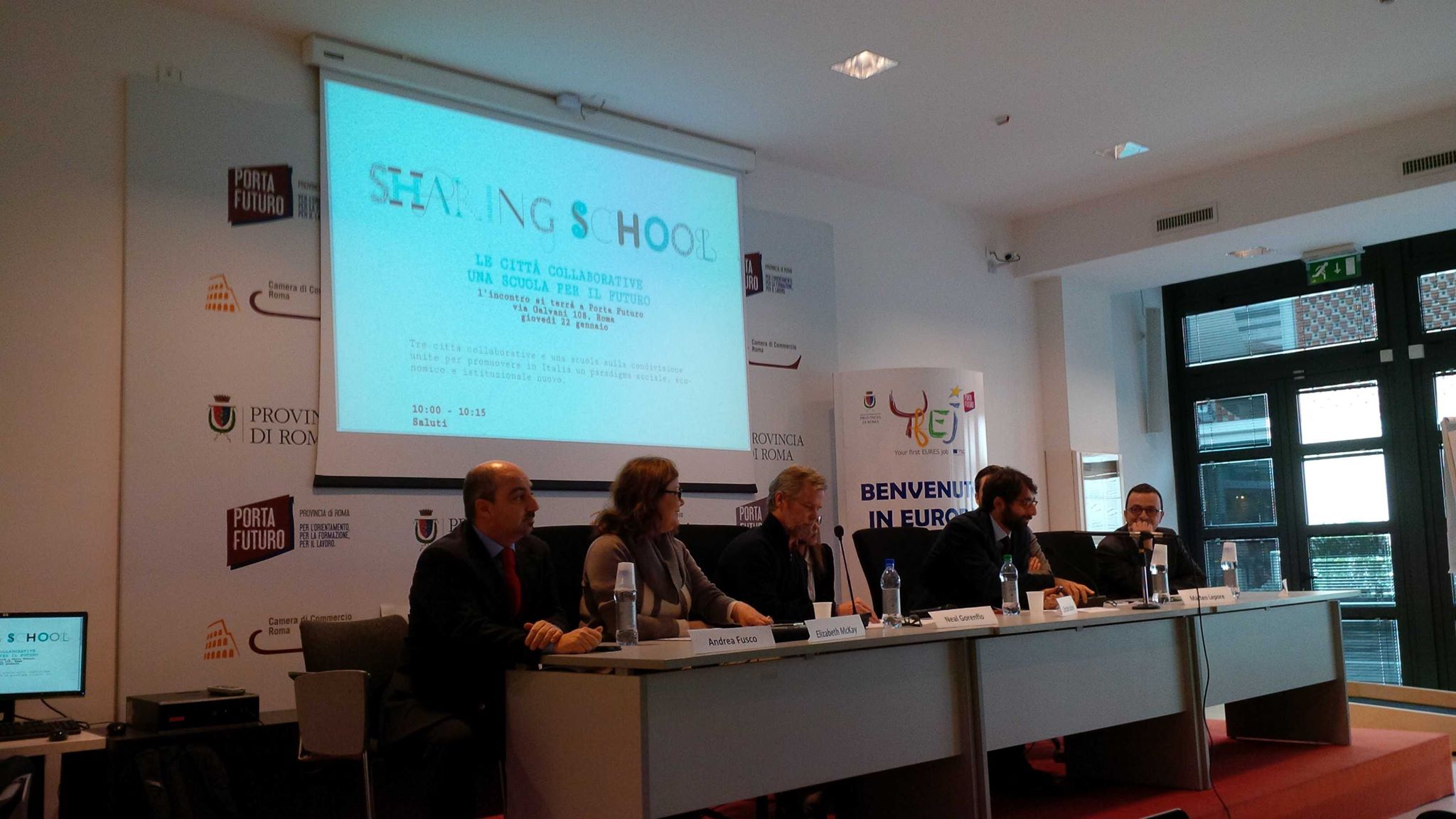
The sharing economy is growing faster than ever and becoming a hot policy issue these days. Casa Netural, Collaboriamo, RENA and LabGov have for this reason decided to launch the “Sharing School”. Thanks to the collaboration between these organizations and with the support of Ouishare, Avanzi and Societing, the School has been able to host highly qualified professionals and experienced innovators. The guest star of the event has been Neal Gorenflo from Shareable, an American leading organization in the field of sharing economy and collaborative practices.
The event held in Rome at Porta Futuro, had the main objective of dealing with the mainstream tendency of sharing economy and to understand if such trend can become the leading paradigm of the new economy. Andrea Fusco, Director of Department III – Services for placement and quality of life of the Province of Rome, the future Metropolitan City, was very happy to host the Sharing School initiative.
Minister Counselor for Public Affairs of the US Embassy in Italy Elizabeth McKay, reminded how the sharing economy has already changed things; it is no longer a new phenomenon and thanks to technological interactions and social media, we are exploring a potential that can disrupt traditional forces. Customers become service providers themselves, acting as catalysts for phasing into the system resources and goods that are normally not exploited.
We were used to think about sharing economy as some “nerd stuffs”, while nowadays there is a sort of “media bulimia” that affect the topic of sharing economy – says Francesco Russo, President of RENA. It is undeniable that we are assisting to a growing tendency of the concept of collaboration, as we simply trust strangers. However, the problem is that we shall distinguish what sharing is really about, and that is the aim of the Sharing School. There is a paradigmatic change of society and in the next future, 40% of the online staffing will be served through services provided by the sharing economy. Then, the approach of the initiative is not only about telling the story of a new economic trend.
As Neal Gorenflo recognizes, we are all here to learn how to gather people and create a common homogeneous vision about the sharing economy. But here we encounter obstacles, since we need to dissolve the gap between trans-formational economy and trans-action sharing, which basically maintains social hierarchies. Neal Gorenflo talked about making a choice between the red pill and blue pill like in The Matrix movie. The blue pill is a story about the re-adaptation of the old capitalist paradigm to the new economic trends, where Uber and AirBnB are the concrete examples of how initiatives of such strand of the sharing economy can still create monopolies. On the other hand, the red pill is the one that inspired our research. It is about the resurgent collaborative experimentation and it is what can wake up reality. We need to open cities, to make them available for use and to activate citizens by creating an economy “by and for” the people. We need to invest on transformational sharing much rather than transactional sharing.
However, as Matteo Lepore – Commissioner to Economy, Development of the City, Tourism, International Relations and Digital Agenda of the City of Bologna – underlined, if we talk about social order and sharing economy, we are inevitably bound to themes such as politics, democracy and participation. In fact, even taking the red pill has the risk of initiating a debate between citizens and the political representation. It is all about a systemic change, otherwise there would be no way back from the loss of collaboration between citizens and institutions. Step by step, we are loosing the sense of citizenship, by projecting a vision of citizens as the residual assets of society. Fortunately, the City of Bologna was able to initiate a process of human capital reactivation, thanks to the implementation of the “Bologna Regulation on public collaboration for urban commons” that seeks to transform the Public Administration in an enabling factor. The City of Bologna is thus a starting point for understanding how collaborative practices can rehabilitate citizens and regenerate urban networks, for instance with the instrument of the “pact of collaboration“. The underlying idea is that important results can only be achieved through effective practices of co-working, which involve citizens and professionals through a platform of mutual exchange of skills and knowledge.
Starting from the community to build competences and deliver effective results on the territory is also the strategy of the City of Milan , says Renato Galliano, Director of Smart City Service in Milan. We have to recognize that it exists a network of collaborative urban cities, which is itself a new form of infrastructure. This is the confirmation that collaborative economy is not only about isolated and scattered projects of mobility sharing, start-ups and civic crowdfunding. The social innovation entails a renaissance of the cities in a wider context, whereas citizens are the locomotives of change and public administrations are the habilitating infrastructure.
As Christian Iaione, Coordinator of LabGov, reminded we have to reinforce the processes of active citizenship and active entrepreneurship, to foster a steady dialogue between the five actors of collaborative governance and to create an “Italian way” to sharing. Indeed, the real sharing is centered on the restitution of value to the community. This is a good opportunity also for the City of Rome. Daniela Patti – from the staff of the Comminisioner to the Urban Transformation in Rome – affirmed that we need to create a network of collaborative cities, to develop instruments to regenerate abandoned urban spaces and to consolidate practices for exploiting the latent potential of the great cultural heritage.
Alex Giordano (Societing and Rural Hub) warned against the dysfunctions that an incorrect practice of sharing economy can create. In this sense, we should not only focus on the quantitative approach and upon capitalist mechanisms. It is in fact essential to reason on communities and social impact. If we have a look at territorial distributions, it is possible to notice how people are divided by interests and have lost the sense and ethic of community building. Fortunately there are breeding grounds of innovation that create value, even if their outreach is limited by disabling institutional leaderships. The problem is that those who have the courage to produce social innovation are constantly marginalized, as Simone Cicero of Ouishare, noticed. Even Enrico Parisio, of Coworking Millepiani says that we need to express such new exigency, as a pedagogic stimulus for social innovation. When we started talking about sharing economy, nobody believed it could be real, reminds Ivan Fadini of Impact Hub Roma. For this reason we are strongly committed today on avoiding the reiteration of traditional economic capitalism.
The commoners will be the heroes of social innovation.
Stay united!
– – – – – – – – – – – – – – – – – – – – – – –
Presentata a Roma la prima edizione della Sharing School.
Si è tenuto il 22 gennaio 2015 l’evento di presentazione della Sharing School di Matera, la prima scuola sulla sharing economy e sulla condivisione per promuovere in Italia un nuovo paradigma sociale, economico e istituzionale. L’incontro, ospitato da Porta Futuro e reso possibile grazie alla collaborazione tra Casa Netural, RENA, Collaboriamo e LabGov, con il supporto di Avanzi, OuiShare e Societing, ha visto la partecipazione, grazie al supporto dell’Ambasciata americana in Italia, di Neal Gorenflo co-fondatore di Shareable.
L’evento, incentrato su temi dell’ economia collaborativa e innovazione sociale, ha rappresentato un importante punto d’incontro tra ospiti internazionali, attori istituzionali, accademici e società civile. Se si vuole sviluppare un nuovo concetto di economia, è necessario rivedere gli orizzonti sociali e promuovere spazi innovativi di collaborazione. E’ in un contesto di inclusione sociale e di promozione della cittadinanza attiva che la sharing economy deve prendere piede perché, come ricorda Neal Gorenflo, le persone devono rappresentare lo snodo per un’economia collaborativa.
Dobbiamo cominciare a comprendere come l’implementazione di un modello di governance condivisa non ruba potere alle amministrazioni, semmai ne rinvigorisce la struttura e la riempie di nuovi contenuti. Per questo il prof. Christian Iaione, coordinatore di LabGov, invita a pensare all’economia come un bene comune che possa essere curato e messo a punto con interventi di animazione da parte di tutti quei soggetti coinvolti nell’ambito della sharing economy, inclusi i cittadini.

by Leonardo Rossi | Jan 16, 2015 | The Urban Media Lab

A study made by the McAfee Company established that the value of our “digital goods” usually value around 35000$ total: the most valuable ones are the “personal memories” like photos or videos (17000$), followed by “health and financial informations” (6000$), “personal informations” (4300$) and informations regarding “hobbies and projects” (3300$).
This entire set of valuable information usually get lost after the passing of a person, and the law find it difficult to create a proper regulation about this problem, since most of the times the owner of the servers that possess such information are located in another country, and so they answers to a different set of norms.
For this reasons the Notariato Italiano, along with Bocconi University, Microsoft and Google, made a roundtable in order to try to create a worldwide protocol that might facilitate the access and the use of personal information by the heirs of a death person. The notaries are ready to act as a trait-d’union between the citizens and the web operators in this possible scenario, in order to reduce the administrative procedures and the costs. This Italian solution is likely to be a trigger event at a European level.
The same concept is also fitting in a various set of different situations; this is the perfect example of sharing the knowledge, the skills and the expertise in order to create a better synergy for living a modern city.
————
Quando una persona muore, che fine fanno i suoi ricordi digitali e le informazioni personali e finanziarie che conservava su dispositivi elettronici, profili social e sul cloud? Questo topic è stato discusso di recente in un convegno, tenutosi a Milano, del Center on International Markets, Money and Regulation dell’Università Bocconi con il Consiglio Nazionale del Notariato.
by Elena De Nictolis | Dec 18, 2014 | Commons Press, Governance labs

The City of Bologna has just adopted the translation prepared by 2013/2014 LabGov interns as the official English version of the Bologna Regulation on public collaboration between citizens and the city for the care and regeneration of urban commons. The official English version of the Regulation is available here.
LabGov interns participated actively to “La città come bene comune” (i.e. “The city as a commons“) project in Bologna, carrying out research activities, training programs and co-design sessions. One of LabGov strategists, Christian Iaione, was also a key member of the working group which drafted the “Regolamento sulla collaborazione per la cura e rigenerazione dei beni comuni urbani” of the Comune di Bologna.
According to the regulation active citizens (i.e. social innovators, entrepreneurs, civil society organizations and knowledge institutions willing to work in the general interest) can enter into a co-design process with the city leading to the signing of a “patto di collaborazione per la cura o rigenerazione dei beni comuni urbani“. Urban commons are mainly public spaces, urban green spaces and abandoned buildings or areas.
Using the institutional technology of public collaboration (i.e. “co-progettazione” or “amministrazione condivisa“) Italian cities and communities can transplant Elinor Ostrom‘s idea of “governance dei beni comuni” (i.e. “governance of the commons”) in urban contexts, as Sheila Foster has already theorized.
The regulation is at the same time a form of social innovation enabling tool and fosters the birth of collaborative economy or sharing economy ventures. Indeed the regulation has dedicated specific articles to “innovazione sociale e servizi collaborativi“, “creatività urbana” and “innovazione digitale“. As a matter of fact social innovation and collaborative services, urban creativity, digital innovation must be the centerpiece of a “sharing city” or “collaborative city“, which is by default a commons-oriented city and therefore a co-city.
Last, “public collaboration” is centered upon the use of bottom-up or collaborative “nudge” or “nudging” techniques and “service design” techniques. Indeed, the regulation strengthens the importance of information/communication tools, training and educational initiatives, facilitation activities, as much as the need for measuring and evaluating the impact of the regulation and collaboration pacts or initiatives activated under the umbrella of the regulation.
by Christian Iaione | Nov 27, 2014 | Commons Press, Governance labs, The Urban Media Lab
In Mantua what can become a “Co-Cities” movement moved its first steps.
CO-cities as a new urban and local governance model
Co-Mantova is a prototype of an institutionalizing process to run cities as a collaborative commons (see Jeremy Rifkin‘s definition) and therefore as “co-cities“. Co-cities should be based on collaborative governance of the commons (inspired by Elinor Ostrom‘s work) whereby urban, environmental, cultural, knowledge and digital commons are co-managed by the five actors of the collaborative governance – social innovators (i.e. active citizens, makers, digital innovators, urban regenerators, rurban innovators, etc.), public authorities, businesses, civil society organizations, knowledge institutions (i.e. schools, universities, cultural academies, etc.) – through an institutionalized public-private-people/community partnership. This partnership will give birth to a local p2p physical, digital and institutional platform with three main aims: living together (collaborative services), growing together (co-ventures), making together (co-production). The project is supported by the local Chamber of Commerce, the City, the Province, local ONGs, SMEs and knowledge institutions, such as the Mantua University Foundation and some local schools.
CO-Mantova builds on the experience developed by LabGov through the “City as a Commons“ project and the “Regolamento sulla collaborazione per i beni comuni urbani” (i.e. Regulation on collaboration for Urban Commons which greatly benefited from Sheila Foster’s work on urban commons) that LabGov contributed to draft for the City of Bologna at the end of that project. Principles and rules embedded in the regulation inspired the drafting of the CO-Mantova Collaborative Governance Pact (which is soon going to be translated into English), a “patto di collaborazione” for the territory.
Methodological process of creation of Co-Mantova as a co-city
The first action has been seeding social innovation through the launch of ideas seeding call “Culture as a commons” to make the social innovators in Mantua emerge. Second step has been the co-design laboratory “Enterprises for the Commons“, an ideas camp where the seven main projects emerged through the call were cultivated and helped create synergies with each other and the city. The third phase has been the governance camp, a collaborative governance scheme prototyping stage which led to the drafting of the collaborative governance pact, the collaboration toolkit and the sustainability plan. Fourth and final phase is the governance testing and modeling through the launch of a public consultation in the city on the text of the Pact and a roadshow generating interest in CO-Mantova among possible signatories belonging to the 5 categories of collaborative governance actors.
The code of the Pact
The CO-Mantova Collaborative Governance Pact provides a code of definitions, values and principles:
Definitions contemplated by the Pact are among other:
– “commons”
“Commons are goods, tangible, intangible and digital, that citizens and the Administration, also through participative and deliberative procedures, recognize to be functional to the individual and collective wellbeing, activating themselves towards them pursuant to article 118, par. 4, of the Italian Constitution, to share the responsibility with the Administration to cure or regenerate them in order to improve their public use[1]”
– “social innovation”
“social innovations are new ideas (products, services and models) that simultaneously meet social needs (more effectively than alternatives) and create new social relationships or collaborations[2]”;
– “collaborative governance of the commons”
“collaborative governance” of the commons is a legal/institutional device whereby the five actors of the collaborative governance – social innovators, public authorities, businesses, civil society organizations, knowledge institutions – co-manage urban, environmental, cultural, knowledge and digital commons of a city through an institutionalized public-private-people/community partnership.
Values and principles of the Pact are:
– Mutual trust: based on the public prerogatives regarding supervision, planning and control, the Administration and the active citizens shape their relationships to the mutual trust and they presuppose that the respective will of collaboration is oriented to the pursuit of purposes of general interest;
– Publicity and transparency: the Administration guarantees the largest knowledge of the partnership opportunities, of the proposals received, of the forms of aid assigned, of the decisions taken, of the results and of the valuations made. It recognizes in the transparency the main tool to ensure fairness in the relationship with the active citizens and verifiability of the actions made and the results obtained;
– Responsibility: the Administration values its responsibility and the citizens’ responsibility as a key factor in the relationship with the citizens, as well as a necessary prerequisite in order for the partnership to be effectively oriented to the production of useful and measurable outcomes;
– Inclusiveness and openness: the interventions of care and regeneration of the commons must be organized in order to allow any interested citizens to join the activities at any time;
– Sustainability: the Administration, in the exercise of discretion in making decisions, verifies that the collaboration with citizens does not cause greater costs than benefits, and that it does not determine negative consequences on the environmental equilibrium;
– Proportionality: the Administration ensure that the administrative requirements, the guarantees and the quality standards required for the proposal, the preliminary investigation and the execution of the collaborative interventions, are commensurate with the real needs of protection of the public interests involved;
– Adequacy and differentiation: the forms of collaboration among citizens and the Administration are adequate to the needs of care and regeneration of the urban commons and they are differentiated depending on the type or on the nature of the urban common and on the people whose well-being it is functional to;
– Informality: the Administration demands that the partnership with the citizens takes place in accordance with the requested formalities only when it is provided for by law. In the rest of the cases it ensures flexibility and simplicity in the relationship, as long as it is possible to guarantee the respect of the public ethic, as it is regulated by the code of conduct of the public sector employees, and the respect of the principles of impartiality, efficiency, transparency and judicial certainty;
– Local democracy: the pact guarantees equality between parties and subscribers and the attribution of reciprocal rights and duties. The pact pursues the improvement of the quality of local democracy;
– Public autonomy: the pact signatories act as “public actors”, holding the ability to take care of the general interest;
– Horizontal subsidiarity: the pact was made possible thanks to the participation of all the parties, which got activated in a collaborative and mutually supportive way, even delegating specific functions if acquitted by others more effectively, in the pursuit of the common good. According to this principle the care of collective needs and the activities of general interest are provided directly by private citizens (both as individuals and as members) and the entities involved in ‘subsidiary’ function, programming, coordinating and possibly managing;
– Legality: the compliance with the principles and rules dictated or accepted in the legal system is the cornerstone on which the entry and stay in the pact is based. The law is intended not only as a means of guarantee for civil coexistence within and outside of the pact, but also as a fundamental tool of cultivation of social cohesion and competitiveness of the territory.
Internal and external governance
Beyond the pact, CO-Mantova led to two governance outputs. One is the Pact itself as an external governance tool that whoever wants to join the Pact has to agree upon. The other is the creation of a Collaboration Handbook or Toolkit overseeing the day-by-day collaborative life within the Pact. In general terms, the actors of Co-Mantova are going to be divided in three groups; social innovators, the technical unit, and the collaboration community. The collaboration toolkit of Co-Mantova is a fundamental instrument to shape the collaborative process among the actors. Some of the contents of the collaboration toolkit are, for instance, rules to inform the collaboration among social innovators (meeting with community and creative youth, citizen’s involvement, new members, personalised pacts), rules for the use of Co-Mantova as a physical and economic collaborative services platform, rules of collaboration for partners and external entities.
Sustainability plan
Another outputs of the co-design process that led to the creation of CO-Mantova is the sustainability plan, realized in order to ensure to the platform Co-Mantova a long-term financial and economic sustainability. From a first analysis of data we can say that even the Mantua area is affected by the same peculiarities of the Italian system, in the presence of a high number of SMEs, but unlike the Italian trend, these SMEs, account for a larger proportion of working population. On the one hand, this could make it more vulnerable to the business system of Mantua, because the population involved in the instability of these companies is representative of a greater number of people than the national average. On the other hand this morphology of the business system is a feature that could be maximized through networking and collaboration tools, such as the initiative to CO-Mantova aims to do.
Communication Plan
The last outcome springing out of co-design process that led to the creation of CO-Mantova is the communication Plan. CO-Mantova.it website is the centerpiece. So is the public consultation process we launched on the whole CO-Mantova process/pact and all other initiatives on the ground and through traditional and social media that CO-Mantova has carried out so far and will be carrying out in the next future.
Stay tuned, participate and join in CO-Mantova and the co-cities movement (email to staff@labgov.it)!
[1] The definition of urban commons is provided by the “Bologna Regulation on collaboration between citizens and the city for the cure and regeneration of urban commons“.
[2] Murray, Calulier-Grice and Mulgan, Open Book of Social Innovation, March 2010.

by Edoardo De Stefani | Jul 21, 2014 | EducationLabs
Social economy has become nowadays a fashionable argument within the panel of the public administration forum; indeed in time of cultural and social crisis, new paths for social innovation are to be fully explored.
It would be nonsense trying to define univocally what social innovation is and how it should be made, however it is possible to track a mainstream in terms of where the compass has to be set: this is the case of the new frontier of social cooperation, which entails the possibility to create a physical and digital hub whereas people work together exchanging ideas, projects, competencies and experimenting innovation as consequence of the autonomous initiatives.
In this sense we can talk about active citizenship, both in terms of liberal expression as well as a function for a renewed economic productivity.
Thus it seems that a structural revolution shall be started from below, as far as the bottom up approach is eventually able to capture the sensitivity of the urban spaces and people.
Again, the idea of creating a common co-working space is the best option to fit the needs of a socio-economic renovation.
The mounting sense is to design a meta-content for social enterprises, which could promote occupation, economic production and social equity and fairness.
The time for urban re-generation has come, so that building a strong network of active citizenship has become the unavoidable premise for social innovation.
Bearing in mind that the founding idea of social innovation is the creation of tangible areas whereby it could be possible to install ideas and incubate projects, we should focus our attention on the working laboratories and their typologies.
To this end, it is worth mentioning the FabLAb initiatives that are very active on the urban territories.
In particular the “Millepiani co-working space” in Rome (http://www.millepiani.eu) hosted an important event on 18/7/2014 to set the basis for launching a territorial network of FabLabs.
The event aimed at exchanging ideas, experiences, suggestions and reflections among those interprets of the social fabric in order to collect and express a common sentiment to the public administration.
The new politics of collaboration, whose basis is promoted within the “Lazio Creativo” planning, is currently providing funds for the development of cultural activities.
In parallel, the regional legislation of “Regione Sicilia” seems to be able to set a milestone in terms of institutional innovation, since it has started recognizing the value of social innovation and its capacity building both in terms of economic productivity or as a form of social inclusiveness.
However, the institutional apparatus is still anchored to a persistent fragmentation of the territories and to an uncertainty of the governance method.
Given all the uncertainties and concerns about the future of the social innovation, in terms of development of active hubs for citizens, the working group composed by the associations that attended the meeting has committed itself to investigate the following dynamics and themes:
1) Fundraising and accession criteria
2) Added value of the social enterprise
3) Governance method and redefinition of public space
4) Pact of collaboration with the public administration
5) Census of actors and activities
6) Real estate speculation
7) Political project – civic targeting- social dialogue
Stay tuned.


