
by Ornella Martinello | Apr 28, 2016 | The Urban Media Lab
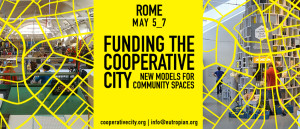 On May 5-7 Rome will host “Funding the Cooperative City. New models for community spaces“. The workshop is organized by Eutropian, a planning, policy and research organization helping urban regeneration processes, together with many institutional and private partners. The event aims at discovering new economic models for community-led urban development through experiences and initiatives from Italy and Europe.
Christian Iaione, LabGov founder and director, professor of Public Law at LUISS University, Rome and member of the International Association for the Study of the Commons, will intervene during the first session held on Thursday on “Community financing in collaboration with the Administration“, in dialogue with Stefania De Masi (Cascina Roccafranca, Turin), Annet van Otterloo (Afrikaanderwijk Cooperative, Rotterdam), Jeroen Laven (ZoHo – Stipo, Rotterdam), Massimo Allulli (Area Studi ANCI), Angelo Melpignano (WithYouWeDo Telecom Crowdfunding).
The next two day the two sessions will cover the following themes: “Self-organized financing and management of local resources” and “Workshop on territorial impact“.
Here is the program of the event.
More about Eutropian in our previous article.
—–
Dal 5 al 7 Maggio, Roma ospiterà “Funding the Cooperative City. New models for community spaces“, workshop organizzato da Eutropian al fine di scoprire, attraverso la condivisione di esperienze italiane ed europee, nuovi modelli economici che sostengano lo sviluppo urbano ad opera della comunità.
Qui il programma dell’evento.

by Benedetta Gillio | Apr 27, 2016 | The Urban Media Lab
 Habitat III is the United Nations Conference on Housing and Sustainable Urban Development, taking place in Quito, Ecuador, 17–20 October 2016.
In the Prague conference the discussions covered various topics, and in the Prague declaration they noted the importance of promoting:
- Innovative and productive cities.
- Green, compact, resource efficient and resilient cities.
- Inclusive and safe cities.
- Good urban governance.
They point out a need to plan and manage urban areas through the cooperation of national governments with regional and local authorities and communities with established coordination mechanism. Cities need to be enabled and empowered in order to be key actors in the implementation of sustainable urban development based on the principles of sustainable development. Citizens should be involved and consulted in a well-designed system of multi-level governance. There is also a need to assure compliance to legal requirements by independent institutions acting in land governance, land registration. International cooperation and exchanges between national, regional and local authorities can promote sustainable economic development, social and environment protection. Social cohesion, better access to services, urban safety. Long term and non-speculative, risk informed investments in housing and urban development can stimulate employment in cities. Resource efficiency and promoting sustainable consumption and production patterns are critical elements for cities to manage growth, increase resource productivity, and decouple economic growth from increased resource use and its environmental impact. Efforts to protect and safeguard the cultural and natural heritage. Promote economic development and job creation.
The following step was Barcelona where the main topic was public spaces. From the Barcelona Declaration came out that:
- Human rights are a key to advancing and developing an urbanization that is sustainable and socially inclusive, that promotes equality, combats discrimination in all its forms and empowers individuals and communities.
- The Right to the City is a new paradigm that provides an alternative framework to re-think cities and urbanization.
- There is a need to preserve the character and quality of existing historical public areas, in order to promote and to transmit heritage to the future generations; improve existing public areas in central and peripheral parts of the city, in order to upgrade their quality and foster the sense of belonging of the communities; design new public spaces in built areas and in new urban expansions, to increase the quality of life of the inhabitants and strengthen social stability.
They focus on public spaces because in an even more urbanized world, the right to the city must be guaranteed to the people who share the urban space today and to the coming generations who are going to inherit it tomorrow. In order for the public space to respond to its true purpose and be at the service of the people and achieve the democratization of our cities, it should be tackled from an integrated logic which goes beyond its own physical boundaries and address fundamental dimensions such as 1) “Agora” (its social and political dimension), 2) Mobility, 3) Economy, 4) Housing.
- AGORA (social and political dimension)
- Accessibility and inclusivity
- Versatility
- Quality design, environmental and human scale
- Distribution and integration
- Recreation and health
- Cultural and political expression
- Conflict resolution and cohabitation
- Governance
- ECONOMY
- Sustainability and democratic control of basic urban supplies and waste
- Balance production of wealth and responsible consumption
- MOBILITY
- Change of paradigm towards a Post-Car-City
- Fostering walkability and bike use on a more human public space
- Implementing democratic and sustainable of public transport networks
- HOUSING
- Right to adequate housing
- Social function of land, property and city
- Housing policies and tools
After Barcelona the meeting moved to Pretoria. There the main topic was “Informal Settlements”. Informal settlements are a global urban phenomenon. They exist in urban contexts all over the world, in various forms and typologies, dimensions, locations. While urban informality is more present in cities in developing countries, housing informality and substandard living conditions can also be found in developed countries. The continued existence of informal settlements is directly linked to the persistence of poverty and inequality, distorted land markets, excluding people from decent work and livelihood to attain individual and collective progress and prosperity. Informal settlements are caused by a range of interrelated factors: population growth and rural to urban and international migration, poverty, basic service deficits, poor governance and policy frameworks, limited access to financial markets, land and property. People living in informal settlements are particularly vulnerable to spatial, social, and economic inequalities, dependence on precarious income generation and livelihoods, poor health as well as lack of affordable housing, high vulnerability to the adverse impacts of poor and exposed environments, climate change, and natural disasters. Exclusion, discrimination and marginalisation characterize the life in informal settlements which is exacerbated by displacements, including the one caused by conflict, crisis, natural disasters and climate change.
The recently adopted Agenda 2030 for sustainable development and especially a new transformative urban agenda will have to address the above challenges taking stock of the shortcomings and achievements of the previous development frameworks and approaches.
This process is aimed at producing the New Urban Agenda composed of 22 issue papers about housing and sustainable urban development. Smart technologies and urban governance are new models of participation with social media.
————————————————————————–
Habitat III è la Conferenza delle Nazioni Unite sui temi di housing e sustainable urban development che si terrà a Quito in Ecuador in Ottobre 2016. Nella conferenza di Praga i temi evidenziati, che fanno da filo conduttore, sono: città innovative e produttive; il verde pubblico e le città resilienti; città inclusive e sicure; buona governance urbana. Fondamentale il tema della cooperazione tra i cittadini e i governi nazionali, regionali e locali. Praga è solo una delle numerose tappe di questo processo che porteranno alla conferenza di Quito.

by Chiara Fratalia | Apr 27, 2016 | The Urban Media Lab

LabGov with professor Christian Iaione will take part in the next IASC conference!
The 4th European Regional Meeting of IASC will have place in Bern from the 10th to the 13th May with the following subject: “Commons in a ‘glocal’ world: global connections and local responses”. IASC (International Association for the Study of the Commons) was founded in 1989 to bring together multi-disciplinary researchers and policymakers, with the purpose of advancing the understanding and improving governance of common-pool resources.
This conference main goal is to provide a space to debate on the ongoing “glocal” processes, which are often not yet addressed in a systematic way. The conference aims at debating the impacts of external changes on the perception and evaluation of resources by actors related to the commons, and thus affecting the access to common-pool resources.
Since the importance of the conference subject, LabGov has decided to participate by submitting a paper in the B20 panel, which would like to examine the concept of Smart Cities in India, and contrast it with the advances that other countries made in redefining their concepts of urban commons.
The paper submitted by prof. Iaione, with the title “The Sharing, Collaborative, Cooperative City”, will be discussed within its panel on Wednesday 11th May. This paper aims at examining the concept of design elements of a smart city from people’s perspective, while generating a significant body of comparative empirical knowledge about sharing economies and their governance within global cities.
The conference will entirely take place in the Social Anthropology Institute of the University of Bern.
_________________________________
LabGov a Berna per discutere di beni comuni. Il coordinatore del gruppo, il prof. Christian Iaione, è autore di un paper che sarà discusso all’interno della Conferenza Regionale Europea di IASC, che si terrà a Berna tra il 10 e il 13 maggio. La conferenza ha lo scopo di analizzare come i processi “glocal” del nostro tempo influenzino la percezione e dunque la gestione dei beni comuni.

by Ornella Martinello | Apr 18, 2016 | The Urban Media Lab
As two thirds of Europeans live in urban areas, the latter have become the core of both institutional relations and economic activities. By carrying out almost 55% of public investments, cities are inescapably fore-front players at different political dimensions. Faced by increasingly more complex issues – from urban poverty and social exclusion to environmental protection and action against climate change -, they represent the locus where challenges arise but also where innovative solutions bloom.
More and more, communities, local authorities, national governments are developing their awareness about the role and importance that the city plays nowadays.
As stated in “Cities of tomorrow“, an EC report published in 2011, cities are and must be “centres of creativity and entrepreneurship, in short: a bundle of opportunities”.
As a matter of fact, to date, little has been achieved in order to sponsor and support a thorough coordination of actions between different levels of governance that should involve cities, States and the European Union in a tangled matrix.
The European Union took on the mission to support the formulation of a coherent EU Urban Agenda through the Riga Declaration of June 2015, in an attempt to foster bottom-up, inclusive and participatory forms of implementation of its social and economic policies.
Most recently, urban governance has been adopted by the Dutch Presidency of the Council of the European Union as one of its top priorities for the first half of 2016. Ultimately, by the end of May, Member States will adopt the Amsterdam Pact that will finally give to the EU its new Urban Agenda.
Despite the fact that it is the outcome of a large-scale effort to an open dialogue involving stakeholders in its formulation, the new document will represent only half of the puzzle.
In other words, the reform of the city as we all knew it must be the outcome of a two-fold, concerted approach that mixes top-down and bottom-up instances.
An EU eager to recognize the importance of the city as the crux of policy implementation indeed represents a big achievement. However, this must be complemented by the promotion of local processes aimed at rebuilding the meaning of “citizenship” at the neighbourhood and city level.
Betting on urban governance means contributing to a new, responsible and inclusive political culture, making citizens’ participation and active cooperation with both private and public sectors structural features of a new form of governance.
Current institutional settings are still inappropriate to embrace the structural, qualitative transformation that such an ambitious idea entails.
A need-based, integrated, cross-sectorial approach built on creative processes and social innovative projects is necessary to start an urban revolution from the bottom.
As a forerunner of participatory forms of governance of the commons, LabGov is extremely open to dialogue with other stakeholders.
That is the reason why we will be in Amsterdam on the 19th of April on the occasion of the conference “The Commons and the Principle of Equality“. The event is part of the “New Amsterdam –City in Transition” series, organized by Pakhius de Zwiger with the ambitious goal to “inform, inspire and debate” on the role of the city within the context of the transition to a society more sustainable, inclusive and capable to face today complex challenges.

Amsterdam has become the capital of the urban revolution in Europe. We were there in February (here the post) to give a contribution to the above-mentioned EU Urban Agenda.
This time we will share our experience on the “bottom-up” side of the urban coin, illustrating how grassroots cooperative projects enable citizens to create their own cities collectively by taking care of the commons and developing a new social culture.
Tine de Moor, Professor of “Institutions for Collective Action in Historical Perspective” at Utrecht University, will open the conference with a lecture on the commons and the sharing economy. Christian Iaione, Professor of Public Law, Director of the Laboratory for the Governance of the Commons, LUISS Roma and member of the International Association for the Study of the Commons, will make a link between the commons and the principle of equality, trying to detect whether it has to be redesigned and whether the governance of the commons can be seen as a new regime for equality and access to resources.
For further details click here.
—–
Amsterdam, capitale delle rivoluzione urbana in atto in Europa, accoglierà domani la conferenza “The Commons and the Principle of Equality“, il quarto incontro della serie “New Amsterdam –City in Transition” organizzata da Pakhius de Zwiger. Informiamo, ispiriamo, dialoghiamo!

by Diletta Di Marco | Mar 18, 2016 | The Urban Media Lab
COST (European Cooperation in Science and Technology) is Europe’s longest-running intergovernmental framework for cooperation in science and technology funding cooperative scientific projects called ‘COST Actions’. With a successful history of implementing scientific networking projects for over 40 years, COST offers scientists the opportunity to embark upon bottom-up, multidisciplinary and collaborative networks across all science and technology domains. They have also enabled the creation of entirely new types of ‘digital’ or ‘virtual’ labour, both paid and unpaid, shifting the borderline between ‘play’ and ‘work’ and creating new types of unpaid labour connected with the consumption and co-creation of goods and services. This affects private life as well as transforming the nature of work and people experience the impacts differently depending on their gender, their age, where they live and what work they do.
Aspects of these changes have been studied separately by many different academic experts including sociologists, economists, geographers, political scientists, psychologists, organisational theorists and people working in such diverse fields as gender studies, management, innovation, development studies and industrial relations.With funding from the European Science Foundation’s COST programme, this Action brings together researchers from all these fields to compare results, survey the evidence and develop an understanding of how these changes in work take place and what their impacts are. The 7th Meeting of Working Groups will take place in Pavia from 21 to 22 March 2016 and Professor Christian Iaione will discuss a panel with the topic “Sharing economy: towards shared rules?” with Ivana Pais (Università Cattolica, Milan) and others speakers as Guido Smorto, (University of Palermo),Ursula Huws and Simon Joyce(University of Hertfordshire Business School) and Cristina Tajani(Municipality of Milan).
Here you can find all the programme: http://dynamicsofvirtualwork.com/wp-content/uploads/2015/12/Sharing-Economy-Panels-Programme2.pdf


 On May 5-7 Rome will host “Funding the Cooperative City. New models for community spaces“. The workshop is organized by Eutropian, a planning, policy and research organization helping urban regeneration processes, together with many institutional and private partners. The event aims at discovering new economic models for community-led urban development through experiences and initiatives from Italy and Europe.


