by Ornella Martinello | Apr 5, 2017 | The Urban Media Lab
On March 23rd-25th, LabGov took part in the Brussels Forum, the annual high-level meeting of the most influential North American and European political, corporate, and intellectual leaders aiming at addressing pressing challenges currently facing both sides of the Atlantic. Between the participants were heads of state, senior officials from the European Union institutions and the member states, U.S. Cabinet officials, Congressional representatives, Parliamentarians, academics, and media. The event offered the exceptional chance to share views on a wide array of themes, from the digital economy and social inclusion to the ability of nation states to retain democratic control over economic decision-making processes.

@Picture from GMF website
Brussels Forum is an international conference convening every year in March in Brussels, organized by the German Marshall Fund of the United States (GMF), a non-partisan American public policy and grant-making institution dedicated to promoting better understanding and cooperation between North America and Europe on transatlantic and global issues. Founded in 1972 through a gift from Germany as a permanent memorial to Marshall Plan assistance, GMF maintains a strong presence on both sides of the Atlantic. In addition to its headquarters in Washington, DC, GMF has six offices in Europe: Berlin, Paris, Brussels, Belgrade, Ankara, and Bucharest. GMF also has smaller representations in Bratislava, Turin, and Stockholm. GMF supports individuals and institutions working in the transatlantic sphere, by convening leaders and members of the policy and business communities, by contributing to research and analysis on transatlantic topics, and by providing exchange opportunities to foster renewed commitment to the transatlantic relationship. In addition, GMF supports a number of initiatives to strengthen democracies.
As a matter of fact, leaders on both sides of the Atlantic continue to deepen transatlantic cooperation on a vast array of distinctly new and global challenges, from the international financial crisis to the digital economy, democratic participation and the changing work market. Brussels Forum, this year in its 12th edition, has provided a venue for the transatlantic community to address these pressing issues. By bringing together leading politicians, thinkers, journalists, and business representatives, Brussels Forum helps shape a new transatlantic agenda that can adapt to changing global realities and new threats.
@Picture from GMF website
LabGov was present at the third panel titled “Inclusive Innovation: Can the Digital Economy Benefit Everyone?”. The background? The status of inequality perceived in both sides of the Atlantic.
“Inequality has been a major topic of transatlantic policy discourse for years. But despite the attention, statistics continue to show a rather dim outlook: the incomes of the top 1 percent in America are 38 times higher than those of the bottom 90 percent, while 9.8 percent of EU citizens are unemployed. Much of that unemployment is concentrated in countries like Greece, Spain, and Italy, whose economic situations have threatened to politically destabilize the Union in its entirety. The digital economy could provide a pathway toward achieving more inclusive and sustainable growth.”
Modarated by Ms Sylke Tempel, Editor-in-Chief of the Berlin Policy Journal, the discussion was enriched by the keynote speeches of the four high-level panelists: Ms. Caroline Atkinson, Head of Global Public Policy at Google; Mr. Robert Atkinson, President of the Information Technology and Innovation Foundation; Mr. Ambroise Fayolle, Vice- President of the European Investment Bank; and Dr. James Manyika, Director of the McKinsey Global Institute.
They tried to answer the following core questions:
- How can we ensure that all citizens are able to unlock the benefits of this new era?
- How do we need to change policy and investment approaches to ensure that people benefit from, recognize,and are better able to take advantage of the opportunities presented by the digital economy?
- Given the current political environment on both sides of the Atlantic, how can a transatlantic conversationaround innovation for inclusive growth benefit leaders in both public policy and the private sector?
As a matter of fact, “embracing technological innovation provides unprecedented opportunities for education, employment, showcasing talents, and making global connections, contributing to higher growth. Here, statistics provide a more optimistic outlook: SMEs that use the web to connect them to global markets experience 22 percent higher revenue growth than those that stay offline. However, despite policy doctrines and investment programs, too few structural changes have been implemented to deliver the type of transformative progress demanded by U.S. and European publics. As a result, political rhetoric increasingly seems to be reacting against the potential of technological progress and the promise of the digital economy, to the detriment of the publics, SME’s and effective public policy.”
Trade and innovation have lifted millions out of poverty, raising standards of living around the world. But the benefits of an increasingly interconnected and interdependent world have not been shared by all. An issue of democratic participation is on the table as the impacts of this unfair distribution eroded public trust in institutions and governments. Hence, public faith in the pillars of society has vanished. Here are a few insights on how participation, access and education can improve the democratization of innovation and technological development.
The Brussel Forum speeches can be found in streaming here: http://brussels.gmfus.org/videos/brussels-forum-2017-young-transatlantic-innovation-leaders-initiative-ytili- announcement
————————————————————–
Dal 23 al 25 marzo ha avuto luogo il Forum di Bruxelles, l’evento che ogni anno raduna leader politici, intellettuali, giornalisti e rappresentanti di grandi aziende europei e nord-americani con lo scopo di affrontare le complesse sfide che interessano entrambi i lati dell’Atlantico. In questa dodicesima edizione del forum i partecipanti si sono confrontati su importanti tematiche, dalla crisi finanziaria internazionale all’economia digitale, dalla democrazia partecipativa ai cambiamenti nel mercato globale.
LabGov ha assistito alla panel discussion “Inclusive Innovation: Can the Digital Economy Benefit Everyone?”. Durante la discussione diversi esperti si sono confrontati sul tema delle diseguaglianze e sulla necessità di trovare una nuova modalità di redistribuzione che consenta a tutti di godere dei benefici delle numerose innovazioni tecnologiche che caratterizzano la nostra epoca.

by Francesca Spigarolo | Apr 4, 2017 | The Urban Media Lab
A semiotic reading of the business incubation world, towards a model of collaborative incubation between small ecosystems.
This article originally appeared in Italian on Doppiozero.
Since a few years something interesting has been observed around the word “incubation”. Metaphorology scholars define it as “catachresis”. As happens (happened) to the Italian locution “la gamba del tavolo” (the table leg), we are dealing with a phenomenon where a metaphor settles itself in our language, moving from being a “tropo” to real language, so passing from being a rhetoric figure to an independent item included in dictionaries and encyclopaedias. The expression does not need any more to make different worlds communicate with each other (which is the main aim of the metaphors). In our days no one while saying “table leg” has the impression of being using a metaphor. In the same way, (almost) no one, speaking about “incubation”, really means to link the neonatology world to the start-up devices.
The word “incubation” has the power to create narrations so visionary and so relevant, but today it is living a saturation phase. There is enough space for a new way of business incubation, which could refill the hole created by lack of sense and activity in the world of support to the companies and that could go even further, opening new generations of modelling metaphors.
What is an incubator? According to the European Commission, during the 90’, was considered “incubator” a space where to concentrate services and support for the start-ups. Lately, at the beginning of the next decade, this definition already underwent a transformation. An incubator is not a space anymore but an organization, an activating subject, an accellerator, who provides services between which an incubation-space, services for supporting the business idea, network creations and opportunities. The definition even tells us that realizing a typology of incubators is possible with a preventive check of some broad variables: rules of employment and admission, functions and services, intensity of the supporting action. In the same report also appears a diagram that tries to make a topologic (in addition to a typologic) representation of the incubators:
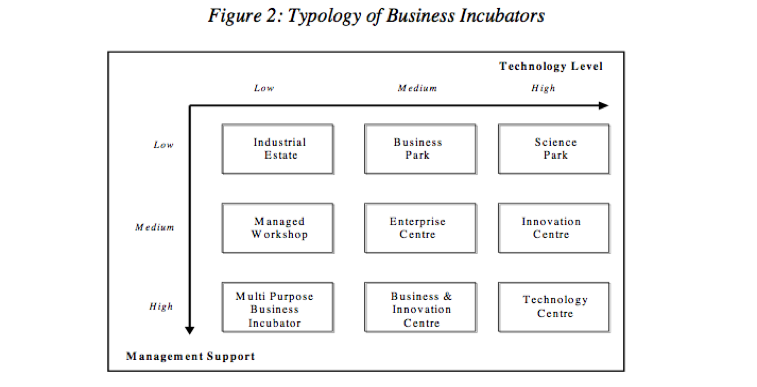
The two dimensions on which the map is constructed are the technological level and the management assistance. It means that the main features of the incubation, underlined by this source, are the financial support and the type of activity generated by the helped start up/s.
An important role is still played by the physical dimension of the “incubator” as a place, be it a park or a centre. In the following years, this word turned into an umbrella-term: it detached itself from the single activity to embrace a broader range of experiences, going from education to services providing, assistance, sponsor searching.
Back to the narrative sphere, “incubator” has an interesting oscillation of meaning, never taken afloat. Differently from what happens in the Italian language, where the word incubator is used both with a male and a female meaning, in the English one, the female acceptation doesn’t exist, making the word far from its bond with a maternal meaning.
The smart marketing is made of leading narrations: abstracts stories that deals with a complex system of values. An example of leading narration is the myth, which at the same time is general and peculiar. The myth, as all leading narrations, is so effective as it activates those values that represent the basis of a society. Myths are simplifications full of meaning. The narration that has been dominating during these years of fast development in the business support area is based on a kind of familiar relationship, as the one between father or mother and son, whose main feature is the support. In the paternal case, chronologically preceeding the second one, the support came out through the perspective of an economic remuneration; in the maternal one instead, through the physical take caring by giving spaces and other assets for the business development. It is as if we were saying (in this dominant and simplifying narrative) that the father gives a pocket money every month, while the mother takes care of the son. Both the parents make their sons depend on them for heir survival, in a kind of relationship one-to-one. As we can see, in the semiotic square standing downward (like a figurative Cartesian Diagram), in the upper axis are settled the two ruling logics, while in the lower one we find the logics of formation (quite totally paternal) and acceleration (quite totally maternal).
When we put in the diagram all the traditional incubation experiences, expression of the tension generated by these two values, we notice that there are more crowded sections contrasted by sections which are almost empty, and which could therefore be available for new players entering the market.
In all the experiences present in the diagram we observe the activation of a hierarchical relationship between the incubator and the incubated subject. Horizontal links are missing. In the open-innovation world, but generally in the collaboration sphere too, a more “collaborative” kind of narration can be discovered. In order to realize it we need a new leading narration, not based on parenting relationships anymore. In the main narration of traditional incubation, in fact, the collaborative logic brings to a negative competition (as between brothers). What we really need is a different logic, similar to the one that we have found studying the scientific communities, where collaborative platforms are already used in order to realize open innovation (in research), but ,moreover, that we have found during two years of considerations (shared between Kilowatt and Social Lab) developed thanks to the CoopUp Bologna experience.
In our experience (CoopUp Bologna as first experiment of community business incubation, ie. incubation ecosystem – our tribe) we noticed a different logic: more “tribal”, based on the construction of a practice and knowledge community, of a collaborative network, of tools for value distribution and creation, of opportunities for exchange, relationship and comparison, in a common growth perspective. To this, we want to dedicate the proposal of collaborative incubation, dedicated not to a single start-up but to ecosystems of new enterprises that are growing together (even together with already existing and structured companies). This proposal might not be suitable for all new businesses. Our experience is addressed in particular to the so-called cohesive companies, as defined by Domenico Sturabotti and Paolo Venturi, and in general to the startups with a “social vocation”, attentive to their impact and consequently not always feeling comfortable with a form of support that promotes a development model very different from that for which they – the new enterprises – have decided, in the first instance, to start a business.
It is possible and perhaps necessary to move from the familiar logic towards a collaborative logic: from the concept of family – dependence, to that tribe, where there is not a parent, but a chieftain – or a shaman – coordinating all (the community, the chain , etc.) and needing everyone to be independent but collaborative (and conscious), so that the whole community functions. The chieftain has to win the confidence of the community, which the parent is not required to do.
We must try to explore a new incubation narrative, starting from a new ecosystem model based on relationships, trust and community. We have grown too used (we catacresizzati) to import without reflecting models from outside, “in the periphery of the empire”, as it was common to say few decades ago. The economic and especially financial magnetism of the Silicon Valley has become a cultural values and entrepreneurial magnetism. Everyone’s commitment should be to recover a European and cooperative approach to the company support. It is specially for this reason that the tribe seems to us a narration which is worth exploring.
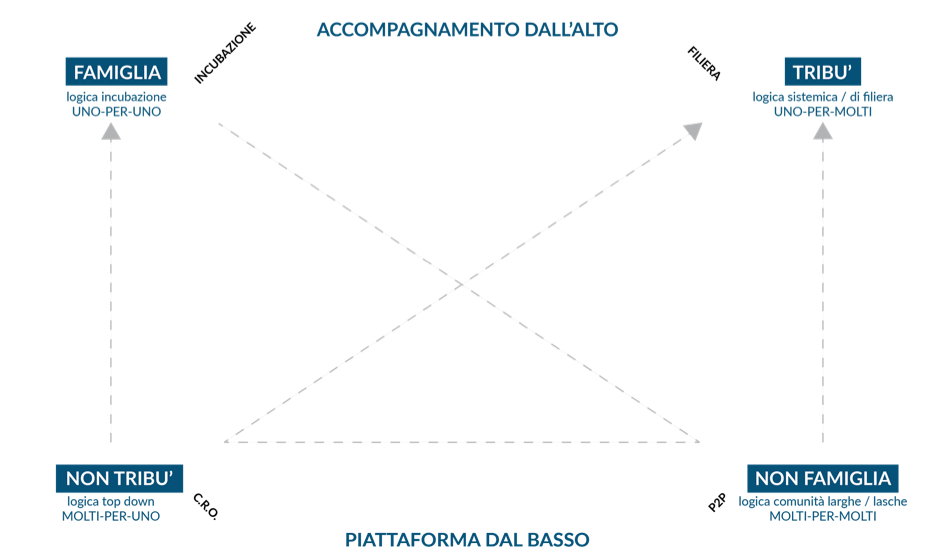
The ecosystem incubation square takes to hart the experiences developed in the last year in the open innovation field. It “contains” the traditional incubation square in the top-left corner, it displays open innovation in the bottom-left corner, the research and development and peer to peer experiences in the bottom-right corner and also leaves open an almost plain space in top-right corner. To say it differently: it is coming to maturity.
In the square of community incubation, in the collaborative and mutualistic ecosystem support, there is need of new figures. The first is a tribal chief, who brings into the system “soft” and interpersonal skills and tools of community organizing. He is in some ways shamanic: his relationships are based on a trust channel, he must be able to read the “health” of an entire community, he needs to know how to manage community-driven dynamics. He is able to go beyond the single sector and above all he knows how to manage in a participatory way the community engagement dynamics. Finally, he knows how not to create dependence on its presence.
But there is not only the head of the tribe, the shaman who knows how to have a systemic vision, the community ecosystem managers. There are also the “community leaders”, situational leaders that activate according to their own talents and skills: those who depending on the specific objective can activate and strengthen the accountability of the entire ecosystem. In open innovation there can be large organizations who work as flying start, which signal a need for innovation that can then activate different collective growth experiences. But also, communities and informal groups, pushed by intense motivation, competence, talent.
The tribe operates as a system in which cooperation prevails over competition. The tribal chief maintains the vision and is able to measure out the roles of the community participants. In the semiotic square of collaborative incubation it is important to firstly populate the team of interlocutors who accept the challenge to co-manage their role as community leaders. We are in an almost-smooth space, more rhizomic that hierarchical, where wit is more important to know how to manage relationships than how to defend positions. “In the smooth […] the points are subordinated to the journey”, was said in Mille plateaux of Deleuze and Guattari. A common journey.
————————————————–
In questo articolo, originariamente pubblicato su Doppiozero, Gaspare Caliri propone una lettura semiotica del mondo dell’incubazione d’impresa e ripercorre la storia del termine “incubazione”, nato come una metafora ed ormai entrato nei nostri dizionari.
“È necessario provare a esplorare una nuova narrazione dell’incubazione, partendo da un nuovo modello di ecosistema basato sulla relazione, sulla fiducia e sulla comunità”

by Francesca Spigarolo | Mar 30, 2017 | The Urban Media Lab
On Friday the 31st of March 2017, the city of Turin will host an event to launch the project Co-City, developed by ANCI, the City of Turin, Turin University, FirstLife and Rete delle case di Quartiere.
The Co-City project, developed within the framework of the European program Urban Innovative Action (UIA), aims at experimenting innovative solutions to regenerate abandoned spaces or/and structures and to fight urban poverty in the most problematic areas of the city. The city will favor the creation of collaboration pacts between different urban actors, and it will stimulate a dialogue at the city level but also at national and European level with universities, innovators, private actors, institutions and members of the civil society.
The launch of the project will be an occasion to present the actions that will be developed in the city, and also to discuss the state of the art of the commons at national and international level. Numerous actors engaged in the field of urban regeneration and innovation will take part to the debate, enriching the discussion with examples coming from Athens (SynAthina), Amsterdam (Pakhuis De Zwjiger), Barcelona (project UIA), Lisbon (BipZip) Milan, Reggio Emilia and Bologna.

The event will begin at 10am, with the institutional greetings from the deputy major Guido Montanari and from the Turin University Dean Gianmaria Ajani, followed by the presentation and discussion of the experiences and studies of several experts. Then, the Co-City project itself will be presented, and afterwards some cities will share their own experience regarding the governance of urban commons. The speech of Marco Giusta, Assessor to the coordination of policies for multiculturalism and integration of the new citizens of Turin, will conclude the event. Afterwards the participants will be invited to take part in an Aperitivo, an occasion to continue the conversation in a more informal setting.
The event will certainly be an interesting occasion to discuss about urban commons and about their strategic role in shaping the future of our cities. More information on Co-City launch event are available here.
—————————————————————
Nella giornata di venerdì 31 Marzo, nella città di Torino presso l’ex Incet, si terrà l’evento di lancio del progetto Co-City, vincitore insieme ad altre 18 città del bando Urban Innovative Action (UIA).
Il progetto prevede l’utilizzo di patti di collaborazione come strumenti di rigenerazione urbana e lotta contro la povertà nelle aree più degradate della città.
Maggiori informazioni sull’evento sono disponibili a questo link.
by Francesca Spigarolo | Mar 23, 2017 | The Urban Media Lab
There is one kind of economy which is good: it is the economy which supports the quality of life of the whole community, creates the abundance of possibilities and opportunities needed to satisfy our needs without hurting others, embraces responsibility and nourishes solidarity. It is the economy which uses and shares the resources fairly, which respects the sustainability of the system.
It is about this kind of economy that the participants in the “4th Conference on Good Economy” will talk about during the conference that will take place in Zagreb from Thursday the 23rd to Saturday the 25th of March 2017. The conference, organized by The Green Network of Activist Groups and by Dobra Ekonomija will be a great occasion for speakers coming from all over the world to meet and exchange knowledge and experience on good economy models. From Delhi to Berlin, from Paris to Barcelona, Sarajevo, Wien, Lincoln or Rome, different practices have been developing: we observe the emergence of “collaborative economy” practices, “open factories”, ecological social enterprises, participatory and democratic governance experiences, collective ownership, and much more.
Professor Christian Iaione, LabGov co-founder, has been invited to the conference to speak about the idea of the “City as a commons” (discussed in this paper) and about the possibility to develop a urban co-governance framework. It will also be an occasion to present the experimentations conducted by LabGov in different Italian cities and in the international arena.
The “City as a Commons” and LabGov experience with urban co-governance in the city of Bologna will also be presented by Professor Christian Iaione during the “Good City for All” seminar, which will take place from the 24th to the 26th of March in the area of the Plitvice lakes. During the event the participants will address important questions, such as how we can coordinate and strengthen civil society’s strategies to tackle urban issues and influence the political agenda positively, within the framework of a European debate on the transformative power of urban politics in a two-fold event.

———————————————————————–
Nei prossimi giorni il Professor Christian Iaione, co-fondatore di LabGov, sarà in Croazia per parlare dell’idea di “The City as a commons” e delle sperimentazioni sviluppate da LabGov a Bologna e in diverse città italiane e straniere con lo scopo di sviluppare nuove forme di co-governance urbana.