
by Adriana Marasco | Aug 19, 2016 | The Urban Media Lab
The sharing economy is an urban phenomenon that is spreading worldwide and is changing the way we conceive commerce, social relations and economic development. During the last two years, this issue arrived also in the judiciary rooms as in the case of Germany ( if you are interested read on The Guardian article). Recently, political institutions, both at the EU level and at the national level in countries like France and Italy, recognized the relevance of the phenomena and decided to intervene with legislative measure. In Italy, a law proposal the “Sharing economy act” is currently under discussion in the Parliament.
The EU Commission has recently given guidelines to ensure that member countries pose an appropriate collaborative economy normative regulation.
The EU Commission’s definition for the collaborative economy refers to “business models where activities are facilitated by collaborative platforms that create an open market for the temporary use of goods and services, often provided by private individuals”.
The guidelines of EU contain some mains point.
First of all to harmonize the rules of EU countries in order to have a legislation on sharing economy guided by common rules and objectives.
Brussels criticized some measures such as those designed by Berlin that forbade citizens to offer for rent the whole house Airbnb or similar services without prior authorization by the city administration and it stresses the importance of minimize bans on services like Airbnb.
On the contrary, the Commission is in favor of soft measures, such as the introduction of limits on the number of days in which you can give for rent their own apartment or a room on sharing sites like Airbnb. Restrictions that should help fight the uncontrolled rise in rents of which stands accused the platform and the armature recovery by traditional actors. In Berlin from 2009 to 2014 rents increased by 56% and 6.1 million overnight stays a year “lost” by hotel chains.
The European Commission raises the problem of Uber drivers as employees,much debated point among the actors of the sharing economy that need to be resolved.
Brussels is in favor on the issue of the rating, the mechanism that many platforms they use to increase customer confidence is the same used by Uber for drivers, most are rated by customers, the more reliable and more soar in the rankings. For many critics is a dangerous mechanism for the consumer which do not measure the actual driver’s reliability, the Commission takes the contrary view.
The Italian situation: the sharing economy act.
In Italy the law proposal on the Sharing Economy was drafted by the Parlimentary intergroup on Innovation, which has decided the last June to open an online consultation in the belief that it can be a step to an Italian cultural change.
In Italy, according to data published in the article of marketing pull of insider information “Sharing Economy: a bill to push Italy” , presenting data from Federico Capeci, CDO & CEO of TNS Italy, during the first festival on sharing economy; in Italy the sharing economy is known by 70% of the population, with good prospect of growth.
Immediately after the mobility services (26%) as Uber and Blablacar, the most successful record it organized the services of exchange and barter (10%), rental services of rooms or private homes (9%), cultural services (8 %) and services of loans between individuals (4%).
Despite the numbers indicate the forecast of continued growth of the sharing economy (there was an increase in the use of 47% as part of mobility and 40% for tourist services and accommodation), a symptom of a high degree of satisfaction those who use it, the lack of trust in those who offer these services and the lack of precise rules slows down the process of affirmation of this form of economy.
The regulation of this issue is very introverted and is necessary to involve the widest number of skills to improve the proposal.
In Italy an online consultation was held and an in-depth meeting organized by the Parliamentary intergroup for Technological Innovation with the collaboration of the association Innovation States General, and attended, along with the parlamentars Ivan Catalano and Veronica Tentori, various organizations including Airbnb, Altroconsumo, Cautious, Confcommercio, Federalberghi, Gnammo , “La Ruche qui dit Oui!” (the Hive-who-says-yes), Red Balloon, as well as academics.
During the meeting they were presented the opposition positions in the presence of the law itself, but it seems that by the platform operators, associations and consumers is shared the approach to the horizontal regulation.
The choice of the managers as withholding agents in general is shared, but one gets the impression that the issue should be confirmed after a series of checks on the application of the law; the threshold of 10 thousand euros of income for the distinction between amateur and professional operators (which are subject to 10% tax) is consistent with the criteria suggested by the EU Commission, shared by operators and also by the recent Airbnb office, where the data more common for non-professional users operators is 2,300 euro.
Have emerged from the meeting various needs first of all , to give a strong meaning to the Sharing Economy; on the definition of the application border, on the way it governs the social collaboration. This definition in the recent EU guidelines can be an important reference, but not sufficient in relation to the theme of the social.
It requires greater clarity on the definition of user operator income to which you apply the 10% tax, especially for those activities whose compensation for the user operator is identifiable as the reimbursement of expenses; have been reaffirmed several aspects to be explored, from the presence of a minimum threshold beyond which the rule applies especially for certain types of es.BlaBlaCar exchange, the documentation required for the determination of income to avoid ‘flood of bureaucracy.
It was discussed during the meeting of the ‘Establishment of the Registry of the managers at the AGCM (Guarantor Authority for Competition and Market), considered by some bureaucracy.
It has been repeatedly reaffirmed the need to push the logic of incentives rather than compulsory measures, and to bring greater clarity to the user’s user profile, which is not professional trader.
Important will be the development and implementation of the forecast of the public administration, as a necessity of identifying and developing the social part of the economy collaborative economy, in which the public sector has a significant impact.
The law proposal, Act 3564 concerning the sharing economy aims to regulate a very diverse field and with blurred lines boundaries, with precise and clear rules to be applied to anyone and to offer the ” shared and optimized allocation of the resources of space, time, goods and services via digital platforms, “whether it be websites or mobile applications.
The bill wants to deal with the challenge of redefining some measuring methods, in a labor market and in a context of rules and economic parameters that are suitable for today’s economy based on the sale and production of goods and services, more than their share or exchange. In this debate emerges strongly the complex issue regarding the legal status and protection of the worker who works through the sharing economy platforms, which today is difficult due to the existing models, designed for a context and a labor market that is in continuous transformation.
In this sense a deeper reflection and specification is required. The main task which the legislature has to perform is to ensure fairness and transparency, especially in terms of rules and taxation, including those working in the sharing economy and traditional economic operators and to protect consumers, in particular as regards issues related to security, health, privacy and transparency on the conditions that underlie the service.
It is necessary to begin to intervene in the field of sharing economy to different professional sectors involved. this bill will guide a process of change that can not be stopped but it should be governed.
This proposed law, as reflected in Article 1 related to the purposes, aims to recognize and enhance the sharing economy, to promote its development and to define measures aiming in particular to provide for instruments to ensure transparency, the tax fairness , fair competition and consumer protection.
Article 2 defines the parties involved and sets out the definition of sharing economy for the purpose of the law.
Article 3 identifies the Competition Authority and the market as competent to regulate and supervise the activities of digital platforms for sharing economy, together with the expertise and setting up the national electronic register of the sharing economy platforms.
Article 4 sets out the provisions relating to the company’s policy document of the sharing economy platforms, which will be subject to the opinion and subsequent approval of the Authority, as a binding condition to be part of the National Register of electronic platforms sharing economy. In this policy document it includes the terms and conditions between the platform and the users, in addition to information and obligations relating to any insurance policies. In the same article it is prescribed that any money transactions are made only through electronic payment systems and set out the unique recording mode for all users, designed to prevent the creation of fake profiles or not related to the actual owner.
Article 5 acts on taxation, in order to uphold the principles of transparency and fairness. The approach is flexible and diversified among those employed in microactivities not professional at integration of their labor income, and those who work in professional or business level, through the identification of a threshold of 10,000 euro.
The platforms of the sharing economy managers act as withholding agents for the revenues generated by the operators users with a fixed rate of 10 percent on all transactions.
In the event that the user’s operator go beyond the threshold income, the excess amount is payable in addition to other income received by the user and therefore is applied the respective rate.
Article 6 regulates the adoption of annual measures for the dissemination of the sharing economy, in order to remove regulatory barriers, regulatory or administrative nature, to its spread, ensuring fair competition and consumer protection, as part of annual law for the market and competition. For the commercial aspects of the sharing economy it is in fact necessary a sectoral regulatory approach, also coordinated with the European legislation, to ensure legal certainty and a level playing field to operators. According to proponents the regulation should be based on the criterion of the size of the sharing economy initiatives to be subject of the rules.
Article 7 contains provisions related on protection of privacy, sets out the definition of “user data” and contains provisions regarding the transfer and deletion of data.
Article 8 provides for the issuing of guidelines aimed at promoting the sharing economy, including in the public administration.
Article 9 concerning monitoring provides for the communication of data from the National Institute of statistic by the platform’s operators present in the Register referred to Article 3, paragraph 2, in order to learn about the development and evolution of the sharing economy and to evaluate the effectiveness of regulatory actions.
Article 10 lays down the rules on checks and sanctions.
Article 11 lays down the transitional rules for the managers of the sharing economy platforms already operating on the entry of force of the law.
Article 12 contains the financial provisions.
Since the implementation of the law are not descended new or increased burdens on public finance and the financial resources resulting from its implementation are intended for the full deductibility of expenses incurred by owners and operators users of the platforms in order accretion of digital skills as well as the realization of technological innovation policies and digitalization of companies.
LabGov is based on the idea that, in order to achieve social and institutional regeneration, it is necessary to create collaborative relationships between citizens, administrations and businesses to share the scarce resources and to take care of the commons, whether tangible or intangible, in urban and local communities.
For this mains reasons Labgov strongly believes that is important to promote sharing economy and to find for sharing economy a common regulation , from EU level to national system as written in The CoR opinion drafted by LabGov coordinator prof. Christian Iaione, as an expert of the EU Committee of the Regions. (If you are interested in this subject, please explore the full document here.)
———————————————————————
L’economia della condivisione nota come Sharing economy è un fenomeno urbano che si sta diffondendo in tutto il mondo e sta cambiando il modo di concepire il commercio, le relazioni sociali e lo sviluppo economico. Nel corso degli ultimi due anni, questo problema è arrivato anche nelle camere giudiziari. Di recente, le istituzioni politiche, sia a livello UE che a livello nazionale in paesi come la Francia e l’Italia, hanno riconosciuto la rilevanza del fenomeno e hanno deciso di intervenire con misure legislative. In Italia, una proposta di legge (Atto 3564) è attualmente in discussione in Parlamento.
by Cristiano Gatti | Jul 15, 2016 | The Urban Media Lab
 Monday, July 11st, 2016 Istituto Centrale per i Beni Sonori ed Audiovisivi hosted a two-hour conference entitled “Impresa e innovazione. Il ruolo della sharing economy” in Rome. The conference was organised by student association Students For Liberty – Rome in partnership with Istituto Bruno Leoni and Fondazione “Luigi Einaudi”. Four speakers animated the debate:
- Sergio Boccadutri (Member of Italian Parliament and Partito Democratico Responsible for Innovation)
- Luigi Corvo (Professor of Social Entrepreneurship and Innovation at the University of Rome Tor Vergata)
- Franco Debenedetti (President of Istituto Bruno Leoni)
- Carlo Tursi (General Manager for Uber Italia).
The moderator was Lorenzo Castellani (Scientific Director of Fondazione Luigi Einaudi).
First of all, Corvo referring to sharing economy dimension explained that: “Absence of evidence is not evidence of absence”. This statement means that closed-minded people don’t want to see and search the evidence of transition. It is true both in sharing economy and in other part of life. Corvo then presented his research about sharing economy. The analysis of the phenomenon requires a brain exercise. It is necessary to find sharing economy enabling factors such as:
- Sleeping assets (for example unused rooms for Airbnb)
- Coordination costs = 0 (people have no costs in coordinate themselves to share their sleeping assests on a platform)
- Risks spread (capital is distribuited: nobody risks more than he or she wants)
- Relation and trust among community
Then, he underlined the hallmarks of the transition toward a new forms of economy. Example of this it is the graph elaborated by P2P Foundation about four future scenarios. In this chart the four fruits of the digitally trasformed economy are divided in two macro areas: capital on one end (neo-feudal cognitive capitalism) and the commons on the other (mature peer production ): this is the first axe. Then, within these areas we are a centralized or distribuited control of a infrastructure that produce Enterprise As Usual (or “Netarchial capitalism such as Facebook), New SME (or “Distribuited capitalism” such as Kickstarter), New big players (o “Resilient Communities” such as Degrowth movement) and Social innovation or “Global Commons”.
According to Corvo’s vision, changes are taking place in different sectors:
- Enterprise: from a hierarchical model to a circular model.
- Ecosystem that now is integrated and not divided. The traditional ecosystem is based on different output for different actors (Public Sector produces public value, Enterprises produce profit and Society produces social value). In the new scenario, PA, Enterprises and Society work for 3P: People, Planet and Profit.
- The model. In order to predict the birth of new innovative platforms, we have to find when the fall of coordination costs and risks from sharing economy trigger the change: this is the rate of transformation from conventional economy to sharing economy.
A further point is the repositioning of actors that is based on certain assumptions:
- Innovation is the way
- Protected markets are dangerous
- No reputation means no future
- Fragility
With respect to this very matter, in the last part of his presentation Corvo explained sharing economy in the light of Mr. Taleb book Antifragile. Things that Gain from Disorder. For more information, please click here.
In the second part of the conference speakers discussed about the role of sharing economy in the society and in public institutions. According with his professional experience, Carlo Tursi showed the Uber story and experience in the world, especially in Europe and Italy. He analyzed the most problematic issues in terms of privacy, costs and impact on society. In his opinion, an important point was that Uber had also a social impact in terms of social flanking measures for people that had lost their job. This controversial issue had stimulated a debate with the audience.
Then, Sergio Boccadutri showed his view about sharing economy: he thinks that it is necessary to overcome the traditional vision of labour market (citizen’s role of prosumer is fundamental) and approve a start-up-friendly tax regime. According to him, it is clear that the world is changing and the policymaker must be ready to act properly.
In the end the President of Istituto Bruno Leoni, Franco Debenedetti drew the conclusions of the conference talking about Italian industrial policy. He focused his attention on the role and the future of some jobs such as bankers, lawyers and doctors: in his view these jobs will be the most influenced and changed by the sharing economy. it is necessary to study this fact.
In conclusion, what emerged from this conference was a clear vision of the actual liquid-situation and the belief that facilitating sharing economy activities is the way to generate economic growth.
by Ieva Punyte | Jul 1, 2016 | The Urban Media Lab
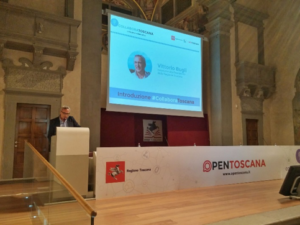
On June 29th 2016 academics, practitioners and active citizens gathered at the Auditorium of Saint Apollonia in via San Gallo 25 in Florence for the opening of #CollaboraToscana, the public policy co-design process led by Tuscany Region, supervised by LabGov and managed by SocioLab.
#CollaboraToscana projected to focus on collaboration and sharing economy aiming to co-create a map of regional public policies – a synergy and a proposal for targets, actions and measures which would be co-designed and deployed at different levels to maximize opportunities and minimize risks for the sharing economy and collaborative development of the region. Therefore, the objective of the conference and workshop series was to introduce diverse, yet interconnected approaches and tools for regional collaborative practices. By emphasizing on sustainability, inclusion and the themes of presentations varied from start-ups to infrastructure, territorial regeneration and security, and from participatory governance to digital innovation and communication – all being closely tied to collaboration and sharing economy.
The event was opened by the Deputy President of the Toscana Region Vittorio Bugli who after a warm welcome acknowledged the promising #CollaboraToscana initiative. V. Bugli stressed that in regards to the sharing economy, sustainability and collaborative management of the region the recognition of civic participation is crucial. The Deputy President thus emphasized that it is important to address migration while focusing on collaboration. “In Tuscany we are very attentive to the reception of migrants fleeing from their countries”- said Bugli. “But we have to think of a greater integration, these people can be an important vantage rather than obstacle in terms of collaboration”- after the conference stressed V. Bugli.
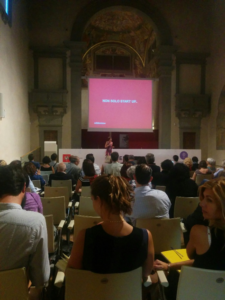 The first keynote Marta Mainieri (Collaboriamo.org), focused on collaboration in terms of innovation and start-ups. M. Mainieri stressed that the new economy model – a collaborative economy – is important first of all because its volumes are rapidly growing. “Gross revenue in the EU from collaborative platform and providers was estimated to be 28 billion in 2015. Growth in recent years has been spectacular with revenues almost doubling from 2014 to 2015”- presented M. Mainieri. Yet, despite of the growing amount of the sharing economy practices, M. Mainieri emphasized the need to recognize the real value of collaboration, which is based on collective knowing, connection, co-planning and communication and therefore is projected to contribute to the construction of open, more inclusive systems that are based on trust and reciprocity, rather than exclusion.
 The second speaker, Massimo Alvisi (Alvisi-Kirimoto, Renzo Piano G124) focused on city requalification and regeneration. By illustrating his presentation with the experiences from Viadotto dei Presidenti in Rome, Via Fossata in Torino, and Librino in Catania, M. Alvisi emphasized that in terms of urban regeneration, collaboration has a great potential to contribute to social wellbeing, security as well as revitalization of deteriorated urban areas (more information related projects: http://renzopianog124.com).
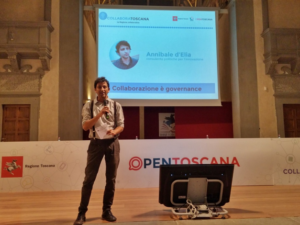 This was followed by the engaging Annibale D’Elia’s presentation. While addressing collaboration A. D’Elia, a consultant for innovation policies, touched upon topics of inclusion and citizens’ engagement. He stressed that collaboration in terms of governance is mainly about the unleashing the energy of the people, who should be enabled and facilitated in order to actively participate and collaborate. Furthermore, the last speaker Michele D’Alena, an expert in e-government processes and social innovation, supported Annibale’s comments by adding that digital means – the information communication technologies (ICT), are essential for sharing economy, collaboration as well as active citizens’ engagement.
The presentations were followed by Silvia Givone who represents Sociolab and works with #CollaboraToscana project. After thanking to all presenters S. Givone introduced the road map and the critical phases of #CollaboraToscana (more about #CollaboraToscana: http://open.toscana.it/).
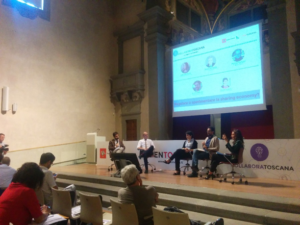
The first part of the conference was followed by the debate between Antonella Galdi, the vice secretary of the National League of Italian Cities, Stefano Bartolini, a professor of political economy at the University Siena, Ernesto Belisario, an expert in law of technology and innovation in public administrations, and Marta Leonori, representing the department of Civil Service.
Lastly, the conference was finalized by the series of workshops on co-planning to co-create concepts of collaboration and sharing economy by mapping (meaning, opportunities and problems) activities. Participants were divided into 4 groups (representing public and private sectors, knowledge institutions, civic social organizations) and were asked to further reflect on prevalent issues (infrastructure, services, goods and governance) and to design possible tools for a regional policies on the economy of sharing and collaboration.
The event was moderated by Christian Iaione, LabGov co-director, who outlined the prevailing currents of collaboration and sharing economy and supported the presentations as well as panel debates by insightful comments.


 s, it is no more suitable for the contemporary society. But where there is an inefficiency, there is an opportunity, and the emerging collaborative forces represent the solution: we move from strict regulation to the co-design, a process during which there is the opportunity to discuss problems and needs rather than directly providing solutions, which will result from a debate with more actors. So we can talk about social enterprises, whose aim is the satisfaction of social needs, taking into account the economic sustainability.


