by Edoardo De Stefani | Nov 23, 2014 | The Urban Media Lab
The capitalist world-system has entered a multiple crisis, while the stalemate of the growth function hampered the socio-economic progress. Energy provision, climate stability, food production and distribution, land access and political stability are consequentially threatened by a system that is no more sustainable and self-reliant. Moreover, the congestion and the rivalry upon the use and exploitation of resources leave no room for development, at least if the current structural paradigm is not questioned. It is far obvious that we need a transition but in order to have a legitimation, it is necessary to establish a new contract that can meet priorities even under a regime of resources constraint. The focal question is then to redesign existing structures in a functional way and appealing to the notion of justice.
In this sense we need to protect the opportunity of people and their ability to participate to the public life; arguably the claim here is simple: if the functioning of the society is based on cooperation, solidarity, democracy, equality and responsibility, then it would be easier to talk about commons. I feel that whenever there is sufficient reason to claim ownership and inclusiveness over public goods -here in the sense of common sharing of resources and assets- there would be enough reason to take care of those commons.
The end of the story is that, if people have the chance to enjoy the public space as something that makes them feeling attached to it, then it is naturally consequential that new inputs and energies will flow in.
The power of commons is the one of making the latent potential of people concrete: the transformative evolution of the capacity of the citizens to serve and cultivate urban life is the product of integration, inclusiveness and social enrichment. However changing paradigm is not merely a matter of smooth transition, rather is it a matter of complete regeneration that goes beyond the classical schemes of social struggles -(see also: TRANSITION EUROPE).
Here there is the twofold dimension of such evolution: revolution is accompanied by innovation and, as far as innovation is concerned, lots of activities founded justification and legitimation across Europe.
In France, the CEPEL centre (Centre d’études politiques de l’Europe latine) follows four main points to study the evolution of such social transformation: public action, identities of citizens, political élites and sociology of elections. Laura Michel, member of CEPEL and professor of Public Action and Governance in Montpellier (Languedoc-Roussillon) underlines how the decentralization of institutional responsibilities and resources criticities forced the inception of new forms of multilevel governance and multi-stakeholder accountability.
First of all, the transformative process that involved the institutional structure is significant for the fact that restored the significance of participatory democracy: citizens, corporations, private entities and public actors are now participating on equal footing at the managerial process.
If we translate it to National ground or to Urban networks, we could easily discover how enhanced participation nourishes people imagination and enhances their willingness in contributing for making the city a better place where to live. Consequently also enterprises and investments would be attracted by a model of active citizenship; the new urban ecosystem would not be anymore a mere storage loci for the depletion of resources,but an incubator of tangible and intangible resources that develop spillover effects throughout the territory.
Clearly we cannot yet simply consider the realm of Commons as a ready to go policy, however it is significative how the paradigm of social innovation is currently spreading all over Europe.
In many Countries it is possible to experience the contours of a new urban outline and the reason is simple: the territory is full of qualities and resources that are not fully exploited and in some cases urban ecosystems resemble the cemetery of lost spaces. Giving life to ghost cities is the effect of a participative governance.
If we investigate our assumptions, it would be possible to understand that the call for a new urban ecosystem is not the sum of few isolated cases, but that the path of Commons -if rightly guided- can lead far away from the classical islands of sufficiency.
Here we have some interesting examples of how social innovation and multi stakeholder participation can produce an high quality social technology, as it positively impact on economy, culture and sustainability.
1. Participatory urban neighborhood, Vienna, Austria
“ Located in the city of Vienna, Austria, the project identifies a set of rules for establishing a sustainable urban neighborhood based on democratic principles of governance, communication, and participation. Instead of proposing a pre-designed urban tissue, the strategy tenders a collective pattern based on a grid of gardens that structure the area. The gardens function as a framework for physical and social development, outlining a porous fabric with low environmental impact and a collective space – re-programmable in time, while furthering ownership capacity-building. The area will first operate as an urban park; a matrix of gardens is inserted around existing trees. Gradually the district grows around these gardens and the shared open space. The approach establishes a minimally-invasive intervention that will develop over time according to the needs of the society at every step – a continuous process of small scale growth and appropriation, with autonomy at every stage ”.
source: Holcim foundation
2. Holcim Foundation for Sustainable Construction, Switzerland :
“Urban growth must deliver urban quality. Cities are defined not just by built density, but also interaction intensity. Only when urban growth results in urban quality will it be accepted by its inhabitants. In the context of the loss of local identity and the globalization of architectural styles and technologies, the research of Yoshiharu Tsukamoto shows that progress and local identity do not need to be mutually exclusive”.
source: Holcim foundation
3. potagers collectifs et familiaux de Bruxelles
The topic of urban gardening is very interesting insofar as it is linked to collective participation.
For example, the Brussels environment is populated by forms of “jarden de quartier”, based on a special project that allows the forming of “contract de quartier durable”.
Some examples of urban gardening in Brussels are: Velt Koekelberg, Jardin majorelle-moelenbeek, Jardin collectif.
Useful links:
www.bruxellesenvironnement.be
www.lizchristygarden.us
www.treebranch.org
www.kbs-frb.be
www..promethea.be

by Edoardo De Stefani | Nov 12, 2014 | Luiss LabGov 2014-2015
We already talked about urban regeneration, as something that goes hand in hand with the structuring of the urban network and its spaces.
Without any doubt, the territory is full of qualities and resources that are not only physical assets.
However since there is no power without control, regeneration is also about participation and governance.
We are used to imagine the urban environment as something populated by a collection of independent individuals and rational decision makers, which make choices as a consequence of an opportunistic calculation.
Fortunately there are actors and situations that prove that such assumption is biased: indeed there is a crescent flow of urban stakeholders that are guided and inspired by a model of deliberative democracy, which resides in the right to participate to a collective decision by influencing the content.
To make it simple, we strongly believe that the discourse is nowadays oriented toward a community development, whereas the dominant paradigm becomes the collaborative governance.
In this sense, the urban resources have to be filled with a technological content, the social one, which shall permit active participation by citizens and cooperation with institutions, administrations, corporations, associations and universities.
The real value added is the latent potential of people, not their hyper individualization.
Certainly, the discourse cannot omit a range of issues that have to be prioritized: economic sustainability, availability of assets and mapping of resources, urban architecture and the relationship with institutional actors.
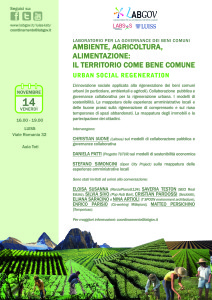
On 14th November at 16.00 in LUISS Guido Carli University, we will have the chance to meet several experts and to launch a debate upon the urban social regeneration.
With the participation of Daniela Patti (project TUTUR) and Stefano Simoncini (Open city project), LabGov will have the pleasure to host the conference; the objective is to transform the meeting into a co-working session and to promote the dialogue between all the participants.
We aim at creating a concrete and usable output for all the presents.
Further info about participants and program at :
by Edoardo De Stefani | Nov 9, 2014 | The Urban Media Lab
Collaborative Governance and fundraising: a national, European and international approach for the regeneration of Italian cities.
Regeneration is a concept that goes hand in hand in with the issue of structuring the urban network and its spaces. It is obvious that local qualities and assets nourish the urban territory, but it is less far evident how to use them.
Indeed, the technological advancement of the socio-economic urban stratus has to be measured in terms of how much we are able to exploit the added value of a certain portion of territory, and then in terms of network capacity.
If we are not able to identify potential or latent assets and to create efficient and creative solutions for managing the resources of a given reality, it is not possible to talk about regeneration.
Indeed regeneration is a multidimensional and inter-sectorial process that aims at promoting the potentiality of the urban landscape through the involvement of all the relevant stakeholders, including citizens above all.
It is clear that the concept of good governance shall be primarily grounded on what the EU defines as “local ecosystems”.
The objective of the workshop promoted by SECI and in collaboration with LabGov and AUDIS, is to initiate a working session of the collaborative methods of governance, followed by a plenary session based on the model of open conference.
The scientific conference is made for all those interested actors which seeks to understand the 4P paradigm (public private people partnership).
The first session will be held at 9:00 in Sala Agorà of the “Triennale di Milano”.
Following, the conference will take place at 14:30 in Sala d’Onore.
For any further detail, please find attached the program
by Edoardo De Stefani | Nov 2, 2014 | The Urban Media Lab
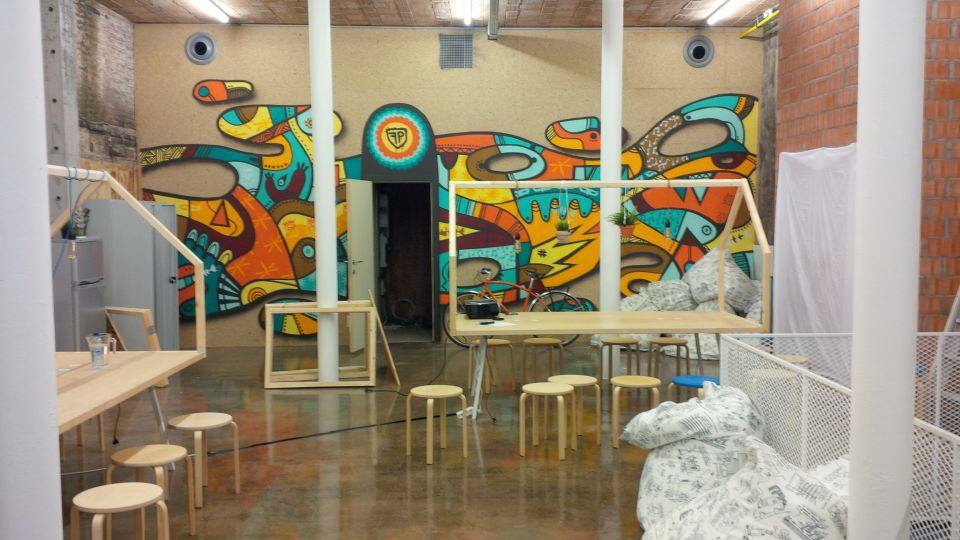
The new frontier of social innovation is the possibility of creating open spaces, namely LABs, for the cultivation of culture, creativity, design, digital innovation, knowledge and deliverable outputs for the community.
The urban network is nowadays highly populated by any sort of LAB, but it is difficult to define what a LAB is and how it should works, as well as defining its governance method.
Certainly there are multiple varieties and typologies of LABs that differ substantially among them; however, there is a common quality that can be traced for all: a “social innovation LAB” is a melting pot for the fabrication of a social energy, in the sense that it is a space where citizens, machines, ideas and methods create together a tangible output that will eventually nourish the urban fabric.
The value of active citizenship is essential and pivotal for the functioning of the consequential spillover effect, as well as for granting a just and novel input within the chain of social factory.
In practice, the role of those people participating in a LAB, is the one of creating a sort of added value for the community.
We would also define such LABs as a space for redefining and designing the experience of a territory by its citizens, as well as for developing new leading approaches and methods for community growth.
Bringing this concept to the market has been one of the last marketing strategies also for enterprises, municipalities and universities that seek to maximise a certain impact on the territory through a prototypical “fast food” approach.
With different targets in mind, there is a long list of POP UP LABs that use a temporary start-up environment to focus on real-life deliverables. The idea is to create a friendly lab-like environment with a temporal constraint.
Here we have some examples:
It is a lab for the experimentation of new methods for living the urban space, through a “call for ideas” that gives the possibility to citizens of “opening the city” and exploiting the so called ghost spaces.
http://www.popuplab.it
Also enterprises as banking corporations are now experimenting a strategy of self-marketing through activities based on the POPUP “Lab-ing”. Bruxelles is currently hosting one of these digital and futuristic LABs.
This Lab is an experimental venture, conceived as a space for ideation and informal collaboration, that should act as a catalyst for disciplines and vocations.
Part think tank, part design agency. It will envision a realistic future of health and well-being. Check it out for recent developments!

by Edoardo De Stefani | Oct 30, 2014 | The Urban Media Lab
Moved by the sense of active citizenship, there is a raising consensus upon strategies for community empowerment.
Many times we assisted to a deterioration of local services, often fueled by a spiral of disabling structural and institutional performances both of private and public actors.
However, the virtuous solution for stimulating the neuralgic points of a territory is the one that endows people and communities with the necessary technology.
Certainly, building a knowledge matrix for understanding the regulation of local public services and the role of local actors and incentives, is a preliminary condition for identifying relevant territorial patterns.
In the field of policymaking and governance of public services, a methodology for multi-sectorial analysis turns out to be useful.
Thus the quality of technologies for community empowerment, here in the sense of local decision-making, can be benchmarked upon the variables of regulation drivers and information sharing.
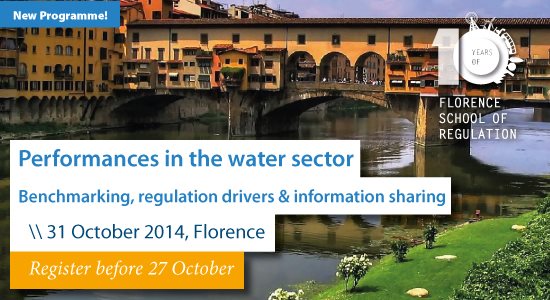
The workshop organized by the Florence School of Local Regulation will open the debate upon ” Performances in the Water Sector, opting for a methodology of analysis based on the FIELD framework (developed by the Turin School of local regulation).
The workshop will also be dedicated to the understanding of regulations, investments and cooperation in the Water Sector, both under the lens of the European framework and with regard to a specific National case study, specifically the Italian one.
Further info at: Program


