by Alessandra Feola | Feb 18, 2015 | The Urban Media Lab
An interview of Prof. Christian Iaione, Coordinator of LabGov, has been published on the Shareable website, the american leading organization for sharing economy and collaborative practices, co-founded by Neal Gorenflo, that collaborated with LabGov both in the CO-Mantova project and the Sharing School . The interview was made by another friend of LabGov, Michel Bauwens, the founder of the Peer-to-Peer Foundation, an international organization focused on studying, researching, documenting and promoting peer to peer practices in a very broad sense, that was in Mantova for the Cooperation Festival organized in November.
Enjoy the interview!
“A commons-based economy cannot thrive without appropriate institutions, especially those that represent a “partner state” approach. Professor Christian Iaione of LUISS University in Rome is a pioneer of such institutional innovation in Italian cities. I believe his work with the city of Bologna on Bologna’s Regulation for the Care and Regeneration of Urban Commons is a breakthrough. This regulation allows citizen coalitions to propose improvements to their neighborhoods, and the city to contract with citizens for key assistance. In other words, the municipality functions as an enabler giving citizens individual and collective autonomy.
More than 30 projects have already been approved in this context and dozens of Italian cities are adopting this regulation. The CO-Mantova project in Mantua, Italy is one such example. It has been set up for citizen-based social innovation using a multi-stakeholder approach that includes Professor Iaione. In the interview below, we asked him about his motivation, the ideas that have shaped his work, his urban commons projects in Bologna and Mantua, and how he sees the expansion of this approach in cities throughout the world.
Michel Bauwens: Before we explore your work, what sparked your passion for urban commons?
 Chris Iaione: I grew up in Southern Italy, but with an Anglo-Saxon imprinting. My parents lived in the US in the sixties. They eventually decided to go back. My father told me they made this choice because they wanted to give back to their country. In the Seventies, they were both Vice-Mayors in their respective hometowns (Contrada and Atripalda, near Avellino). The first time I went to the US was 1980. I was five years old and running away from a catastrophic earthquake that hit my city and its county (Avellino). Schools and other public services were shut down. My mother, my brothers and I fled to New York and New Jersey to stay with friends and relatives. My father decided to stay in Italy to take care of his city and his citizens.
These were the first lessons I learned about life and the US. The sense of duty that my father taught me with his example, and that the US can be a welcoming land for those in need. Almost twenty years later in 1999, I enrolled in the UC Berkeley Extension Program. In Berkeley I learned the importance of becoming a unique human able to collaborate with other unique human beings, rather than competing to be the first of my class. I came back to the States for a third time to intern at the International Law Institute in D.C.—a city where you can feel the immanent presence of power and how distant institutions can be from the needs of citizens and how reluctant they are to innovate, but also how you can find innovators within government.
Lessons learned: if you want to change something you have to change it from the inside by finding those who are willing to work with you. I then had the opportunity to work and develop my academic studies as a research fellow at New York University School of Law. It was there that I developed the theoretical framework for local public entrepreneurship, which is the basis of the CO-Mantova project and the idea of the city as a commons. My study on the tragedy of urban roads and experiments in Bologna lead to this.
You run LabGov – LABoratory for the GOVernance of commons dealing with new commons-centric urban governance, which is part of an important Italian academic institution LUISS University, and, in particular, the International Center on Democracy and Democratization led by Leonardo Morlino, a prominent international political scientist. What is LabGov?
LabGov is an in-house clinic for social, economic, institutional and legal innovators that carry out empirical work to implement innovations in public policy based on collaborative governance and public collaboration for the commons, subsidiarity, active citizenship, sharing economy, collaborative consumption, shared value, and collective impact. I co-produce the clinic with young people graduating from LUISS University. I designed this program having in mind a powerful new social class which is on the rise. It is a class of active citizens, social innovators, makers, creatives, sharing and collaborative economy practitioners, service designers, co-working and co-production experts, and urban designers.
This social class is pushing or nudging society, business and institutions towards new frontiers. Student should have the opportunity to join this social class and help it move the frontier forward. That is why, through the clinic, student interns develop projects that must come to life. Students must implement innovation in areas where innovation has not been brought yet or amplify the innovation in existing projects. In 2013 LabGov was devoted to the subject “The City as a Commons,” while in 2014 it was focused on “Culture as a Commons.”
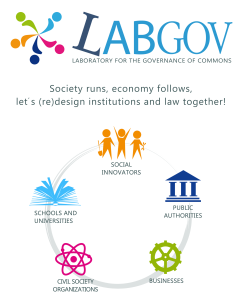
In academic year 2014-2015 the focus of study is green governance, to be understood as a social, economic, institutional and legal technology. Therefore, this year the LabGov is devoted to the “land as a commons: environment, agriculture and food.” All the real life projects we design in the Laboratory are then proposed to real life actors that are willing to experiment with the ideas we seed. LabGov is a nonprofit rooted in the university but working on the outside. LabGov intends to update the Triple Helix concept of the university-industry-government relationship because we believe in a Quintuple Helix approach (embedded in LabGov logo) where universities become an active member of the community and facilitate the creation of new forms of partnerships in the general interest between government, industry and businesses, the not for profit sector, social innovators and citizens, and other institutions such as schools, academies, plus research and cultural centers.

You are known as one of the key authors of the new regulation on collaboration for the care and regeneration of urban commons, which was adopted by Bologna and is now being adopted by other Italian cities. What exactly does the “Regolamento sulla collaborazione per i beni comuni urbani” entail, and are there already practical consequences?
The Bologna Regulation is part of the “The City as a Commons” project that LabGov started in 2012. It consists of two years of field work and three “urban commons governance labs.” The Bologna regulation is a 30 page regulatory framework outlining how local authorities, citizens and the community at large can manage public and private spaces and assets together (available in English here). As such, it’s a sort of handbook for civic and public collaboration, and also a new vision for government. It reflects the strong belief that we need a cultural shift in terms of how we think about government, moving away from the Leviathan State or Welfare State toward collaborative or polycentric governance. This calls for more public collaboration, nudge regulations, and citytelling.
I have been researching the topic of the commons for quite a long time, and at some point I realized that the city could actually be interpreted as a collaborative commons. I synthesized my research in a paper “City as a Commons” presented at a conference in Utrecht and later published in the Indiana University Digital Library of the Commons. This was the background study for the Bologna and Mantova projects. I am now working with Sheila Foster from Fordham Law School on a more comprehensive study which is going to lay out a theoretical framework building on the background studies I developed in Italian (see an article titled La città come bene comune) and the empirical work I am carrying out in several Italian cities.
We met at the presentation of CO-Mantova, an ambitious project to revive the local economy with young social innovators, which also proposes an innovative fivefold local governance scheme. Tell us why Mantova needed this, how the process with youth worked, and how the city, province, and Chamber of Commerce came to accept the process. Above all: what’s next?
CO-Mantova is a prototype of a process to run the city as a collaborative commons, i.e. a “co-city.” A co-city should be based on collaborative governance of the commons whereby urban, environmental, cultural, knowledge and digital commons are co-managed by the five actors of the collaborative/polycentric governance—social innovators (i.e. active citizens, makers, digital innovators, urban regenerators, rurban innovators, etc.), public authorities, businesses, civil society organizations, knowledge institutions (i.e. schools, universities, cultural academies, etc.)—through an institutionalized public-private-citizen partnership. This partnership will give birth to a local peer-to-peer physical, digital and institutional platform with three main aims: living together (collaborative services), growing together (co-ventures), making together (co-production).
The project is supported by the local Chamber of Commerce, the City, the Province, local NGOs, young entrepreneurs, SMEs, and knowledge institutions, such as the Mantua University Foundation, and some very forward-looking local schools.
The first step was “seeding social innovation” through a collaborative call for “Culture as a Commons” to bring forth social innovators in Mantua. Second step was the co-design laboratory “Enterprises for the Commons,” an ideas camp where the seven projects from the call were cultivated and synergies created between projects and with the city. The third phase was the Governance camp, a collaborative governance prototyping stage which led to the drafting of the Collaborative Governance Pact (see the Italian version here, English version forthcoming) the Collaboration Toolkit and the Sustainability Plan, which was presented to the public during the Festival of Cooperation on November 27th last year.
 The next step is the fourth and final phase: the governance testing and modeling through the launch of a public consultation in the city on the text of the Pact and a roadshow generating interest in CO-Mantova among possible signatories belonging to the five categories of collaborative governance actors. We are also may have CO-Mantova opening up a Commons School.
What are the prospects for public collaboration and commons-oriented local governance schemes? What do you see happening elsewhere and what do you want to see change in the near future?
This really depends on the local context. In my opinion, people are what matters the most, and the best entry point is always to find the people or group who believe in change, and in doing things better by pushing the boundaries of institutional innovation. You need people with around-the-clock commitment beyond their official duty both to the community, the institution and to excellence.
You always have to take into account that public officials are likely to be very cautious, since changing one thing tends to impact other things. Innovation is not the result of revolution, but it’s quiet, not necessarily slow, but difficult and involves a continuous negotiation process. This is something that you have to “figure out on the ground.” If you manage to implement change with the public administration rather than using political drivers, your change and is much more likely to be permanent.
There are some good example on how public collaboration and commons-oriented local governance schemes are taking place. Florence is one example where collaboration has been seeded in several institutions and projects that the city is already running. The new mayor and new commissioners have already showed interest in expanding the reach of a collaborative approach within the city government.
Moreover, a growing community of innovators is working in Italy to foster collaborative practices, sharing economy and social innovation. For example the Sharing School that was held from 23 to 26 of January in Matera, the 2019 European Capital of Culture.
What else are you working on? What are your long-term goals?
We are talking about a cultural shift. The new governance model proposed is a new way for us to relate to almost everything, from economy to society as a whole and to other people, in other words: our vision of the world changes. Whether this cultural paradigm takes expression in sharing a car, or caring about where the trash ends up, this is all part of a 21st century way of living: a way of sharing things, sharing services, sharing spaces, sharing production and sharing responsibilities.
You need a “nudging class” instead of a ruling class, a class that has the drive to convince and nudge society and institutions towards a sharing and collaborative paradigm. But you cannot force change, you have to nudge people to share and collaborate.
For this reason, since 2012, I’ve suggested the creation of a federalized network of local hubs of expertise gathering best practices, starting up experimentations in different territories, spreading governance culture and disseminating knowledge among Italian territories. This National Collaboration Network could become a hub that provides collaboration toolkits, regulations and governance schemes, as well as training programs and day-by-day assistance for local administrators to help them drive change toward sharing and governance of the commons. This could accelerate the shift towards a 21st century paradigm of public administration.
What other cities are you allied with or are learning from? Is CO-Mantova part of any networks or associations that support commons-based urban development?
Many other cities are taking the route synthesized by CO-Mantova and opened by Bologna with its regulation on collaboration for urban commons. Milano, Firenze, Roma, Naples, Battipaglia, and Palermo have decided or are deciding to invest energy, skills, and other resources on the challenge of collaboration. They increasingly believe that only through co-design and bottom-up processes of civic and economic empowerment is it possible to face the challenges that congestion, agglomeration, and density that cities will face in the future.
How are LUISS students or LabGov interns involved in Co-Mantova? And what feedback are you getting from them so far?
Labgovers, as we call LabGov interns, participated actively during all the phases of the Mantova project. They supported project design and field implementation. They handled internal and external communication, organized the workshops and conferences, and facilitated the different project working groups, which, for instance, created the Collaboration Pact, the Collaboration Toolkit, and the Sustainability Plan.
For them, CO-Mantova was their first fieldwork and occasion to test the competencies acquired during their University study, and through the colloquium that LabGov holds every year on commons governance, sharing economy, social innovation, nudge regulation. LabGov helps young, talented students develop useful skills for their careers. All skills that due to the continuous transformation of society, you will not find in books or learn in a classroom. For this reason, LabGov teaches collaboration, service design, project management, and the sharing of roles and responsibilities through a “learning by doing” approach. Thanks to LabGov, young students and graduates enter the working world better prepared than their colleagues. I am confident that Labgovers will hold important positions in society and will be the driving force of change by fostering collaboration and a commons-oriented economic approach.
In conclusion, how do you see the inter-relationship of the commons, city governments, citizens, market players and market institutions?
The job of city governments, and maybe every government layer, is changing. Their function is less about commanding or providing. They are increasingly acting as a platform that enables collaboration between citizens and social innovators, not for profit organizations, businesses and universities — the five actors of collaborative governance — to unleash the full potential of urban, cultural, and environmental commons, promote a sustainable commons-oriented development paradigm, updating the concept of State or government and therefore implying as Neal Gorenflo would say a “shift in power and social relations.” Market institutions are more interested in this process than one might think. This is the main take away of the Mantova experiment. In fact, it is the local Chamber of Commerce, the local cooperative movement, the local businesses and the young entrepreneurs that are investing more in this innovative project than other sectors. SMEs and big companies alike are looking for new, innovative approaches to the way value is produced. The race to the bottom that globalization has triggered is no longer an available strategy for a knowledge economy system like Mantova. Economic actors increasingly understand that they should invest in producing collaborative value and create collaborative economic ecosystems that foster creativity, knowledge, identity, and trust.
This new phenomenon represents an opportunity to revolutionize the current state of play of the society, economy, institutions and law. This new social, economic, institutional and legal paradigm is going to characterize the 21st century as the “CO-century,” the century of COmmons, COllaboration, COoperation, COmmunity, COmmunication, CO-design, CO-production, CO-management, COexistence, CO-living. For all these reasons, it is urgent to design the rules and institutions of this new century. LabGov.it is working on this frontier and is doing it together with experts, organizations, and individuals that represent what we think is a newly rising social class, a class of economic and institutional innovators.
“If you are looking for glory, you are probably not a very good innovation agent”.
This interview has been taken by the Shareable website: http://www.shareable.net/blog/interviewed-professor-christian-iaione-on-the-city-as-commons

by Stefano Speranza | Feb 16, 2015 | The Urban Media Lab
After the economic crisis out-broken in 2007 and the consequent period of time defined by recession, all of us are aware that in this situation, one of the most important thing in which to believe in, is to do with what we have got. For this reason, the creativity in using material stuffs, the fact of using something instead of putting it, the replacement of simple owning with shared use (as the sharing economy demonstrates), become every day more important.
Well, we should name all of this mix as “Resilience”. That, for what we are interested in, is to say the capacity, for a society, to anticipate disruptions, to adapt to events and to create lasting value.
And what about the city of Rome?
The project “Roma Resiliente”, that the Municipality of Rome act in the framework of the programme “100 Resilient Cities” promoted by the Rockefeller Foundation, is getting going.
Actually, the Foundation decided to allocate one-hundred million dollars – in occasion of its hundredth birthday – to one hundred cities selected among more than four hundred cities.
Rome was selected as first, together with thirty-two more cities in the world, by eight judges among which the former U.S. President, Mr. Bill Clinton.
The working plan, proposed by Giovanni Caudo (Municipality of Rome’s council member for the Urban Transformation) has persuaded the examination board, and has been awarded with one million dollars to be allocated to the City.
The main goal of the proposal is to create an improved resilience, that is to say the capability in resisting to disasters caused by people or simply natural events, and to raise again stronger than before. This is possible thanks to the building of a widespread “culture of resilience” among citizens, associations and enterprises, and the advent of an evaluated institutional capability.
Thanks to the partnership with the Rockefeller Foundation, the local administration will launch a partecipatory process for the creation of a resilience plan for the Municipality of Rome.
Among the priorities identified in the working plan emerge the so called resilience challenges that are, for the city of Rome, earthquakes, flooding, pollution or environmental degradation, rising of the sea level and the consequent coastal erosion.
But, overlooking for a moment natural diseases, “Rome is struggling to reverse decades of poorly regulated development and address its informal housing neighbourhoods, inadequate infrastructure provision, and urban sprawl. This activity has made Rome highly vulnerable to flooding and other disruptions, which threaten to undermine social cohesion and prosperity in this city of immense cultural and economic significance. Rome’s city limits include large expanses of still viable rural land and natural reserves, and its forward looking planners are focused on transforming these assets in order to maintain and protect its environment and build long-term resilience to shocks and stresses”, as the officialwebsite of the 100 Resilient Cities reports.
Last but not least, Roma Resiliente is going to deal with themes such as nutrition and green common areas.
Actually, on January, 20th at the Piccola Protomoteca of the Capitol Hill of Rome was held a meeting dedicated to “Agricolture and food for resilient cities”. During this meeting were analysed and illustrated the best practices and the good purposes about a new kind of food policies, which should consist of the best quality of the nutrition as a tool for improving public health , the sustainability of the production and distribution chains of food, the stress on the role of urban agriculture.
Undoubtedly, such policies are one of the fundamental paths that will make our cities more resilient and, the cooperation of the multiple social actors is needed.
Institutions alone cannot go far away. The community garden that we, as LUISS-LabGov, are taking care of, is a clear example. Together with the dozens of shared gardens in the whole city of Rome, our community garden represent a nice resilient partnership among citizens, students and academy.
For further infos, please visit the following websites:
http://www.100resilientcities.org/
http://www.urbanistica.comune.roma.it/roma-resiliente.html
http://www.luiss.edu/news/2014/11/25/shared-garden-becomes-greenhouse-social-innovation
E’ stato lanciato il progetto “Roma Resiliente”, che la città di Roma intende realizzare nell’ambito del programma “100 Resilient Cities” promosso dalla Rockefeller Foundation.
Difatti, la prestigiosa fondazione americana ha deciso, in occasione del proprio centesimo compleanno, di donare cento milioni di dollari a cento città nel mondo, selezionate fra oltre quattrocento.
Grazie alla partnership con la Rockefeller Foundation, l’amministrazione romana avvierà un processo partecipativo per la creazione di un piano di resilienza per Roma Capitale.
Tra le priorità identificate nel piano di lavoro emergono le sfide di resilienza che, per la città di Roma, riguardano anche l’alimentazione e l’agricoltura.
In questo scenario, il community garden dell’Università LUISS “Guido Carli” rappresenta un esempio positivo.
by Edoardo De Stefani | Jan 28, 2015 | The Urban Media Lab

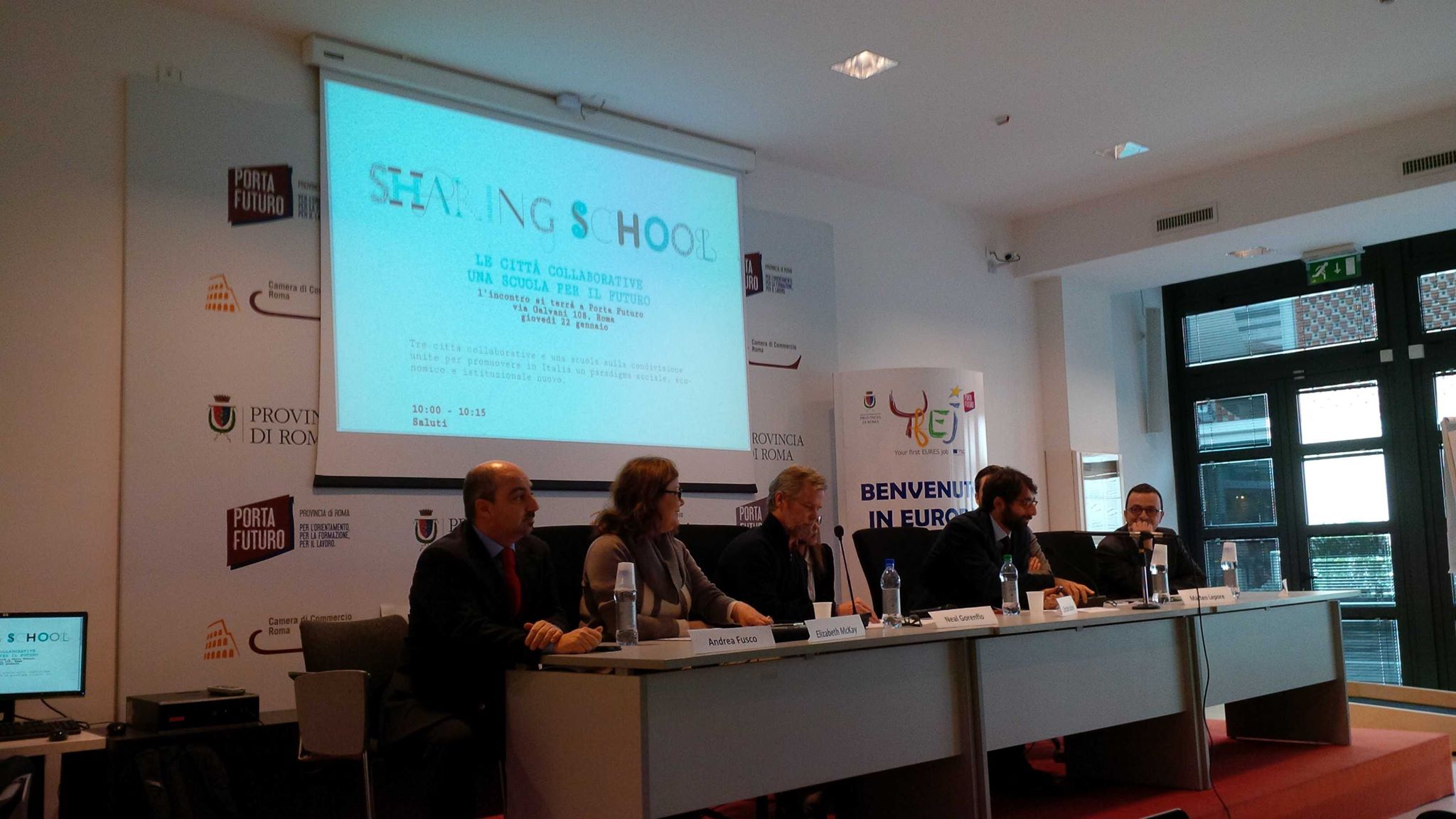
The sharing economy is growing faster than ever and becoming a hot policy issue these days. Casa Netural, Collaboriamo, RENA and LabGov have for this reason decided to launch the “Sharing School”. Thanks to the collaboration between these organizations and with the support of Ouishare, Avanzi and Societing, the School has been able to host highly qualified professionals and experienced innovators. The guest star of the event has been Neal Gorenflo from Shareable, an American leading organization in the field of sharing economy and collaborative practices.
The event held in Rome at Porta Futuro, had the main objective of dealing with the mainstream tendency of sharing economy and to understand if such trend can become the leading paradigm of the new economy. Andrea Fusco, Director of Department III – Services for placement and quality of life of the Province of Rome, the future Metropolitan City, was very happy to host the Sharing School initiative.
Minister Counselor for Public Affairs of the US Embassy in Italy Elizabeth McKay, reminded how the sharing economy has already changed things; it is no longer a new phenomenon and thanks to technological interactions and social media, we are exploring a potential that can disrupt traditional forces. Customers become service providers themselves, acting as catalysts for phasing into the system resources and goods that are normally not exploited.
We were used to think about sharing economy as some “nerd stuffs”, while nowadays there is a sort of “media bulimia” that affect the topic of sharing economy – says Francesco Russo, President of RENA. It is undeniable that we are assisting to a growing tendency of the concept of collaboration, as we simply trust strangers. However, the problem is that we shall distinguish what sharing is really about, and that is the aim of the Sharing School. There is a paradigmatic change of society and in the next future, 40% of the online staffing will be served through services provided by the sharing economy. Then, the approach of the initiative is not only about telling the story of a new economic trend.
As Neal Gorenflo recognizes, we are all here to learn how to gather people and create a common homogeneous vision about the sharing economy. But here we encounter obstacles, since we need to dissolve the gap between trans-formational economy and trans-action sharing, which basically maintains social hierarchies. Neal Gorenflo talked about making a choice between the red pill and blue pill like in The Matrix movie. The blue pill is a story about the re-adaptation of the old capitalist paradigm to the new economic trends, where Uber and AirBnB are the concrete examples of how initiatives of such strand of the sharing economy can still create monopolies. On the other hand, the red pill is the one that inspired our research. It is about the resurgent collaborative experimentation and it is what can wake up reality. We need to open cities, to make them available for use and to activate citizens by creating an economy “by and for” the people. We need to invest on transformational sharing much rather than transactional sharing.
However, as Matteo Lepore – Commissioner to Economy, Development of the City, Tourism, International Relations and Digital Agenda of the City of Bologna – underlined, if we talk about social order and sharing economy, we are inevitably bound to themes such as politics, democracy and participation. In fact, even taking the red pill has the risk of initiating a debate between citizens and the political representation. It is all about a systemic change, otherwise there would be no way back from the loss of collaboration between citizens and institutions. Step by step, we are loosing the sense of citizenship, by projecting a vision of citizens as the residual assets of society. Fortunately, the City of Bologna was able to initiate a process of human capital reactivation, thanks to the implementation of the “Bologna Regulation on public collaboration for urban commons” that seeks to transform the Public Administration in an enabling factor. The City of Bologna is thus a starting point for understanding how collaborative practices can rehabilitate citizens and regenerate urban networks, for instance with the instrument of the “pact of collaboration“. The underlying idea is that important results can only be achieved through effective practices of co-working, which involve citizens and professionals through a platform of mutual exchange of skills and knowledge.
Starting from the community to build competences and deliver effective results on the territory is also the strategy of the City of Milan , says Renato Galliano, Director of Smart City Service in Milan. We have to recognize that it exists a network of collaborative urban cities, which is itself a new form of infrastructure. This is the confirmation that collaborative economy is not only about isolated and scattered projects of mobility sharing, start-ups and civic crowdfunding. The social innovation entails a renaissance of the cities in a wider context, whereas citizens are the locomotives of change and public administrations are the habilitating infrastructure.
As Christian Iaione, Coordinator of LabGov, reminded we have to reinforce the processes of active citizenship and active entrepreneurship, to foster a steady dialogue between the five actors of collaborative governance and to create an “Italian way” to sharing. Indeed, the real sharing is centered on the restitution of value to the community. This is a good opportunity also for the City of Rome. Daniela Patti – from the staff of the Comminisioner to the Urban Transformation in Rome – affirmed that we need to create a network of collaborative cities, to develop instruments to regenerate abandoned urban spaces and to consolidate practices for exploiting the latent potential of the great cultural heritage.
Alex Giordano (Societing and Rural Hub) warned against the dysfunctions that an incorrect practice of sharing economy can create. In this sense, we should not only focus on the quantitative approach and upon capitalist mechanisms. It is in fact essential to reason on communities and social impact. If we have a look at territorial distributions, it is possible to notice how people are divided by interests and have lost the sense and ethic of community building. Fortunately there are breeding grounds of innovation that create value, even if their outreach is limited by disabling institutional leaderships. The problem is that those who have the courage to produce social innovation are constantly marginalized, as Simone Cicero of Ouishare, noticed. Even Enrico Parisio, of Coworking Millepiani says that we need to express such new exigency, as a pedagogic stimulus for social innovation. When we started talking about sharing economy, nobody believed it could be real, reminds Ivan Fadini of Impact Hub Roma. For this reason we are strongly committed today on avoiding the reiteration of traditional economic capitalism.
The commoners will be the heroes of social innovation.
Stay united!
– – – – – – – – – – – – – – – – – – – – – – –
Presentata a Roma la prima edizione della Sharing School.
Si è tenuto il 22 gennaio 2015 l’evento di presentazione della Sharing School di Matera, la prima scuola sulla sharing economy e sulla condivisione per promuovere in Italia un nuovo paradigma sociale, economico e istituzionale. L’incontro, ospitato da Porta Futuro e reso possibile grazie alla collaborazione tra Casa Netural, RENA, Collaboriamo e LabGov, con il supporto di Avanzi, OuiShare e Societing, ha visto la partecipazione, grazie al supporto dell’Ambasciata americana in Italia, di Neal Gorenflo co-fondatore di Shareable.
L’evento, incentrato su temi dell’ economia collaborativa e innovazione sociale, ha rappresentato un importante punto d’incontro tra ospiti internazionali, attori istituzionali, accademici e società civile. Se si vuole sviluppare un nuovo concetto di economia, è necessario rivedere gli orizzonti sociali e promuovere spazi innovativi di collaborazione. E’ in un contesto di inclusione sociale e di promozione della cittadinanza attiva che la sharing economy deve prendere piede perché, come ricorda Neal Gorenflo, le persone devono rappresentare lo snodo per un’economia collaborativa.
Dobbiamo cominciare a comprendere come l’implementazione di un modello di governance condivisa non ruba potere alle amministrazioni, semmai ne rinvigorisce la struttura e la riempie di nuovi contenuti. Per questo il prof. Christian Iaione, coordinatore di LabGov, invita a pensare all’economia come un bene comune che possa essere curato e messo a punto con interventi di animazione da parte di tutti quei soggetti coinvolti nell’ambito della sharing economy, inclusi i cittadini.
by Giulia Spinaci | Jan 13, 2015 | The Urban Media Lab

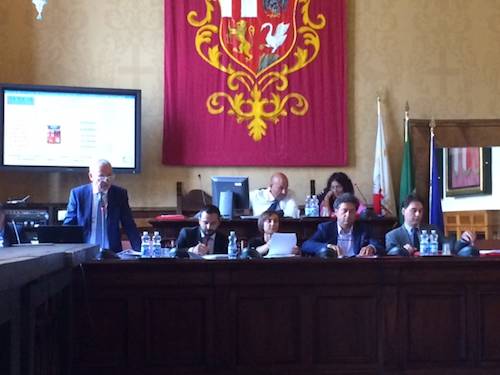
Ever since the City of Bologna approved in May ’14 the Regulation on Collaboration Between the Citizens and the City for the Care and Regeneration of the Urban Commons, twenty municipalities have approved the Regulation and fourth-three more are examining it. In this sense, the city of Orvieto has numerous predecessors, but this does not change the fact that it should be considered a success in itself.
Every little, medium and big city that voted in favor of a collaborative governance of the urban commons represents an important achievement along the way towards the end of the practice of devolving power. Active citizens have the chance to take care by themselves of the place they live and to do it hand in hand with the public administration, in a constructive cooperation that brings benefits to the whole community.
On December 29th, 2014, thus, Orvieto joined the list of the cities that decided to completely revolutionize the way of thinking about the commons, and in particular about the urban ones. The Municipal Council endorsed the Regulation by a unanimous decision. A fact, this, which highlights that behind themes like this, there is a common background able to eliminate the differences between the various political factions in favor of a shared agreement. Furthermore, the approval in itself helps avoiding all those cases in which the active citizenship is blocked and even punished (e.g. the emblematic case of Mrs. Ilaria Montis who was fined for having cleaned the seaside of Is Solinas (CI) and for throwing the garbages in dumpsters far away from her house). To regulate a phenomenon does not mean to block it or to establish boundaries and limits, but rather to let it flow according to its characteristics and according to the different realities it takes place in.
The Regulation found its origin in the work carried out also by LabGov experts in Bologna and is centered upon the principle of horizontal/circular subsidiarity enshrined in the Italian Constitution (Art. 118) in an innovative way. Article 118 should not be interpreted as a way of merely dividing the responsibilities between the private sector and the public one, but rather as a shared background on which a new model of society shall be built. A society where active citizens can practically contribute to the renewal of the reality they live in. Obviously, this implies that the Regulation cannot be applied everywhere in the same form. Changes are firmly supported in order to adapt the goals to the concrete situation and to the history and values of the city at issue.
The analogies and differences between the four different versions of the Regulation approved in the cities of Bologna, Ivrea, Siena and Chieri were already analyzed, through seven parameters. Now, with the same methodology, it has come the moment to present the vision that the city of Orvieto decided to offer with the approval of the Regulation, in comparison to the original version of Bologna.
- Principles. The Municipality of Orvieto maintained all the original principles that constitute the foundations of the original version of the regulation. However, an interesting voice was added by the City Council of Orvieto during the drafting phase: art. 10 makes an explicit reference to the Framework Convention on the Value of Cultural Heritage for Society, approved in Faro in 2005. In the words of Paolo Maurizio Talanti, the Democratic Party councilman of Orvieto “a city with such an artistic and cultural heritage like ours shall know that the knowledge and use of the cultural heritage is an individual right […]”.
- Subjects. For both Bologna and Orvieto, the subjects taken into consideration are the active citizens, namely “all subjects, single or associated, anyhow gathered in social formations, also of entrepreneurial type or with social vocation, which are active for the care and regeneration of urban commons”.
- Organizational aspects. Unlike the case of Bologna, Orvieto does not explicitly provide a unique office for the evaluation of the proposals of the active citizens, thus provoking an organizational gap that risks to provoke overlapping procedures and ambiguity during the implementation. In fact, according to the topic, each proposal will be submitted to the competent office.
- Type of administration. The kind of administration that takes shape in Orvieto is based on the authorization by the public offices, which are competent to technically evaluate the feasibility of the projects.
- Relevance of the private assets. The Regulation of Orvieto puts a particular emphasis on the public spaces as objects of the care of the active citizens, leaving however the possibility for a shared management of the private spaces for public use. Worth mentioning is the fact that the regulation merges the provision about the public spaces with the one about private ones in a unique norm.
- Forms of support. This is probably the most interesting aspect of the whole Regulation of Orvieto. In fact, the text completely eliminate all forms of exemption and relief from levies and local taxes and of administrative facilities, such as in obtaining permits. The Municipality may contribute to the reimbursement of costs only in those cases where an in-kind support is not possible.
- Disputes. Contrary to the Bologna Regulation, which provided for the creation of a Conciliation Board in order to solve future disputes, the City Council of Orvieto did not, thus leaving open the possibility to submit the arising cases to the ordinary jurisdiction instruments.
Strongly adapted to the local situation, the Regulation of Orvieto, with its strengths and weaknesses, constitutes a remarkable example of how much our society is changing and how well the Regulation fits in this challenging and stimulating environment.
_________________________________
Il Comune di Orvieto approva il Regolamento sulla collaborazione fra cittadini e amministrazione per la cura e la rigenerazione dei beni comuni urbani!
Il Comune di Orvieto ha due settimane fa approvato il Regolamento sulla Collaborazione tra Cittadini e Amministrazione per la Cura e la Rigenerazione dei Beni Comuni Urbani. Seppur con un testo adattato alla realtà della città, l’approvazione del Regolamento dimostra un rinnovato modo di pensare sui beni comuni urbani che si sta diffondendo velocemente in tutta Italia.


