
by Chiara De Angelis | Feb 21, 2018 | The Urban Media Lab
On Thursday, February 22nd, and Friday 23rd, the Sapienza University of Rome is going to host “Smart Park a Centocelle“: two days of workshop all dedicated to the Centocelle Archeological Park, an area that is currently hosting an experimental project of urban regeneration from a “Smart” perspective, conducted by ENEA in collaboration with LUISS LabGov.
The workshop is organized in the context of the Lab of Environmental Desing from the degree course in Landscape Architecture, coordinated by Prof. Arch. Alessandra Battisti in collaboration with Ing. Mauro Annunziato from ENEA, and will be structured as following:
Thursday, February 22nd
- h 9.00: Institutional Welcome – Prof. Laura Ricci
- Introduction
- Prof. Alessandra Battisti (La Sapienza)
- Ing. Mauro Annunziato (ENEA)
- h 10.00: ENEA’s projects: Smart Cities & Smart Communities – Arch. Claudia Meloni (ENEA)
- h 10.30: Enabling Technologies for Smart Cities – Arch. Sabrina Romano (ENEA)
- h 11.00: Analysis of the urban climate and mitigation scenarios in Piazza dei Mirti – Michele Zinzi (ENEA)
- h 11.30: Co-Cities methodology for urban co-governance – Chiara Prevete and Chiara De Angelis (LabGov)
- h 14.00: workshop
Friday, February 23rd
- h 9.00: workshop
- h 14.30: presentation of the results
- h 16.30: open discussion on the results with LabGov’s co-founder Prof. Christian Iaione and community members
- Conclusions
The full program can be found here: http://www.architettura.uniroma1.it/sites/sf01/files/allegati_notizie/Workshop%20Centocelle.pdf

by Alessia Palladino | Jan 18, 2018 | The Urban Media Lab

On January 19th, the 13th meeting of the URBACT Local Group will take place in Naples, at the Complesso Santa Trinità delle Monache (ex Military Hospital), from 2.30 p.m. to 7.30 p.m..
The meeting will aim at discussing about the most appropriate management models at various levels: it will deal with the detection of the best management model for the S.S. Trinità delle Monache Complex to be proposed to the Administration; furthermore, it will be a chance to discuss about the identification of the different useful tools for the implementation or management of specific actions pursuant to the Local Action Plan (as public – private partnerships, programme agreements, public calls for tender and more over).
Professor Christian Iaione will give a speech about these issues at 3.15 p.m., named “Le città tra autogestioni e co-gestioni dei beni collettivi. Modelli e prospettive“, comparing and bearing in mind innovative experiments carried out in Italy and abroad.
The complete programme can be consulted here.
Domani, venerdì 19 gennaio, si terrà presso il Complesso Santa Trinità delle Monache il 13° incontro dell’URBACT Local Group. Il Professor Christian Iaione discuterà sui possibili modelli di gestione per l’ex Ospedale Militare, tenendo conto delle varie sperimentazioni innovative portate avanti in Italia e all’estero.
by Chiara De Angelis | Nov 30, 2017 | The Urban Media Lab
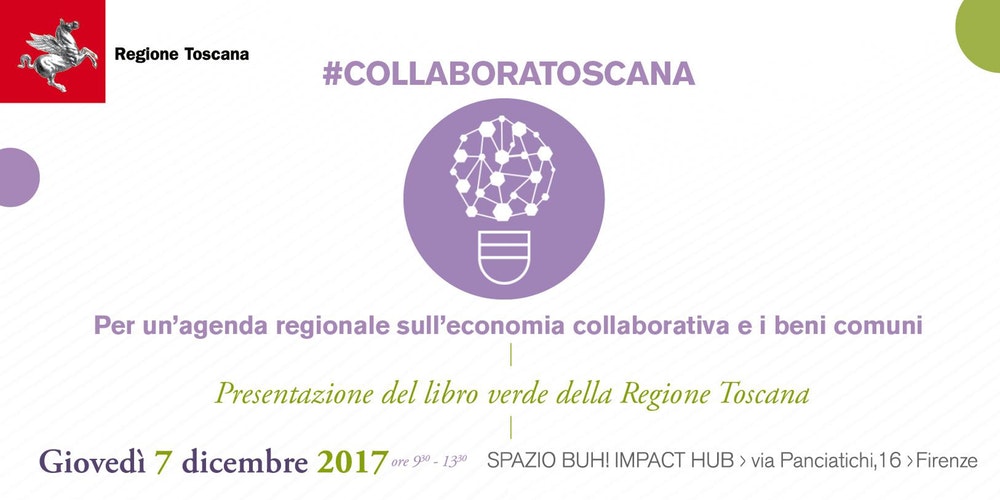
On Thursday, December 7th, Florence will host the presentation of the Green Paper of Regione Toscana for a Regional Agenda on collaborative economy and commons.
#COLLABORATOSCANA is the process led by the Tuscany Region with the support of LabGov and SocioLab, to build a regional public policy on sharing economy and collaborative economy.
The process consisted in co-design sessions and workshop that involved different sectors of the regional structure and a variety of local stakeholders coming from different areas (entreprises, startups, third sector, NGOs, active citizenship) with the aim of defining a Green Paper containing a mapping of regional public policies to be put together, and a series of proposals on objectives, actions and measures spotted to the co-design path.
The #COLLABORATOSCANA Green Paper will be presented in collaboration with ANCI Toscana on December 7th from 9.30 AM to 1.30 PM in BUH Circolo Culturale Urbano (Via Panciatichi 16, Florence).
The process is developd with the scientific support of the international research project “Co-Cities and Co-Territories” within LUISS LabGov, directed by prof Christian Iaione, and its methodology is cured by Sociolab cooperative, and supported by Collaboriamo.org.
Tickets are available on https://www.eventbrite.it/e/biglietti-collaboratoscana-39213191712
Giovedì 17 dicembre sarà presentato presso BUH Circolo Culturale Urbano (Via Panciatichi 16) a Firenze il Libro Verde della Regione Toscana per un’agenda regionale sull’economia collaborativa e i beni comuni.

by Monica Bernardi | Nov 27, 2017 | The Urban Media Lab
photo credit: Shareen Elnaschie @shareenee
As presented in a previous article of LabGov, in March 2017 the City of Madrid, together with the European Cultural Foundation (ECF) and the Connected Action for the Commons hold the Innovative City Development Meeting. A gathering of innovative city makers – researchers, activists, experts and city officials – distinguished for a progressive approach to cultural issues, social innovation, urban development and participatory governance processes with city governments.
The meeting started from the assumption that today institutions should co-make the city with local people, and it represented the chance to reflect upon the way to reach this collaborative perspective. A growing commons movement indeed is spreading in Europe and more and more institutions are trying to involve local people in making co-decision when it comes to issues closely affecting their neighborhoods and cities. In the last years Connected Action for the Commons has been co-working to scale up collaborative working practices and services for people in their locality, and from a small group of like-minded organisations today it represents a growing and influential network of cultural change-makers that inspired the meeting.
Many sessions were facilitated by the LabGov’s co-founder, Christian Iaione, who also contributed with advises and suggestions to the final report of the meeting, written and compiled by Nicola Mullenger, with contributions also from Katarina Pavić and Igor Stokfiszewski. The report, presented in July 2017 at the International Association for the Study of the Commons conference, details the main reflections emerged during the meeting and three case studies, as well as some recommendations for city makers.
Here below, the main outcomes of the report are briefly illustrate.
The design of the meeting. Each city maker gave a four-minutes speech highlighting a challenge they are working on and focusing on concrete issues in their own communities. Smaller facilitated groups discussed challenges and possible solutions “for collaborative city change-making with the aim to find practices that can encourage community and institutional participatory city-making processes”. Among the various presentations the report lists the case of A Coruña (Spain), Chişinău (Moldova) and Naples (Italy), showing the “diversity of issues and geographical areas in Europe where citizen participation and commoning practices” face many challenges but are already making a difference.
- Ideas for bottom–up transnational municipal reform. From the case studies and their challenges the reflection converged on the required conditions to pave the way for urban co-governance or urban commons participatory governance, as well as city making. The groups of discussion try to answer to two main questions:
- what are the values that could inspire commons-based assets and service management schemes?
Trust, transparency, equality and diversity within institutions, as well as a right balance between values and coordination should be pursued creating a system carefully balanced with the need for an open process that makes the space for experimentation and in which solutions and information are shared. This system should relies on a definition of common interest, like a charter of the “Value of Commons”, as in Naples. As underlined in the report “the institution needs to sustain engagement with core individuals and communities, and continuously attract diverse opinions, as well as finding evaluation models to communicate and replicate successes and acknowledge failures”.
- what are the methodologies, legal and financial tools and linchpins that could make a commons-based solution work?
Holding regular gatherings of different stakeholder to co-decide and plans actions appears to be a relevant aspect, and the report suggests to use shared spaces and reflect on the role of moderation. In addition, it recommend: 1.to make clear how decisions are made by using city referendums with clear goal posts to make decisions and make usership; 2. to start with a realistic aim of collaboration (such as the participatory budgeting) and to create information packages (such as a “how to co-budget” guide); 3. to support public servants in acquiring the necessary skills (define tools and operations and share/build skills); 4. to protect public services; 5. to implement a public consultation process across several cities and use an accessible tool to show and compare the results, involving citizens (which see the impacts in first person).
- First considerations and next steps. The first highlights of the meeting should be developed further (both within the institutional work setting and outside in a peer-to-peer context). But some of them can be already taken forward and applied as a pilot experience or can help in developing or scaling up existing experiences. An idea that would be able to enhance equality in our society could be the development of a series of flexible models applicable in different contexts and people, considering sustainability, legality and financial roles. The creation of a clear chart, with clear information, can help communities to activate informed civic decision-making processes.
According to the report “institutions need to decide what is a public good” and define the public interest and the private thing, clarifying how participation can help them. Shared information and transparency can lead to a deeper trust between all stakeholders and to a better balance in welcoming different voices. “Keeping the door open to experimentation could lead to further impact and also help to create a similar language to explain value”; it can also help in recognizing different values that will have a lasting impact on social cohesion.
- The group found beneficial the peer examination of the challenges and suggested to meet again in order to deepen and exchange practices, projects and policies on participatory governance or co-governance and city making. “They recommended that the formation of a space for exchange, experimentation, mutual learning and co-working could enable the sharing of tools that city makers need going forward”.
The organizers hope this collaborative methodology of work and these results can serve as a guide for institutions that want to start co-design process, inspiring new commoning processes with local people more involving and democratic.
The full report is available here.
**
Marzo 2017. Madrid ospita l’Innovative City Development Meeting all’interno dell’Idea Camp 2017. Un’occasione di incontro per innovatori e city makers per discutere di co-creazione collaborativa della città, governance partecipativa dei beni comuni e co-governance urbana. Da quell’incontro è nato un report che riassume alcune delle considerazioni e delle raccomandazioni emerse durante il meeting e che è stato presentato in Luglio alla Conferenza dell’Associazione Internazionale per lo Studio dei Beni Comuni (IASC2017). Il post ne ripercorre i punti salienti.

by Chiara De Angelis | Nov 22, 2017 | The Urban Media Lab

From November 22nd to 24th, Rijeka (Croatia) is going to host the Participatory Governance in Culture: Exploring Practices, Theories and Policies Conference.
The Conference is organized by Kultura Nova Foundation, in partnership with Rijeka 2020 LLC and collaboration with European Cultural Foundation (ECF) and International Federation of Arts Councils and Culture Agencies (IFACCA) as a part of the “Approaches to Participatory Governance of Cultural Institutions” project supported by UNESCO’s International Fund for Cultural Diversity. The conference is also supported by the regional intergovernmental forum Central European Initiative.
The Conference, through the presence of scholars, researchers, theoreticians, cultural operators, artists, practitioners, activists, policymakers and decision-makers from across the world, is going to cover a number of issues and concerns about the challenges, limitations, paradoxes and perspectives that cultural research, practices and policies are facing around the concept of participatory governance in culture. The different paper and panel sessions will explore changes in the socio-political context, cultural and social effects of new models of governance, modes and levels of involvement of all relevant stakeholders in decision-making processes and the (re)organization and relevance of their roles.
Prof Christian Iaione, LabGov’s co-founder, is going to attend the conference as a keynote speaker. He will give a speech on “The right to the Co-City” on Thursday, November 23rd, at 7 pm.
The full program is available on the official website of the Conference: http://conference.participatory-governance-in-culture.net/hr/programme


