by Benedetta Gillio | Feb 22, 2016 | EducationLabs, Luiss LabGov 2015-2016
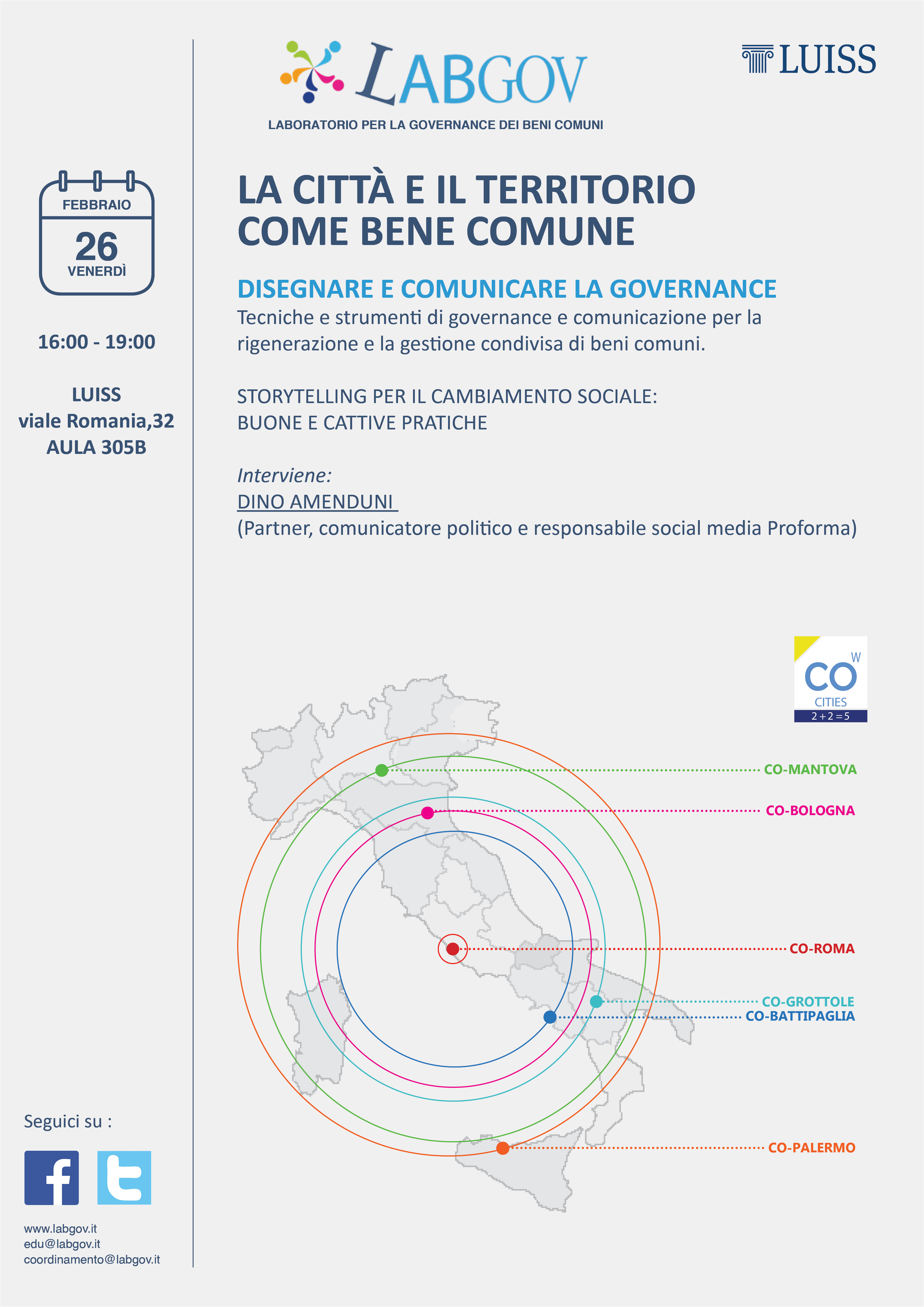
On the 26th of February the keynote speaker will be Dino Amenduni, one of the best international experts in social communication. He is partner of Proforma, the communication agency who d esigned the campaigns of political characters as Vendola and Renzi, of organizations such as CGIL, of companies and various multinationals.
We will ask him advices on how to communicate our project ( CO-Roma ) to the city and how to mobilize the resources of the crowd. We are going to talk about storytelling, what is and where storytelling came from .
Firstly he will explain us how to make a campaign through ten fundamental points. In a second moment, LabGov will discuss with him about his last project and his work of Rome’s commons mapping: LabGov is waiting for Dino Amenduni and his suggestions. Nowdays communication and how to comunicate is the first step to bring the projects to succeed; Dino Amenduni will share with us him knowledge about it.
————————————————————————————-
Il 26 febbraio il keynote speaker sarà Dino Amenduni, uno dei maggiori esperti nazionali di comunicazione social. È partner di Proforma, l’agenzia di comunicazione che pensato le campagne di comunicazione di personaggi come Vendola e Renzi, organizzazioni come CGIL, aziende e multinazionali varie. Chiederemo a lui consigli su come comunicare il progetto nella città e su come mobilitare le risorse del crowd per contribuire con noi alla mappatura.
rticle written by many hands from Benedetta Gillio, Adriana Marasco
by Benedetta Gillio | Dec 23, 2015 | EducationLabs, Luiss LabGov 2015-2016
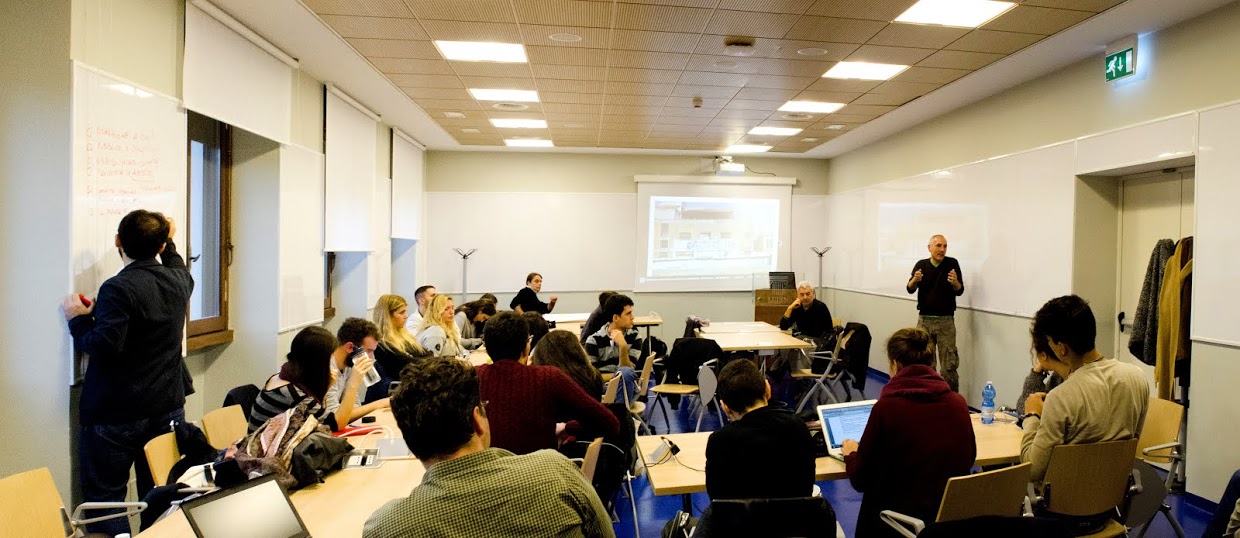
 On Friday November 20th , the first day of the LabGov weekend, was dedicated to the activities of co-design. The labgovers listened the experiences carried out in the four sites of experimentation identified: Garbatella, Appia Antica, Ostia and Municipio V.
In each of the four areas, the new labgovers have visited some really active environments meeeting and their activators and founders. Together they reasoned about the difficulties they face every day and how to intervene to continue to carry on their efforts, with strong aggregation and deep innovation. At Garbatella, for example, they have been visited the co-working Millepiani, the CSOA La Strada and the FabLab. These collaborative spaces, as explained Maurizio Moretti, are signals of the needs and demand of citizens. In every field, they found more or less the same problematic situations, with this lack of dialogue with the administration every obstacles seems giant.
In particular, in the neighborhood a common good of cognitive nature of Ostia was identified, namely the Istituto Tecnico Urbani, a high school with great potential. It is a school characterized by a very proactive teaching body, but at the same time a place in unsuitable conditions, nearby a very large and completely abandoned park. The situation is further complicated by the detached school of Acilia, which has the same administration and headmaster that is facing enormous difficulties due to the management of the two institutions apart from each other. The idea is to intervene to make the most of these cognitive and cultural heritage useful for the students and citizens,most of the hardest part of the project is to find the necessary funds to buy the materials for the schools and teachers to enable them to work better.
Another school has been mapped Pisacane school in the district Prenestino, a real intercultural concentration in one of the Romans with the highest number of immigrants. In Municipio V, in addition to the school, other milestones have been the Alveare and the former factory Cantarini. The Alveare is one of the first co-working space with Babysitting in Rome, as the main problem of the allocation of space now expiring. you need to find a way clear and quick assignment of collaborative spaces to ensure the many citizens and professionals who revolve around them to continue their activities. Another stop on Municipio V has been precisely the former factory Cantarini, an abandoned industrial area in 2014 that could become an important resource for the whole neighborhood.
Finally, the inspection of the Appia Antica Park was primarily organized in three milestones: the first in the Hortus Urbis, not a simple garden! The Labgovers listened to the stories and experiences of some of the people who work there, it is a real place of integration and dissemination of knowledge. They were subsequently visited the Cartiera Latina, a structure which often hosts exhibitions and conferences, and the Casale di Vaccareccia, for now largely abandoned. They focused on another highly critical point of the park represented by the mobility obstacle, in particular cycling is practically impossible.
This was followed by a moment of co-design, during which the labgovers, having posted placards, each with a theme, started to write on post-its their ideas, highlighting on the critical issues, opportunities and actions to solve the various problematic ideas identified. Then a moment of confrontation follows with experts from various sectors, such as Roberta Franceschinelli, creator of the Culturability Competition for the foundation Unipolis, Prof. Luigi Corvo, who stressed the importance to intercept the civic need to intervene where there is a more concrete need.
This concept was then taken up by Michele Gradoli, who argued that the objective must be thought in concrete and deep manner with a strong knowledge of the places where you are going to work. Instead ,Nicola Cabria for Human Foundation invited the labgovers to take this model of analysis in all areas of life: turning problems into opportunities, reversing the negative situation into a positive is the best mantra.
The architect Eloisa Susanna recalled that the temporary use can be a very important tool for urban regeneration that allows the immediate reactivation of the abandoned areas.
The second day, November 21st, was divided into two parts: the first during which Giorgio De Finis, director of the MAAM (Museo dell’altro e dell’Altrove), told them about the Museum and its development, and second part during which the students, around the tables of co-design, continued to give shape to their ideas in the search for the termination to the problems and limits identified for each common good.
The tables of co-design and, more generally, these two days have shown what can be challenged, and what Rome really needs. All this first phase, in fact, served just to try to understand the city, its problems, its needs and desires. We understand that it will be a long and difficult process, but so worth it to wait and to get busy on.
————————————————————
Sessione di co-progettazione del 20/21 Novembre
La prima giornata del workshop, venerdì 20 Novembre 2015, è stata dedicata alle attività di co-progettazione. I ragazzi hanno raccontato i sopralluoghi effettuati nei quattro cantieri di sperimentazione individuati: Garbatella, Appia Antica, Ostia e Municipio V.
In ciascuno dei quartieri, i nuovi labgovers hanno visitato alcune delle realtà attive e hanno conosciuto i loro attivatori; insieme hanno ragionato sulle difficoltà che incontrano ogni giorno e su come poter intervenire per continuare a svolgere le proprie funzioni di formazione, aggregazione e innovazione. A Garbatella, ad esempio, è stato visitato il co-working Millepiani, il CSOA La Strada e il FabLab. Questi spazi collaborativi, come ha spiegato in un secondo momento l’arch. Moretti, tra le loro funzioni hanno quella di segnalare i bisogni e le richieste dei cittadini. Riscontrano tutti più o meno la stessa problematicità, ovvero il mancato dialogo con l’ amministrazione, i cui tempi e meccanismi di funzionamento non sono altro che un ostacolo.
In particolare, nel quartiere di Ostia è stato individuato un bene comune di natura cognitiva, ovvero l’Istituto Tecnico Urbani. Si tratta di una scuola caratterizzata da un corpo docenti molto propositivo e desideroso di fare, ma al tempo stesso da luoghi in condizioni non idonee, ad esempio uno spazio verde, adiacente alla scuola, molto grande e completamente abbandonato. La situazione è resa ancor più complicata dalla sede distaccata di Acilia, che ha la stessa amministrazione che quindi incontra enormi difficoltà dovute anche alla gestione dei due istituti distanti l’uno dall’altro. Bisognerebbe intervenire e riuscire a sfruttare al meglio questi beni cognitivi e culturali e trovare i fondi necessari per acquistare i materiali utili agli studenti e ai docenti per metterli nelle condizioni di lavorare al meglio.
Altra scuola mappata è stata la scuola Pisacane, nel quartiere Prenestino-Centocelle, un vero e proprio presidio interculturale in uno dei quartieri romani con il più alto numero di immigrati. Nel Municipio V, oltre alla scuola, altre tappe sono state l’Alveare e l’ex fabbrica Cantarini. L’ Alveare è uno dei primi co-working con spazio baby di Roma, ha come problema principale quello dell’assegnazione di uno spazio ormai in scadenza. E’ necessario trovare una modalità chiara e rapida di assegnazione degli spazi collaborativi in modo da garantire ai tanti cittadini e professionisti che ruotano intorno ad essi di proseguire le loro attività. Altra tappa del Municipio V è stata appunto la ex fabbrica Cantarini, un’area industriale dismessa dal 2014 che potrebbe diventare una importante risorsa per tutto il quartiere.
Infine, ma non per questo meno importante, il sopralluogo nel Parco dell’Appia Antica organizzato essenzialmente in tre tappe: la prima nell’Hortus Urbis, non un semplice orto! Ascoltando le storie ed esperienze di alcuni dei soggetti che vi operano, si tratta di un vero e proprio luogo d’integrazione e diffusione di conoscenze. In seguito sono stati visitati la Cartiera Latina, struttura che ospita spesso mostre, convegni, (anche se va registrato un suo grande limite: l’assenza di un impianto di riscaldamento non ne consente il suo pieno utilizzo), ed il Casale della Vaccareccia, ormai per gran parte in stato di abbandono. Un’altra grande criticità del parco è rappresentata, inoltre, dalla mobilità, in particolare ciclabile, praticamente impossibilitata.
A ciò è seguito un momento di co-progettazione, durante il quale i ragazzi, dopo aver affisso dei cartelloni, ciascuno avente un tema, hanno iniziato a scrivere su dei post-it le loro idee, evidenziando le criticità, le opportunità e le azioni possibili per risolvere le varie problematicità individuate. A seguire un momento di confronto con esperti di vari settori come Roberta Franceschinelli, ideatrice del Concorso Culturability della fondazione Unipolis, il Prof. Luigi Corvo, che ha sottolineato l’ importanza di intercettare il bisogno civico e di intervenire laddove c’è una maggiore concretezza di intervento.
Quest’ultimo concetto è stato poi ripreso da Michele Gradoli, sostenendo che bisogna pensare all’obbiettivo in concreto e conoscere approfonditamente i posti su cui si sta andando a lavorare. Nicola Cabria, per Human Foundation, ha invitato i ragazzi ad assumere questo modello di analisi in ogni campo della vita: trasformando i problemi in opportunità, ribaltando la situazione negativa in positiva. L’architetto Eloisa Susanna ha ricordato come l’uso temporaneo possa essere uno strumento di rigenerazione urbana molto importante che consente la riattivazione immediata di spazi abbandonati, come ad esempio nel caso delle aree industriali dismesse e Maurizio Moretti di ADLM architetti ci ha mostrato in un video come questo tema potrebbe essere declinato all’interno del V Municipio.
La giornata successiva del 21 Novembre si è divisa in due momenti: un primo durante il quale Giorgio De Finis, direttore del MAAM (Museo dell’ Altro e del’Altrove), ha raccontato di come è nato il Museo e dei suoi sviluppi, ed un secondo momento durante il quale i ragazzi, attorno a dei tavoli di co-progettazione, hanno continuato a progettare, a dare una forma alle proprie idee nella ricerca di quella risolutiva per i problemi e limiti individuati per ciascun bene comune.

I tavoli di co- progettazione e, più in generale, queste due giornate hanno dimostrato quanto possa essere stimolante ed efficiente unire le forze, ed è proprio quello di cui ha bisogno Roma. Tutta questa prima fase, infatti, è servita proprio a cercare di capire la città, i suoi problemi, i suoi bisogni e desideri, con la consapevolezza che sarà un processo lungo e difficile, ma per cui vale la pena di aspettare e soprattutto darsi da fare.

by Benedetta Gillio | Dec 10, 2015 | The Urban Media Lab
On the 9th of December, professor Christian Iaione, LabGov coordinator, was guest of the event organized by FuturaTrento at Bookique , a literary cafè that became a place where experts and citizens can share their ideas through the word because ideas are instruments able to change reality.

The main topic discussed was the sharing as a tool to promote the care and the regeneration of the commons. After all, how he said < a common good is a sharing good > that needed the alliance between institutions, that should have the duty of making the best conditions to administrate that resources, and communities, to survive.
The sharing is, also, at the heart of contemporary discussion about economic theory: from the sharing economy to the the pooling economy, a new economy composed of “collaborative economy”, sharing economy initiatives that foster peer-to-peer approach and/or involve users in the design of the productive process or transform clients into a community; and of “commons-based economy”, “open cooperativism”, “open platform cooperativism” for sharing economy initiatives that are collectively owned or managed, democratically governed, do not extract value out of local economies but anchor jobs, respect human dignity and offer new forms of social security.Recently, on December the 4th the Committee of the Regions adopted the opinion on sharing economy written by Christian Iaione and Benedetta Brighenti, deputy major of Castelnuovo Rangone and Alternate Member of the Committee of the Regions ( COR ), with the collaboration of a team of researchers and practicioners.
All of these changes and new concepts are the symbol of this age of transition, characterized by the need of a new form of governance based on a strong partnership and collaboration between public, institutions, creative citizens and businesses.
This process of individuation of the appropriate governance tools is not so easy, but it is necessary for the local, regional, and national development. It is our future.
More information are available here:
MLOL – Provincia di Trento – Scheda media _Corriere del Trentino_
—————————————————————————-
Nella giornata del 9 Dicembre, il Professor Iaione ha partecipato al caffè dibattito Bookique, organizzato da FuturaTrento. Si è discusso di condivisione, beni comuni, sharing economy: i punti di partenza per riformulare la governance.

by Benedetta Gillio | Sep 30, 2015 | EducationLabs, Luiss LabGov 2015-2016
The fourth edition of LUISS LabGov Educational Lab (workshops, co-design sessions and fieldwork) will re-start on October 2nd, 2015! The meeting will be held in Viale Romania, 32 – 00198 Rome at 4.00 PM.
After focusing on Bologna, Mantua and Battipaglia, the new Edu Lab will a ddress Rome, its potentials and weaknesses at a very difficult time for the city, its institutions, and its society. The Laboratory will aim to design a Commons-based collaborative governance tool tailored to the needs and characteristics of the Italian Capital City. As we have done until now, we will apply the CO-Cities approach, based on a strong partnership between institutions, the private sector and the community. The five souls of the collaborative governance (social innovation, public authorities, schools/universities, businesses, organized civil society) will work together to re-design their own city, making it more economically sustainable.
The CO-Cities approach requires opening experimentation grounds. LabGov 2015/2016, together with many partners representing CO-Rome, will open and manage several urban cooperation grounds in different areas of the City: The Lab will focus on Garbatella neighborhood, the Appia Antica Park, a high school in Ostia and the V Municipality (Prenestino-Centocelle). They represent four different types of urban commons to regenerate and invest in. The Lab will take this long, but very stimulating journey in the City with many allies, partners and friends who will provide insightful advice to prototype a Commons-based collaborative governance for Rome. The Laboratory stays open to contributions, help and advice. Collaboration will run Rome as a Commons, because Commons need appropriate governance tools.
_____________________
La quarta edizione di LUISS LabGov (workshops, sessioni di co-design e fieldwork) ripartirà il 2 ottobre 2015 alle ore 16.00 in Viale Romania, 32 – Roma!
Dopo i grandi risultati ottenuti a Bologna, mantova e Battipaglia, il nuovo LABoratorio per la GOVernance dei beni comuni riprenderà le sue attività concentrandosi sulla Città Eterna: Roma. Anche in questo caso, le 5 anime della governance collaborativa (social innovation, istituzioni, Università , imprese e società civile) collaboreranno per RIcostruire Roma, rendendola più vivibile e sostenibile.
Vi aspettiamo!

by Benedetta Gillio | Jul 26, 2015 | Commons Press, The Urban Media Lab
The European Union Committee of the Regions, the EU’s Assembly of Regional and Local Representatives, has launched an initiative to open at the EU level the discussion on what is known as “sharing economy” and/or “collaborative economy“. The name itself and the scope is under scrutiny. Several EU institutions are working on similar if not identical subjects, using different label such as collaborative economy, circular economy or commons-based economy.
Benedetta Brighenti, Vice Mayor of Castelnuovo Rangone, will act as political rapporteur and Christian Iaione, LabGov director, will act as technical expert appointed by the Committee to carry out the consultation process with stakeholders and later the actual drafting of the CoR opinion.
Many European, national and local policymakers, public officials, scholars and practitioners from all over Europe willing to contribute to the CoR opinion drafting process will be involved in the launch of a new platform on sharing/collaborative economy.
The final version of the opinion is going to be approved on December 3.4, 2015. By the end of August, Brighenti and Iaione will deliver the draft opinion on which the consultation process will be carried out. The main moments of the consultation process are going to be held in Berlin at the CoR ECON Commission meeting on September 28, 2015, in Rome at LUISS University within a conference on the Smart Collaborative City on October 12, 2015, and The City as a Commons conference in Bologna on November 6-7, 2015, Milan on November 9-10 at SharItaly.
Brighenti and Iaione are willing to meet and involve as many public officials, practitioners, operators and scholars as possible in the discussion and will be available to hold deep dives, hangouts or workshops in other European cities that are willing to organize them.
Find below the working document that paves the way for the CoR opinion:
COR-2015-02698-00-00-DT-TRA-EN
COR-2015-02698-00-00-DT-TRA-ES
COR-2015-02698-00-00-DT-TRA-NL
COR-2015-02698-00-00-DT-TRA-FR
COR-2015-02698-00-00-DT-TRA-DE
COR-2015-02698-00-00-DT-TRA-HR
COR-2015-02698-00-00-DT-TRA-RO
COR-2015-02698-00-00-DT-TRA-BG
COR-2015-02698-00-00-DT-TRA-SL
COR-2015-02698-00-00-DT-TRA-SK
COR-2015-02698-00-00-DT-TRA-PL
COR-2015-02698-00-00-DT-TRA-MT
COR-2015-02698-00-00-DT-TRA-LV
COR-2015-02698-00-00-DT-TRA-HU
COR-2015-02698-00-00-DT-TRA-ET
COR-2015-02698-00-00-DT-TRA-CS
COR-2015-02698-00-00-DT-TRA-FI
COR-2015-02698-00-00-DT-TRA-EL
COR-2015-02698-00-00-DT-TRA-DA
COR-2015-02698-00-00-DT-TRA-PT
—————————-
Il Comitato delle regioni ha appena lanciato una iniziativa per aprire o riaprire la discussione su un nuovo paradigma sociale, economico e istituzionale che viene definito economia della condivisione, e che include, si integra o sovrappone ad altre forme di nuova economia come l’economia collaborativa, l’economia circolare, l’economia dei beni comuni.
COR-2015-02698-00-00-DT-TRA-IT_sharing economy

 esigned the campaigns of political characters as Vendola and Renzi, of organizations such as CGIL, of companies and various multinationals.


