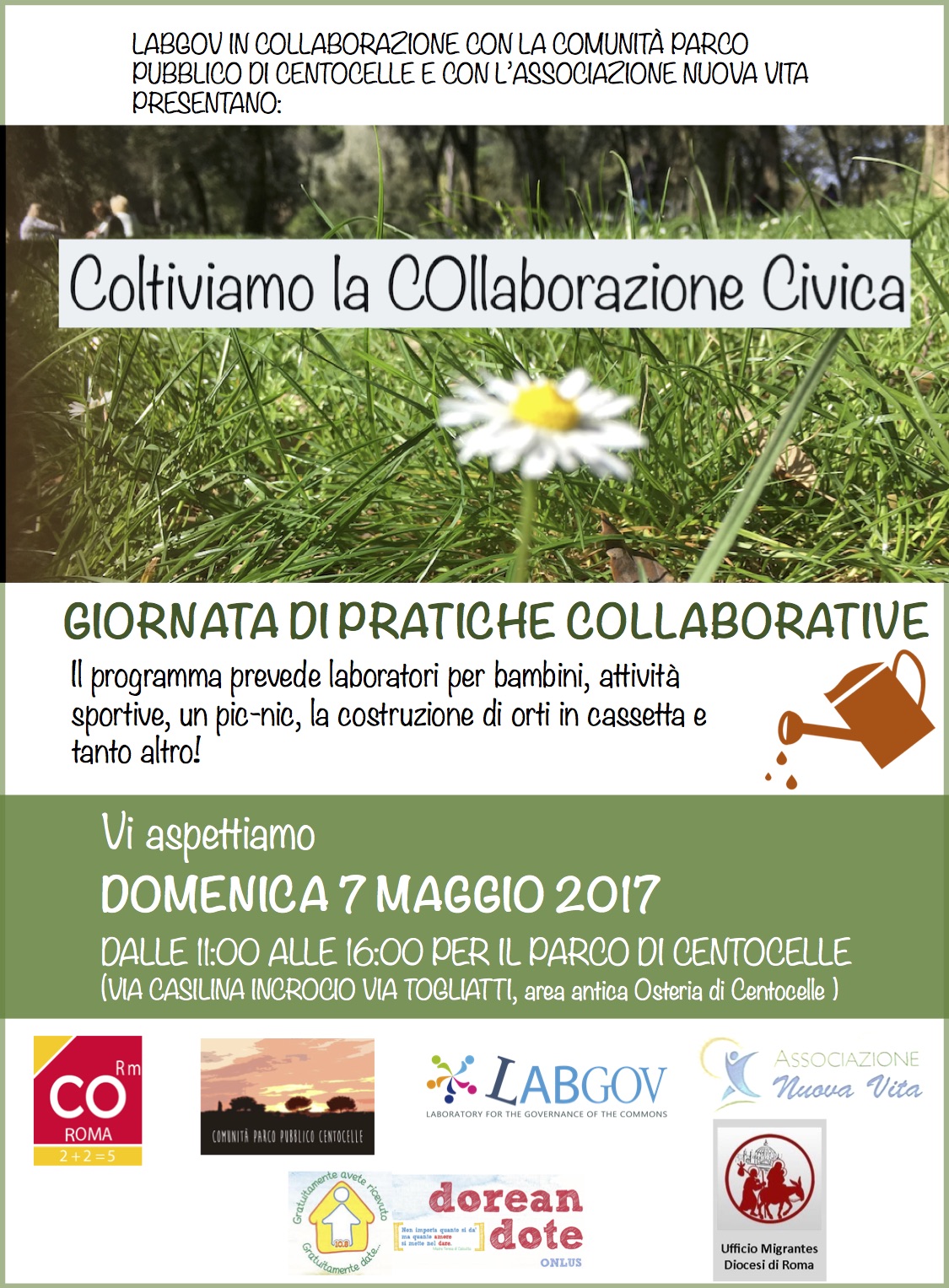
On Sunday, May 7th, the labgovers 2016/2017, in collaboration with the Comunità Parco Pubblico Centocelle and Associazione Nuova Vita, and in the context of the Co-Roma process, organize “Coltiviamo la COllaborazione Civica“: a day of collaborative practices, as the final step of the lab.
During the day there will be labs for kids, sport activities and a practice of community garden with recycled materials: the community garden comes out from the university once again, to plant the collaboration seed.
Domenica 7 maggio i labgovers anno 2016/2017, in collaborazione con la Comunità Parco Pubblico Centocelle e con l’Associazione Nuova Vita, e nell’ambito del processo Co-Roma, organizzano “Coltiviamo la COllaborazione Civica“: una giornata di pratiche collaborative, come step conclusivo del laboratorio.
La giornata prevede attività laboratoriali per bambini, giochi, attività sportive, e una pratica di orto collaborativo con materiali riciclati: l’#OrtoLuiss esce ancora una volta dall’università per piantare il seme della collaborazione.
Appuntamento alle 11.00 all’incrocio tra Via Casilina e Via Palmiro Togliatti!
On Thursday, May 4th, and Friday, May 5th, the city of Rome is going to host URBANITAS, the first forum for a sustainable, resilient and creative city. Public institutions, research centers, enterprises, national and international stakeholders will be involved in a 2-days forum tailored for the promotion of a dialogue about the future of the city of Rome according to the New Urban Agenda and The City We Needprinciples, and for the elaboration of concrete proposals in the context of 5 thematic areas: governance and commons, co-design, creative districts, mobility and circular economy.
The forum, organized by Ordine degli Architetti di Roma and Open City Roma, is articulated in two days:
May 4th @MAXXI: the first part of the day will be dedicated, after an opening plenary, to an Urban Thinkers Session, where urban best practices will be presented by experts. LabGov’s co-founder, Christian Iaione, is going to attend this session. Afterwards, the forum is going to host 6 Urban Thinkers Labs.
May 5th @Sala Convegni AIL: the morning will be fully dedicated to a plenary session on mobility. The afternoon provides 4 round tables with experts, academics and councillors from Rome’s Municipality. After the end of Urbanitas works, Open House Roma (the annual event on urban culture and architecture) is going to start.
Registration to one or more sessions are available at this link.
Il 4 e 5 maggio 2017 Roma ospiterà Urbanitas,il primo forum per una città sostenibile, resiliente e creativa, che coinvolgerà istituzioni, enti di ricerca, imprese, cittadini, stakeholder nazionali e internazionali per promuovere un dialogo sul futuro di Roma ed elaborare proposte concrete in 5 aree tematiche specifiche: governance e beni comuni, co-design, distretti creativi, mobilità dolce ed economia circolare.
E’ possibile registrarsi a una o più sessioni a questo link.
The City of Madrid, from April 19th to April 21st, is hosting the World Forum on urban violence and education for coexistance and peace, an event designed for being a meeting place for academics, local leaders international networks, NGOs and actors from civil society in order to open a process of debate, reflection and co-design over solutions that foster urban environments able to remove the expressions of violence in the city.
LabGov, with its co-founder Christian Iaione, will be attending the Forum and participating in first person during one of the workshops proposed during the Forum: Nueva institucionalidad, bienes comunes y experimentación jurídica, that will be held on Thursday 20th in Aula 3 (La N@ve Boetticher) from 9 to 10 AM.
The Forum aims to identify the main challenges of violence and conflicts that cities should cope with and facilitate the exchange of experiences and offer alternatives to ensure coexistence. To do this, the problem should be addressed with practice, focusing on those experiences of education for coexistence and peace where solutions are identified.
The complete program of the Forum is available on the official website.
La Ciudad de Madrid alojará desde el 19 al 21 de abril el Foro Mundial sobre las Violencias Urbanas y Educación para la Convivencia y la Paz. Se trata de un evento diseñado para ser un espacio de encuentro entre académicos, líderes locales, redes internacionales, ONGs y actores de la sociedad civil con el objetivo de abrir un proceso de debate, reflexión y co-diseño de soluciones que promuevan contextos urbanos capaces de eliminar las expresiones de violencia en la ciudad.
LabGov, representada por su co-fundador Christian Iaione, asistirá al Foro y participará en primera persona durante uno de los talleres propuestos durante el evento: Nueva institucionalidad, bienes comunes y experimentación jurídica, el cual se realizará el jueves 20 de abril en el Aula 3 (La N@ve Boetticher) de 9 a 10 de la mañana.
El Foro busca identificar los principales desafíos de violencia y conflictos en los que la ciudad debería enfocarse y facilitar el intercambio de experiencias, así como ofrecer alternativas para garantizar la convivencia. Para esto, el problema debería ser abordado desde la práctica, focalizando en aquellas experiencias de educación para la convivencia y paz donde se identifiquen soluciones.
El programa completo del Foro se encuentra disponible en la pagina oficial.
El programa del taller se encuentra disponible aquí.
Save the date! Venerdì 7 e sabato 8 aprile ultimo co-working di LabGov EDU 2016/2017, con ospiti d’eccezione.
Venerdì, dalle 16.00 alle 19.00 in aula 307/a, il prof. Francesco Rullani presenterà un intervento su “Società 4.0: Social Innovation e Social Entrepreneurship come nuovi strumenti per affrontare nuovi sfide”.
Sabato la giornata sarà divisa in due: la mattina Enrico Fontana, Laura Marino e Luca di Addezio di Legambiente parleranno ai labgovers di economia civile. Il pomeriggio invece sarà dedicato alla pianificazione delle prossime attività on field e al co-design del prossimo anno di laboratorio.
The City of Turin is currently hosting the fifth edition of the Biennale Democrazia, a cultural event promoted by the City of Turin and by the Fondazione per la Cultura Torino, with the aim of spreading a culture of democracy that is able to result in democratic practices. The 2017 edition is fully dedicated to the concept of emergency, to the uses and abuses of this term, and to all the things that this word hides and shows.
The theme of this fifth edition is articulated in five thematic routes:
State of necessity
Society of uncertainty
New beginnings
Focus_Questions to Europe
Focus_The city that changes
LabGov, with its co-founder prof. Christian Iaione, will attend the Biennale Democrazia on Saturday, April 1st, during the panel “Storie di beni comuni” (“Stories of Commons”), coordinated by Alessandra Quarta and attended by Gianluca Cantisani and Roberto Covolo as well. The panel is organized in collaboration with the “Servizio Arredo Urbano, Rigenerazione urbana e Integrazione della Città di Torino” within the framework of the CO-CITY project.
The three speakers are going to investigate the new models of urban welfare and of community co-production. Some of the most significative experiences in Italy are going to be analyzed, in order to show how with the co-management of commons, innovative government tools and paths can be activated.
Dal 29 marzo al 2 aprile la città di Torino ospita la Biennale Democrazia, giunta alla sua quinta edizione e quest’anno dedicata al tema dell’emergenza, agli usi e agli abusi di questo termine così usato negli ultimi anni, e a tutto ciò che la parola nasconde e manifesta.
Il prof. Iaione, co-fondatore di LabGov, parteciperà insieme a Gianluca Cantisani e Roberto Covolo, il primo aprile alle ore 11.00 al panel “Storie di beni comuni”, moderato da Alessandra Quarta e organizzato in collaborazione con il Servizio Arredo Urbano, Rigenerazione urbana e Integrazione della Città di Torino, nell’ambito del progetto CO-CITY. Durante il panel verranno investigati nuovi modelli di welfare urnano e di co-produzione di comunità. Saranno analizzate alcune delle esperienze più significative in Italia, per dimostrare come con la co-gestione dei beni comuni possano essere attivati strumenti e percorsi di governo innovativi.

 collaboration with the Comunità Parco Pubblico Centocelle and Associazione Nuova Vita, and in the context of the Co-Roma process, organize “Coltiviamo la COllaborazione Civica“: a day of collaborative practices, as the final step of the lab.




