
by Francesca Spigarolo | Apr 4, 2017 | The Urban Media Lab
A semiotic reading of the business incubation world, towards a model of collaborative incubation between small ecosystems.
This article originally appeared in Italian on Doppiozero.
Since a few years something interesting has been observed around the word “incubation”. Metaphorology scholars define it as “catachresis”. As happens (happened) to the Italian locution “la gamba del tavolo” (the table leg), we are dealing with a phenomenon where a metaphor settles itself in our language, moving from being a “tropo” to real language, so passing from being a rhetoric figure to an independent item included in dictionaries and encyclopaedias. The expression does not need any more to make different worlds communicate with each other (which is the main aim of the metaphors). In our days no one while saying “table leg” has the impression of being using a metaphor. In the same way, (almost) no one, speaking about “incubation”, really means to link the neonatology world to the start-up devices.
The word “incubation” has the power to create narrations so visionary and so relevant, but today it is living a saturation phase. There is enough space for a new way of business incubation, which could refill the hole created by lack of sense and activity in the world of support to the companies and that could go even further, opening new generations of modelling metaphors.
What is an incubator? According to the European Commission, during the 90’, was considered “incubator” a space where to concentrate services and support for the start-ups. Lately, at the beginning of the next decade, this definition already underwent a transformation. An incubator is not a space anymore but an organization, an activating subject, an accellerator, who provides services between which an incubation-space, services for supporting the business idea, network creations and opportunities. The definition even tells us that realizing a typology of incubators is possible with a preventive check of some broad variables: rules of employment and admission, functions and services, intensity of the supporting action. In the same report also appears a diagram that tries to make a topologic (in addition to a typologic) representation of the incubators:
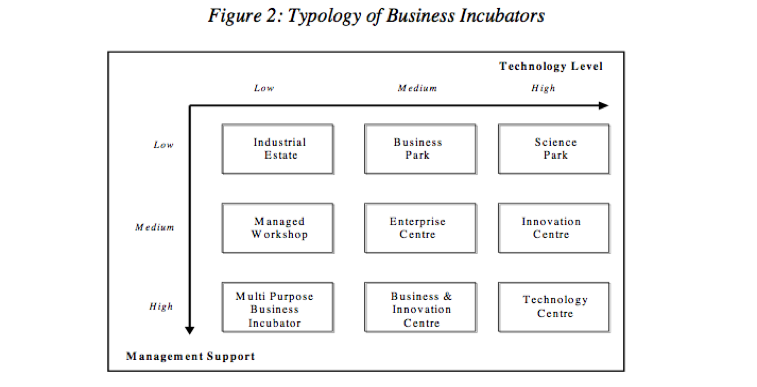
The two dimensions on which the map is constructed are the technological level and the management assistance. It means that the main features of the incubation, underlined by this source, are the financial support and the type of activity generated by the helped start up/s.
An important role is still played by the physical dimension of the “incubator” as a place, be it a park or a centre. In the following years, this word turned into an umbrella-term: it detached itself from the single activity to embrace a broader range of experiences, going from education to services providing, assistance, sponsor searching.
Back to the narrative sphere, “incubator” has an interesting oscillation of meaning, never taken afloat. Differently from what happens in the Italian language, where the word incubator is used both with a male and a female meaning, in the English one, the female acceptation doesn’t exist, making the word far from its bond with a maternal meaning.
The smart marketing is made of leading narrations: abstracts stories that deals with a complex system of values. An example of leading narration is the myth, which at the same time is general and peculiar. The myth, as all leading narrations, is so effective as it activates those values that represent the basis of a society. Myths are simplifications full of meaning. The narration that has been dominating during these years of fast development in the business support area is based on a kind of familiar relationship, as the one between father or mother and son, whose main feature is the support. In the paternal case, chronologically preceeding the second one, the support came out through the perspective of an economic remuneration; in the maternal one instead, through the physical take caring by giving spaces and other assets for the business development. It is as if we were saying (in this dominant and simplifying narrative) that the father gives a pocket money every month, while the mother takes care of the son. Both the parents make their sons depend on them for heir survival, in a kind of relationship one-to-one. As we can see, in the semiotic square standing downward (like a figurative Cartesian Diagram), in the upper axis are settled the two ruling logics, while in the lower one we find the logics of formation (quite totally paternal) and acceleration (quite totally maternal).
When we put in the diagram all the traditional incubation experiences, expression of the tension generated by these two values, we notice that there are more crowded sections contrasted by sections which are almost empty, and which could therefore be available for new players entering the market.
In all the experiences present in the diagram we observe the activation of a hierarchical relationship between the incubator and the incubated subject. Horizontal links are missing. In the open-innovation world, but generally in the collaboration sphere too, a more “collaborative” kind of narration can be discovered. In order to realize it we need a new leading narration, not based on parenting relationships anymore. In the main narration of traditional incubation, in fact, the collaborative logic brings to a negative competition (as between brothers). What we really need is a different logic, similar to the one that we have found studying the scientific communities, where collaborative platforms are already used in order to realize open innovation (in research), but ,moreover, that we have found during two years of considerations (shared between Kilowatt and Social Lab) developed thanks to the CoopUp Bologna experience.
In our experience (CoopUp Bologna as first experiment of community business incubation, ie. incubation ecosystem – our tribe) we noticed a different logic: more “tribal”, based on the construction of a practice and knowledge community, of a collaborative network, of tools for value distribution and creation, of opportunities for exchange, relationship and comparison, in a common growth perspective. To this, we want to dedicate the proposal of collaborative incubation, dedicated not to a single start-up but to ecosystems of new enterprises that are growing together (even together with already existing and structured companies). This proposal might not be suitable for all new businesses. Our experience is addressed in particular to the so-called cohesive companies, as defined by Domenico Sturabotti and Paolo Venturi, and in general to the startups with a “social vocation”, attentive to their impact and consequently not always feeling comfortable with a form of support that promotes a development model very different from that for which they – the new enterprises – have decided, in the first instance, to start a business.
It is possible and perhaps necessary to move from the familiar logic towards a collaborative logic: from the concept of family – dependence, to that tribe, where there is not a parent, but a chieftain – or a shaman – coordinating all (the community, the chain , etc.) and needing everyone to be independent but collaborative (and conscious), so that the whole community functions. The chieftain has to win the confidence of the community, which the parent is not required to do.
We must try to explore a new incubation narrative, starting from a new ecosystem model based on relationships, trust and community. We have grown too used (we catacresizzati) to import without reflecting models from outside, “in the periphery of the empire”, as it was common to say few decades ago. The economic and especially financial magnetism of the Silicon Valley has become a cultural values and entrepreneurial magnetism. Everyone’s commitment should be to recover a European and cooperative approach to the company support. It is specially for this reason that the tribe seems to us a narration which is worth exploring.
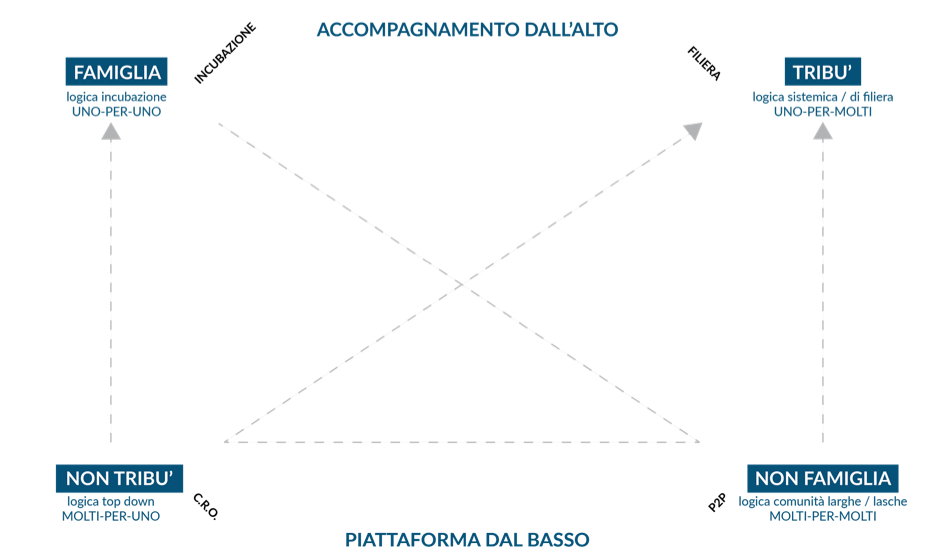
The ecosystem incubation square takes to hart the experiences developed in the last year in the open innovation field. It “contains” the traditional incubation square in the top-left corner, it displays open innovation in the bottom-left corner, the research and development and peer to peer experiences in the bottom-right corner and also leaves open an almost plain space in top-right corner. To say it differently: it is coming to maturity.
In the square of community incubation, in the collaborative and mutualistic ecosystem support, there is need of new figures. The first is a tribal chief, who brings into the system “soft” and interpersonal skills and tools of community organizing. He is in some ways shamanic: his relationships are based on a trust channel, he must be able to read the “health” of an entire community, he needs to know how to manage community-driven dynamics. He is able to go beyond the single sector and above all he knows how to manage in a participatory way the community engagement dynamics. Finally, he knows how not to create dependence on its presence.
But there is not only the head of the tribe, the shaman who knows how to have a systemic vision, the community ecosystem managers. There are also the “community leaders”, situational leaders that activate according to their own talents and skills: those who depending on the specific objective can activate and strengthen the accountability of the entire ecosystem. In open innovation there can be large organizations who work as flying start, which signal a need for innovation that can then activate different collective growth experiences. But also, communities and informal groups, pushed by intense motivation, competence, talent.
The tribe operates as a system in which cooperation prevails over competition. The tribal chief maintains the vision and is able to measure out the roles of the community participants. In the semiotic square of collaborative incubation it is important to firstly populate the team of interlocutors who accept the challenge to co-manage their role as community leaders. We are in an almost-smooth space, more rhizomic that hierarchical, where wit is more important to know how to manage relationships than how to defend positions. “In the smooth […] the points are subordinated to the journey”, was said in Mille plateaux of Deleuze and Guattari. A common journey.
————————————————–
In questo articolo, originariamente pubblicato su Doppiozero, Gaspare Caliri propone una lettura semiotica del mondo dell’incubazione d’impresa e ripercorre la storia del termine “incubazione”, nato come una metafora ed ormai entrato nei nostri dizionari.
“È necessario provare a esplorare una nuova narrazione dell’incubazione, partendo da un nuovo modello di ecosistema basato sulla relazione, sulla fiducia e sulla comunità”

by Francesca Spigarolo | Mar 30, 2017 | The Urban Media Lab
On Friday the 31st of March 2017, the city of Turin will host an event to launch the project Co-City, developed by ANCI, the City of Turin, Turin University, FirstLife and Rete delle case di Quartiere.
The Co-City project, developed within the framework of the European program Urban Innovative Action (UIA), aims at experimenting innovative solutions to regenerate abandoned spaces or/and structures and to fight urban poverty in the most problematic areas of the city. The city will favor the creation of collaboration pacts between different urban actors, and it will stimulate a dialogue at the city level but also at national and European level with universities, innovators, private actors, institutions and members of the civil society.
The launch of the project will be an occasion to present the actions that will be developed in the city, and also to discuss the state of the art of the commons at national and international level. Numerous actors engaged in the field of urban regeneration and innovation will take part to the debate, enriching the discussion with examples coming from Athens (SynAthina), Amsterdam (Pakhuis De Zwjiger), Barcelona (project UIA), Lisbon (BipZip) Milan, Reggio Emilia and Bologna.

The event will begin at 10am, with the institutional greetings from the deputy major Guido Montanari and from the Turin University Dean Gianmaria Ajani, followed by the presentation and discussion of the experiences and studies of several experts. Then, the Co-City project itself will be presented, and afterwards some cities will share their own experience regarding the governance of urban commons. The speech of Marco Giusta, Assessor to the coordination of policies for multiculturalism and integration of the new citizens of Turin, will conclude the event. Afterwards the participants will be invited to take part in an Aperitivo, an occasion to continue the conversation in a more informal setting.
The event will certainly be an interesting occasion to discuss about urban commons and about their strategic role in shaping the future of our cities. More information on Co-City launch event are available here.
—————————————————————
Nella giornata di venerdì 31 Marzo, nella città di Torino presso l’ex Incet, si terrà l’evento di lancio del progetto Co-City, vincitore insieme ad altre 18 città del bando Urban Innovative Action (UIA).
Il progetto prevede l’utilizzo di patti di collaborazione come strumenti di rigenerazione urbana e lotta contro la povertà nelle aree più degradate della città.
Maggiori informazioni sull’evento sono disponibili a questo link.
by Francesca Spigarolo | Mar 23, 2017 | The Urban Media Lab
There is one kind of economy which is good: it is the economy which supports the quality of life of the whole community, creates the abundance of possibilities and opportunities needed to satisfy our needs without hurting others, embraces responsibility and nourishes solidarity. It is the economy which uses and shares the resources fairly, which respects the sustainability of the system.
It is about this kind of economy that the participants in the “4th Conference on Good Economy” will talk about during the conference that will take place in Zagreb from Thursday the 23rd to Saturday the 25th of March 2017. The conference, organized by The Green Network of Activist Groups and by Dobra Ekonomija will be a great occasion for speakers coming from all over the world to meet and exchange knowledge and experience on good economy models. From Delhi to Berlin, from Paris to Barcelona, Sarajevo, Wien, Lincoln or Rome, different practices have been developing: we observe the emergence of “collaborative economy” practices, “open factories”, ecological social enterprises, participatory and democratic governance experiences, collective ownership, and much more.
Professor Christian Iaione, LabGov co-founder, has been invited to the conference to speak about the idea of the “City as a commons” (discussed in this paper) and about the possibility to develop a urban co-governance framework. It will also be an occasion to present the experimentations conducted by LabGov in different Italian cities and in the international arena.
The “City as a Commons” and LabGov experience with urban co-governance in the city of Bologna will also be presented by Professor Christian Iaione during the “Good City for All” seminar, which will take place from the 24th to the 26th of March in the area of the Plitvice lakes. During the event the participants will address important questions, such as how we can coordinate and strengthen civil society’s strategies to tackle urban issues and influence the political agenda positively, within the framework of a European debate on the transformative power of urban politics in a two-fold event.

———————————————————————–
Nei prossimi giorni il Professor Christian Iaione, co-fondatore di LabGov, sarà in Croazia per parlare dell’idea di “The City as a commons” e delle sperimentazioni sviluppate da LabGov a Bologna e in diverse città italiane e straniere con lo scopo di sviluppare nuove forme di co-governance urbana.

by Francesca Spigarolo | Mar 9, 2017 | The Urban Media Lab
On Tuesday the 15th and Wednesday the 16th of March 2017, the city of Reggio Emilia will host the 2-days conference “Social innovation, commons, collaboration models. Cities and local communities development”.
The event will bring together experts, policy makers, social innovators and citizens, and will be a valuable occasion to reflect on the transformations that contemporary cities are undergoing and on the challenges they are facing. Furthermore, it will be a moment to discover and analyze the numerous practices and experimentations which are being developed by Italian cities, which are trying to provide an answer to the complex and overlapping issues experienced in the urban environment. Cities are being transformed thanks to social, economic and cultural initiatives, which are activated by a variety of urban actors, from institutions to private actors, universities and members of the civil society (associations and citizens). These actors are collaborating and finding new ways to work together in different sectors of urban policies, creating in this way a community of urban innovators.
During the conference, taking as a starting point the experiences of Collaboratorio Reggio and QUA (Quartiere bene comune), activated by the Administration of Reggio Emilia, different topics connected to social innovation, collaboration and urban development will be discussed.
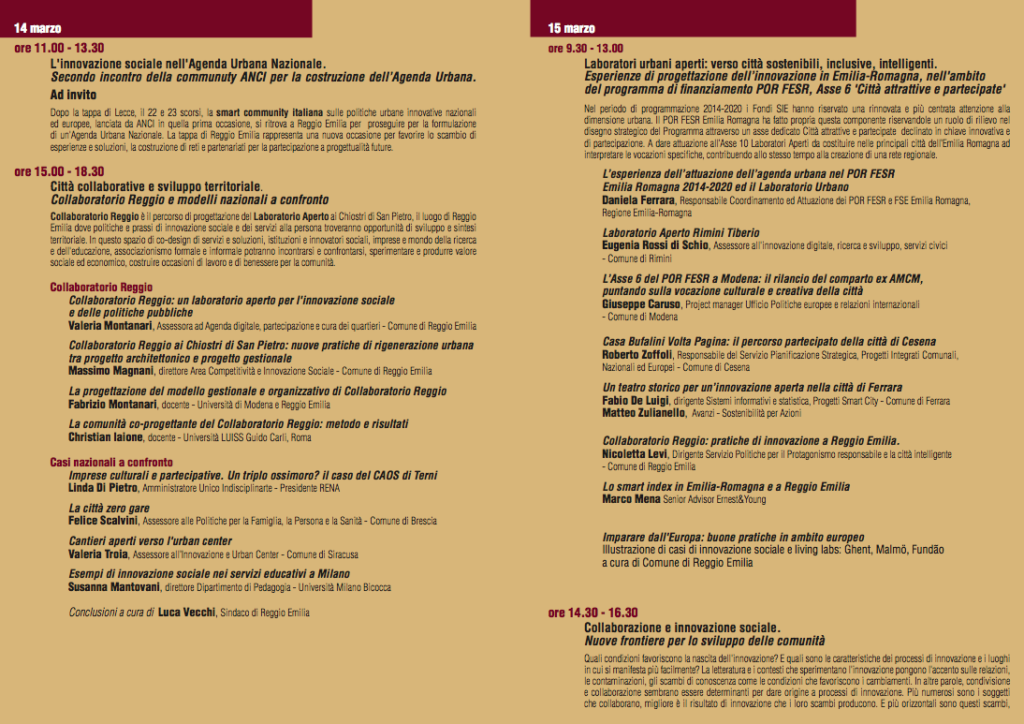
The conference will begin on the 14th of March at 11am with a discussion about the role of social innovation in the national Urban Agenda, which is being promoted by ANCI.
In the afternoon of the same day the discussion will turn to analyze the topic of “collaborative cities and local development” and the experience of Collaboratorio Reggio (a co-design path through which the identity and functions of a new urban actor, the Open Laboratory, were collectively imagined – more information on the path are available here) will be compared and connected to experiences developed all over the country.
The Collaboratorio Reggio path will be illustrated and analyzed thanks to the contribution of Valeria Montanari (Council Member for Digital Agenda, Participation and Care of the Neighborhoods), Massimo Magnani (Director of the Competitiveness and Social Innovation Area), Fabrizio Montanari ( Professor at the University of Modena and Reggio Emilia) and Christian Iaione (LabGov coordinator and Public Law Professor at UNI Marconi and LUISS Guido Carli University in Rome). Other experiences developed in different parts of the country will also be presented: from the case of CAOS in Terni, to that of “La città zero gare” in Brescia, from the development of the Urban Center of Siracusa to the social innovation experimentations activated in the field of education in Milan.
The morning of the second day will be dedicated to the topic of Open Urban Laboratories, which are being financed by the POR FESR Emilia Romagna with the aim of fostering innovation and participation as key components of a transformation process aiming at the creation of sustainable, smart and inclusive cities.
Afterwards, through a roundtable which will see the participation of, among the others, both Christian Iaione and Sheila Foster (LabGov co-founders), it will be possible to analyze the fundamental role of collaboration and social innovation in cities and community development, and in the improvement of citizens’ life.
The complete program of the event is available at the end of this article (in Italian).
———————————————————————————
Martedì 14 e mercoledì 15 marzo 2017, presso il Centro Internazionale Loris Malaguzzi di Reggio Emilia si terrà il convegno “Innovazione sociale, beni comuni, modelli di collaborazione. La città e lo sviluppo delle comunità locali”.
Le pressioni che i sistemi urbani subiscono in ragione dei processi di mutamento demografico, climatico, economico impongono alle città di dare risposta a sfide vecchie e nuove. Le città italiane non si sono fatte trovare impreparate, e hanno messo in campo una pluralità di pratiche e sperimentazioni all’insegna della collaborazione e riguardanti i diversi settori delle politiche urbane, attivando così una community dell’innovazione urbana.
Al protagonismo delle istituzioni si è accompagnato un crescente protagonismo delle comunità nella tutela dei beni comuni urbani. Le città sempre più si vanno trasformando grazie a iniziative sociali, economiche, culturali che nascono e sopravvivono tramite l’attivazione di nuove reti e relazioni. A partire dai progetti Collaboratorio Reggio e QUA – Quartiere bene comune, realizzati dal Comune di Reggio Emilia, parleremo con esperti della sfida dell’Agenda Urbana legata ai temi dell’innovazione.
Ecco il programma dell’evento, disponibile anche qui.

by Francesca Spigarolo | Mar 6, 2017 | The Urban Media Lab
During the last decade, Community Land Trust has been welcomed in many European countries by grassroots movements and policy makers alike as a valuable response to the increasing difficulties that a large portion of the population encountered to get access to decent and affordable housing. When trying to enter the housing market, people often face two obstacles. First, expensive private rent and even more high-priced individual private ownership have become out of reach for those who lack the financial power to afford it; secondly, the supply and quality of social housing has proven unable to meet the demand of a growing number of low-income people who seek access to it[1]. In spite of the lack of a long-term stable framework for the affordable housing sector in Europe,[2] a whole range of piece-meal solutions aimed at increasing the supply of affordable housing have been put in place through both public policy interventions at a State and regional level, and the activism of not-for-profit housing cooperatives, housing associations, and self-organized groups of people.
Especially concerned with the long-term affordability of housing for low- or moderate-income people, Community Land Trust has gained ascendancy among those solutions that are capable of responding to the pitfalls of the housing market and has consequently known an unprecedented spread throughout Europe during the last decade. Community Land Trust (also known by its acronym CLT) is a land ownership scheme capable of fostering housing long-term affordability while at the same time allowing the broad participation of the community involved[3]. Community Land Trust arrived on the scene in the United States in the late 1960s as an outgrowth of the Southern Civil Rights Movement and was originally used as a mechanism for African-American farmers to gain access to agricultural land[4]. Since then, CLT has steadily grown in importance across the United States, so far as it has been employed in urban and rural areas as a means to provide an alternative to low- and moderate- income people for affordable housing and neighborhood revitalization[5]. According to the National Community Land Trust Network (NCLTN), which represents the major association for CLTs in the United States[6], there were in 2011 “a total of 246 CLTs in the network with coverage in 45 states and probably about 6,000 homes in the land trusts’ hands across the country”[7].
Community Land Trust is a membership-based, non-profit organization chartered to hold and manage land in trust for the benefit of a given community. These three main elements – land, trust and community – are the core of the CLT model. As to the first element, land is held in trust by the CLT for the benefit of the community. Actually, the CLT acquires land through purchase or donation with an intention to retain title in perpetuity and to remove the land from the speculative market[8]. While permanently retaining title to the land, the CLT enters into long-term agreements with prospective low- or moderate-income residents, which are thus given ownership of buildings and improvements on the land. The result is a split between the ownership of land and improvements. As to the element of trust, stewardship or “trusteeship”[9] of the land for the long term is ensured by the CLT in different ways. Firstly, the ground lease set out a range of mutually agreed restrictions between the CLT and residents, such as resale-price, buyer-eligibility, occupancy, and use restrictions, which ensure that homes remain affordable for future buyers over time. Secondly, the CLT does not disappear once homes are eventually sold by leaseholders; on the contrary, CLT may retain an option to repurchase the buildings located on the land when residents wish to sell them and, in the event a resident defaults on her mortgage, the CLT may have a right to step in to prevent foreclosure[10]. As to the third element – community – the democratic governance structure of the CLT reflects the idea that CLT operates within a given community (a single neighborhood or an entire city) and that all members of the community should have a degree of control over the way the land is managed. First of all, membership of the CLT is open to anyone living within the boundaries of the community and not only to residents, each group having the responsibility of electing one third of the governing body. Moreover, the board of trustees – normally called Board of Directors – is tripartite and includes representatives of (i) residents of the trust-owned land, (ii) members of the community who do not lease land from the CLT, and (iii) other people who are meant to represent the public interest, such as public officials and non-profit organizations and funders.
The CLT model, including all the features described above, has been given legal recognition into the federal Housing and Community Development Act of 1992, where it is defined as
“a community housing development organization […]
(1) that is not sponsored by a for-profit organization;
(2) that is established to carry out the activities under paragraph (3);
(3) that:
(A) acquires parcels of land, held in perpetuity, primarily for conveyance under long-term ground leases;
(B) transfers ownership of any structural improvements located on such leased parcels to the lessees; and
(C) retains a preemptive option to purchase any such structural improvement at a price determined by formula that is designed to ensure that the improvement remains affordable to low- and moderate-income families in perpetuity;
(4) whose corporate membership is open to any adult resident of a particular geographic area specified in the bylaws of the organization; and
(5) whose board of directors:
(A) includes a majority of members who are elected by the corporate membership; and
(B) is composed of equal numbers of
(i) lessees pursuant to paragraph (3)(B);
(ii) corporate members who are not lessee, and
(iii) any other category of persons described in the bylaws of the organization”[11].
Since then, CLTs have steadily spread throughout the United States. The expansion of the CLT movement has been pushed by different factors. First, non-profit organizations have committed themselves to help groups to identify and reclaim vacant land and turning it into a community resource, as is the case for 596 Acres. Secondly, CLT has been increasingly welcomed by local administrations as a valuable response to the shortfalls of the public housing market. An example of this is the Request for Expressions of Interest (RFEI) recently issued by the New York City Department of Housing Preservation and Development (HPD), whose objective is to identify qualified groups who are interested in forming a CLT[12]. The formal recognition of CLT by legislation, the growth of a national CLT network, along with the increased attention of public authorities, have also favored the diffusion of the CLT model outside the United States. Along these lines, both groups and local authorities in several European countries have attempted to adapt the CLT model to national contexts and promote its use, being attracted by its ability to preserve long-term housing affordability while triggering neighborhood revitalization, both of which are much-needed in large European urban centers.
[1] For a thorough analysis of the situation of the housing market and related policy development in each of the European member States, see The State of Housing in the EU 2015, Housing Europe, the European Federation for Public, Cooperative and Social Housing
Brussels, available for download at http://www.housingeurope.eu/resource-468/the-state-of-housing-in-the-eu-2015 (last accessed on December 26th, 2016).
[2] This is one of the key findings of « The State of Housing in the EU 2015 ». A summary of the report is available for download at http://www.housingeurope.eu/resource-468/the-state-of-housing-in-the-eu-2015 (last accessed on December 27th, 2016).
[3] Its first advocates described CLT as “a social mechanism which has as its purpose the resolution of the fundamental questions of allocation, continuity and exchange”: The Community Land Trust. A guide to a New Model of Land Tenure in America, International Independence Institute, Center for Community Economic Development, 1972 (reprint 2007). In the book, the basic structure of CLT is also carefully explained.
[4] J. E. Davis, Origins and Evolution of the Community Land Trust in the United States, in J. E. Davis (ed.), The Community Land Trust Reader, The Lincoln Institute of Land Policy, Cambridge, Massachusetts, 2010, p. 3-47.
[5] According to Abramovitz, the reasons for the increased emphasis on affordability in the US are to be linked to “the massive number of low- and moderate-income rental units built under various subsidy programs in the late 1960s and early 1970s that have been in danger of being lost as affordable housing through mortgage prepayment. […] In addition, the rapid housing price inflation experienced in many parts of the country during the 1980s further strained the ability of the private housing market to sustain an adequate supply of affordable units”: D. M. Abramowitz, Community Land Trusts and Ground Leases, in 1 J. Affordable Hous. & Cmty. Dev. L. 5 1991-1992, p. 5.
[6] Information about the CLT network in the United States are available at http://cltnetwork.org
[7] See S. Soifer, “Community Land Trust”, in The Encyclopedia of Housing, 2012, p. 2.
[8] “A Community Land Trust takes land off the speculative market and places it in a regional, membership-based, non-profit corporation”: The Community Land Trust Handbook, Institute for Community Economics, 1983.
[9] J. E. Davis, Origins and Evolution of the Community Land Trust in the United States, cit., p. 18-19.
[10] For details concerning the functioning of CLT, see the CLT Technical Manual, available at http://cltnetwork.org/2011-clt-technical-manual/.
[11]See Housing and Community Development Act of 1992.
[12] http://www1.nyc.gov/site/hpd/developers/request-for-proposals/CLT-RFEI.page
Fabiana Bettini, Postdoctoral Researcher, Sciences Po Law School, Paris
This article is drawn from a broader research conducted in the framework of the ERC-funded project “INCLUSIVE” (2014-2019) led by Professor Séverine Dusollier and hosted by the Sciences Po Law School, Paris
——————————————————————
Nell’ultimo decennio il modello del Community Land Trust (CLT), sviluppatosi negli Stati Uniti, ha iniziato a diffondersi in Europa grazie all’impegno della società civile e di diverse amministrazioni e policy makers. I CLT offrono una valida risposta alle crescenti difficoltà che una un’ampia porzione della popolazione incontra nell’individuare soluzioni abitative vivibili ed economicamente accessibili.


