
by Francesca Spigarolo | Feb 17, 2017 | The Urban Media Lab
Verge NYC – Invisibility, a 2.5-day design event organized by students at Parsons School of Design, will take place from the 22nd to the 24th of February 2017.
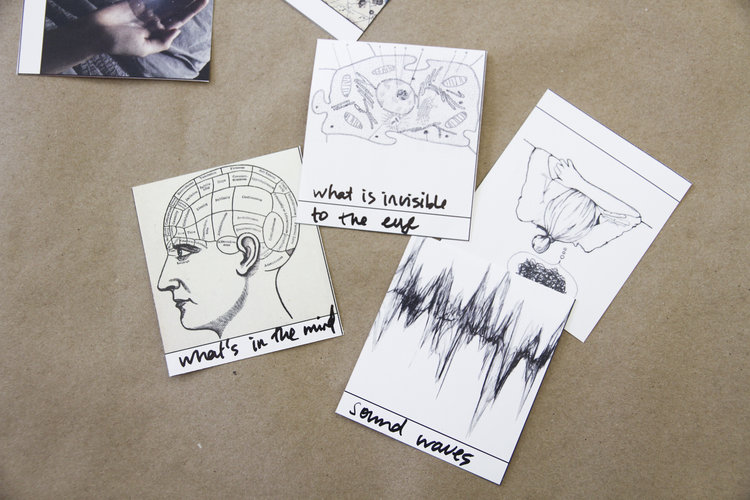
This year the event will focus on the theme of invisibility, with the idea of highlighting “Invisibility as an opportunity for new strategies to impact our societies” and using “design and trans-disciplinary collaboration as acts of seeing, revealing, and creating new perceptions which investigate invisibility”.
Through panel discussions and conversations the theme of invisibility and of restoring visibility to the unseen will be observed in relation to different issues, ranging from urban regeneration to migration, from inequalities and inclusion to civic engagement, with the aim of confronting complex and transdisciplinary questions such as: “How might we continue to reveal intangible aspects of society and human behaviors? How can we restore visibility to the unseen, unheard communities disenfranchised/displaced by power and politics? In the face of unprecedented social issues emerging from the ongoing refugee crisis how do we highlight contradictions of different inclusion strategies? What aspects are better left invisible?”.
LabGov’s co-founders, Sheila Foster (Fordham University) and Christian Iaione (Luiss University and UniMarconi) will be present at the event, which will bring together leading thinkers, field experts and change-makers with the aim of investigating the invisibility theme. In particular, on Thursday the 23rd from 12.15 to 1.15PM Professor Foster will moderate a panel discussion on “The in/visibility of the urban commons”, which will see the participation of Professor Iaione together with Paola Canavò (Associate Professor of Urban Design at University of Calabria) and Francesco Rossi (Deputy Governor for Urban Planning, Housing, Transport, Calabria Region).
Furthermore, Professor Foster and Iaione will take part in the two-days conversation on “Invisibility in urban commons – envisioning and reclaiming spaces” that will take place in the afternoon of the 23rd and 24th. The conversation, which will be leaded by Cynthia Warner & Lissa Fedrizzi from the University Transdisciplinary Lab, will also involve Eduardo Staszowski, Director at Parsons DESIS Lab. The conversation will stimulate a reflection on the possibility of adopting the “urban commons” framework as a way to create “new social arrangements that enable sharing of (not always visible) spaces, resources, and information among urban denizens, to meet their needs”. The potential of the urban commons and the possible obstacles to their growth will be analyzed through the lenses of un/reclaiming spaces, dynamic and inclusive governance, and alternative economies. Furthermore, the “urban commons” framework will be considered as a possible arrangement to apply in the specific urban case study of the 14th Street in Manhattan, which will be closed to private transit during upcoming repairs to the subway line, offering the opportunity to imagine totally new uses, relationships, and interactions for the street landscape.
The program of the event is available on the website (where it is possible to find the panels and conversations complete list).
by Francesca Spigarolo | Feb 13, 2017 | The Urban Media Lab
On the 16th and 17th of February a 2-days workshop about resourcing and monitoring, organized within the framework of the TRANSIT (TRANsformative Social Innovation Theory) Project, will take place in Maastricht.
TRANSIT is a research project, co-founded by the European Commission, which addresses the question of “How social innovation can interact with other forms of (transformative) change, and how actors are (dis) empowered therein”. The projects aims at developing a theory with practical relevance, and in order to do so it adopts a research method which encourages feedback from social entrepreneurs and innovators, policy makers and academics.
In line with this approach, the workshop organized in Maastricht will bring together experts from TRANSIT with practitioners, funders and change agents working on transformative social innovation. The workshop will focus on the question of resourcing and monitoring, which are key issues we need to address in order to help social innovation initiatives going beyond the local achievements they are collecting, by joining forces in seeking contextual and institutional change. To activate an institutionalization process, resourcing and monitoring – two dimensions which are closely linked – are fundamental. Addressing these two dimensions means addressing 5 sources of tension which are being faced by social innovation initiatives: the question of the internal struggle over growth and direction, the fishing in the same pond issue, the internal and external need for monitoring, the problems of base founding and the co-option from imposed agendas. The workshop will also offer the occasion to review the latest research insights of the TRANSIT project about Social Innovation Initiatives resourcing and monitoring based on in-depth analysis of 20 transnational networks and 80 local manifestations of social innovation.
Professor Christian Iaione, LabGov’s co-founder, will be between the participants in the event, which will be a valuable occasion to exchange insights with other experts and change agents, to discuss and critique different strategies for resourcing, monitoring and sustaining SII, and to develop guidance for policymakers and practitioners on facilitating SII contributions to transformative societal change.
by Francesca Spigarolo | Feb 10, 2017 | The Urban Media Lab
In his book “Cities for People” the Danish Architect Jan Gehl tells us that if we want to build lively, sustainable, safe and healthy cities, we need to pay more attention to the human dimension, which in the last decades has been highly neglected. According to Gehl, urban planners need to observe the city at eye level, adopting the point of view of a pedestrian rather than thinking about the city only in abstract terms, as “the battle for quality is on a small scale”. Gehl’s view is deeply influenced by the seminal work of the American activist and journalist Jane Jacobs, the first strong voice who denounced the dominant urban planning ideology for having lost contact with real cities and with the needs of their communities.
Today, more and more cities are realizing the importance of going back to the human dimension as a starting point for dealing with the interconnected issues resulting from intense urbanization.
This appears particularly true when we turn to consider the question of traffic. Since the car’s advent, a great amount of time and energies have been devoted to the transformation of the urban environment required to accommodate the ever-growing traffic. This has often meant sacrificing common spaces in order to allow for car’s circulation and parking, which resulted in what could be defined as the “Tragedy of the urban roads” [1], that we discussed in this article.
The dramatic consequences of such approaches have become evident, and contemporary cities are focusing on finding ways to reduce traffic, re-appropriating public spaces and making their streets and neighborhoods more livable and sustainable. Different traffic-reducing measures have been experimented and implemented in the past years, ranging from investments in sustainable and accessible public transportation and bike sharing to measures aiming at discouraging cars’ usage, including car bans, no-cars zones, increases in parking prices combined with reduction of parking spots, and much more.
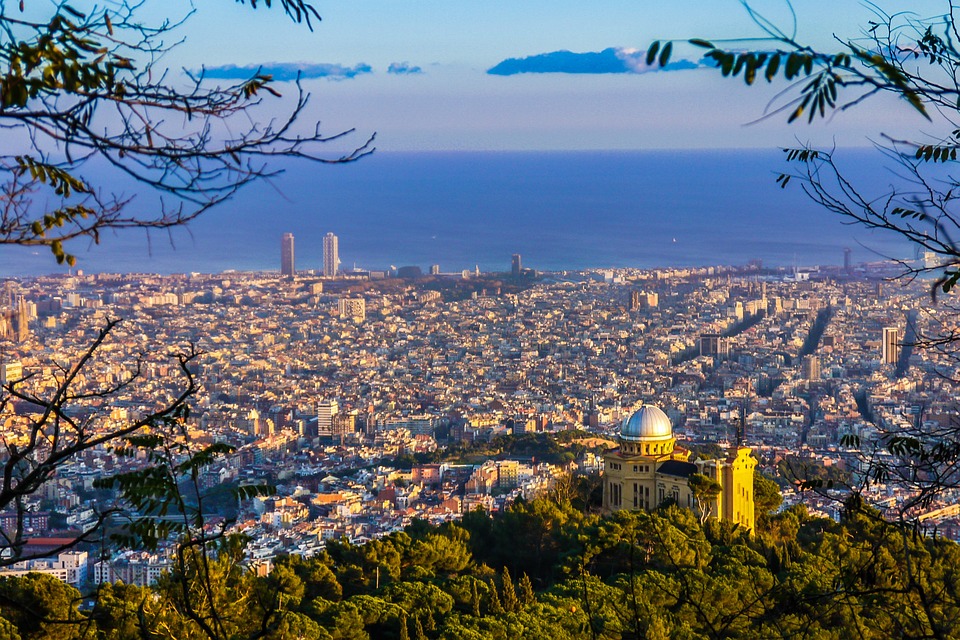
The city of Barcellona, picture under CC license (available here:https://goo.gl/images/aYqPKZ)
One innovative solution which is worth observing comes from the city of Barcelona, where the newly elected administration is not limiting itself to the introduction of traffic-reducing measures, but is instead completely rethinking the entire city structure, bringing it back to the human scale. Such transformation will take place through the creation of Superilles, macro-neighborhoods designed by adopting the point of view of the pedestrian, with the aim of making the city more livable and sustainable for its citizens. The program Superilles “Let’s fill streets with life” envisages the creation of nine macro-areas, within which car-circulation will be reduced at its minimum, favoring the development of sustainable mobility, green areas and new spaces for collective living. Car circulation will be limited to the perimeter roads of the neighborhoods and parking spots on the street-side will be greatly reduced, resulting in the re-appropriation of collective space. The project is ambitious in its objectives: the city aims at reducing its car use by 21% over the next 2 years, while at the same time increasing the amount of mobility by foot, bicycle and public transport. To facilitate this transformation in people’s habits, the creation of superilles will be complemented by the introduction of a stronger orthogonal bus network, limited to the main streets, and by the creation of 300 kilometers of cycling lines.
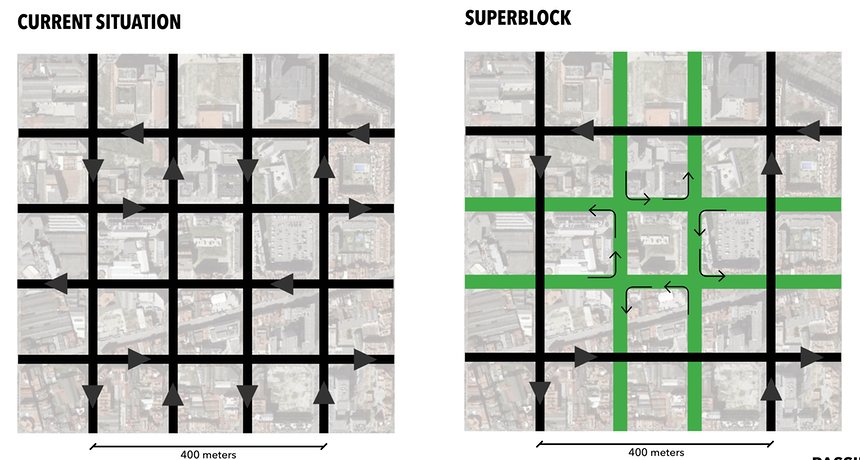
This innovative approach to traffic and urban development is only one of the novelties introduced by the new administration, which since its election in 2015 has been attempting to “win back the city”. The administration, guided by the ex-housing activist Ada Colau, who was elected on behalf of the citizens’ movement Barcelona en Comù, is strongly committed to the defense of the common good and to the improvement of people’s quality of life. Furthermore, it believes in the importance of bringing about a transformation by challenging the economic and political dominant paradigms from below, by involving as many people as possible in transparent and participatory decision-making processes. In this way, as explained in the How to win back the city en Comù guide, the city can go back to being the place of encounter, of innovation and of exchange of ideas that it should be, and can become the place where a true democracy is reconstructed.
As stated by Ada Colau, “We’re living in extraordinary times that demand brave and creative solutions. If we’re able to imagine a different city, we’ll have the power to transform it”. This is exactly what is being done in the Barcelona where, through the creation of the superilles, the human dimension is brought back to the center and we are reminded of the importance of creating “cities for people”.
[1] Christian Iaione, The Tragedy of Urban Roads: Saving Cities from Choking, Calling on Citizens to Combat Climate Change, 37 Fordham Urb. L.J. 889 (2009).
——————————————–
Una soluzione innovativa al problema del traffico (recentemente discusso in questo articolo), arriva dalla città di Barcellona, in cui la nuova amministrazione si propone di ripensare l’intera struttura a partire dal punto di vista dei pedoni, riconoscendo l’importanza di quella che l’architetto danese Jan Ghel descrive come la “dimensione umana”. Questo avverrà attraverso la creazione di Superilles, macro-aree al cui interno la circolazione dei veicoli sarà impedita, favorendo invece lo sviluppo di aree verdi e spazi comuni. Complementare alla riduzione del traffico sarà un forte investimento nello sviluppo di trasporti pubblici e piste ciclabili, volto a stimolare lo sviluppo di forme di mobilità sostenibili.

by Francesca Spigarolo | Feb 8, 2017 | Commons Press, The Urban Media Lab
“What is at the heart of the problems erupting worldwide? Is anything good emerging from these multiple crises? Can a new system grow from within the old one? Is it already here, visible and thriving? These questions are addressed by Michel Bauwens and Vasilis Niaros in the report, “Value in the Commons Economy”, co-published by Heinrich Böll Foundation and the P2PFoundation. The authors’ main thesis describes the ‘value crisis’ affecting our current world as a sign of an underlying transformation in our ‘value system’. Society is shifting from a system based on value created in a market system (through labor and capital) to one which recognizes broader value streams. These streams are experienced as ‘contributions’ to structures based on the co-construction of shared resources, also known as ‘commons’. While this new system of value creation and distribution still operates within the mainstream value orthodoxy today, the Value in the Commons Economy report emphasizes how pioneering communities are working on expanding the new system from within, and building the potential to eventually break free of those confines.”
The complete report is available here.

by Francesca Spigarolo | Feb 1, 2017 | The Urban Media Lab
Creative regeneration of public spaces and innovative public policies will be at the center of the reflection that the public meeting “RELAZIONI. Ecosistema città, governance diffusa, comunità creative” will activate.
The Municipality of Ruvo di Puglia is inviting its citizens, local associations and political groups to participate in the event, which will take place on Saturday the 4th of February in the hall of Palazzo Caputi.
The public meeting will see the participation of Christian Iaione (UniMarconi e LabGov – LABoratorio per la GOVernance dei beni comuni) and Annibale D’Elia (Comune di Milano, Associazione INnovare X INcludere), two experts who, since a long time, have been practicing and experimenting with innovation in governance and public policies. Starting from examples of local creative regeneration experiences, the discussion will explore the opportunities generated by political innovation, which has the potential to multiplicate human and social relations and to strengthen urban life dynamics. This meeting will allow for a deeper reflection on how citizens’ involvement can be stimulated through innovative public policies aiming at assessing the value of common goods and at structuring their collective management.
As explained by Monica Filograno, Councillor in charge of the city’s Culture Department whose speech will open the meeting, this event will be an important occasion to draw hypothesis on the future administrative path to be followed by the Administration and to discuss together the value of the commons in city’s life. The innovation process that the local Administration intends to activate in order to strengthen collaboration and sharing in city management requires us to reflect on the best direction to take, understanding also the broader international and national context in which “efforts to rethink cities as ecosystems in which everyone can find a space to express himself” are being made. The meeting will be then concluded by a speech of Pasquale Chieco, Major of Ruvo di Puglia.

——————————
Rigenerazione creativa degli spazi urbani e innovazione nelle politiche pubbliche saranno al centro dell’incontro pubblico “RELAZIONI. Ecosistema città, governance diffusa, comunità creative” che avrà luogo sabato 4 febbraio presso la sala eventi di Palazzo Caputi a Ruvo di Puglia.
Durante l’evento, organizzato dall’Amministrazione comunale, queste tematiche saranno affrontate attraverso un dialogo con due esperti e “pratici” che da tempo sperimentano con l’innovazione nella governance e nelle politiche pubbliche: Christian Iaione (Roma UniMarconi e LabGov) e Annibale D’elia (Comune di Milano, Associazione INnovare X Includere).
“A partire da alcune esperienze concrete di rigenerazione creativa di spazi pubblici, nel corso dell’incontro si racconteranno le tante possibilità di moltiplicazione delle relazioni umane e sociali e delle dinamiche della vita cittadina che possono essere generate dall’innovazione politica”.


