
by Maria Elena Santagati | Feb 3, 2017 | The Urban Media Lab
“…che la cultura, più che mai oggi, sia uno strumento irrinunciabile per scrivere il nostro futuro”[1].
It is becoming increasingly apparent that culture is an ever-present dimension in different debates, beyond the traditional artistic-cultural one: culture as a right, culture as wellbeing and welfare, culture as a commons, culture as a factor of social and economic development, culture as education, culture as a driving force for urban regeneration, culture as a resource for sustainable development, culture as citizenship.
Besides the emergence of a participatory and collaborative approach in conceiving and managing cultural projects, events and institutions, there is an ever-raising awareness of the intersectoral implications of culture as a process, also in terms of spillover effects. This is particularly enhanced and demonstrated by European and international policies, documents and initiatives as well as by the celebration of 2018 as the European Year of Cultural Heritage: documents such as “Council Conclusions on cultural heritage as a strategic resource for a sustainable Europe” (May 2014, available here), emphasizing the role and relevance of cultural heritage for a “smart, sustainable and inclusive growth”, “Commission Communication towards an integrated approach to cultural heritage for Europe” (July 2014, available here) and its related documents, or the final results of “Cultural Heritage counts for Europe” project (2013-2015), which deeply recommends the adoption of an holistic approach to cultural heritage.
As for the participatory issue, it is promoted by the EU with the “Council conclusions on the participatory governance of cultural heritage” (2014, available here) and the interesting “Mapping of practices in the EU Member States on Participatory governance of cultural heritage” (2015, to be found here), realized by the EENC-European Expert Network on Culture within the OMC Working group on cultural heritage.
Also UNESCO approved a specific project “Approaches to participatory governance of cultural institutions”, carried out by Kultura Nova Foundation in Croatia and supported by UNESCO’s Cultural Diversity Fund (June 2016-June 2018). Moreover, in its paper “Engaging local communities in Stewardship of World Heritage” (World Heritage, paper nr 40, November 2014, available here) it calls for community engagement at all stages of the World Heritage process, by learning experience from the Community Management of Protected Areas Conservation (COMPACT) methodology.
This collaborative and comprehensive trend is also emerging in many cooperatives, associations and organizations’ practices, both for international and local projects. For instance, the outstanding project and participatory process of Matera 2019 European Capital of Culture, or the experience of Hotel du Nord in Marseille, an inhabitants’ cooperative providing a network of accomodations and hosts and touring opportunities through heritage walks, or that of La Paranza in Naples, a cooperative of young people from the disadvantaged neighbourhood Rione Sanità managing the Paleochristian Catacombs.
The Commons Post, aware of the fundamental role played by culture, is committed to investigate this topic by proposing different cases and best practices, both international and local, throughout the year. The European and international policies and initiatives and the potential, the role, the effects of culture-driven processes led by different communities in different contexts will come under the spotlight.
Our purpose is to stress the leading role of culture in many changes under way. It’s time to overcome a short-sighted approach to culture and to acknowledge its long term sustainable contribution to the formulation of effective policies, processes and projects.
Because culture sounds future!
[1] Dal Pozzolo L., Garbarini A., Oltre la sindrome del Vilcoyote. Politiche culturali per disegnare il futuro. Luca Dal Pozzolo, Aldo Garbarini in conversazione con Francesco De Biase, FrancoAngeli, 2016, p.9
———————————————————————————-
La cultura come filo rosso che attraversa numerosi dibattiti e processi di sviluppo. La sua centralità in questa fase di cambiamento e l’esigenza di un approccio sempre più trasversale e di lungo termine non viene soltanto sottolineata da numerosi documenti europei, ma emerge anche dalle pratiche messe in atto da associazioni, cooperative e organizzazioni di varia natura a vari livelli. Per questo motivo, la cultura sarà tra le tematiche su cui andremo a concentrare la nostra attenzione nel 2017.

by Maria Elena Santagati | Dec 20, 2016 | The Urban Media Lab
The Italian Ministry for Economic Development financed and published 8 feasibility studies related to “cooperative di comunità” (community cooperatives) in order to promote innovative projects and networks among cooperatives, enhancing a more innovative form of collaboration between public sector and cooperative system. The initiative is conducted within the national program of development and promotion of the cooperative movement (art. 11 law n. 59/92). The studies, carried out by partnerships among different stakeholders, operators, universities and research centers, deal with different sectors, e.g. agriculture, health, community, tourism, and will serve as a model for interested actors.
On the 17th of November 2016 during the event “Progetti di frontiera per le cooperative: studi di fattibilità per una collaborazione innovativa fra il sistema pubblico e il movimento cooperativo” the results of the eight studies were presented at the Ministry for Economic Development. LabGov was present at the event, represented by his coordinator Christian Iaione, who was between the discussants.
Hereafter two particularly interesting studies that were presented in this occasion are described, while it is possible to find the complete studies here.
The feasibility study concerning tourism and culture refers to the development of a large cooperative tourism supply chain aiming at the promotion of territories and at increasing audience in the cultural sector. It has been coordinated by CoopCulture in collaboration with Consorzio Beni Culturali Italia, Cooperativa Betania, Cooperativa Atlantide, SireCoop, research centers such as CNR, CISET, IREFORR, Università di Napoli Federico II and many other associations.
The study proposes a new approach and model aiming at:
- overcoming critical issues related to cultural heritage, which is extremely rich and various but still fragmented and whose value is underestimated also in economic terms
- improving services related to culture and cultural heritage for a better tourism supply
- providing cooperatives with useful instruments to strengthen and enhance their productive processes, also in terms of economies of scale
- promoting a stronger integration with cultural actors and other related sectors, developing a networking approach
- launching new forms of cooperation with public administrations
- promoting new cooperatives operating in the supply chain
The feasibility study for the development of “cooperative di comunità” has been conducted by Irecoop (Emilia-Romagna Regional Institute for cooperative education) and Lama Development and Cooperation Agency, in collaboration with Italia Consulting Network SpA, Associazione Italiana per la promozione della Cultura della Cooperazione e del Nonprofit – A.I.C.CO.N., Atlante, Euricse- Istituto Europeo di Ricerca sull’Impresa Cooperativa e Sociale, Fondazione Barberini, Università di Tor Vergata.
The study considers the “cooperativa di comunità” as a new institutional and economic molecule activating generative processes, thus becoming a key element for local, cohesive and sustainable development of different territories. Even if the term has not an ad hoc juridical definition in Italy, but still refers to ongoing practices, the authors identify these constitutive elements: “in presenza di un territorio in condizioni di vulnerabilità e di un fabbisogno specifico, capace di generare anche un’opportunità imprenditoriale, espresso da una comunità reale (non virtual community) si sviluppa una attività economica finalizzata al perseguimento dello sviluppo comunitario e della massimizzazione del benessere collettivo (non solo dei soci) e non a quello della massimizzazione del profitto”. After having analyzed interesting and successful examples, the study identifies the fundamental conditions to ensure the activity and stability of these specific cooperatives, and to this end it provides useful considerations for policy makers, such as the importance of accompanying the project throughout its development with dedicated instruments and methodologies, providing support and mentoring for capacity building activities, providing a mix of financial instruments especially for social and territorial vulnerable areas.
All the studies investigate the ever-growing phenomenon of collaborative innovation, which needs to be promoted, supported and structured if we want to maximize its impact. This ministerial initiative is a further step in this direction.
The studies can be consulted here. (in Italian).
————————————————
Il Ministero dello Sviluppo Economico ha finanziato e pubblicato otto studi di fattibilità per lo sviluppo delle cooperative di comunità, con l’obiettivo di generare nuovi progetti integrati e di filiera tra le imprese cooperative, promuovendo una collaborazione innovativa tra settore pubblico e settore cooperativo.
Gli studi sono replicabili e possono essere presi a modello da altri soggetti interessati che ne condividano le finalità progettuali.
I risultati degli studi sono disponibili sul sito del Ministero dello Sviluppo Economico (a questo link).
by Maria Elena Santagati | Oct 3, 2016 | The Urban Media Lab
Digital cultural heritage for a smart, sustainable and inclusive Europe
The “intangible cultural heritage” means the practices, representations, expressions, knowledge, skills – as well as the instruments, objects, artefacts and cultural spaces associated therewith – that communities, groups and, in some cases, individuals recognize as part of their cultural heritage. This intangible cultural heritage, transmitted from generation to generation, is constantly recreated by communities and groups in response to their environment, their interaction with nature and their history, and provides them with a sense of identity and continuity, thus promoting respect for cultural diversity and human creativity.
Art.2, UNESCO Convention for the safeguarding of the intangible cultural heritage, 2003
The Parties agree to promote an understanding of the common heritage of Europe, which consists of:
a. all forms of cultural heritage in Europe which together constitute a shared source of remembrance, understanding, identity, cohesion and creativity, and
b. the ideals, principles and values, derived from the experience gained through progress and past conflicts, which foster the development of a peaceful and stable society, founded on respect for human rights, democracy and the rule of law.
Art.3, Council of Europe Framework Convention on the Value of Cultural Heritage for Society, 2005
More than 10 years after these two outstanding international documents, the first one from UNESCO, the second one from the Council of Europe, an interesting motion for a resolution has been signed on April 22nd 2016, by Mr Paolo Corsini and other members of the European Parliamentary Assembly on the topic: Safeguarding and enhancing Europe’s intangible cultural heritage. The purpose is not simply to protect European intangible cultural heritage, but “to ensure that a part of our historical memory and our identity is not lost for ever. In this connection, […] Parties undertake to develop the use of digital techniques to improve access to cultural heritage“, also through “the creation of a European Intangible Heritage Forum“.
In order to elaborate a position paper for the Resolution, a public consultation on the protection and enhancement of intangible heritage of European communities has been launched on June 11th in Rome (until the end of the year). It is carried on by #DiCultHer, a new network made up of more than sixty Italian organizations, universities, research centers, schools and companies whose aim is to create a “virtual school” for Digital Cultural Heritage, Arts and Humanities. Many training centers cooperate to propose specific workshops regarding digitalization and culture, thus providing cultural operators and citizens with adequate skills to manage this new challenge. The second edition of the Italian Week for Digital Cultural Heritage,Arts & Humanities will take place on April 2017, providing learning activities, meetings and a school contest as well: “Crowddreaming: i giovani co-creano culture digitali“.
In this sense, digitalization represents a beneficial instrument to share our common heritage and thus to enhance European citizens’ identity and cohesion. Besides the launch of the famous European digital library Europeana in 2008, the Commission pointed out its position on the topic also in the Recommendation on digitization and online accessibility of cultural material and digital preservation, 24 August 2006 and 27 November 2011, and its related reports, such as the European Commission Report on Bringing Europe’s Cultural Heritage Online.
Research and innovation play a crucial role in this regard, so that in the Work Program of Horizon2020 for SC6 “Europe in a changing world – inclusive, innovative and reflective Societies”, a specific topic in the call “Understanding Europe – promoting the European public and cultural space” is devoted to “Virtual museums and social platform on European digital heritage, memory, identity and cultural interaction”.
Awareness about the role of culture and cultural heritage in building a smart, sustainable and inclusive Europe has certainly increased these last years, leading to new wide-ranging and challenging implications.
————————————————————
La consapevolezza del ruolo che la cultura e l’eredità culturale possono svolgere nella creazione di città più sostenibili e inclusive è notevolmente aumentata in Europa negli ultimi anni. A seguito di due importanti documenti internazionali, promossi dall’UNESCO e dal Consiglio d’Europa, il 22 Aprile 2016 è stata promossa un’interessante mozione che propone risoluzione sull’argomento della “conservazione e valorizzazione del patrimonio immateriale”. È inoltre stata indetta una consultazione pubblica con lo scopo di elaborare un position paper per la risoluzione. A occuparsi di questa elaborazione è #DiCultHer, un network composto da più di sessanta organizzazioni, università e centri di ricerca italiani, che ha come scopo la creazione di una “scuola virtuale” per che si occupi di “Digital Cultural Heritage, Arts and Humanities”.

by Maria Elena Santagati | May 17, 2016 | The Urban Media Lab

On April 19th-20th Bruxelles hosted the European Culture Forum, the biennal flagship event organised by the European Commission, this year focused on “Talent and creativity for a stronger and more inclusive Europe”. Different sessions highlighted the role of culture and creativity in society. Three plenary sessions were devoted to these topics:
Plenary Session 1: Can culture help to overcome the fragmentation of society?
Plenary Session 2: Can culture help re-launching economic growth?
Plenary Session 3: Can culture improve Europe’s standing in the world?
In addition to these, other 15 sessions, among which the n.5 concerning “Our Future European Cultural Heritage: Engage, Share, Co-create”. The importance of the participatory issue is stressed also because the sustainability of cultural heritage “depends on our ability to adopt new cross-cutting approaches to unlock its economic and social potential, turning heritage sites into drivers of economic activity, centres of knowledge, focal points of creativity, culture and social innovation”. An important edition that of 2016, also thanks to the announcement of a European Year of cultural heritage by Tibor Navracsics, EU Commissioner for education, culture, youth and sport: “I’m delighted to announce that the Commission is proposing to make 2018 the European year of cultural heritage. It will be an opportunity to promote knowledge and understanding about cultural heritage”. The final decision will be taken by the European Parliament and the Council.
Concerning the impacts of culture, in October 2015 an important report was published on the topic of “Cultural and creative spillovers in Europe: Report on a preliminary evidence review”, authored by Tom Fleming Creative Consultancy (TFCC) and commissioned by an international research partnership made up of Arts Council England (ACE), Arts Council of Ireland, European centre for creative economy (ECCE), European Cultural Foundation, European Creative Business Network e Creative England. The project aims at elaborating an international evidence library, through the analysis of 100 case studies and their spillover effects, in order to identify conditions to enable spillovers and to list related indicators. In this report, cultural and creative spillovers are defined “as the process by which activity in the arts, culture and creative industries has a subsequent broader impact on places, society or the economy through the overflow of concepts, ideas, skills, knowledge and different types of capital”. They are classified into 3 categories: knowledge, industry and network spillovers, according to the different impacts, that can be of course interrelated.
On April 5th, the European Commission launched the creation of a European Network of Creative Hubs, in order to reinforce networks of creative hubs at European level, since “by facilitating co-creation, creative hubs can help to cope with the sharing economy”.
In December 2015, the Working Group of EU Member States’ Experts on the development of the Key Competence Cultural Awareness and Expression published an important document aimed at providing policy-makers with recommendations and inspiring practices: “Cultural awareness and expression handbook”. As a matter of fact, it is one of the eight key competence identified by the European Union in 2006[1], defined as the “appreciation of the importance of the creative expression of ideas, experiences and emotions in a range of media, including music, performing arts, literature, and the visual arts”. It acquires a great importance not only with regards to appreciation and expression skills, but above all because “a solid understanding of one’s own culture and a sense of identity can provide the basis for an open attitude towards and respect for diversity of cultural expression”.
On April 2016, Europa Nostra, a European network of 250 member organizations,150 associated organizations and around 1500 individual members, delivered its annual cultural heritage Awards, in partnership with the European Commission. Besides celebrating excellence, Europa Nostra constitutes an important lobby at the European level and it is active also in the field of endangered cultural heritage and landscape. The Awards are given from 2002 in different categories: 1.Conservation, 2.Research, 3. Dedicated service by individuals or organizations, 4. Education, Training and Awareness-Raising. The fourth one rewards “outstanding initiatives related to education, training and awareness-raising in the field of tangible and/or intangible cultural heritage, to promote and/or to contribute to the sustainable development of the environment”. In 2016, the winners in this last category are:
- “The Great War through the eyes of a child”, Roeselare, Belgium
- “Star in School”, Karlovac, Croatia
- “Adopt a Monument”, Tampere, Finland
- Preserving and promoting dance heritage, Berlin, Germany
- “The Little Museum of Dublin”, Dublin, Ireland
- Cultural Heritage Education Programme: “Apprendisti Ciceroni”, Milan, Italy
- Sustainable Development of Mourela Plateau, Peneda-Gerês National Park, Portugal
- “Heritage Schools”, Bristol, United Kingdom
At the European level, there is evidence of an increasing awareness of the role of culture in overall society, of how pervasive cultural spillovers are. We just need effective policies giving priority to these long-term objectives both at the national and at the local level.
[1] The other 7 key competences are: 1.Communication in the mother tongue, 2. Communication in foreign languages, 3. Mathematical competence and basic competences in science and technology, 4. Digital competence, 5. Learning to learn, 6. Social and civic competences and 7.Sense of initiative and entrepreneurship.
———————————————————————————
Cultura&Società, tema ormai al centro del dibattito a livello europeo. Aggiornamenti su progetti e studi recenti, dallo European Culture Forum ai premi di Europa Nostra, dagli studi sui cultural spillovers a quelli sull’ottava competenza chiave “consapevolezza ed espressione culturale”.

by Maria Elena Santagati | Mar 8, 2016 | The Urban Media Lab
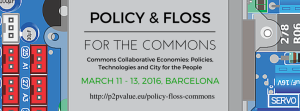 On the 11th, 12th and 13th of March, Barcelona will host the International Workshop on Commons Collaborative Economies: Policies, Technologies and City for the People, promoted by the Municipality in collaboration with the P2P Value European project, a techno-social platform for sustainable models and value generation in commons-based peer production in the Future Internet.
The aim of the workshop is “to highlight the relevance of the commons-oriented approach of peer production and collaborative economy” by producing two specific outcomes: proposing policy recommendations and providing technical guidelines to build free and open software and decentralized technologies.
The increasing importance of commons-based peer production raises questions also with regards to the role of public administration. Focusing on policy, the event will thus be an important opportunity for policy makers to exchange and interact with the technical teams of FLOSS (Free/Libre/Open Source Software) platforms for commons-based peer production communities (which were the subject of a previous workshop held on March 2015), and also to provide useful contents as regards the European Commission’s activity on collaborative economy.
The program will mix working groups and plenaries, which will focus on:
- Public policies for commons collaborative economy
- Commons and the city
- Importance of decentralized technologies
- Peer cooperativism: collaborative economy, feminist economy & social and solidarity economy
- Value and collaborative production.
Among the speakers of this interdisciplinary workshop, many scholars, experts and practitioners from Europe and beyond. Professor Christian Iaione will chair the plenary on “Commons and the city” together with Joan Subirats i Humet, Institute of Government and Public Policy (IGOP), Autonomous University of Barcelona.
—–
Appuntamento a Barcellona dall’11 al 13 marzo per “Commons Collaborative Economies: Policies, Technologies and City for the People”, incontro promosso da P2P Value e dalla Municipalità di Barcellona con l’intento di evidenziare l’approccio commons-oriented nell’ambito della collaborative economy. Obiettivo: elaborare indicazioni di policy e strumenti operativi. Tra i relatori, il professor Christian Iaione.


