by Diletta Di Marco | Apr 25, 2016 | The Urban Media Lab
Wednesday, April 27, 2016 from 17:00 PM, the event “Per una nuova cultura della città: la periferia come bene comune”organized by Giovani per Roma Association will be held at Sala Quaroni , placed in via Ciro il Grande in Rome EUR. Professor Christian Iaione from LabGov will partecipate to discuss the role of urban common as the engine for the regeneration of the suburbs. The main theme of the conference is urban innovation: how current urban dimensions could represent challenges fostering original future models of governance? In fact, the idea that lies behind this new critical way to organize the city is to build together a robust yet innovative system and to rethink the spaces and services putting at the centre stage the role of the citizenship. Other crucial issues will be addressed: the respect for the environment, the enhancement of the territory and the quality of life.
The event will be opened by Andrea Santoro, President of Municipio Roma IX. The conference will be attended by the following experts: Massimo Alvisi from Alvisikirimoto+Partners, Francesco Marsico from Caritas Italia, Davide Lottieri as President of Campus Bio-Medico Spa, Maurizio Gubbiotti as Special Commissioner for RomaNatura, Roberto Setola as Founder of the Italian Association for experts in Critical Infrastructures, Nicola Ferrigni for LinkLab and Francesco Limone as Director of ELIS Corporate School.
Here the full program of the event.
To participate please send a message to: INFO@GIOVANIXROMA.ORG.

——————————————————————————————————————
Il 27 Aprile 2016 ore 17:00 LabGov prenderà parte grazie all’intervento del Professor Christian Iaione all’incontro “PER UNA NUOVA CULTURA DELLA CITTÀ: LA PERIFERIA COME BENE COMUNE”. L’evento avrà luogo presso la Sala Quaroni – Via Ciro il Grande, 16 – Sede EUR- Roma. Il tema principale dell’incontro sarà come le attuali dimensioni urbane pongono nuove sfide al futuro della città ed ai modelli di governo.A seguito del convegno verrà istituito un gruppo di lavoro multidisciplinare per la stesura di un documento programmatico per lo sviluppo e la valorizzazione del ruolo delle periferie nel contesto urbano e sociale di Roma Capitale. Per prendere parte al convegno scrivere a INFO@GIOVANIXROMA.ORG
by Benedetta Gillio | Mar 8, 2016 | The Urban Media Lab
UN-Habitat is the United Nations programme working towards a better urban future. Its mission is to promote socially and environmentally sustainable human settlements development and the achievement of adequate shelter for all. Cities are facing unprecedented demographic, environmental, economic, social and spatial challenges. There has been a phenomenal shift towards urbanization, with 6 out of every 10 people in the world expected to reside in urban areas by 2030. Over 90 per cent of this growth will take place in Africa, Asia, Latin America, and the Caribbean. In the absence of effective urban planning, the consequences of this rapid urbanization will be dramatic. In many places around the world, the effects can already be felt: lack of proper housing nd growth of slums, inadequate and out-dated infrastructure – be it roads, public transport, water, sanitation, or electricity – escalating poverty and unemployment, safety and crime problems, pollution and health issues, as well as poorly managed natural or man-made disasters and other catastrophes due to the effects of climate change. Mindsets, policies, and approaches towards urbanization need to change in order for the growth of cities and urban areas to be turned into opportunities that will leave nobody behind. Sustainable housing plays a key role in human quality of life in general in the European region. The positive impact of housing can be increased through application of the following principles: environmental protection, economic growth, social inclusion, citizen participation and cultural adequacy. Development of sustainable housing in the UNECE region afaces many challenges caused in particular by globalization, demographic changes and the recent economic crisis. In some cases urbanization has led to urban sprawl, which has had a negative impact on existing settlements and has reduced the land available for other uses.In other cases, urbanization has been uncontrolled, creating and expanding informal settlements, whose residents may lack security of housing and social and physical infrastructure. The Czech Republic has proposed the High Level Regional Meeting for Habitat III in Prague in March 2016 with a theme of “Sustainable Housing in Livable Cities: European Habitat”. During the meeting, it is expected that the Habitat III Regional Report and Prague Declaration will be available and adopted.
Habitat III Europe Regional Meeting “European Habitat” will involve a wide range of participants, that will debate regional priorities for the New Urban Agenda, and policy recommendations in the form of a final regional participants’ declaration. Habitat III – Regional Meeting, Europe will take place in Prague from 16/03/2016 to 18/03/2016. The “European Habitat” is focusing on the region of the United Nations Economic Commission for Europe consisting of 56 Member States, while participation is open for all. In this regard, “European Habitat” will gather recommendations reflecting the consensus reached at the regional level on sustainable housing and other topics from the spectrum of a proposed New Urban Agenda.In the process towards a New Urban Agenda, Habitat III Europe Regional Meeting “European Habitat” will discuss how to ensure access to decent, adequate, affordable and healthy housing for all, with due attention to reducing the impact of the housing sector on the environment. Final declaration from “European Habitat” will be considered official inputs to the Habitat III process. Join us at this exciting opportunity to discuss the challenges of Sustainable Housing in Liveable Cities. Final “Prague Declaration” from “European Habitat” will be considered official inputs to the Habitat III process.
Here the programme: https://www.habitat3.org/prague

by Diletta Di Marco | Dec 2, 2015 | The Urban Media Lab
“Collaborare è Bologna” is a project of the City of Bologna, managed with the Bologna Urban Center and various partners to promote a “culture of collaboration” with continuous and consistent community involvement,and to make technologies, resources, spaces, knowledge, skills and information more accessible. In this framework, on 19 May 2014, the Municipality of Bologna approved the “Regulations on the collaboration between citizens and the Administration”, for the treatment and regeneration of the commons. This is an instruction manual for a collaborative dialogue between the public, private and community spheres, a tool that seeks to simplify and promote forms of collaboration in the management of the commons, implementing the principle of subsidiarity provided for by the Constitution in its 118 article.
The project is divided into three sub-projects, designed by listening the citizens and letting them cooperate with associations, institutions, firms and interest groups:
> Fare_insieme: projects for the treatment of public spaces (i.e islands for underground waste collection, new lighting and upgrading of the main public spaces of the center, projects for cleaning the urban spaces, contrasting graphic vandalism, teaching citizens the shared care of open spaces).
> Vivere_insieme: projects with an innovative approach on many issues. Starting from mobility, for a city in which citizens are moving on foot, by bike and on public transport until the creation of projects in areas with specific problems (Pilastro and Bolognina are the interested zones).
> Crescere_insieme: projects in which public places become collaborative spaces and engines of economic development. The project provides a digital network infrastructure in step with Europe, to promote Bologna as a City of Food and renew the relationship between the university and the city.
From October 22 to December 3, 2015 a series of meetings will take place in different neighborhoods and with an online consultation for the citizens to define the priorities of the city.
The path was created in order to strengthen the collaborative ties and develop priorities, to implement the energy of the city and the ability of citizens to collaborate.
The Municipality is organizing six meetings, one for each district to activate a digital platform where citizens, schools, businesses and associations of Bologna will contribute to the emergence of the urban commons and draw a map of the urban regeneration projects and future actions. The aim is to design together a view of the commons to implement the available European funds, with the support of the regional and municipal authorities.
The round tables are organized with the direct participation of the citizens; the focus is on discovering the priorities of citizens and neighborhoods. Which are the places that need special attention?
Each meeting tries to answer to practical questions, and the participation of Neighborhood Presidents and the Mayor is an unique opportunity to present the measures already implemented and funded (relative to the district headquarters of the meeting) with a strong focus on the regeneration projects in progress and current demographic changes.
Each meeting is built on working groups, and for two hours all present citizens can intervene and bring out, area by area, problems and potential solutions.
The project “collaborare è Bologna” is organized by the city of Bologna with the collaboration of the Neighborhoods, Urban Center Bologna, ASP – Company Public Services for the person, IES – School Education Institution and the Institution for Social Inclusion and Community. The official hashtag is #collaborarebologna— search it on Social Media. For more information, write an email to gestionecomunita@comune.bologna.it. The next meeting’s programme of December 3rd is already online on the website: www.urbancenterbologna.it. Change begins with participation, and participation begins with you!


by Diletta Di Marco | Oct 27, 2015 | Luiss LabGov 2015-2016
Last weekend, on 16 and 17 October LabGov held the first co-working session for 2015-2016. On Friday afternoon, the new LabGovers came together to discuss and to co-design a new idea for Rome together. Students were inspired by foremost experts in the field of regeneration and care of the commons. Each expert, with his or her own particular approach, could make an important contribution to the discussion.
The afternoon began with the intervention of the famous architect Massimo Alvisi, promoter of the project CO-Battipaglia and G124. The intervention has shown, through its key points for urban regeneration and using as example the cities of Turin, Catania and Rome, how collaborative relationships between the city and its inhabitants can stimulate active citizenship in the care for the commons. Massimo Alvisi told of the importance of working in a multidisciplinary environment and acting with determination in the territory. Because public buildings are a common good, participation is a key issue, especially for citizens. His method for participation was simple, with small interventions that have created wealth and stimulated energy. The focus is how citizens who are reclaiming their places in the city should not transform the territories but synthesize impactful solutions for the things that have gone wrong. Massimo Alvisi also demonstrated how a city can be developed through simple ideas in the service of its people to really meet the needs of a city. It can care of all its participants, where every small stimulus is a big step towards a path of cooperation. It is precisely in the areas most abandoned and suffering, that the presence of basic services can activate citizenship. That is where you have the key role of urban regeneration and the creation of a barrier-free city.
The second intervention involved Professor Sheila Foster, Professor of Law and Faculty Co-Director, Fordham Urban Law Center. She told the student how being an an activist and at the same time an expert could impact on things at different levels. She worked with environmental groups in New Jersey, Philadelphia, and New York and she reported to the students with energy her experiences. At LabGov, she discussed how the city can benefit from new forms of collaboration and participation through a new administrative approach. The creation of links is the basis of trust in a smart city.She focused on there the difference between “planning vs. doing” things, in order to help the administrations with experts to re-design and plan the commons.According Sheila Foster, collaboration is already a practice but we should push that to the next level, especially here in Rome.
The afternoon dedicated to building a new Rome, also had the pleasure of hosting a prominent communication expert. Michele D’Alena currently works at the Press and Communications Office of the City of Bologna, for which he also coordinated the process of the Digital Agenda and the project of the new civic network. Michele trasmetted to LAbgov students the basic know-how to enable them to change the administration with a buttom-up process, for Michele, that means first of all change the connection between citizens and the communication and transparency of their legislators and public policers. The proper communication, the marketing and the co-design of the processes shoulb be aimed at creating an active citizenship and an open-government.
The last guest was Flavia Barca, former commissioner of the culture of Rome, who gave us a very personal contribution on how, in Rome, to overcome the crisis, we must recognize the importance of cultural heritage. The impact that cultural heritage can have on economic, cultural and social, is the cornerstone of a new way of doing politics. This idea of culture for us is new, and we must rethink and revive the historical memory. Re-inhabiting the ruins, the past must be reconsidered and switched to instrument. The 1st part of the session was also attended by Lavinia Pastore, Paola Cannavò, Enrico Parisio for Mille Piani and Sara Seganti for Human Foundation.

The second part of the session was held on Saturday morning, from 10 am to 5 pm. Students spent their first hour in the garden with expert Zappata Romana. Strategists organized lectures with students in which they explained the three stages of analysis, mapping and testing. During the first co-working session, LabGovers they split into groups to co-create and start the process. The sustainability group led by Professor Luigi Corvo and Lavinia Pastore had the goal of making feasible the economic-financial, social and environmental ideas of the design group.
During this first session, it was considered necessary to dwell on the economic-financial profile, specifically analyzing the cost items and revenue to be leveraged to make the project sustainable. In particular to do so, after highlighting the various categories of stakeholders potentially affected, we focused on tools for fundraising, to the increase revenue of the project, and crowdsourcing, to reduce their costs. The former included mainly spontaneous donations, especially necessary to start a communication campaign that can reach large groups of people, and corporate investments, both civil and institutional. The latter are needed to lower start-up costs of the project.Special thanks also goes to the point of view reported by Sara Seganti for Human Foundation, thanks to her our students understand the importance of a proper evaluation for investments, and more than anything else the impact that these have on the whole society.
The design team, with the help of Eloisa Susanna, Serene Baldari and Paola Cannavò, worked on areas in which to intervene, reviewing areas and imagining solutions to get in touch with the people. One of the objectives that arose in this group was identifying the potential and the critical places. Another key thing that this group set out to do was to analyze existing structures, in particular those that are already based on collaborative structures such as co-working spaces and fablabs. A short-term objective essential for the group is mapping the area by taking a cue from existing best practices.
The third group worked on the difference between assets and assets not mappable mappable with Guglielmo Apolloni, especially, on how to experience an active search for these on the territory. The Communication’s role more sensitive in the process of starting the project, work on their balance is based on the purpose of receiving more visibility and transparency as possible.
The meeting gave the students a chance to take to the field, having acquired the know-how. The next goal is to go and visit the site to review its territory and its needs. Students have identified the managers of several sites to develop with them a relationship of partnership and trust. On November 13, the group will launch the second module of LabGov 2016 where all the students will report their experiences in comparison with the “collaboration-yards” studied.

by Diletta Di Marco | Oct 7, 2015 | EducationLabs
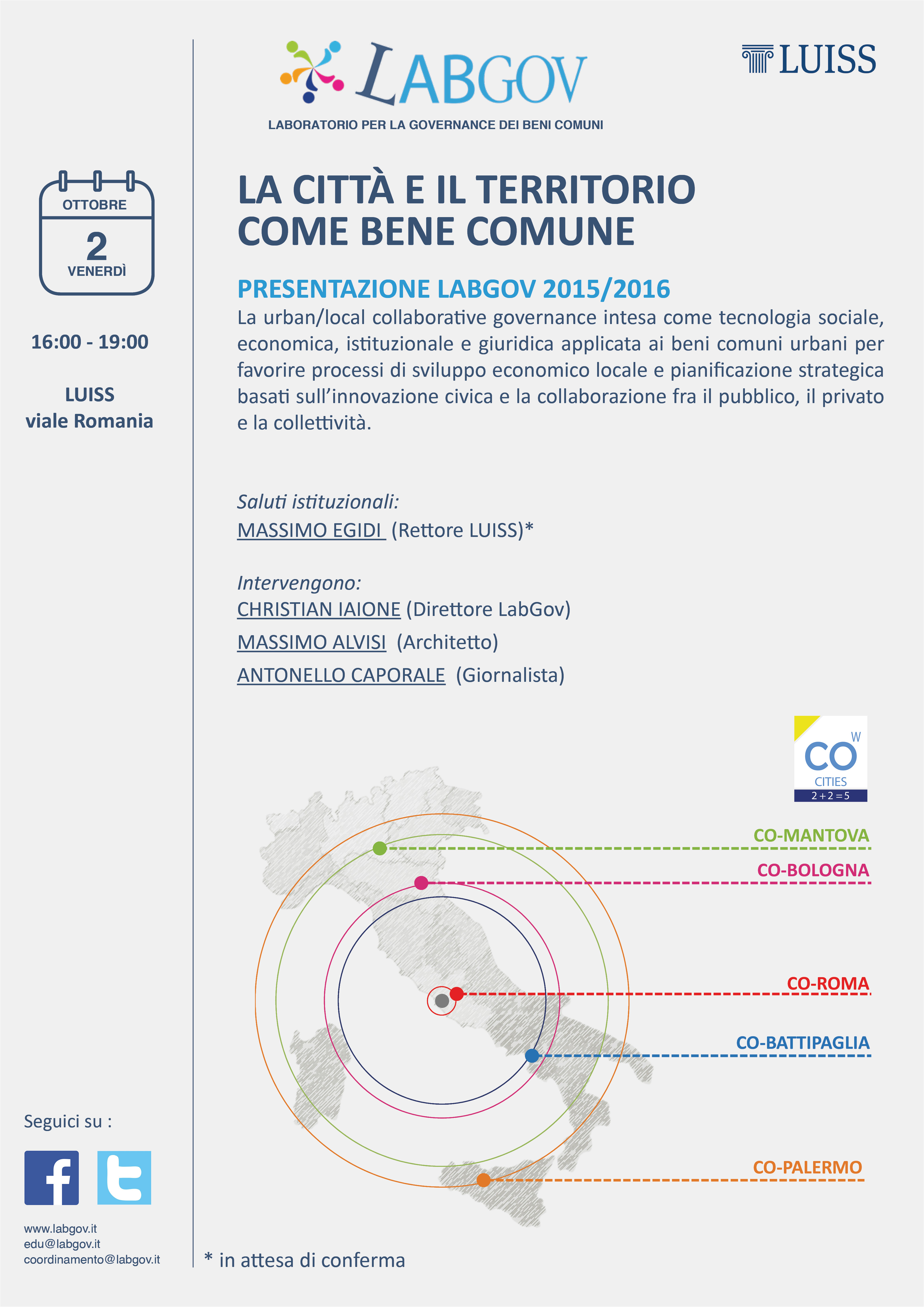
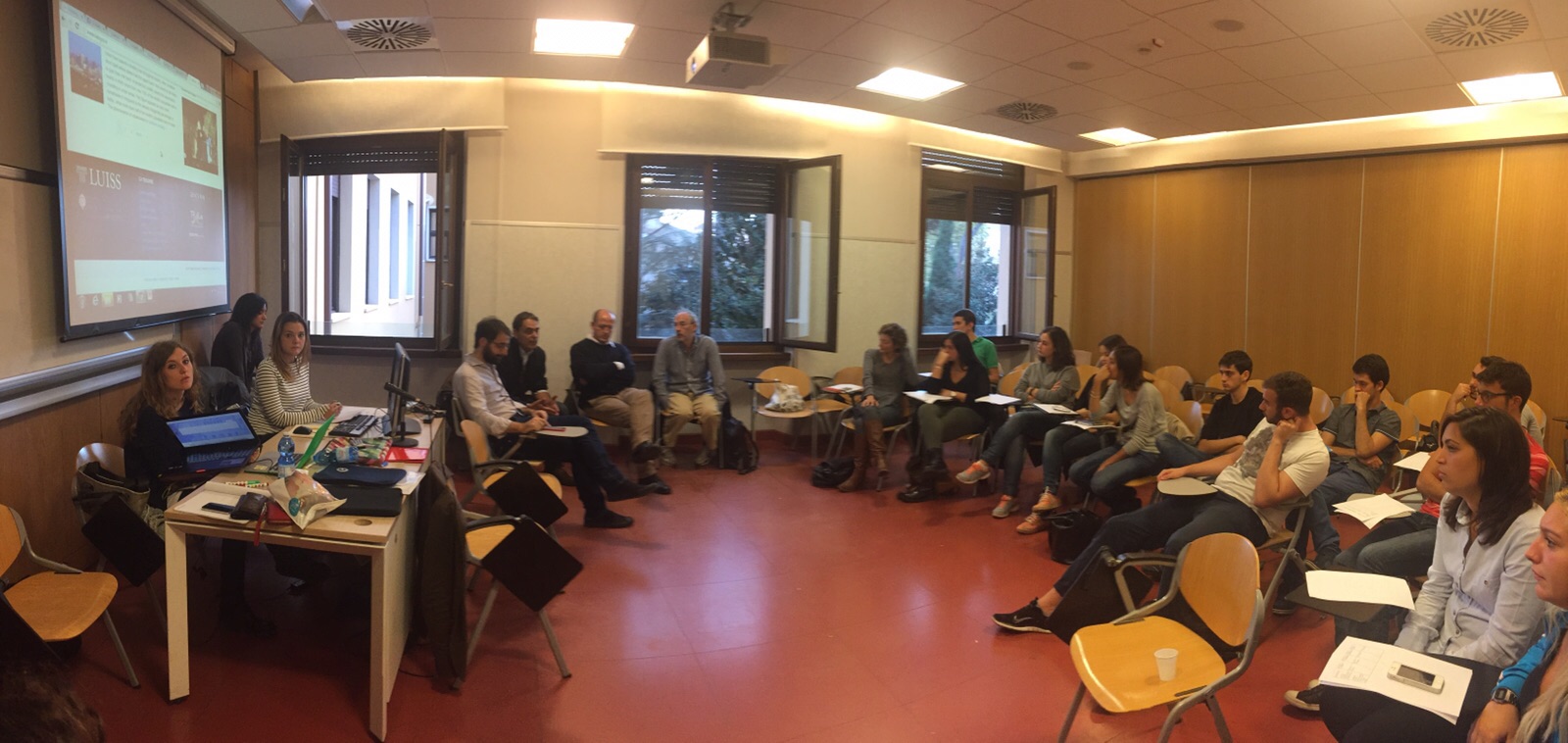
October 2nd we launched LabGov once again for the new academic year 2015/2016! On our first afternoon of the year, full of emotions and debates, we started with a very ambitious and challenging project. In the presence of the new LabGovers (Law, Economics, and Political Science students)several professors, staff members and illustrious experts had the chance to work together, listen to the inspiring words of one another’s previous experiences and imagine a new project for this year. We expect great ambition and willpower, as well as excellent results to share!
The meeting was attended by the Rector of the University Massimo Egidi, the famous Architect Massimo Alvisi and other partners of LabGov, including Luca D’Eusebio for Zappata Romana, Luca Parisio, Serena Baldari and Antonello Caporale. During the afternoon, the new program for the year was introduced by the name of CO-Rome, a project that involves the study of Rome as a city in which we try to build an innovative institutional future, with different and better views . The five souls of the collaborative governance (social innovation, public authorities, schools/universities, businesses, organized civil society) will work together to re-design our own city, making it more economically sustainable.
The goal of LabGov is to form new professional figures: “the practitioners of the commons.” These are people who are able to work in government, in business and in societies. They employ and enhance the resources, ideas, energy, skills and talents of these businesses and societies, which are widespread in the community and in the territories.
Autonomy, accountability, transparency and international openness are the values that make LabGov an incubator of innovative ideas built to establish a new economic and institutional paradigm.
The objects of analysis and experimentation will be as follows: collaborative urban and local governance; and economic, institutional and legal technology applied to the commons (urban, industrial, environmental, cultural, cognitive, digital, etc.). These objects promote processes of local economic development and strategic planning, based on innovation and civic collaboration between the public, private and community.
We will start with an initial mapping phase with a careful reading of the territory and its forms of collaboration. We will then have two phases of design and a follow-up.
As we have already done before, we will apply the CO-Cities approach, based on a strong partnership between institutions, the private sector and the community with significant help on the research side by the academic field.
This year, the co-design will be the fundamental instrument to create a prototype for effective governance and to identify tools based on the needs and characteristics of this city. We have to create a governance tool for the city of Rome that is suitable to the city’s peculiarities. This is our challenge: CO-Roma! In our research, we indentified different areas for testing urban cooperation, which are located on the outskirts of Rome: Garbatella neighborhood, the Appia Antica Park, a high school in Ostia and the V Municipality (Prenestino-Centocelle).
They represent four different types of urban commons to regenerate and invest in. This year, the Lab will focus on a very stimulating challenge for the City. A very stimulating journey cha in the City with many allies, partners and friends who will provide insightful advice to prototype a Commons-based collaborative governance for Rome. The Laboratory stays open to contributions, help and advice. The fourth edition of the Lab will take place in two phases. The former phase will focus on the workshops (October 2/2015, November 13/2015, February 26/2016 and April 8/2016). The latter phase will include co-working sessions (16/17 October 2015, 20/21 November 2015, 04/05 March 2016 and 15/-16 April 2016).
During the project, students will also engage in the field. They will cultivate the garden within LUISS University, a real testing ground of governance. In these 100 hours of pure innovation, together we will discover new stimulating and exciting forms of cooperation! For any information please write to our official account.