
by Chiara De Angelis | Mar 15, 2017 | Storytelling 2016-2017
On Friday, March 10th, we had the honor to host Professor Sheila Foster, LabGov’s co-founder, co-director of the Fordham Urban Law Center and founder of the Fordham University Urban Consortium, and Professor Maria Rosaria Marella, professor in Private Law at the University of Perugia. Two experts at the international level together to talk about the city as a commons, and about use and property in the urban space as well.
To govern the city as an urban common is the goal for witch we’ve been working for years. Cities are at the same time resources and generative elements so that we can bring by them other several different resources and our duty is to take care of them and to use them as better as we can. How do we create these processes of distribution of resources by the commons to the citizens? What are the limits to the private property and how we decide what’s the right moment to entrust the management of the property to the comunity in order to avoid the “slippage” phenomenon?”.
It is not easy to find answers to these questions but we can notice that the Italian law system tries to solve this problem with a juridic act according to witch is possible to buy properties in collectives without having in return money, but reinvesting it in the society.
Professor Sheila Foster shared with the labgovers her experience on urban commons, defined as something that has to be open, accessible and potentially collectively owned, and talked about the big issue of resource distribution within the city, which leads us to the problem of how do we allocate resources. Professor Foster also shared her knowledge on experiences in New York City (a city that is currently acting as a private land owner) on community-owned networks (broadband) and collaborative ecosystems, that act as incubators fostering common-pooled small business and start-ups, and teach them how to create tech goods, and how to use the commons to pull and distribute resources.
Professor Marella, starting from the assumption of the city as a commons as a place where value and wealth are produced, proposed the legal tools we currently are putting in place to have access to and redistribute resources: the right of access and use, and the limits to the property.
A great moment of discussion and thinking with the students followed the two speeches.

Il 10 marzo, durante il terzo workshop di LabGov EDU 2016/2017, abbiamo avuto l’onore di avere come relatrici dell’incontro la professoressa Sheila Foster, co-fondatrice di LabGov, co-direttore del Fordham Urban Law Center e fondatore del Fordham University Urban Consortium, e la professoressa Maria Rosaria Marella, docente del Dip. di Giurisprudenza presso l’università di Perugia. Due esperti di beni comuni a livello internazionale, insieme per condividere con i labgover la loro esperienza.
La prof.ssa Foster, esperta di governance dei beni comuni urbani intesi sia come risorse in sé sia come elementi generativi, ha condiviso la visione di beni comuni urbani come qualcosa che deve essere aperto, accessibile, e “collectively owned” e parlato di esperienze portate avanti a New York, nello specifico nel Bronx e ad Harlem, concentrandosi sugli ecosistemi collaborativi
Ha poi proseguito la prof.ssa Marella portandoci ad esempio il caso di “salute ambiente e territorio” sul quartiere del Pigneto di Roma per evidenziare i problemi che la proprietà pubblica e privata stanno affrontando negli ultimi anni concernenti i limiti del loro utilizzo e la mancata valorizzazione dei loro benefits.
È emerso che la città è:
- luogo di produzione, di ricchezza e di produzione.
- luogo di espressione.
Una prima riflessione/domanda emersa è stata:
‘’Tutti producono valore, ma come possiamo avere accesso a questa ricchezza? In che misura questa ricchezza può essere distribuita?’’
 Giuridicamente non esistono molti riferimenti: tendenzialmente ci sono strumenti che hanno in qualche modo realizzato il diritto di uso agli spazi, e di conseguenza limiti alla proprietà (pubblica e privata). Il caso Pigneto a Roma è molto sentito ed è una situazione molto articolata. Vi è una piccola piazza molto frequentata, gestita dai residenti, in cui organizzano cene e feste particolari. Un giorno una fila di box viene venduta ad un imprenditore che presenta subito un cambio di destinazione di uso per farci una sorta di Starbucks italiano.
Cosa si può fare? C’è un modo per resistere al cambio di utilizzo? In che misura questa comunità ha la possibilità di utilizzare questo spazio e quanto può rivendicarlo?
Si può pensare di evitare la proprietà dando ai singoli utenti l’uso di un’unità in modo che la circolazione dell’immobile nel mercato può essere controllata dalla comunità.
Ci sono già degli esempi di uso comune come i regolamenti (patto tra i cittadini e il comune in cui si stipulano delle regole), immobili assegnati alla comunità con amministrazione favorevole, ad esempio l’ex asilo filangieri (Napoli) (serie di beni diventati accessibili al pubblico).
Nel caso Pigneto questo diritto della cittadinanza non è realizzabile perché non si può rivendicare un bene accessibile – anche se privato – alla comunità.
Ai due speech è seguito un interessante momento di dialogo e confronto con gli studenti.
Appuntamento al 17 e 18 marzo per il primo co-working del secondo semestre!
by Chiara De Angelis | Mar 3, 2017 | The Urban Media Lab
On Saturday, March 4th, Madrid will host the Open Data Day 2017. The Open Data community will reunite to sensitize citizens and local actors on their use, purpose and opportunities. It will be a great occasion to show and spread knowledge on the benefits related to Open Data, in order to promote the adoption of policies on data in both administrations, private sector and civil society.
LabGov will attend the Open Data Day with its co-founder Christian Iaione, who is going to join a conversation on Commons, institutions and co-creation with Claudia Delso, Councilor for Participation and Democratic Innocation in the Municipality of La Coruña, and Ana Méndez de Andés, Assessor of Cultural Area in the Municipality of Madrid.
The full program of the event is available here: http://medialab-prado.es/article/dia-de-los-datos-abiertos-2017#sec-6
by Chiara De Angelis | Mar 1, 2017 | The Urban Media Lab
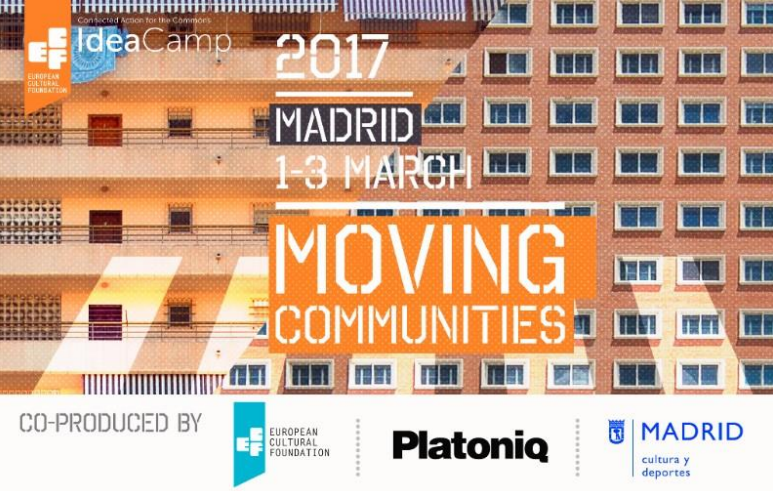
In the framework of the Idea Camp 2017, the City of Madrid, the European Cultural Foundation and the Connected Action for the Commons are organizing the Innovative City Development meeting with municipal and city officials who are working in a progressive approach on cultural and urban related issues, using participatory methods. On March 2nd and 3rd attendees from Poland, Spain, Greece, Moldova will co-exchange about the city as commons and also meet with the Idea Makers.
The meeting will have two fundamental goals:
- To facilitate co-exchange and learning about the city as commons through presentation of practices and experiences
- To engage the participants to broaden knowledge on both activists’ and institutions’ approach to city space and its problems.
Connected Action for the Commons will contextualize the meeting: it is a network and an action research program working mainly on topics linked to the commons such as public spaces, culture and democracy. It is in the process of co-developing and exchanging expertise as a network and engaging its local communities.
Christian Iaione, LabGov’s co-founder, will attend the meeting and facilitate the majority of the sessions.
Further information about the Idea Camp 2017 is available here: http://www.culturalfoundation.eu/connected-action/
by Chiara De Angelis | Feb 7, 2017 | Storytelling 2016-2017
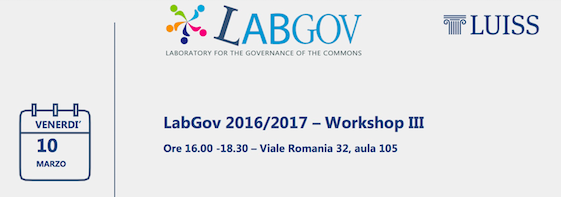
On Friday, March 10th, LabGov EDU 2016/2017 will host in its workshop two experts of commons at an international level: professor Sheila Foster, co-director of the Fordham Urban Law Center and co-founder of LabGov, and Maria Rosaria Marella, professor of private law at Perugia University.
Professor Foster will focus on “The City as a Commons”, the relation between commons and urban context, with a speech on pooling and generating common goods in undeserved neighborhoods, while Professor Marella is going to focus on use and property in urban spaces.
After the two panels, labgovers and LabGov’s experts will have time to discuss with Professor Foster and Professor Marella about the thematics related to urban commons.

Venerdì 10 marzo si terrà il workshop che aprirà la seconda sessione di attività di LabGov Edu. Interverranno due esperte internazionali nell’ambito dei beni comuni, la professoressa Sheila Foster e la professoressa Maria Rosaria Marella.
Sheila Foster è professoressa alla Fordham University e cofondatrice di LabGov; il suo intervento si collocherà nella cornice del percorso di apprendimento che i Labgovers stanno portando avanti sui beni comuni, e in particolare sulla relazione tra il contesto urbano e i beni comuni (“the City as a commons”); la professoressa inoltre racconterà le esperienze di New York in tale ambito. La professoressa Marella, ordinaria di diritto privato all’Università di Perugia, focalizzerà la sua attenzione sui beni comuni come paradigma che va oltre i concetti di pubblico e privato; inoltre parlerà agli studenti dell’uso e della proprietà nello spazio urbano.
Quella del 10 marzo è la prima data della serie di appuntamenti del secondo semestre, che vedrà i LabGovers impegnati in workshop teorici, co-working pratici e attività nel territorio della città. Continua dunque il percorso del Laboratorio nell’università, dopo una prima sessione densa di incontri con esperti di beni comuni, giornalisti urbani, architetti e urbanisti e attività di rigenerazione urbana. Dopo questa data l’appuntamento sarà per la terza sessione di co-working, il 17 e 18 marzo.

by Chiara De Angelis | Oct 19, 2016 | The Urban Media Lab
From October 20th to 22th Paris is hosting the 3rd IASC Conference on knowledge commons. The Conference is co-organized by the INCLUSIVE team at Sciences Po Paris and the International Association for the Study of the Commons.
After the successful editions held in 2012 and 2014, this third conference will aim to look at the normative effects and institutionalization of the many initiatives based on knowledge commons and how commons provide new legal tools, public policy choices, and forms of social, economic and governance innovations.
The conference is divided into 6 tracks:
- Track 1: Commons Policies and international law
- Track 2: Commons as a new concept in intellectual property
- Track 3: Indigenous and local communities’ knowledge and social practices
- Track 4: Commons in knowledge production and dissemination
- Track 5: Scientific research as a commons
- Track 6: Knowledge commons and the city
LabGov will attend the conference with its co-founder Christian Iaione, who will be presenting a paper about “The urban commons as infrastructure to produce urban knowledge as a commons” (co-written with Elena De Nictolis) during Track 6.
Have a look at the complete program on the official website: http://knowledgecommons.paris/


 Giuridicamente non esistono molti riferimenti: tendenzialmente ci sono strumenti che hanno in qualche modo realizzato il diritto di uso agli spazi, e di conseguenza limiti alla proprietà (pubblica e privata). Il caso Pigneto a Roma è molto sentito ed è una situazione molto articolata. Vi è una piccola piazza molto frequentata, gestita dai residenti, in cui organizzano cene e feste particolari. Un giorno una fila di box viene venduta ad un imprenditore che presenta subito un cambio di destinazione di uso per farci una sorta di Starbucks italiano.

