On Sunday, May 7th, the labgovers 2016/2017, in collaboration with the Comunità Parco Pubblico Centocelle and Associazione Nuova Vita, and in the context of the Co-Roma process, organize “Coltiviamo la COllaborazione Civica“: a day of collaborative practices, as the final step of the lab.
During the day there will be labs for kids, sport activities and a practice of community garden with recycled materials: the community garden comes out from the university once again, to plant the collaboration seed.
Domenica 7 maggio i labgovers anno 2016/2017, in collaborazione con la Comunità Parco Pubblico Centocelle e con l’Associazione Nuova Vita, e nell’ambito del processo Co-Roma, organizzano “Coltiviamo la COllaborazione Civica“: una giornata di pratiche collaborative, come step conclusivo del laboratorio.
La giornata prevede attività laboratoriali per bambini, giochi, attività sportive, e una pratica di orto collaborativo con materiali riciclati: l’#OrtoLuiss esce ancora una volta dall’università per piantare il seme della collaborazione.
Appuntamento alle 11.00 all’incrocio tra Via Casilina e Via Palmiro Togliatti!
Friday 11th November,2016, the labgovers have taken part in the third session of co-working guided by the advices of professor Paola Santoro.
The session started with the report concerning the on-the-spot- investigations made by the students the 8th and 10th of November at the archaeological park of Centocelle and its surroundings. Their impressions and considerations were different, and this was also due to the fact that some people belonging to associations active in the area appeared to be hostile to the actions of Labgov. Despite these episodes, the students agreed on the fact that there is a clear feeling of uneasiness and resignation regarding the Park and its neighbourhood.
Following this report made by the students, Paola Santoro taught them how to use the Value Proposition Canvas, a tool extremely useful in the field of facilitation of common goods. The following task for the students in fact, was targeting the needs, the fears, the wants and the substitutes connected to the park, and placing them inside the model. Despite the difficulties found in the choice of the best category to fit each concept, the results have been quite similar across the different groups. The session concluded focusing on the activities of the following day, which would have been devoted to find solutions for the many problems of the area.
On Friday 14th and Saturday 15th October, the first co-working session of this year, 2016-2017, will be held. During the first day, the new labgovers will discuss with Paola Santoro, service designer, how to facilitate urban commons. They will reflect on the meaning of this strategy and on its relevance to build a community and to realise a collaborative project. Paola will illustrate the CO-Roma project and her experience.
On Saturday, there will be Eloisa Susanna, an architect of G124 and partner of CO-Roma. She will be talking about the method adopted for both Co-Battipaglia and CO-Roma projects, and she will describe the experience she made working in the suburbs of Rome. Then, the labgovers will meet Claudio Gnessi and Stefania Favorito of the Ecomuseo Casilino and Urio Cini and Alessandra Noce, two active citizens and members of the Community for the Public Park of Centocelle. Together they will reflect and work on the potentialities and problems of the park and of the territory around it. Let the work of mapping and experimentation begin!
———————————————————————————————————
Nelle giornate del 14 e 15 ottobre, nella sede di Viale Romania si terrà la prima sessione di co-working del laboratorio 2016-2017. Nella prima giornata i ragazzi incontreranno Paola Santoro, service designer, insieme alla quale rifletteranno su cosa significa facilitare i beni comuni, a partire dalla sua esperienza di facilitatrice nel progetto CO-Roma. Il giorno successivo sarà presente Eloisa Susanna, architetto di G124 e partner di CO-Roma, la quale racconterà il lavoro svolto nelle periferie di Roma, in particolar modo nel Municipio V, cuore del progetto CO-Roma. Successivamente interverranno Claudio Gnessi e Stefania Favoriro, di Ecomuseo Casilino e Urio Cini e Alessandra Noce, della Comunità per il Parco Pubblico di Centocelle, con i quali i ragazzi ragioneranno e lavoreranno sulle potenzialità e criticità del parco e del territorio attorno. Che i lavori abbiano inizio!
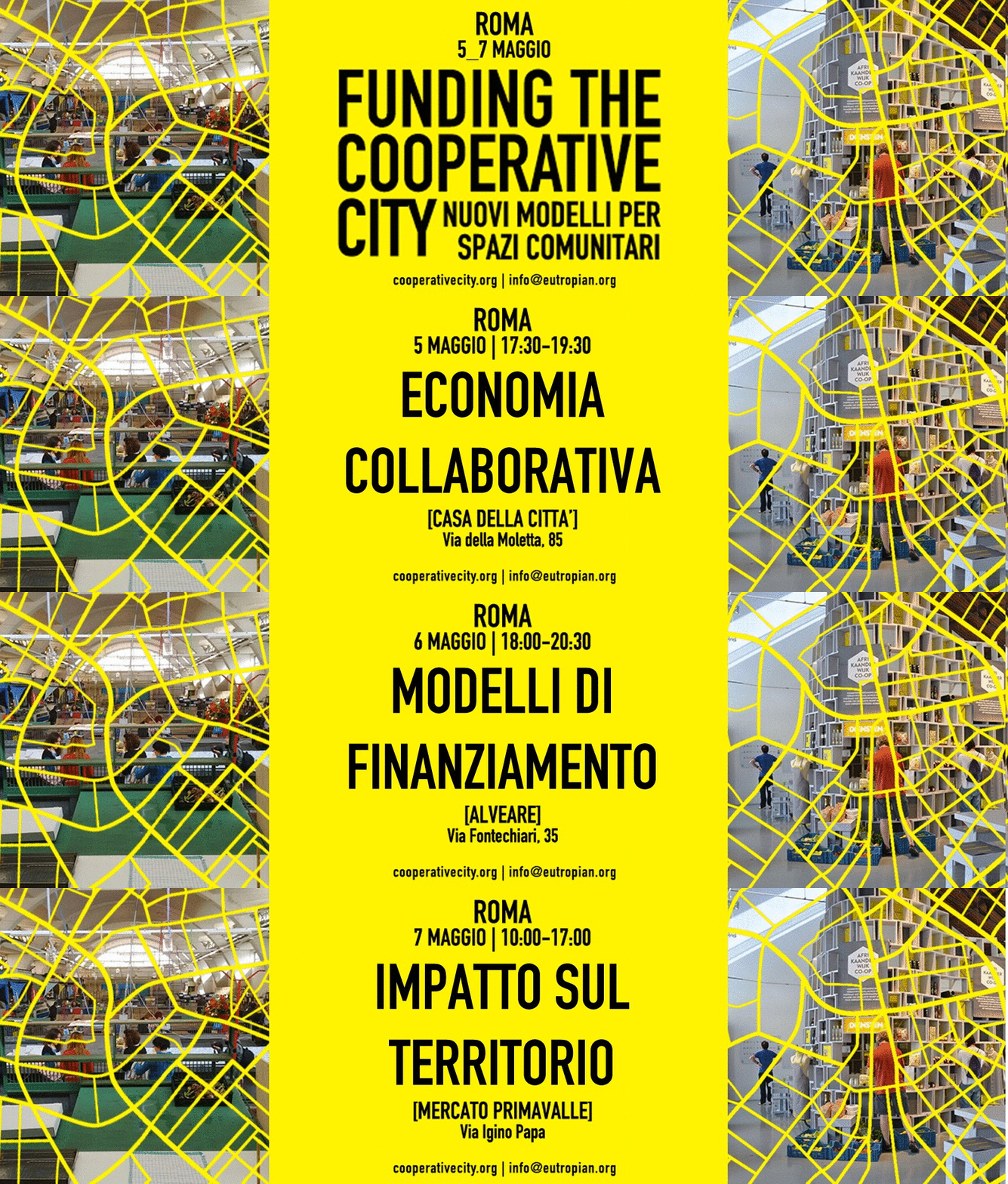
Community financing in collaboration with the Administration. This was the theme of the first event in the three-day long workshop “Funding the Cooperative City – Rome” Nuovi modelli per spazi comunitari, which took place in Rome (@Casa della Città) on 5th May.
In front of the audience, Daniela Patti, Managing Director of Eutropian GmbH in Vienna and Founder of Eutropian association in Rome, introduced local and international speakers:
Afrikaanderwijk Cooperative and Freehousebring existing workspaces, entrepreneurs, producers, social organizations and the market together. They promote sustainable local production, knowledge, cultural development and entrepreneurship based on shared responsibility and participation. The primary purpose is for people in the Afrikaander district to reclaim the right to develop their own neighbourhood.
Afrikaanderwijk Cooperative and Freehouse are working in Rotterdam-Zuid’s Afrikaander district to create a stronger and wealthier area for residents and businesses. In order for the Afrikaander district not become the victim of the expansion of the creative city, Freehouse set up small-scale projects to regenerate the districts and its market from within. In collaboration with residents, artists, and fashion designer Freehouse created a workshop for making and designing clothes, a communal kitchen area and a shop selling local products and offering small-scale delivery services. Another crucial element is the Afrikaander Market, which has been in decline for several years because it is not possible to combine products and services on the same stall. With over 300 acts of civil disobedience, they found a solution: red carpet fashion shows presented the work of young local designers and alongside items available on the market. In addition, the one-sided market assortment was expanded with local quality products. At the present, they offer over 48 jobs and various internship to the community.
Fondazione Cascina Roccafranca, founded by Turin municipality and participated by associations and informal groups is an innovative, social and cultural civic centre designed to citizen participation. It is a “container” that provides service: such as an accommodation centre, advice shops, a restaurant and a cafeteria that contribute to economic sustainability. There is also an Eco-museum and activities about ethical consumption, courses (theatre, dance, painting, diction …) reading groups, cinema clubs, foreign language courses, after-school programs, etc. Both the Foundation and other actors organize the activities and the services.
There are 100 courses involving over 3500 people, not only from the neighbourhood but also from the entire city. Actually, 40 volunteers and 20 specialists work in the Foundation. Through the improvement of relationship among different ages, cultures and actors, the Foundation wants to encourage citizens to be a part of their community and to work not only for their private needs but also for the commons. To do this, it is necessary to focus on citizen rights, social cohesion and new models of cooperation (especially PPP).
Zo-Ho is Rotterdam’s makers’ quarter. In 2013, owner Havensteder, Stipo and Municipality cooperated and decided to develop the area in a gradual process called slow urbanism. The area has been the opportunity to redevelop itself for 10 years. Havensteder offered tenants the chance to use and develop their property in an appropriate manner. The municipality provided spaces for experimentation and invested in social strategy and public spaces. Tenants found suitable neighbours and provided frameworks for the development of buildings and public spaces. Thus, users of the area, companies, organizations, inhabitants, and visitors can get involved with the development plans.
Two examples of improving Zo-Ho at eye level are Restaurant Gare du Nord (a successful organic vegan restaurant in a former train wagon on a derelict building site. The staff came from the neighbourhood) and residents from the Noord district starting an area cooperation to improve their district in an economic sustainable way. Zo-Ho become an experimenting and prototyping area and the success of the project persuaded other people to join the district.
LabGov Luiss is a place of experimentation, created to train the “experts in the governance of urban commons”. The goal is to create a new institutional and economic system based on the model of “civic collaboration”, “collaborative governance of the commons” and “circular subsidiarity”, according to which public institutions shall favor all citizens (individuals or in associative forms). In order to achieve social and institutional regeneration, it is necessary to create collaborative relationships between citizens, administrations and businesses to share the scarce resources and to take care of the commons, whether tangible or intangible, in urban and local community.
Prof. Iaione talked about the experiences of Pilastro, Co-Bologna and Co-Roma underlining some key points. First, the scheme of experimentation concerns reproducing institutions in the street (it is a matter of co-design; the results are new forms of social institutions). Then, it is a tension between social norms and formal rules because bureaucracy doesn’t work in the same direction (public procurement is different from co-design) but it is necessary a collaborative approach between internal and external actors to agglomerate knowledge. LabGov’s work is an experimental research on the field; it is natural that there are problems and imperfections in the process because we are in a transition from dualistic to cooperative paradigm. The city could be seen as a laboratory. There is not one solution, it’s a process.
Area Studi ANCI is a part of Cittalia – Fondazione Anci Ricerche and it is a network dedicated to research and study activities on issues of major interest for Italian Municipalities. The Foundation initially got involved in environmental, institutional and innovation programs and then focus on welfare, social inclusion, local governance, public and urban policies. The mission of Cittalia is to support Italian cities and Municipalities in facing the challenges of a changing society, so that they can develop effective public policies and improve their capacity to plan, manage and assess their actions.
Regarding the state of art of the co-city, Dr. Allulli agrees with the previous speaker. He talked about three assumptions: city rulers intend Co-city as a mere replacement of the role of PA (it is not correct because Co-city is more). The second assumption concerns the lack of understanding between politicians and social innovators because the former talks about money, the latter about legitimization, spaces and resources. Then he affirms that, although the contradictory situation, Italy is a land of pioneers: a lot of PA are changing their mind, they think in term of resources not only money. According to this, good news are the crowdfunding growing experience, participatory budgeting and exchanging best practices.
WithYouWeDO is a TIM’s Social Responsibility Enterprise programme. It is a crowdfunding platform, c’est-à-dire a method of web funding by large numbers of people, or crowds, with the goal of raising funds, even of small amounts, to finance projects placed on a platform/website. This platform is available for the non-profit sector and the public. WithYouWeDo promotes and supports the funding of initiatives, ideas and projects in the following areas:
Social Innovation: from innovative projects for solidarity to building new models for integration.
Spreading Digital Culture: schools, art and literature, from protecting heritage to innovation in the expression of creativity.
Environmental Protection: everything that relates to environmental sustainability.
The platform includes two types of support:
Reward Based Crowdfunding is form of fundraising to support a project in exchange for non-monetary recognition or reward on achieving the objective set out at the start of the campaign.
Donation Based Crowdfunding on the other hand is a way of donating to support a given idea or campaign, without receiving anything in return: a sort of ‘intellectual investment’.
In conclusion, we can affirm that this event has been an opportunity to discover citizen spaces and new economic models for community-led urban development with initiatives from Italy and Europe.
–
Funding the Cooperative City – Rome è stata un’occasione per conoscere nuovi modelli economici per uno sviluppo urbano promossi dalla cittadinanza con iniziative italiane e straniere. In particolare, l’evento del 5 maggio intitolato “Finanziamento di comunità in collaborazione con l’Amministrazione” si è caratterizzato come una chiacchierata tra esperienze italiane (LabGov e Cascina Roccafranca), internazionali (Afrikaanderwijk Cooperative e Zo-Ho) e contributi tecnici (Area Studi ANCI e WithTouWeDo).
Saturday, May 7th, 2016 from 10:00 to 16:00 the one-day event “Insieme per il bene comune – dalla terra al cielo” will be held in Rome at the “Isola Felice”, garden, next to the Church of St. Felice da Cantalice in the Centocelle district. It is a civic maintenance and urban mending initiative that closes the non-formal education program of LUISS LabGov 2015/2016.
It will be a feast day in the name of civic collaboration, organized by LUISS LabGov together with Associazione 100 e a capo, with the support of Municipio V as part of the Co-Rome process.
During the event, a community garden will be built in the San Felice garden, using materials found and prepared by the students of LUISS LabGov education program.It will be managed by Associazione 100 e a capo, an association of parents and grandparents of the primary school Cecconi in Centocelle that will take care of it within a green space adopted a few months ago and thus subtracted to abandonment and degradation.
There will be creative activities and workshops such as filling the bins to embellish the green area, followed by a walk and/or bike ride within the Centocelle Park.
The goal is to disseminate good practices in order to protect the environment and the beauty of Rome, through the promotion of civic use and care of urban commons. LUISS students, assisted by an interdisciplinary pool of landscapers and street architects, social media managers, lawyers of the community, services designers and triple sustainability experts have also worked on a medium/long-term strategy to generate jobs and solidarity starting from Centocelle commons.
Going outside the university buildings in order to create the first “urban collaborative garden” is just the first step to test new solutions and grow the collaboration between the five top actors at the city level: citizens, institutions, companies, schools and associations.
The new community garden, the first powerful initiative in a suburb in Rome, is just the beginning of a journey that has as an additional objective in leading to the creation of a new institutional form of community for the governance of the commons, which are essential to the well-being of neighborhoods, such as the Centocelle Park.
The new LUISS community garden that symbolizes the “seed” that, beginning from the existing collaborative resources, wants to give birth to a new institutional form of active community that has a chance to give its contribute in re-writing and drawing on a daily basis the rules of social coexistence and urban economic development in the management of services, activities, neighborhoods and city commons, along with public institutions.
The ultimate purpose of the Co-Roma_Roma collabora! – this is the name that LUISS students gave to the whole project – it is to develop, design and test a strategy for the governance of the commons suitable to shape “the city and the territory of Rome as commons.”
Representatives from the University LUISS Guido Carli, local institutions, associations and neighborhood committees will intervene.
For more information write to:
edu@labgov.it
—————————————————————————————————
Sabato 7 Maggio 2016 dalle ore 10:00 alle ore 16:00 si terrà a Roma presso “l’Isola Felice”, giardino attiguo alla Chiesa diSan Felice da Cantalice nel quartiere Centocelle, una giornata – evento ‘‘Insieme per il bene comune – dalla terra al cielo”, operazione di manutenzione civica e rammendo urbano conclusiva del programma di educazione non formale LUISS LabGov 2015/2016.
Sarà una giornata di festa all’insegna della collaborazione civica organizzata da Luiss LabGov e Associazione 100 e a capo con il supporto del Municipio V nell’ambito del processo Co-Roma.
Nel corso della giornata verrà costruito nel Giardino San Felice un orto condiviso, con materiali reperiti e preparati dagli studenti del laboratorio educativo Luiss LabGov. L’orto condiviso verrà gestito dall’Associazione 100 e a capo, un’associazione di genitori e nonni della scuola primaria Cecconi di Centocelle, che se ne prenderà cura all’interno di uno spazio verde adottato da qualche mese e sottratto quindi all’abbandono e al degrado.
Si svolgeranno laboratori ludico-creativi come il riempimento dei cassoni per abbellire l’area verde; seguirà una passeggiata a piedi e/o in bicicletta all’interno del Parco di Centocelle.
L’obiettivo è quello di diffondere una buona prassi a tutela dell’ambiente e della bellezza di Roma attraverso la promozione di forme di uso civico e cura dei beni comuni urbani. Gli studenti Luiss assistiti da un pool interdisciplinare di paesaggisti e architetti di strada, social media managers, giuristi di comunità, designers dei servizi ed esperti di tripla sostenibilità hanno lavorato anche ad una strategia di medio-lungo termine per generare lavoro e solidarietà a partire dai beni comuni del quartiere Centocelle. Uscire dall’università per creare il primo “giardino di collaborazione urbana” è solo il primo passo per sperimentare nuove soluzioni e ‘‘coltivare’’ la collaborazione tra cinque fondamentali attori della città: i cittadini, le istituzioni, le imprese, le scuole e l’associazionismo.
L’installazione dell’orto condiviso, prima importante operazione in una periferia romana, è solo l’inizio di un percorso che ha come ulteriore obiettivo quello di portare alla costituzione di una nuova istituzione di comunità per la gestione di beni comuni fondamentale per il benessere del quartiere come il Parco di Centocelle. Dall’ortoLuiss, nasce un nuovo orto che simbolicamente rappresenta il ‘‘seme’’ che, partendo dalle risorse collaborative esistenti, vuole dare vita ad una nuova istituzione di comunità, una comunità attiva che abbia la possibilità di contribuire a riscrivere e disegnare quotidianamente le regole della convivenza sociale e lo sviluppo economico urbano nella gestione di servizi, attività, quartieri e beni della città insieme con le istituzioni pubbliche.
Lo scopo ultimo del processo Co-Roma_Roma collabora!, questo il nome che gli studenti Luiss hanno dato all’intero progetto, è quello di elaborare, disegnare e sperimentare una strategia di governance dei beni comuni idonea a configurare “la città e il territorio di Roma come beni comuni”.
Interverranno rappresentanti dell’Università LUISS Guido Carli le Istituzioni locali, le associazioni e i comitati di quartiere.

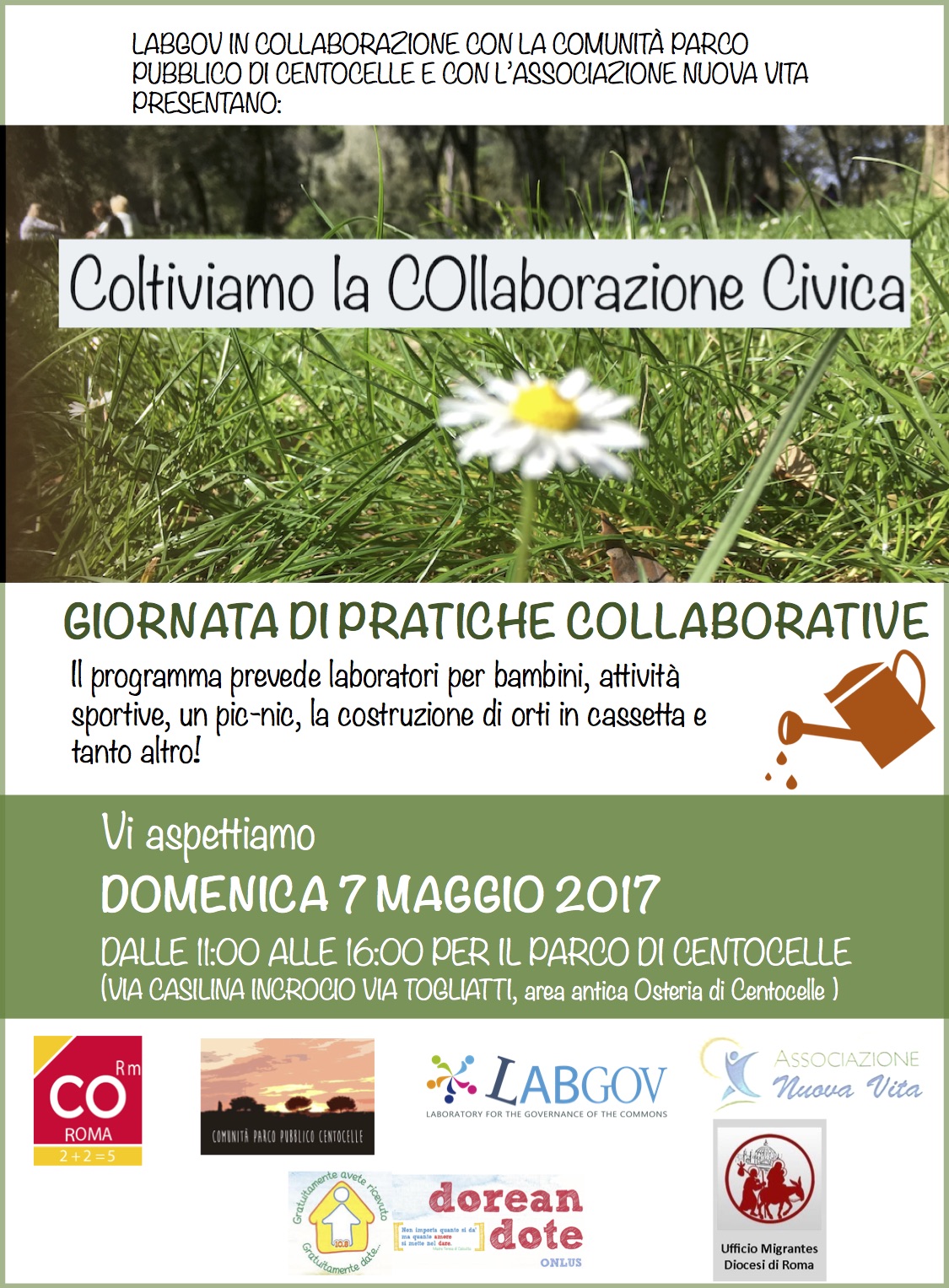
 collaboration with the Comunità Parco Pubblico Centocelle and Associazione Nuova Vita, and in the context of the Co-Roma process, organize “Coltiviamo la COllaborazione Civica“: a day of collaborative practices, as the final step of the lab.