
by Marina Bassi | Jun 12, 2015 | The Urban Media Lab
During last Saturday the 6th and Sunday the 7th of June, Spero2020 has taken place in Siracusa. LabGov – LABoratory for the GOVernance of Commons joined the event. Professor Christian Iaione, coordinator of LabGov, participated at the event as a contributor of the two-days’ work tables.
Spero2020 was an event – organised by Tempi Nuovi Siracusa and AJS Connection – that takes its cue from Matteo Renzi’s Leopolda, convinced that dialogue and constructive part is the way to put the focus on political needs and desires of citizens, helping to reduce the gap between public administration and territory.
Focused on the province of Siracusa, Spero2020 was aimed to undertake the comparison and the production of ideas and solutions, involving stakeholders and provincial stakeholders to 12 thematic groups. The working groups have addressed two specific focus developed on the basis of needs expressed during the path towards Spero2020.
The twelves focusing areas have been the following:
- Energy
- Environment
- Accountability
- Culture and Tourism
- Universities
- Welfare
- Mediterranean issues
- Development
- Social Innovation e Smart City
- Agriculture
- Governance of territory
- Youth and future
At the conclusion of the event a policy document has been worked out, and it was a work of synthesis of the proposals submitted to the tables in the two days of work. A complex and challenging action of grassroots participation with the help and cooperation of all those who believe that our country deserve better.
It is to make a mark decisive for the generations to come, all together.
More info on: http://www.spero2020.it/
______________________________
Spero2020 – nuovi metodi di costruzione delle politiche pubbliche
Lo scorso weekend, nelle giornate di Sabato 6 e Domenica 7 giugno, si è tenuto nella provincia di Siracusa l’evento Spero2020. LabGov ha partecipato all’incontro durante le due sessioni di lavoro. Queste hanno prodotto un documento programmatico di sintesi, incrocio fra le esigenze del territorio e i bisogni dei cittadini.

by Leonardo Rossi | Mar 25, 2015 | The Urban Media Lab

On November 18-20 2014 there was the 4th edition of the “Smart City Expo World Congress” (SCEWC), and it took place in Barcelona.
The topics covered during this event were: Smart Society, Technology, Governance, Energy, Mobility and Sustainable City.
It was an event full of discussions, projects and a lot of great ideas were discussed around such topics; the “Smart Society” theme was focused on the fostering of creativity, innovation, economic development and collaboration inside the boundaries of the cities, bringing the population to the center of decision-making in order to make urban and social development more democratic. Cities must be reinvented and transformed so that they become more sustainable, and improve quality of life and economic performance. This should be a shared vision and the way forward for citizens, public and private organizations and multi-stakeholders.
This topic is growing in importance in modern society, and recently there was also an European call, “Horizon 2020”, that was focused on the attempt to bring the population closer to the European mechanisms, in order to foster the collaboration between citizens and governments, and create a network of Smart Cities all around Europe.
All the topics that formed the “core” of this were deeply covered, and all seemed to express a common will to shift the modern view and use of energy, technologies and governance towards a collaborative approach, were the citizens cooperate with the governments in order to produce and support a lifestyle focused on the sustainability of energy, lifestyle, governance and technologies.
As a matter of fact, consumers are in a demanding shift, asking for a new energy model, environmentally and economically sustainable, making better use of local scale and renewable resources, while having a global focus and a strong partnership between governments and companies. The marketplace for wind or solar energy is shifting and reaching the mainstream. Every industry is regulatory and subsidy dependent. Clean energy in short will be able to deliver to local stable energy and subsidies will decline over time, as many of the renewables are able to be paid by themselves. This technological revolution is an opportunity of real change in how cities are operated and therefore a possible way forward for economic and social development.
This congress was a great example of how the modern societies’ demands managed to influence the economic and political spheres, and the fact that more and more multinational companies like IBM, Philips, Nissan, BNP Paribas, Microsoft, Oracle and Cisco became more concerned about such topics and aware of the possible available solutions is indeed a beacon of light into the grim darkness of the “non-collaborative future”.
The 5th edition of the SCEWC will take place on the 17-19 of November 2015, and given the growing success and importance of such event, it is possible to hope for some real projects to be proposed regarding the topics of sustainability.
Smart City Expo World Congress: Le Multinazionali accendono il faro della speranza.
Nella quarta edizione della SCEWC si sono discusse tematiche fondamentali quali energia, tecnologie, Smart Cities, governance e sostenibilità.
Dalle conferenze e dai workshop è emerso che la società sta cambiando e che desidera sempre più spostarsi verso una società più attenta e proiettata alla sostenibilità e alla governance comune.
Il ciclo di conferenze ha dimostrato come la società moderna riesce ad influenzare la sfera politica ed economica; il fatto che numerose multinazionali del calibro di IBM, Philips, Nissan, BNP Paribas, Microsoft, Oracle e Cisco abbiano preso parte a questo evento dimostrandosi sensibili alle tematiche sopracitate ci rende più fiduciosi riguardo al futuro.
La prossima edizione del SCEWC si terrà dal 17 al 19 Novembre del 2015 e si potrebbe azzardare la speranza di vedere una serie di progetti concreti prendere forma.
by Francesca Spigarolo | Mar 22, 2015 | EducationLabs, Luiss LabGov 2014-2015
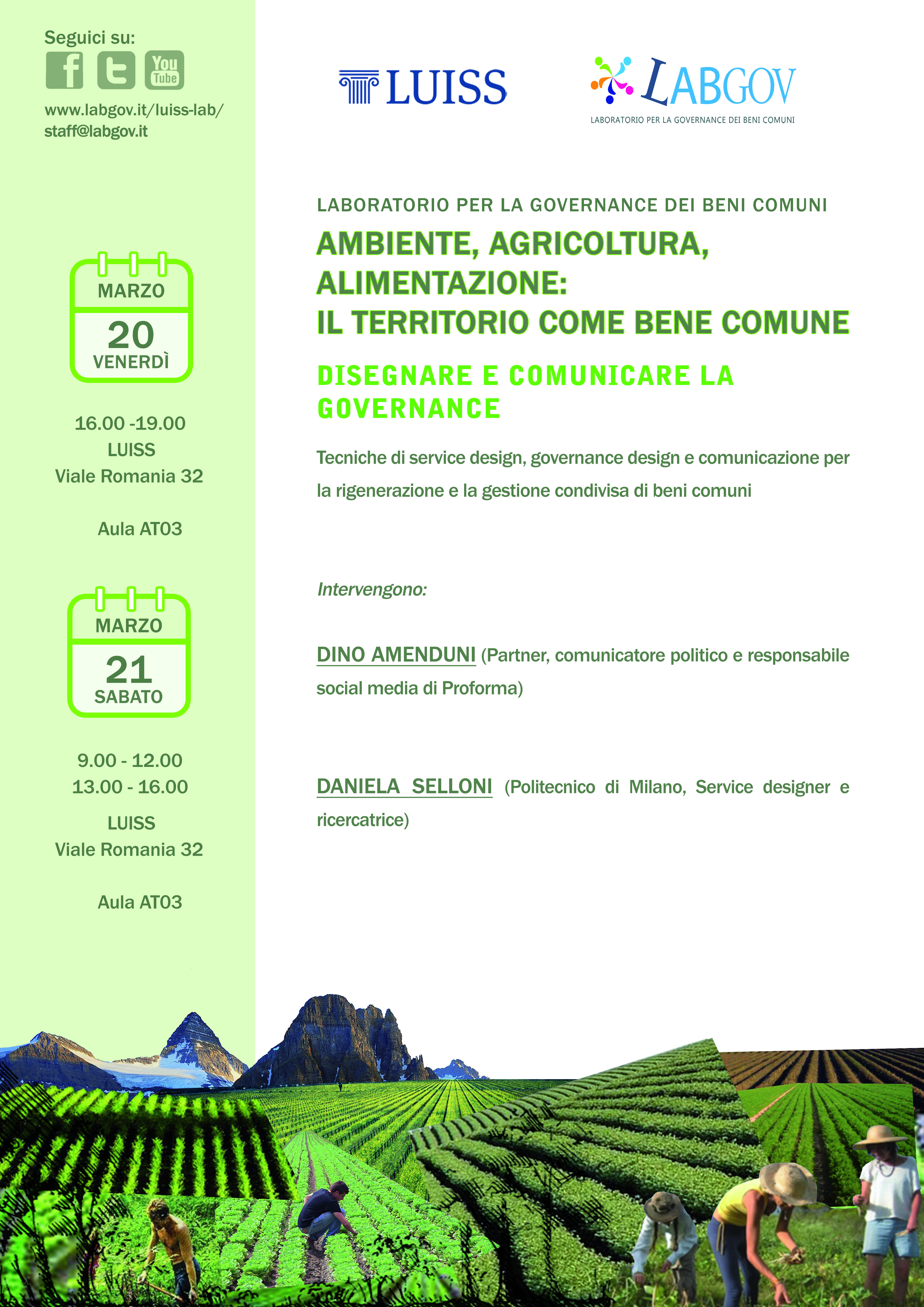
 Is it possible to develop new forms of legal order through a strategy that better protect the territory of our country? How can legality become a cultural element shared by our community rather than being an abstract concept? These were some of the questions raised at the conference “Territorio e nuove forme di Legalità” that took place on March, 17th at LUISS University in Rome.
The conference was an opportunity for the Labgovers to show the projects, activities and achievements of the Laboratory, to receive valuable feedbacks and advices from the participants and to listen at their opinions on the topic of land and governance, which holds a fundamental importance of 2014/2015 LabGov’s edition.
The meeting was opened by LUISS General Director Giovanni Lo Storto, who explained that the reason behind his choice to create a community garden inside the University was “to allow the students to change the state of affairs by providing them with the instruments they need” and to provide them with “a gym where the students can share knowledge and grow together”.
The first speaker to take the floor was Paola Severino, professor of Criminal Law and LUISS Executive Vice Provost who affirmed that through “concreteness and fantasy”, students contribute to the debate. This qualities, which are fully shared by LabGov, are essential to develop the idea itself and the benefits generated by the Commons and to “make the concept of legality something concrete rather than abstract”. “Legality must be recovered with the contribution of the citizens, it cannot be passively waited”. The Professor then spoke about the importance of having “effective sanctions which can lead to concrete results” and which must be developed along with a strong “culture of legality”.
Then, the floor was taken by Gian Carlo Caselli, president of the “Osservatorio Agromafie” scientific committee. Dr. Caselli, started his speech from his personal experience against organized criminality in Palermo, and spoke about the importance of creating “citizenry participation through which the hegemony of corruption and misconduct can be interrupted”. According to Caselli, we need of “new paths to build legality which will allow us to enjoy rights in our territory”. “Trust in the Institutions must be built”, so that “legality will be seen not only as a set of rules but as bringing advantages to the whole community”. Caselli then concluded his speech with a critique to the indifference which amounts to “not taking care of the polis when we could instead cooperate and contribute to its development”.
The second part of the conference took the form of a round table in which the speakers contributed to the discussion by providing their numerous opinions on the topic.
Professor Melina Decaro, professor of public comparative law, asserted that “more than talking about the right to food, it would be more accurate to speak about a right to the natural capital”.
Professor Gian Candido De Martin, professor of public law, underlined the importance of “building a culture that can function as a frame for the rules”, because “what we need is not prohibition, but awareness of the value of common resources”.
Then, Bruno Frattasi (Head of the Interior Ministry Legislative and Regulatory Affairs Department) focused on the idea of “security and legality as shared goods that must be achieved through an alliance between public and private actors”, followed by professor La Spina (professor of public policies) who spoke about the need to have an “integration between a regulation coming from the centre and an organization from the bottom”.
Finally, the floor was given to Antonella Manzione, Head of the Council of Ministries Presidency Legislative and Regulatory Affairs Department , whose starting point was the importance of “creating the culture of legality and building an active citizenship through education in schools and families”. To properly manage the territory we need the citizens to participate and take care of it, but for this to be possible we need to support with some concrete normative instruments those individuals that are willing to get involved. Attempts to create these instruments have been made, as we can see in the article 24 of the “Decreto Sblocca Italia”, but this pieces of legislation are mostly unknown and unapplied. Manzione concluded her speech by reporting the words of a 17 year old girl, saying that what is really needed is “a space, both physical and mental, in which hope and future can be built”.
The conference was concluded with a greeting by Maria Letizia Gardoni, President of Coldiretti Giovani Impresa, and with her wish to see “the growth of daily gestures showing social and political responsibility”.

by Edoardo De Stefani | Dec 3, 2014 | EducationLabs
The second edition of Sharitaly, the first Italian event entirely dedicated to the sharing economy, was a great occasion for launching the “sharing school” program that will be held in the city of Matera on January 2015, the 23rd.
The four days full immersion is a program based on a “learning by doing approach”, which aims at forming participants on the raising theme of sharing economy.
The possibility to experiment collaboration among participants is the pivotal practice of the school. Through active participation, cooperation, inclusion and strong theoretical background, the program aims at analyzing recent trends and best practices of the sharing economy and to provide the necessary instruments for designing and managing community services.
The school is thus recommended for all those people, enterprises or public actors which seek to deepen their knowledge of practices related to the Commons, as well as to the sharing economy.
Matera, elected as European Capital of Culture 2019, is the perfect place for hosting the “sharing school” because of its public spaces and because of the high rate of sensitivity to innovation of the civic community that lives in Matera.
CasaNeutral is an example of how the paradigm of co-working can become social innovation as well as a leading professional experience.
Moreover, thanks to the collaboration of all partners, the school will be able to host highly qualified professionals and experienced innovators.
For inscriptions and more info please click on the link below:
http://www.sharingschool.it
La seconda edizione del Sharitaly, il primo evento italiano interamente dedicato alla economia della condivisione, è stato una grande occasione per il lancio del programma school sharing che si terrà nella città di Matera a partire dal 23 gennaio 2015. Matera, eletta Capitale Europea della Cultura 2019, è il luogo ideale per ospitare la sharing school per i suoi spazi pubblici e per l’alto tasso di sensibilità per l’innovazione della comunità civica che ci vive. La full immersion di quattro giorni è un programma basato su un “learning by doing”, che mira a formare i partecipanti sul tema raccolta di sharing economy.
Per le iscrizioni e per maggiori info:
http://www.sharingschool.it
by Alessandra Feola | Oct 6, 2014 | The Urban Media Lab
 In Mantua on the 10th and 11th of October will be presented the governance proposal to the public.
With the beginning of October the “Entrepreneurs for the Commons co-design Laboratory” – promoted by the “Cooperative and Civic Economy Enterprises Group” established within the Chamber of Commerce of Mantua and realized in collaboration with Labsus – Laboratory for the subsidiariarity, started a new phase of its path, the third and last phase called “Governance Camp”.
In the first phase it has been opened a Call for ideas “Culture as a Commons”, made by the Province of Mantua that selected 5 winning projects. The second phase consisted in an Ideas camp that started in June since the last meeting on the 29th and 30th of September with prof. Luigi Corvo. The Ideas Camp aimed at cultivate, improve and coordinate the project ideas.
During the Ideas Camp the project ideas has been prototype and systematized through interdisciplinary tools and techniques: participatory design, digital communication, services design, cultural and creative entrepreneurialism, fundraising added to co-working session and working groups.
The new phase of the Lab will consist in the Governance Camp. The Lab’s participansts will be involved in the analysis, construction and prototyping of a governance proposal that starts from the original projects present within the Lab and arrives to the construction of a network of alliances with institutional, civic and economic subjects.
The meeting will be held by professor Christian Iaione, scientific director of Labsus, on the next 10th and 11th of October at Politecnico University in Piazza d’Arco, 3.
Finally on Saturday the 11th the Lab will presented its governance proposal during the #fattidicultura Festival, organized by Pantacon association at Santagnese10, the creative co-working space of the Municipality of Mantua.
The #fattidicultura Festival aims to tell the cultural phenomenon that spreads in Italy in 2014. The title of the four days events intends to recall the “facts of culture” but also what does mean “to be made by culture”. In Mantua will arrive all the histories of cultural transformation in Italy, examples of creative contaminations that continues theirs process within challenge and questions. #fattidicultura will be a moment for discuss with who believe in culture. Moreover it will be a moment to present what Mantua is able to create.
Locandina_Mantova_10_11_ottobre

 During last Saturday the 6th and Sunday the 7th of June, Spero2020 has taken place in Siracusa. LabGov – LABoratory for the GOVernance of Commons joined the event. Professor Christian Iaione, coordinator of LabGov, participated at the event as a contributor of the two-days’ work tables.