by Marina Bassi | Aug 9, 2015 | The Urban Media Lab
 The “Open Collaboration Pact between the Municipality of Bologna and Fondazione del Monte di Bologna e Ravenna” has been agreed! The pact aimes at re-conceiving urban spaces as a common resource for communities. . The Open collaboration pact is the first step in the process (towards) CO-Bologna, the public policy launched by the city during the Civic collaboration fest in may 2015, during the celebration for the first year since the approval of the“Regulation on the collaboration among citizens and administration for the care and regeneration of urban commons”. All those efforts aims at installing collaboration as a structural methodology to run the city as a collaborative commons.
Bologna, the first city in Italy to conduct collaborative governance experimentation, will host the 1st IASC Conference, named “The City as a Commons: Reconceiving Urban Space, Common Goods And City Governance” is coming! The conference is organized by LabGov in collaboration with Fordham University of New York and ICEDD, the International center for democracy and democratization.The Conference will be held in Bologna, on November 6-7 2015. The conference will be co-chaired by Professor Christian Iaione (UniMarconi University and LUISS Guido Carli) and Professor Sheila Foster (Fordham University).
In the track “Designing and governing the city as a commons” all issues about institutional design for urban commons will be faced, and scholars and practicioners will discuss, asking questions and comparing possible solutions. Are there specific model to run the city as a commons? The decline of public financing and cyclical real estate and fiscal crises, result of the Leviathan-state governance model, have forced cities to struggle to prevent urban shrinking or gentrification processes, as well as to support and maintain shared resources and common goods or regulate urban development to keep cities as a fair, just, diverse, human flourishing and creative environment. Out of the public-private management dichotomy, are there other models to design or re-design urban settlements and other governance solutions to manage cities themselves as not just market-friendly, but also as human-friendly urban collaborative commons?
The deadline is approaching, still two days to register as an auditor or submit your paper on: http://www.labgov.it/wordpress/urbancommons/design-and-governing/


by Marina Bassi | Aug 9, 2015 | The Urban Media Lab
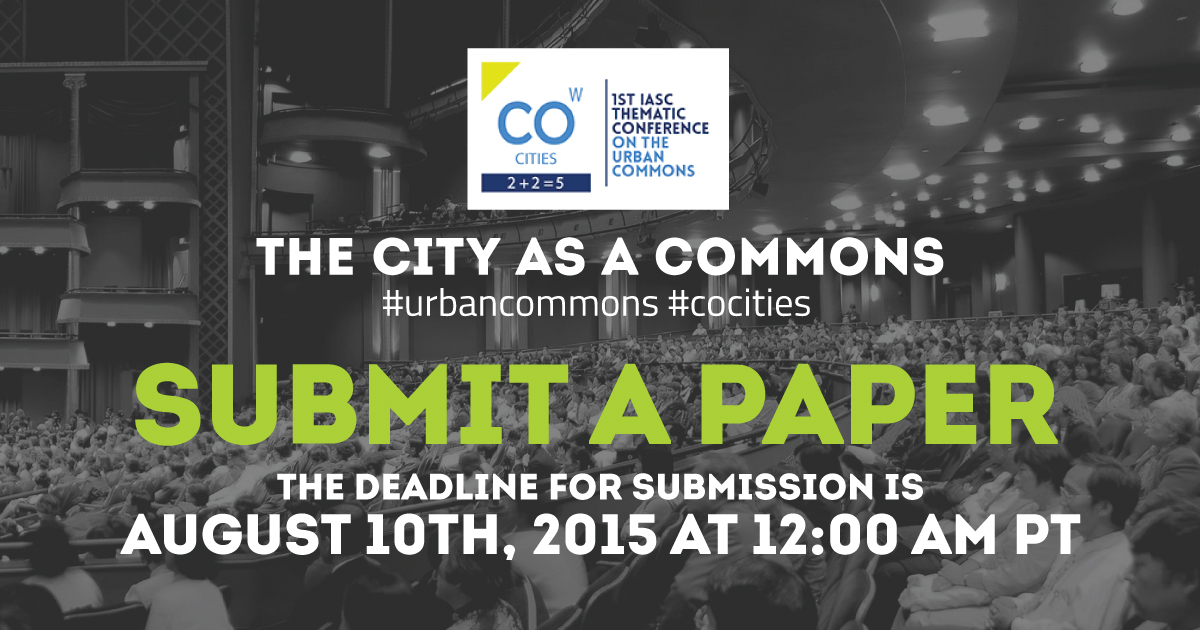
The 1st IASC (International Association for the Study of the Commons) Thematic Conference on urban commons is approaching. The call for abstracts is out until Aug 10th at 12:00 AM PT. The Conference title unveils the complexity and the ambition of an event that wishes to gather for two days the most prominent scholars and practitioners on urban commons, social innovation, sharing economy, to talk about “The City as a Commons: Reconceiving Urban Space, Common Goods And City Governance”. The Conference is organized by LabGov – LABoratory for the GOVernance of Commons, a partnership between the Urban Law Center of Fordham University and the International Center on Democracy and Democratization (ICEDD) of the LUISS University of Rome (http://www.labgov.it/the-city-as-a-commons-the-first-international-conference-on-urban-commons/). It will take place in Bologna on November 6-7, 2015. One of the track of the Conference concerns the Democratic Innovation and how governance of the urban commons could influence it. This is why we decided to interview one of the most prominent international scholars on democratic theory, Professor Nadia Urbinati.
On July the 5th, the Greek citizens went to the polls for the referendum announced by their Prime Minister, Alexis Tsipras. Greek people were asked to reply to a hard question, which then raised countless debates and opinions starting from the decision whether accept, or not, the austerity policies and economic measures proposed by the European Union and international creditors, to solve the issues about the Greek debt.
Many scholars, professors, writers and academics put the stress on the important fact that Greece is the cradle of democracy, the country where were born the most important historical thinkers of democracy.
Nadia Urbinati is one of those we are referring to. She is “Kyriakos Tsakopoulos Professor of Political Theory and Hellenic Studies” at the Department of Political Science of the Columbia University, she is also a political theorist who specializes in modern and contemporary political thought and the democratic and anti-democratic traditions. She co-chaired the Columbia University Faculty Seminar on Political and Social Thought and founded and chaired the Workshop on Politics, Religion and Human Rights.
The day before the Greek referendum, the Italian newspaper “La Repubblica” published an interesting article written by professor Urbinati. The title of the article is Greece and the European democracy myth which briefly but effectively analyses the history of democracy and the development of the political thought around this myth.
Some LabGov editors seized the opportunity and had the chance to build up a dialogue with professor Nadia Urbinati, trying to investigate the intersections between LabGov projects and the academic thought of professor Urbinati:
1) The twenty-first century seems to be identified as “urban century”. Can you create a model of urban democracy in Greece, in Italy, in Europe, or in the world? What features should you get?
Aristotle writes in the collection of the Greek constitutions that there are urban democracies and countryside democracies. However, a good democracy is mostly urban. Democracy, historically speaking, had its roots and developed in urban areas. Cooperation among people is essential to achieve it, regular exchanges are needed. These features are all better achieved in a urban environment. It is even possible to say, that democracy is the best form of an urban policy.
In ancient Greece or during the American or French revolution, participation was limited and fluctuant. Ephialte and Pericles created daily indemnities to allow people to participate. Today the situation is completely different, and there is the co-existence of two apparently opposite trends: on the one hand, physicality is no longer necessary in order to share in power, (the social media allow us to participate without “being there”); but on the other hand, politics lost credibility and attraction at least at the national level. Yet we witness the rise to a re-discover of “locality” and as we know democracy lives in small spaces better than in large ones, closer to us better than far from us.
2) The twenty-first century seems to have also another feature, a prefix. The one of the Latin “cum” or the Anglo-Saxon “CO-“. There are many debate on co-operation, co-working, co-design of the commons (i.e. “beni comuni”), the regained centrality of the community, the importance of communication, the knowledge economy, etc. In Bologna, Mantua, Battipaglia, Palermo, Rome – as well as in other Italian and foreign cities – are emerging examples underlining the need for the community to get involved in public life through public actions and in daily collaboration of citizens. For example, in Battipaglia there is a process of collaborative planning, which puts around the same table to co-design services: citizens, institutions, businesses, civil society organizations, schools and universities. The main goal is to propose a new approach to the city’s development through a fostered channel of both citizens and institutions. In Bologna, we recently celebrated the first year of the Regulation on the collaboration between citizens and Public Administration for the care and regeneration of urban commons (i.e. “Regolamento sulla collaborazione per la cura e rigenerazione dei beni comuni urbani“). In Mantua, it has been built a platform of collaborative governance for a development centered on local culture and knowledge. What kind of role can these experiments have in the broader process of rethinking the local democracy? Could – a model of this kind – be the right approach to give Mediterranean countries back the role of “cradle of democracy”?
The founding fathers had this intuition. Altiero Spinelli thought of the unification starting from the local not only the national. Subsidiarity tells us that what can be solved at the local level, should not be solved at the national level. Take the issue of immigration, which is wrongly always thought as a national problem. However, it is in each municipality that lies the seeds of a possible solution: we should involve marginalized people; there are many things they can do, and many sector in which they can play a big role as participant. But in order to do so, a strong local community is needed.
3) Greece, and even more its citizens need to work in order to reactivate their economy: how can an investment in democratic innovations turn into a positive economic investment for the welfare of the local community?
Let’s think of the referendum recently held in Greece; it did not turn out to be what many believed it ought to, but at least it was a strong statement by the Greek people. Most of us had no idea of the meaning of public debt (who owns what to whom?). We need a stronger Europe, with less bias by Norther States against Mediterranean States. And above all we would need bright leaders and with strong European belief. In the US, when the State of California when bankrupt, Washington took the lead of a process of economic regeneration — we have to do the same in Europe too. Innovations, even democratic ones, may have a positive impact on our life; and so we would need to invest in our community, and unleash all their potentiality. Cooperation is the only way forward.
4) According to Professor François Garçon, author of Knowing Switzerland, the debt crisis reflected the indifference of the sovereign people. Greece, which has already taken a first step through a referendum, towards a model of direct democracy on economic and financial choices, could now explore new ways to regain possession of their relays and by doing so revive the economy itself, starting from small urban and regional economies. What is your opinion on that?
On an European dimension: we can and we must criticize the actual governance in Europe. The member states have no equal power and have no equivalence among them. There is not a European demos capable of expressing beyond the states. Treaties are no longer enough, especially in a time of economic crisis. The whole European construction was allowed by very lucky circumstances, like economic growth and reconstruction after WW2. Unfortunately, today’s circumstances are dramatically different. We must return to strengthen the local even more than the national if we want to have a political EU. The state should be an enabler of this change, and lately a partner.
5) How would it be possible, for local community inspired by the Rules of Bologna to interact with each other, and so give their contribution in the creation of democratic and horizontal network of local communities? Can they really change democratic and economic premises
It is a matter of education. Legality begins in interpersonal relationships, and cooperation is already a sign of education. American pragmatist thinkers had understood that for the management of a public good coordination was necessary to make everyone fell responsible. We often use the wrong words. For example the word “owner” is improper. We use the word for understanding reasons, but we rarely “own” something; we rather “borrow” or “share”. The key to success is to set good rules so as to make all the people who are involved in some communal enterprise feel they are partners on a equal foot.

by Diletta Di Marco | Jul 5, 2015 | The Urban Media Lab
 We are honored to announce you that the 1st IASC (International Association for the Study of the Commons) Thematic Conference on urban commons is coming. The IASC Conference, named “ The City as a Commons: Reconceiving Urban Space, Common Goods And City Governance” is organized by LabGov in collaboration with Fordham University of New York and the International Center on Democracy and Democratization (ICEDD) of the LUISS University of Rome. It will take place in Bologna on 6-7 November 2015.
The conference will be co-chared by the LabGov’s coordinator Prof. Christian Iaione (UniMarconi University and LUISS Guido Carli) and by Prof. Sheila Foster (Fordham University) pioneer scholar in conceiving the urban commons.
Many scholars, researchers, policymakers, practitioners and social innovators will take stock of the developments in the interdisciplinary study of the urban commons. The International Scientific Review Committee is composed by leading scholar in the field of urban commons such as Tine De Moor (Utrecht University), Insa Theesfeld (Martin-Luther-Universität), Richard Burdett (London School of Economics), Paola Cannavò (Università della Calabria), Christian Borch (Copenhagen Business School), Leonardo Morlino (LUISS Guido Carli) and Ivana Pais (Università Cattolica del Sacro Cuore).
Keynotes speech will be Tine De Moor (Utrecht University), Richard Sennett (London School of Economics, New York University), Silke Helfrich and Michel Bauwens both from Commons Strategies Group.
The conference will intend to equip participants with inspirational examples of urban development, as well as provide an understanding of the conditions for implementation and the context, measurement and assessment of that impact for the commons. The conference will introduce you into the ongoing study of the commons, stressing the importance of an “urban commons narrative” for urban infrastructure, urban welfare and urban development. Our goal is to bridge together bright minds that are city-focused to foster learning, inspiration and wonder – and provoke innovation.
The conference will seek to better understand the idea of urban commons at different scales, under what circumstances and contexts urban commons emerge, what contributes to their durability and effectiveness, and what undermines them. The conference will highlight six thematic questions, to which a paper submission is required, they are:
- Conceinving the urban commons
- Mapping the urban commons
- The urban commons and democratic innovation
- The collaborative/sharing economy as the basis as a commons-based urban economy
- Social innovation as the basis for a commons-based urban welfare
- Designing and governing the city as a commons
In order to participate abstracts may be submitted to urbancommons@labgov.it or through the dedicated application form on the website. The deadline for submission is August 10th, 2015 at 12:00 AM CET.
Follow the LabGov’s Facebook and Twitter account that will be constantly updated on the news about the Conference. The official hashtag of the conference is #commonscities.
Download the program HERE
__________________________________
La città come bene comune: la prima IASC Conference organizzata da LabGov
La prima IASC (International Association for the Study of the Commons) Thematic Conference sui beni comuni urbani sta arrivando. La IASC Conference, dal nome “ The City as a Commons: Reconceiving Urban Space, Common Goods And City Governance” sarà organizzata da LabGov, in collaborazione con Fordham University di New York e ICEDD International Center on Democracy and Democratization dell’Università LUISS di Roma, e avrà luogo i prossimi 6-7 novembre 2015 a Bologna.
Scarica il programma QUI.

by Stefano Speranza | Apr 26, 2015 | The Urban Media Lab
 It is more than a year since the municipality of Bologna adopted the Regulation for the care and regeneration of Urban Commons, that was also translated into English few months later (you can read it here).
Since that moment, the idea behind the project itself has rapidly spread not only in Italy, where tens of municipalities decided to adopt the Regulation, but also all over the world.
Indeed, this regulation, that is part of a greater project based on the idea of the “City as a Commons”, has been appreciated by international commons activists such as David Bollier and Michel Bauwens, here and here.
So, after a year, Virginio Merola, Bologna’s mayor, has established the Civic Collaboration Fest, a whole day dedicated to celebrating the spirit of the city of Bologna, which is already called by many “civic collaboration”, with the aim to mobilize Bologna’s citizens who get to work every day in order to make the city more liveable and beautiful.
Virginio Merola’s words are emblematic: “I would like to see Bologna full of enthusiasm every second Saturday of May, every year, with all the people realizing what could be our potentials. For this reason, the Civic Collaboration Day is dedicated especially to our indisputable right to look for happiness, fighting every day against our biggest enemy, that is the resignation. We all know that collaborating together for the common good is what has made of Bologna a special and different city. We face every problem in this way, working together in every field and facing every prospective obstacle. And it is in this context that the first Italian Social streets and the Iperbole Civic Network were born”.
So far, thanks to the regulation adopted, more than 100 collaboration pacts have been signed between the Administration and the citizens. Doubtless, these pacts have triggered a new civic sense.
That is why next month, on the 16th of May, Santa Viola neighbourhood is waiting for more than twenty-thousand people for the first Civic Collaboration Fest, occasion in which the visitors will enjoy the many events thanks to the efforts of more than three hundred volunteers.
As regards the programme, the Fest will start at 10 a.m. at the MAST, with the “Cities as Commons” international conference with the mayor Virginio Merola, professor Sheila Foster – Vice Dean and Albert A. Walsh Professor of Real Estate, Land use and Property law at Fordham University School of Law – the international commons activists David Bollier and Neal Gorenflo, and professor Christian Iaione – LabGov’s coordinator.
In the afternoon, at the Pontelungo sport complex, it will be time for the “Bologna Collabora” co-design session for the collaborative governance of Bologna. The session will follow the three aspects that public policies must consider, that is to say living together (collaborative services), growing together (co-ventures) and making together (co-production), which are the three axis through which Co-Mantova too was designed.
Finally, from 7 p.m. on, in via Emilia Ponente, the “Purple Night” street fest will take place.
To join all the activities, please fill in the following form! And, to take a look to the full programme and to obtain any further information, please follow this link.
Save the date, see you in Bologna!
A distanza di poco più di un anno dall’adozione da parte del Comune di Bologna del regolamento sulla cura e la rigenerazione dei beni comuni urbani, il prossimo 16 maggio si terrà a Bologna la prima festa della collaborazione civica.
L’evento è stato fortemente voluto dal Comune poiché, citando le parole del sindaco Virginio Merola: “la Festa della Collaborazione civica è dedicata soprattutto al nostro sacrosanto diritto di ricercare la felicità, combattendo ogni giorno il nostro nemico più grande che è la rassegnazione. La Collaborazione per il bene comune, lo sappiamo, è ciò che ha sempre reso speciale e diversa Bologna. In ogni campo e di fronte ad ogni ostacolo, noi i problemi li affrontiamo così, collaborando insieme”.
La giornata inizierà con una conferenza internazionale al MAST alle ore 10, la quale vedrà come relatori il sindaco Virginio Merola, la professoressa Sheila Foster, il professor Christian Iaione e due dei più importanti attivisti dei Commons a livello internazionale, David Bollier e Neal Gorenflo.
Nel pomeriggio, presso il centro sportivo Pontelungo, i cittadini avranno l’opportunità di partecipare ad un workshop per promuovere la partecipazione e la co-progettazione di pratiche e politiche pubbliche collaborative tra la città e il Comune.
La giornata si chiuderà con la Festa di strada in collaborazione con il Comitato Santa Viola con giochi, musica e fuochi artificiali in via Emilia Ponente, per l’occasione chiusa al traffico, a partire dalle ore 19.

by Marina Bassi | Nov 25, 2014 | Governance labs, The Urban Media Lab
Mantua – November 26th/27th. The local Chamber of Commerce, the City of Mantua, the Province, local ONGs, SMEs and knowledge institutions, such as the Mantua University Foundation and some local schools are glad to support the two days event that will take place in Mantua.
The main objective of the Festival will concerns the conception of a prototype of an institutionalizing process to run the city as a collaborative commons and therefore as a “co-city”. A co-city should be based on international collaborative governance of the commons whereby urban, environmental, cultural, knowledge and digital commons are co-managed by the five actors of the collaborative governance – social innovators, public authorities, businesses, civil society organizations, knowledge institutions through an institutionalized public-private-people/community partnership. This partnership will give birth to a local p2p physical, digital and institutional platform with three main aims: living together , growing together, making together. The cooperative model endorsed by “Tavolo della Cooperazione e dell’Economia Civile” is based on the innovative features of open dialogue, cooperative system design and mutual sharing. Thanks to the effort of Labsus – Laboratory for subsidiarity the city of Mantua was able to produce a concrete institutional experiment based on the principle of co-working. The call for ideas “Culture as a Commons (La Cultura come bene Comune), launched by the initiative of the city of Mantua, Fondazione Cariplo and Chamber of Commerce of Mantua, gathered a series of brilliant ideas and prospects for the cultivation of a long lasting project: install a permanent structure for a model of collaborative governance. The underlying conviction is that such renewed institutional framework could activate and liberate the positive energies of the urban circuit, including the talents and resources of citizens, associations, administrations and social innovators. The new model for collaborative governance is the technological content that the current society needs for promoting growth and sustainability, both in economic terms and as social determinants.
Among the participants during the two-days event, there will be Sheila Foster, Michel Bauwens and Neal Gorenflo, which represent all together the legitimized source for the ignition of an international debate.
Professor Christian Iaione will moderate the debate during the second day.
Further info at:
http://www.promoimpresaonline.it/default.asp?idtema=1&idtemacat=1&page=news&action=read&idnews=195 Brochure festival

 The “Open Collaboration Pact between the Municipality of Bologna and Fondazione del Monte di Bologna e Ravenna” has been agreed! The pact aimes at re-conceiving urban spaces as a common resource for communities. . The Open collaboration pact is the first step in the process (towards) CO-Bologna, the public policy launched by the city during the Civic collaboration fest in may 2015, during the celebration for the first year since the approval of the“Regulation on the collaboration among citizens and administration for the care and regeneration of urban commons”. All those efforts aims at installing collaboration as a structural methodology to run the city as a collaborative commons.
