by Chiara Fratalia | Jun 30, 2016 | Commons Press
This article is a focus on the figure of LabGov’s coordinator, professor Christian Iaione.
Christian Iaione is associate professor of public law at Guglielmo Marconi University of Rome, fellow of the Urban Law Center at Fordham University, and visiting professor of governance of the commons at LUISS Guido Carli. He is an expert of the EU Committee of the Regions and he is member of the Sharing Economy International Advisory Board of the Seoul Metropolitan Government.
Prof. Iaione has published several articles in the field of public and administrative law and, in particular, land use, public goods and the commons, public services and public contracts, urban law and local government. He has authored two books on In house publicly-owned companies. Contribution to the principle of self-organization and self-production of local governments (Jovene, 2007 – 2012, II ed.) and The regulation of urban mobility (Jovene, 2008) and has co-authored Italy of the Commons (Carocci, 2012) and The Age of Sharing (Carocci, 2015).
Here is an anthology of his publications:
Books:
- L’Italia dei beni comuni (with G.Arena), Carrocci, Rome, (2012).
- L’età della condivisione (with G.Arena) Carrocci, Rome (2015).
Recent Publications:
- La città collaborativa: la governance dei beni comuni per l’urbanistica collaborata e collaborativa, published in Agenda RE-CYCLE, Proposte per reinventare la città (Il Mulino, 2017). Available soon.
- The City as a Commons (Yale Law and Policy Review, 2016), together with Sheila R. Foster. “City space is highly contested space. As rapid urbanization takes hold around much of the world, contestations over city space – how that space is used and for whose benefit – are at the heart of many urban movements and policy debates”. Full article here.
- Lo Stato – Piattaforma di immaginazione civica, la politica e le istituzioni nel secolo del CO-, published in 25 anni di riforme della PA: troppe norme, pochi traguardi, 39 (Forum PA, Annual Report 2016). An analysis of how the State should begin to function as a Platform and of how institutions and policies should evolve in the “CO-” age – a period in which the key words seem to be community, collaboration, cooperation, communication, commons, co-design, co-production, co-management, co-housing, co-design, sharing, knowledge, etc. Full article here.
- La quintupla elica come approccio alla governance dell’innovazione sociale, published in I luoghi dell’innovazione aperta, modelli di sviluppo territoriale e inclusione sociale, 74 (Quaderni, Fondazione G.Brodolini, Studi e Ricerche, November 2016). In this paper it is stated that the “Collaborative City” (CO-City) urban co-governance framework, based on the three levels of sharing, pooling and poly-centrism, can facilitate collaborative and open knowledge production and social innovation processes within the city. Furthermore, the CO-City approach further elaborates on the triple helix governance model and develops a more complex and precise version, defined as quintuple helix model, which identifies the five actors of the polycentric governance. Full article here.
- Poolism: sharing economy vs. pooling economy (LabGov website, 2015). Sharing economy builds on new or revived social patterns having important business, legal and institutional implications: the social practices of sharing and collaboration. They both build on the well known social practice of co-operation.
Full article here.
- The Co-City (American Journal of Economics and Sociology, 2015).
This paper introduces an innovative, experimental, adaptive, and iterative approach to creating legal and institutional frameworks based on urban polycentric governance to foster collaborative urban planning. Full article here.
- The Collaborative and Polycentric Governance of the Urban and Local Commons (Urban Pamphleteer #5, 2015), together with Paola Cannavò. “Institutions, designed in a historical era in which the government handed out basic services to citizens, are nowadays required to design new types of services in collaboration with citizens. In order to define better forms of urban and local governance, it’s necessary to study and elaborate a new paradigm, to find new theories, policies and development models”. Full article here.
- Governing the Urban Commons (Italian Journal of Public Law, 2015).
The purpose of this paper is to investigate a fundamental question relating to institutional design in the public sector. After two centuries of Leviathan-like public institutions or Welfare State, do we still need full delegation of every public responsibility and/or exclusive monopoly of the power to manage public affairs? Full article here.
- La collaborazione civica per l’amministrazione, la governance e l’economia dei beni comuni (L’età della condivisione, 2015).
“In Italia i beni comuni sono ormai entrati nel lessico quotidiano. Il rischio è che «beni comuni» diventi un’espressione di senso comune, ma priva di effettivo valore semantico e, soprattutto, di rigore scientifico: casella vuota che chiunque si senta legittimato a riempire con qualunque significato”. Full article here.
- Città e Beni Comuni (L’Italia dei Beni Comuni, 2012).
“Dove va una persona se vive in una città, non ha la fortuna di possedere un giardino e sente il bisogno di immergersi in un ambiente naturale, usufruire di tutti i servizi che uno spazio verde può fornire come correre, leggere un libro su un prato all’aria aperta, respirare aria mediamente più pulita?”. Full article here.
- The Tragedy of Urban Roads: Saving Cities from Choking, Calling on Citizens to Combat Climate Change (Fordham Urban Law Journal, 2009).
This article argues that the best response to the tragedy of road congestion has to rely on market-based regulatory techniques and public policies aimed at controlling the demand-side of transportation congestion.
Full article here.
- Local Public Entrepreneurship and Judicial Intervention in a Euro-American and Global Perspective (Washington University Global Studies Law Review, 2008). “Local public entrepreneurship encompasses a variety of activities carried out by local governments designed to foster local economic development. This article presents local public entrepreneurship as a windfall of the right to local self-government”. Full article here.
A complete list of his publications is available here.
Recent articles and interviews:
- Il Giornale delle Fondazioni, “Spunti per una ri-costruzione” December 13th 2016. Available here.
- Linkiesta, “Non sarà il referendum a cambiare l’Italia, ma le città e il protagonismo delle piccole comunità”, November 26th 2016. Available here.
- New Europe – Cities in Transition, “The Possibility of a Co-city” – November 17th, 2016. Available here.
- Green European Journal, “The City as Commons” (Interview to Christian Iaione by Kati Van De Welde, ) Novembre 2016. Available here.
- Forum PA, “Christian iaione illustra il paradigma della città cooperativa” – Novembre 4th 2016 http://www.forumpa.it/citta-e-territorio/christian-iaione-illustra-il-paradigma-della-citta-collaborativa?utm_source=newsletter&utm_medium=FORUMPANET&utm_campaign=MAILUP
- Vita, “Bologna dove decolla la Pooling Economy”, November 3rd 2016 http://www.vita.it/it/article/2016/11/03/bologna-dove-decolla-la-pooling-economy/141452/
- Collaboriamo, “Co-progettare una policy sull’economia della collaborazione e della condivisione. L’esperienza di #CollaboraToscana” – September 11th 2016 http://www.collaboriamo.org/co-progettare-una-policy-regionale-sulleconomia-della-collaborazione-e-della-condivisione-lesperienza-di-collaboratoscana/
- The Academy of Urbanism, “Co-governance, building a stronger spirit of Collaboration” – July 25th 2016 https://www.academyofurbanism.org.uk/journal-co-governance-building-a-stronger-spirit-of-collaboration/
- European Cultural Fundation, Build the city Magazine, June 2016 “LabGov-Laboratory for the Governance of the Commons. A discussion between Michel Bauwens and Christian Iaione” and “Bologna celebrates one year of a bold experiment in urban commoning, by Neal Gorenflo” http://www.culturalfoundation.eu/library/build-the-city-magazine
- Shareable “Interviewed: Professor Christian Iaione on the City as a Commons” – February 17th 2015 http://www.shareable.net/blog/interviewed-professor-christian-iaione-on-the-city-as-commons
- Zavit (Israeli Environmental News Agency) – Interview with Professor Christian Iaione, 12 Aprile 2016.http://zavit.org.il/%D7%A2%D7%99%D7%A8-%D7%9C%D7%9B%D7%95%D7%9C%D7%A0%D7%95/Video available here http://www.ukayamut.com/Christian-Iaione
- Commons Transition, “The City as Commons, with Professor Christian Iaione” – March 2nd 2015 http://commonstransition.org/the-city-as-commons-with-professor-christian-iaione/
by Chiara Fratalia | Jun 30, 2016 | Commons Press
“The City as a Commons” is an article written by LabGov coordinator, professor Christian Iaione, together with Sheila Foster, and it was published in 2016 on the Yale Law and Policy Review.
As rapid urbanization intensifies around the world, so do contestations over how city space is utilized and for whose benefit urban revitalization is undertaken. The most prominent sites of this contestation are efforts by city residents to claim important urban goods – open squares, parks, abandoned or underutilized buildings, vacant lots, cultural institutions, streets and other urban infrastructure – as collective, or shared, resources of urban communities. The assertion of a common stake or interest in resources shared with others is a way of resisting the privatization and/or commodification of these resources. We situate these claims within an emerging “urban commons” framework embraced by progressive reformers and scholars across multiple disciplines. The urban commons framework has the potential to provide a discourse, and set of tools, for the development of revitalized and inclusive cities. Yet, scholars have failed to fully develop the concept of the “urban commons,” limiting its utility to policymakers. In this article, we offer a pluralistic account of the urban commons, including the idea of the city itself as a commons. We find that, as a descriptive matter, the characteristics of some shared urban resources mimic open-access, depletable resources that require a governance or management regime to protect them in a congested and rivalrous urban environment. For other kinds of resources in dispute, the language and framework of the commons operates as a normative claim to open up access of an otherwise closed or limited access good. This latter claim resonates with the social obligation norm in property law identified by progressive property scholars and reflected in some doctrines which recognize that private ownership rights must sometimes yield to the common good or community interest. Ultimately, however, the urban commons framework is more than a legal tool to make proprietary claims on particular urban goods and resources. Rather, we argue that the utility of the commons framework is to raise the question of how best to manage, or govern, shared or common resources. The literature on the commons suggests alternatives beyond privatization of common resources or monopolistic public regulatory control over them. We propose that the collaborative and polycentric governance strategies already being employed to manage some natural and urban common resources can be scaled up to the city level to guide decisions about how city space and common goods are used, who has access to them, and how they are shared among a diverse population. We explore what it might look like to manage the city as a commons by describing two evolving models of what we call “urban collaborative governance”: the sharing city and the collaborative city.
If you are interested in this subject, please explore the full paper here.

by Diletta Di Marco | Oct 27, 2015 | Luiss LabGov 2015-2016
Last weekend, on 16 and 17 October LabGov held the first co-working session for 2015-2016. On Friday afternoon, the new LabGovers came together to discuss and to co-design a new idea for Rome together. Students were inspired by foremost experts in the field of regeneration and care of the commons. Each expert, with his or her own particular approach, could make an important contribution to the discussion.
The afternoon began with the intervention of the famous architect Massimo Alvisi, promoter of the project CO-Battipaglia and G124. The intervention has shown, through its key points for urban regeneration and using as example the cities of Turin, Catania and Rome, how collaborative relationships between the city and its inhabitants can stimulate active citizenship in the care for the commons. Massimo Alvisi told of the importance of working in a multidisciplinary environment and acting with determination in the territory. Because public buildings are a common good, participation is a key issue, especially for citizens. His method for participation was simple, with small interventions that have created wealth and stimulated energy. The focus is how citizens who are reclaiming their places in the city should not transform the territories but synthesize impactful solutions for the things that have gone wrong. Massimo Alvisi also demonstrated how a city can be developed through simple ideas in the service of its people to really meet the needs of a city. It can care of all its participants, where every small stimulus is a big step towards a path of cooperation. It is precisely in the areas most abandoned and suffering, that the presence of basic services can activate citizenship. That is where you have the key role of urban regeneration and the creation of a barrier-free city.
The second intervention involved Professor Sheila Foster, Professor of Law and Faculty Co-Director, Fordham Urban Law Center. She told the student how being an an activist and at the same time an expert could impact on things at different levels. She worked with environmental groups in New Jersey, Philadelphia, and New York and she reported to the students with energy her experiences. At LabGov, she discussed how the city can benefit from new forms of collaboration and participation through a new administrative approach. The creation of links is the basis of trust in a smart city.She focused on there the difference between “planning vs. doing” things, in order to help the administrations with experts to re-design and plan the commons.According Sheila Foster, collaboration is already a practice but we should push that to the next level, especially here in Rome.
The afternoon dedicated to building a new Rome, also had the pleasure of hosting a prominent communication expert. Michele D’Alena currently works at the Press and Communications Office of the City of Bologna, for which he also coordinated the process of the Digital Agenda and the project of the new civic network. Michele trasmetted to LAbgov students the basic know-how to enable them to change the administration with a buttom-up process, for Michele, that means first of all change the connection between citizens and the communication and transparency of their legislators and public policers. The proper communication, the marketing and the co-design of the processes shoulb be aimed at creating an active citizenship and an open-government.
The last guest was Flavia Barca, former commissioner of the culture of Rome, who gave us a very personal contribution on how, in Rome, to overcome the crisis, we must recognize the importance of cultural heritage. The impact that cultural heritage can have on economic, cultural and social, is the cornerstone of a new way of doing politics. This idea of culture for us is new, and we must rethink and revive the historical memory. Re-inhabiting the ruins, the past must be reconsidered and switched to instrument. The 1st part of the session was also attended by Lavinia Pastore, Paola Cannavò, Enrico Parisio for Mille Piani and Sara Seganti for Human Foundation.

The second part of the session was held on Saturday morning, from 10 am to 5 pm. Students spent their first hour in the garden with expert Zappata Romana. Strategists organized lectures with students in which they explained the three stages of analysis, mapping and testing. During the first co-working session, LabGovers they split into groups to co-create and start the process. The sustainability group led by Professor Luigi Corvo and Lavinia Pastore had the goal of making feasible the economic-financial, social and environmental ideas of the design group.
During this first session, it was considered necessary to dwell on the economic-financial profile, specifically analyzing the cost items and revenue to be leveraged to make the project sustainable. In particular to do so, after highlighting the various categories of stakeholders potentially affected, we focused on tools for fundraising, to the increase revenue of the project, and crowdsourcing, to reduce their costs. The former included mainly spontaneous donations, especially necessary to start a communication campaign that can reach large groups of people, and corporate investments, both civil and institutional. The latter are needed to lower start-up costs of the project.Special thanks also goes to the point of view reported by Sara Seganti for Human Foundation, thanks to her our students understand the importance of a proper evaluation for investments, and more than anything else the impact that these have on the whole society.
The design team, with the help of Eloisa Susanna, Serene Baldari and Paola Cannavò, worked on areas in which to intervene, reviewing areas and imagining solutions to get in touch with the people. One of the objectives that arose in this group was identifying the potential and the critical places. Another key thing that this group set out to do was to analyze existing structures, in particular those that are already based on collaborative structures such as co-working spaces and fablabs. A short-term objective essential for the group is mapping the area by taking a cue from existing best practices.
The third group worked on the difference between assets and assets not mappable mappable with Guglielmo Apolloni, especially, on how to experience an active search for these on the territory. The Communication’s role more sensitive in the process of starting the project, work on their balance is based on the purpose of receiving more visibility and transparency as possible.
The meeting gave the students a chance to take to the field, having acquired the know-how. The next goal is to go and visit the site to review its territory and its needs. Students have identified the managers of several sites to develop with them a relationship of partnership and trust. On November 13, the group will launch the second module of LabGov 2016 where all the students will report their experiences in comparison with the “collaboration-yards” studied.


by Giulia Spinaci | Sep 12, 2015 | The Urban Media Lab

Photo Credit: Shutterstock.com/ Ivelin Radkov
Welcome back to the reflections on the New York City experience! Episode 1 showed the other side of the sharing economy, which is more linked to the economic struggles of the society than usually thought. Now let us have a deeper look into this reality.
The NYC directory of sharing economy organizations tells an interesting story about the needs of the New Yorkers. The directory is divided into 15 thematic sections and strikingly, the three longest lists are “Space” (25 organizations), “On-demand services” (18 organizations), and “Transport” (13 organizations), which together amount for almost 50% of the total. This does not come as a surprise if we think about Manhattan: a crowded and congested place, where people are always in a rush. It is the standard stereotype of the biggest American cities, but New York certainly epitomizes this characteristic.
Many of the organizations of the above-mentioned directory are actually solving most of the daily problems that living in New York City provokes. That is the reason why they are so famous and widespread. In fact, the operational model they are implementing in New York is replicable elsewhere, and sharing economy organizations like Airbnb and Uber are known – and used – worldwide.
The capacity of finding unexplored market niches is outstanding. If some of these sharing economy organizations are classical in terms of the service provided, others are quite bizarre! Do you need to hire someone to stand in line for restaurants or special events for you? Taskrabbit is the solution. Do you want to show off each month different luxury watches and ties? Eleven James and Freshneck will fulfil your wishes.
As previously noted, these sharing models are based on the match between a tiny/non-existent supply and a large potential demand, and on the assumption that trust is the “fuel” that ensures the correct functioning of the machine. Nevertheless, these models are not infallible and the first signs of dissatisfaction by users (but not only) have appeared. Quality has been often questioned and complaints rarely result in a disciplinary action or in a constructive solution. The problem primarily lies in the lack of a regulatory framework for these “sharing” experiments. Self-regulation has been invoked several times, but, as of now, it has not brought a definitive solution.
There are two main dilemmas and the case study of Uber will explain both of them. First, it is unclear (and not regulated properly) the relationship between users and providers of the service/good. Formally, drivers are not agents of the company and “Uber and its fellow service providers do not assign passengers to drivers nor control the conduct of the drivers. Rather, ride-sharing companies purport only to provide an “interactive computer service” through which a driver and a passenger may engage in a direct deal” (St Aubin Keith, 2014). From there, a question of civil liability arises and as of now, it is unlikely that Uber will be held accountable to victims of accidents.
Secondly, Uber undermines regular taxi drivers, who respect tougher regulation and earn much less. Since 2011, 12.000 cars have invaded New York apparently to enlarge the service to neighbourhoods usually outside the yellow cabs’ zone, but numbers speak clear. “In April, according to city data requisitioned from the company, of the roughly 76,000 New York City pickups Uber made on the average day, about 63,000 were in central Manhattan” (New York Times, 26/07/15). Substantially, they invaded the yellow cabs’ zone. This comes at the expense of regular taxi drivers who earn less and less money, and who thus accuse Uber of “economic terrorism”.
However, maybe the solution to these dilemmas is near. Gov. Andrew Cuomo proposed a State-wide regulatory framework for Uber (Observer, 23/07/15). On the one hand, it will not restrict job growth, while on the other it will provide the necessary norms for the service to operate rightly and safely.
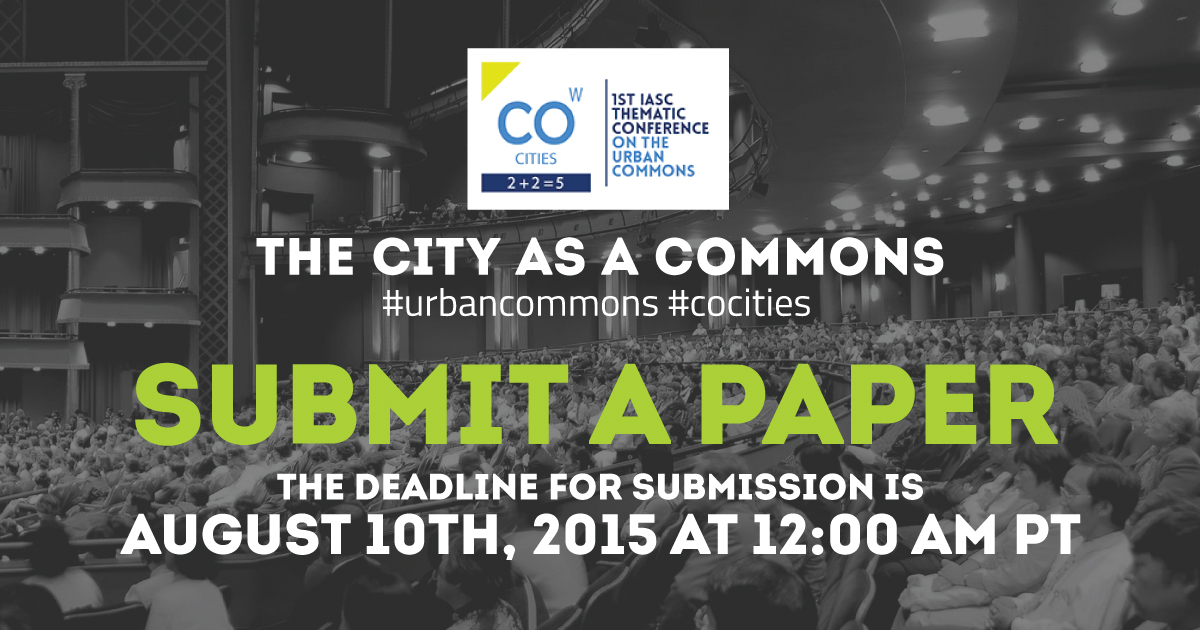
If you are interested in this topic and to urban commons then SAVE THE DATE! LabGov is proud to announce that “The City as a Commons: Reconceiving Urban Space, Common Goods and City Governance” will be the theme of the first IASC Conference to be held on 6-7 November 2015 in Bologna, Italy. The conference will be co-chaired by Prof. Christian Iaione (LUISS Guido Carli and UniMarconi University) and by Prof. Sheila Foster (Fordham University), and it will develop along 6 different tracks. These thematic areas will be examined in two full days of plenary panels, keynote presentations, and parallel sessions with selected papers from a call for papers. The conference will conclude with a roundtable discussion intended to reflect on the methods and future directions for urban commons research. The second track will be “Mapping the Urban Commons”. What institutions with private-public partnerships might be considered an urban commons institution? What are the key research questions and methodologies to analyse these case-studies? If you wish to hear the answer to these questions by international experts, then come attending the conference!

by Diletta Di Marco | Aug 10, 2015 | The Urban Media Lab
 In the early 2000s the Center for Social Innovation at the Stanford Graduate School of Business launched the Stanford Social Innovation Review with the first “Editors’ Note” defining Social Innovation as “the process of inventing, securing support for, and implementing novel solutions to social needs and problems” with a clear manifesto: “dissolving boundaries and brokering a dialogue between the public, private, and nonprofit sectors.” [1]
From that time until now, research has made many leaps and bounds but there is still a huge potential and need to develop new skills and competences for an age of innovation and collaboration, especially, in the urban field. Our civil society, social economy and social enterprise movement has always found the power to drive positive change through its knowhow besides its values, knowledge and networks. In order to realize the full potential of our resources, it is crucial to embed strong and flexible knowhow that will help build a strong method and skills for innovative civil society organizations and social enterprises in a changing world. The reality is lagging behind these targets. But can we derive and propose some of these dynamic solutions through an innovative approach of commons? Does Commons-Based Urban Welfare Contribute to Social Cohesion?
Sharing and collaboration is also emerging as a model for a new urban lifestyle and new forms of social cohesion. Urban residents increasingly conceive private spaces and goods as common spaces and resources open to access or use by other people, share needs and tasks, help each other, give birth to new ways of living and moving within urban contexts, generate new forms of reciprocity, self- and mutual aid. Local governments following the capability approach are enabling forms of generative welfare to foster human flourishing. What are the lessons and forms of social innovation that we can learn from? One possibility is the regeneration of neighborhoods, private spaces and buildings to transform them into common spaces for co-living, co-housing, and other forms of collaborative living and welfare. The emergence of an urban collaboration class is transforming social relations between urban inhabitants and therefore should trigger a rethinking of welfare systems at the urban level. These questions are the ones which we must build on.
The first IASC Conference is trying to find new stimuli. With its focus on “The City as a Commons: Reconceiving Urban Space, Common Goods And City Governance” LabGov organizes it in collaboration with Fordham University of New York and the ICEDD of the LUISS University of Rome. The Conference will take place in Bologna on 6-7 November 2015. The conference will be co-chaired by the LabGov’s coordinator Professor Christian Iaione (UniMarconi University and LUISS Guido Carli) and by Prof. Sheila Foster (Fordham University) both pioneer scholars in conceiving the urban commons.
 The Conference aim to analyses the phenomenon of urban commons in a comprehensive way, dividing the two day work in 6 Tracks. One of the them is devoted to the Social innovation as the Basis for a Commons-Based Urban Welfare. Professors, scholars, experts are invited to submit a paper for contributing to the ongoing debate on Social Innovation. The Conference want to investigate on what are the lessons and the forms of innovation that it is possible to learn from the literature on social innovation and from the experiences of the movement active all around the world.
The real change is already around us. We have to learn about how we should compare and how we must share. From the point of view of Eddy Adams, member of the EU URBACT “cities exchange and learning” Programme, Social Innovation consists on new ways to tackle the most chronic social challenges.
Recently, the change has also paced the Italian capital of Piedmont. Thanks to prominent figures such as Michele Fatibene, the city of Turin has officially sent these days an internal communication to its employees with a special project invite: Innova.To. This project is a collaborative/cooperative “competition”, which aims to engage employees of the City of Turin in developing projects that can help improve the performance of the City through the reduction of waste and the use of resources. The initiative is part of the Torino Smart City project which is an incentive, even within the Administration, for the adoption of tools that enable the participation and sharing of knowledge and ideas.
Ezio Manzini, a leading thinker in design for sustainability, founded DESIS, an international network on design for social innovation and sustainability, in his latest work “Design,when everybody designs”draws the first comprehensive picture of design for social innovation defying that as the most dynamic field of action for both expert and nonexpert designers in the coming decades. Thanks to his experience, what is certainly clear is that also your input is necessary! The deadline for the paper submission is tomorrow, August 10, 2015 at 12.00 pm.
Submit your paper until today!
http://www.labgov.it/wordpress/urbancommons/thematic-conference/
[1] http://ssir.org/articles/entry/rediscovering_social_innovation?pnd#sthash.iewswdNp.dpuf)