by Sofia Mazzuco | Nov 8, 2017 | The Urban Media Lab
Image Source: https://issuu.com/architecture00/docs/compendium_for_the_civic_economy_publ
The privatization of resources has led to a concentrated market economy where access to services and the degree of its quality highly depends on individual’s purchasing power. Today, the management and distribution of the majority of resources and services, such as energy, water, food, education, and health, is controlled by a few large corporations who exploit it for their own profit. Besides creating a division between providers and consumers this concentration of power contributes to an unsustainable economy that drives overexploitation of resources.
Currently, a new economy is arising along with adaptations on the governance structure of different cities (such as Bologna, Amsterdam, NY, Barcelona, and Milan, to mention a few) where polycentric governance is being established and citizens gradually become directly involved in community and urban development; some define it as the civic economy, others call it the social economy. This new economy is essentially concerned with social development and addresses economic issues through a holistic approach, mindful of both the scarcity of resources and the complexity of social issues.
The civic economy is collaborative and aligned with social innovation. It invites sharing to replace competition and supports communities in becoming co-investors and co-producers instead of just consumers, meaning active communities collectively addressing local and globally interconnected issues. This supports individuals and communities in becoming more resilient and less vulnerable to economic fluctuations, depending less on the open market and on the welfare state. “Though locally driven, their initiatives are deeply rooted in global social, cultural and technological trends that originated well before the recent economic shocks.” [1]
The civic economy identifies and enhances the potential of local resources for development – resources not always obvious at first and that can be as varied as waste, places, skills, and social exchanges. It emerges in different ways and through different structures (with social entrepreneurs, co-operatives or companies aiming for social innovation), resisting the power of large corporations through sustainable and context-tailored provision. That said, the civic economy aims for a closed-loop system, with resources being reused for holistic development and sustainable provision of services. It also triggers social capital through reinvented social exchanges that play a key role in supporting management and ownership of given resources.
A successful example of a civic economy structure driven by a co-operative legal framework is the project Food-Coop, a food store started in 1973 in Park Slope, Brooklyn (New York City) to provide healthy products at an affordable price. Those who shop at Food-Coop are mutually its co-investors and commit to around 4 hours/month of work to maintain the co-operative, performing tasks that vary from cashier to food-packaging, cleaning, organizing shelves, dealing with food providers, etc. There are currently 17 thousand co-investors who perform 75% of the management roles. This structure allows diminishing the management costs and creates ownership and engagement possibilities that, in turn, build a community of shoppers that enhances social capital in the neighborhood. [2] The success of this food store model influenced its replication in Paris, under the name of La Louve, and in Belgium as Bees Coop, with one more soon to be inaugurated in Bologna. [3]
Another example of how co-operatives can support sustainability and access to quality services is FL Solar United Neighbours (SUN) [4]. SUN is a USA based network of co-operatives supporting wider implementation of solar energy systems in communities, allowing buyers to save up to 20% of the supposed investment through bulk-buying. “This cooperative network targets homeowners, helping them increase the cost-saving tied to installing solar panels” [5]. Affordability of sustainable energy strongly influences community resilience.
The civic economy can also emerge through processes not reliant on the co-operative model. An example is Baisikeli, a Copenhagen based social innovation enterprise that legally collects old bicycles scrapped on streets to give them new meaning. Part of these bicycles is repaired at Baisikeli workshop to be sold or rented and provides a funding source. The other part of the bicycles is sent to Africa and is repaired and adapted by African Baisikeli workers who are given training by Danish Baisikeli workers, who spend a few months of the year in Africa sharing their skills.
To influence the betterment of the transport system in the Africa a micro-finance scheme was set to allow locals to purchase the restructured bikes, with small installments coming out of their paychecks. “As well as low-cost mobility, Baisikeli also provides an even more important long-term benefit: the transfer of knowledge and skills in fields such as bike mechanics, logistics, and administration.” [6] The final goal of the project is to spark the bicycle industry in Africa for potential exportation and local economic development. Baisikeli thus sets a closed-loop system influencing holistic development (social, environmental, and economic) by sparking dormant resources and establishing global skill-exchange networks. [7]
These three case studies show how the civic economy can drive community and globally networked development. It is important to emphasize that the civic it does not place wealth as the foremost element of its structure; namely, it seizes holistic development that the market economy and the welfare estate cannot deliver alone. Mindful of the relationship between systems, the civic economy establishes closed-loop processes that support regeneration and resilience in the long-term.
The publication “A Compendium for the Civic Economy“ features numerous case studies of how the civic economy can look like, including edible public spaces, peer-to-peer initiatives and social entrepreneurship, defining it as “a trend that goes beyond traditional divides between the public, private and third sectors; an attitude that questions all aspects of supply chains and makes them more equitable; an approach that enables citizens to be co-producers and investors instead of just consumers; and an opportunity to unlock and share the resources we have more effectively.” [1]

Image source: http://www.soundingsoffice.com/wp-content/uploads/2011/05/cc-cover-final-press_5_90-1_web1.jpg
As long as social innovation keeps evolving, the civic economy will reinvent itself over and over again, finding creative means to drive closed-loop and resilient development. Identifying resources, in people or places, and reorganizing systems and social exchanges is crucial for its development, proven that collaboration certainly leads to enriching possibilities.
__
Recentemente si sta realizzando una nuova economia, tramite adattamenti nella struttura di governance di diverse città (come Bologna, Amsterdam, New York, Barcelona, e Milano, tramite altre) dove la governance policentrica si stabilisce e i cittadini diventano direttamente coinvolti con lo sviluppo delle loro comunità e della città; alcuni la definiscono economia civica, altri la chiamano economia sociale. Questa nuova economia riguarda soprattutto lo sviluppo sociale e affronta le questioni di matrice economica da una prospettiva olistica, tenendo presente la scarsità di risorse e la complessità di questioni sociali.
L’economia civica è collaborativa e in linea con l’innovazione sociale. Invita alla condivisione in luogo della competizione e stimola le comunità a diventare co-investitori e co-produttori piuttosto che essere esclusivamente consumatori, influenzando comunità attive collettivamente affrontando questioni locali e globalmente interconnesse.
__
References:
[1] Architecture 00 (2011) Compendium for the Civic Economy. (p.9) Available at: https://issuu.com/architecture00/docs/compendium_for_the_civic_economy_publ
[2] https://www.foodcoop.com/
[3] http://www.repubblica.it/cronaca/2017/10/04/news/food_coop_supermarket_partecipativo_italia-177371670/
[4] http://www.solarunitedneighbors.org/
[5] https://nextcity.org/daily/entry/5-ways-worker-cooperatives-counter-corporate-power
[6] Architecture 00 (2011) Compendium for the Civic Economy. (p.25) Available at: https://issuu.com/architecture00/docs/compendium_for_the_civic_economy_publ
[7] http://baisikeli.dk/
by Chiara De Angelis | Oct 23, 2017 | The Urban Media Lab
On October 24th and 25th, Milan is going to host ICityLab 2017 “Towards a sustainable city”, the annual FPA meeting focused on cities, sponsored by the Municipality of Milan.
The opening of the meeting will be dedicated to the presentation of ICity Rate, the first FPA annual report that draws a ranking of Italian Smart Cities in relation twith the objectives of sustainable development proposed by the ONU 2030 Agenda.The report will help us to understand where are we in relation to those objectives: the results of the research will be presented during the first meeting, held in the innovative spaces of BASE Milano, on Tuesday, October 24th from 10 AM.
Gianni Dominici, FPA General Director, explains that Milan has benn chosen because it is actually the city that is working more than the others in the logic of an “urban lab“, focusing on all the actors of the city.
The program provides 40 sessions in two days: conventions, labs and working tables where local entities, public administrations, innovative entreprises, local actors, the third sector and representatives of the active citizenship will participate actively. The themes of the events will focus on policies and platforms for civic participation and civic crowdfunding, tools for urban regeneration and re-use of public spazes, digital innovation for the city, the new borders of 4.0 manifacture, big data and IOT, participatory budgenting and so on.
LabGov’s co-founder Christian Iaione is going to attend the meeting, and in particular:
– the convention dedicated to “Regenerating the cities: a national perspective“. The focus is going to be on the national and international measures taken by the Italian government and the EU to answer the local needs of a participated solution to the re-use of spaces. The meeting will be held on Wednesday, 25th from 9.30 AM to 11.30 AM, in Sala 2;
– the convention on “Innovative and circular Procurements“, fundamental elements when speaking about innovation processes and urban Living Labs. The meeting will be held on Wednesday, 25th from 11.45 AM to 13.45 AM, in Sala 1
The full program of the event is available on the official website: http://icitylab2017.eventifpa.it/
Milano ospiterà il 24 e 25 ottobre ICityLab 2017, “Verso una città sostenibile”, l’appuntamento nazionale sulle città organizzato da FPA, quest’anno con il patrocinio del Comune di Milano.
Il programma dell’evento è disponibile a questo link: http://icitylab2017.eventifpa.it/

by Giulia Ganugi | Oct 23, 2017 | The Urban Media Lab
Credits: pictures from http://www.socialstreet.it
Four years ago, in September 2013, the Facebook group Residenti in Via Fondazza – Bologna was born: after a fast growth of its members and thank to a strong mediatic interest, the group triggered the Social Street phenomenon. The Social Street is a form of neighbourhood communities, whose purpose is to «promote socialization between neighbours in the same street in order to build relationships, to interchange needs, to share expertise and knowledges, to implement common interest projects, with common benefits from a closer social interaction […] It is a no-profit activity with social purpose. Social Street is not pursuing any political, religious, ideological view. It brings people together with the sole criterion of the proximity between area residents»[1].
Indeed, since every group is organized around a specific urban area – street, square, park, part of neighbourhood – the territory takes on strong importance, because it becomes the basis for the construction of a shared identity among Social Street members. These ones share, moreover, three main values:
- Sociality;
- Gratuitousness;
- Inclusion.
The sociality, as well as being the primary need from which the experience was born, also becomes the most important goal to reach. All the initiatives organized have the single purpose to stimulate citizens in socialising and participating in common projects. Semantically the gift implies gratitude and allows to activate virtuous circles of reciprocity and trust[2]; in addition, every donated goods and services implies a bonding value[3]. Lastly, the access to Social Street is open to everyone for total participation, regardless any ethnical, political or religious differences.
Currently there are 397 Social Street in Italy and 8 abroad – Portugal, Netherlands, Poland, US, Canada, Brasil and New Zealand. In Italy they spread more in the North and gradually less in the Centre-South of the country: Milan 86, Bologna 67, Rome 45, Palermo 21 (data are updated on 13/10/2017). Among all neighbourhood groups there is a huge diversity due to:
- geographical position;
- collocation within cities;
- birth year;
- type of activities;
- internal/external governance.
Here what I want to focus on is the external governance, meaning the relational network established by every Social Street with other socio-political subjects of the territory, such as the Municipality, the local administrative institutions and any other kind of associations belonging to civil society. From the beginning Social Street groups chose different approach to deal with this issue. The website, opened by the first Social Street’s founders, underlines that reaching the goal of sociality does not require funding, private spaces to be rent or any formal collaborations with municipalities. Therefore some group decide to follow strictly these guidelines and maintain just an informal dialogue with other urban actors. The fear to be exploited by public administration and the will not to be identified as a possible solution to local collective problems affect this choice as well. On the contrary, other groups that engage in urban regeneration or participatory projects feel the necessity to collaborate closely with public administrations, sometimes even applying for common projects with other civil society actors.
The structure arising from these practices recall the concept of multi-level governance, namely new forms of state power organization based on a double process: an increase in the distribution of power between different levels of government and the creation of policy making coalitions that only in part consist of representatives of the state, opening the participation to private and civil actors[4]. These network-based forms of governance, though, do not always have codified rules and regulations that shape or define participation and identify the exact domains or arenas of power. On the one hand, such absence of codification potentially permits socially innovative forms of organisation and of governing; on the other hand, it also opens up a vast terrain of contestation and potential conflict[5]. The innovation occurs when bottom-linked governance is achieved, that is when bottom-up initiatives combine with top-down policies, including alternative mechanisms of negotiation between various groups and networks, potentially empowering local government and embracing who disagrees with mainstream policy formulation and who presents alternative creative strategies[6]. In Italy, already in 2001, the constitutional reform of Title V – Article 118 – defined the principle of horizontal subsidiarity, underlining the support that State, regions and municipalities must give to the free exercise of general interest activities by citizens as individual and as organizations. Moreover, in 2014 the City of Bologna implemented the Regulation on civic collaboration for the urban commons, that allows to establish collaborations between local governments and citizens in order to care, re-generate and manage urban commons, tangible and intangible, functional to the individual and collective wellbeing.
Going back to Social Streets, there are many examples of both choices.
The first Social Street, Residenti in Via Fondazza, strongly claims its independence from every type of stable and formalized relationship with the public administration. This choice, nevertheless, does not prevent its members from organizing many activities and events for the realization of which they regularly ask for permissions about public spaces’ use to the City of Bologna. One of the services that this group has implemented is a system of bike sharing, after the request to the public administration to install more bicycle parking spots. Some residents have offered unused bicycles to the neighbours; now these bicycle are identified by a signboard saying that they belong to the Social Street. When one of the members needs a bicycle, he/she can directly ask for the key to the greengrocer of Via Fondazza, use the bicycle until he/she needs it and bring it back to the square at the end.

Credits: picture from the Facebook group “Residenti in via Fondazza – Bologna”
From three years, Via Fondazza is also the location of Muri Di Versi, an event of poetry, music and culture aiming to animate the surrounding area and to invite everyone to socialise exchanging every existing type of art.

Credits: picture from the Facebook group “Residenti in Via Fondazza – Bologna”
Similarly, one of the Social Streets in Verona, Residenti in Via Venti Settembre, refused the Municipality request to work closely for drawing a call for new Social Street creation. Furthermore, even if the members adopted a garden placed along the street and the small building inside it as location for their weekly meetings, taking care of both regularly, they prefer to ask the City for permission about public space use each time, instead of setting a permanent collaboration.

Credits: picture from Facebook group “Residenti in via Venti Settembre – Verona – Social Street”
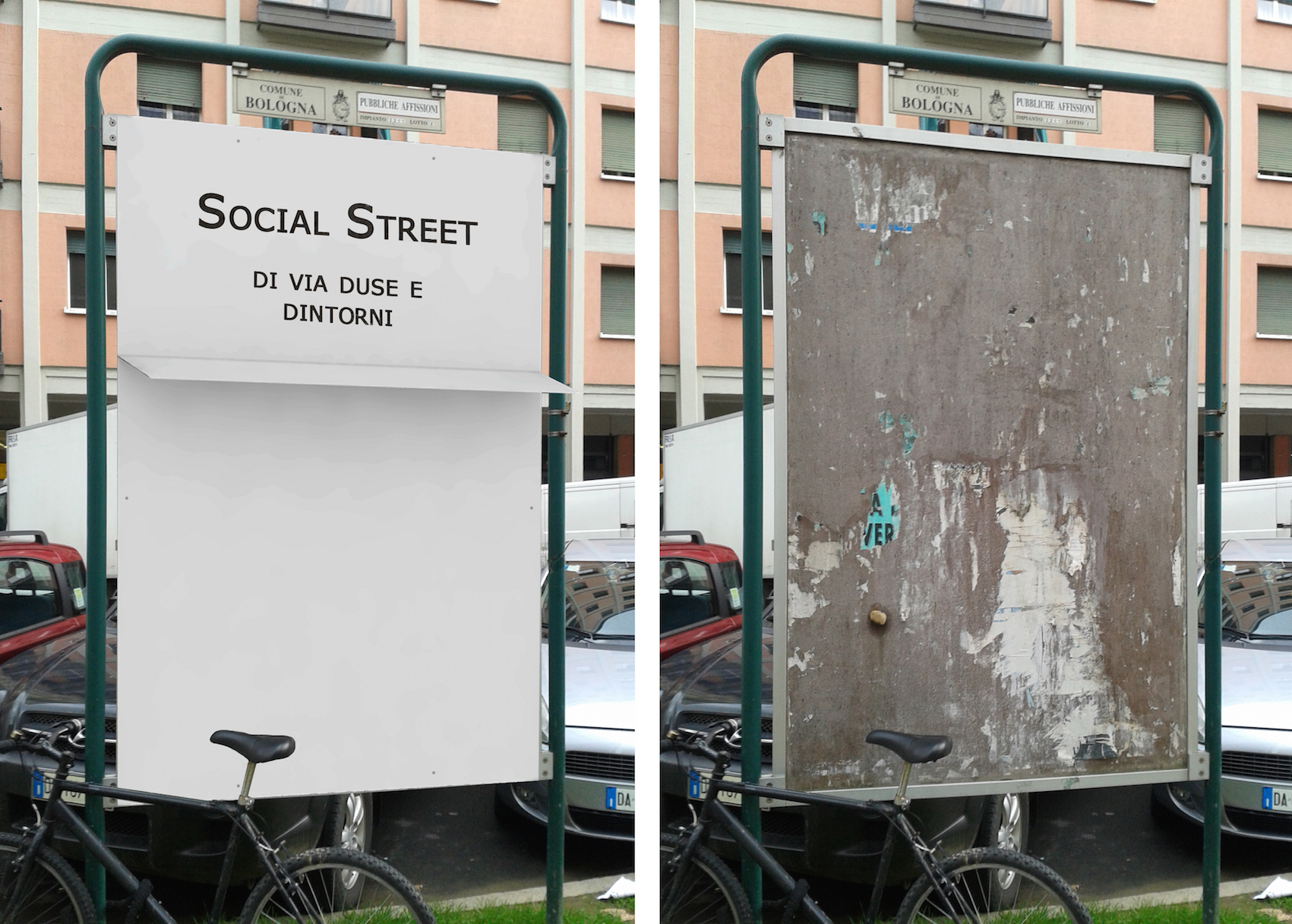
Opposite attitude characterizes decisions taken by other groups. Another Social Street of Bologna, Residenti in Via Duse, was the first group of citizens to sign a collaboration pact with the Municipality through the Regulation mentioned above. Thanks to this partnership, citizens have obtained the possibility to use and take care of a public notice board, otherwise left unused, for advertising their activities/events/projects and for exchanging useful information. Moreover, they managed to associate with other civil actors active in the same urban area, such as a neighbourhood committee and a cooperative of architects, in order to develop together participatory projects and to rent an indoor space where to gather in.

Credits: picture from Facebook group “Residenti in Via Duse e dintorni Bologna – Social Street”
Similar is the case of Residenti in Via San Pio X, Social Street in Trento, where the members, animated by strong interest in networking with the local area and in spreading a conception of common management for public spaces, are collaborating with public institutions and many associations and schools. They took care of regenerating a public wall along the street; since one year and a half they garden regularly local flowerbeds; a notice board and a book-crossing library have been installed. Besides, the Social Street implemented a project within schools, spreading among students the idea of active citizenship and of common responsibility towards the local territory.

Credits: picture from Facebook group “Residenti in via San Pio X e dintorni Trento – Social Street”
Preferring to avoid the use of money, other Social Streets simply signed the collaboration pact with their own Municipality: it is the case of Residenti in Via Pitteri, in Ferrara, for example, where members, among many other activities, take care of a little urban area and a park, receiving in exchange from the City the material to keep it clean and the maintenance necessary for structures.

Credits: picture from Facebook group “Residenti in via Pitteri e dintorni – a Ferrara”
In conclusion, Social Streets can take different directions when they network within the city. This does not mean though that the groups, not willing to establish collaborations, are less careful about the local territory or about collective needs, but it only means that the latter are diverse in every context. Different are also the population living in a specific area, services offered by public institutions or third sector, the geographical configuration of the space. Therefore, it is unreasonable to identify the most efficient practice, rather it is important not to forget an analysis of geographical, social, economic and political aspects of local contexts, considering the path-dependence rooted in every Social Street and, generally, in every bottom-up movement.
Il fenomeno Social Street ha appena compiuto quattro anni dalla nascita del primo gruppo di residenti. Dopo una breve introduzione riguardo ai principali valori alla base dell’idea, in questa riflessione si vuole portare l’attenzione sulla differenza che caratterizza i vari gruppi. In particolare, i diversi approcci con cui ogni Social Street si rapporta alla pubblica amministrazione e agli attori di terzo settore, delineando diversi assetti di governance.
[1] http://www.socialstreet.it/
[2] Riccardo Prandini, 1998, Le radici fiduciarie del legame sociale, Milano: Franco Angeli.
[3] Jacques T. Godbout and Alain C. Caillè, 1998, The World of the Gift, Canada; McGillQueen University’s Press.
[4] Pradel M, Garcìa M. & Eizaguirre S., 2013, Theorizing multi-level governance in social innovation dynamics. In: Moulaert F., MacCallum D., Mehmood A. & Hamdouch Abdelillah (Eds.), The International Handbook on Social Innovation. Collective Action, Social Learning and Transdisciplinary Research, pp. 155-168, Cheltenham: Edward Elgar.
[5] Swyngedouw E., 2005, Governance Innovation and The Citizen: The Janus Face of Governace-beyond-the-state, Urban Studies, 42 (11), 1991-2006.
[6] Eizaguirre S, Pradel M., Terrones A., Matinez-Celorrio X., Garcìa M., 2012, Multilevel Governance and Social Cohesion: Bringing Back Conflict in Citizenship Practice, Urban Studies, 49 (9), 1999-2016.
by Chiara De Angelis | Oct 12, 2017 | Luiss LabGov 2017-2018
Save the date!
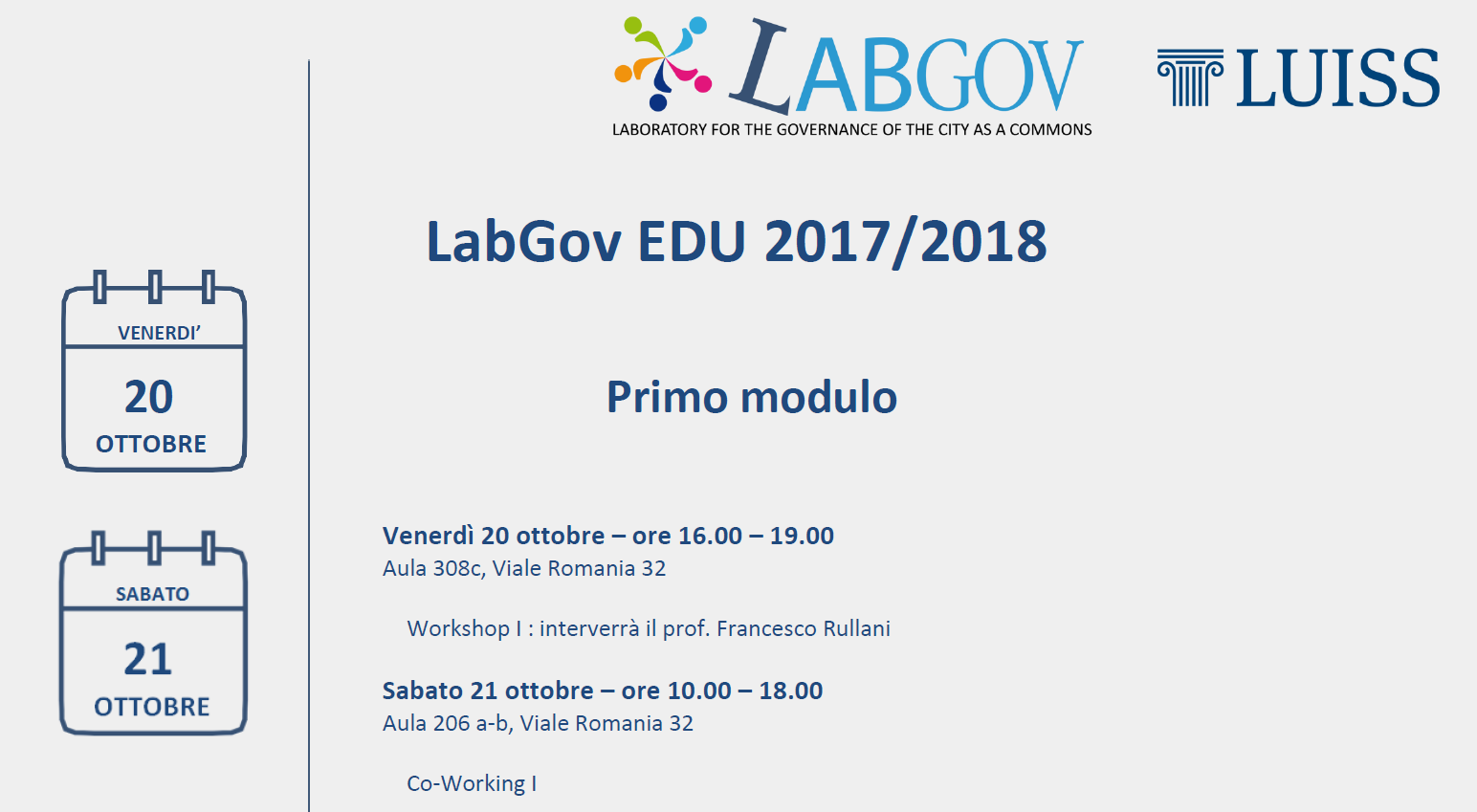
Venerdì 20 e sabato 21 ottobre primo modulo di LabGov EDU 2017/2018!
Venerdì, dalle 16. 00 alle 18.00 in aula 308/c avremo ospite il prof. Francesco Rullani, esperto di implicazioni organizzative, strategiche e manageriali dell’adozione di modelli di produzione di conoscenza aperti, che presenterà un intervento su Social Innovation e Social Entrepreneurship come nuovi strumenti per affrontare nuovi sfide.
Durante l’ultima ora del venerdì i labgovers verranno formati per il co-working del sabato.
Sabato la giornata sarà interamente dedicata al primo co-working dell’anno: divisi in gruppi, i labgovers tramite tecniche di co-design inizieranno a progettare sul tema del Social Business.

L’appuntamento successivo di LabGov EDU al 17-18 novembre!

by Alessia Palladino | Jul 3, 2017 | The Urban Media Lab

Last June 9th 2017 the City of Genoa freely undersigned an agreement on the Tourists Tax with Airbnb Ireland, the famous platform that connects people having extra space to rent (i.e. Hosts) with people (i.e. Guests) who need it for a short-term accommodation (i.e. Listing).
The agreement introduces a participatory model for the management of resources coming from the tax. This experience makes Genoa an unique example in Italy of effective collaboration and dialogue with a platform, promoted in absence of any statutory requirement.
This policy has been recognized as a “Good Practice” by the European program Urbact: namely, it has been the only one selected among 270 projects coming from 219 cities of 29 European Countries.
Genoa represents a pioneering model for the other European cities in terms of sustainable urban development in the tourist sector, one of the main source of income for the whole Region.
It is currently managing – as the Lead partner – the “Interactive Cities” network, which explores the impact of digital tools on governance, and the way digital, social media and user generated content can improve it.
In this perspective, the agreement itself may be considered the last step of a longer participatory path, started in 2016 with a partnership at regional level.
Indeed, Airbnb started working with the Region and communities last year; their collaboration were focused on the creation of appropriate policies aimed to promote responsible tourism and home sharing rules.
The partnership was one of the initiatives included in the Pact for the Strategic Development of Tourism (Patto per lo sviluppo strategico del turismo).
It aimed to:
- Educate hosts on local home sharing rules;
- Create an open and transparent community;
- Promote the Region as a destination for tourism.
The agreement recently signed by the City of Genoa is aligned with the objectives pursued at regional level. It concerns a pragmatic method for the implementation, collection and remittance of the Tourists Tax, by the Platform on its behalf (pursuant to Article 1, “The Platform accepts that the municipal Tourists tax for overnight stays owed by the Guests for overnight stays in Listings that are booked on the Platform, will be collected by the Platform and reimmitted to the Municipality on behalf of the Hosts”).
It will in be in force experimentally for a year, since August 1st 2017, and it will allow to regulate a fundamental sector of the local economy.
In detail, it is made up of 13 articles. The content could be divided into three main headings:
- Method for the management of the Tourists Tax;
- Parties obligations;
- Penalties and breach of contract.
The Platform will inform its registered Hosts about its new role. It will consequently include in its Terms of Service a provision about the collection and remittance of the Tax by the Platform on their behalf.
The Agreement provides powers of audit and check for the Municipality of Genoa, related to data disclosure too. In this case, the Municipality will have both a general access to anonymized data and also, on a case by case basis, a limited access to individual account details, in order to verify the effective collection of the Tax by the Platform.
Airbnb initiatives have also turned to other Italian cities (City of Florence, Rome prefecture), as well as it agreed to enforce rental limits in other two key European markets, such as London and Amsterdam.
These cases represents a different approach of the home-sharing company, despite of many other Silicon Valley ones: it may be due to avoid the risk of crashing down on the use of the service, because of policymakers restrictions.
Recently, the Platform has published a report about the economic impact of the community in Italy in 2016, which boosted about € 4.1 billion.
About Genoa experience:
- There were 1100 active Host-users;
- Each Host rented his own space for 39 nights per year, earning around €2700;
- 57000 Guests booked an Airbnb accommodation, with an increase of demand by 70% over the previous year.
The development of home-sharing in Genoa produced better economic and environmental impacts compared to traditional accommodation.
Nevertheless, researchers at the Ladest Institute of the University of Siena (Ladest) have been monitoring for two years the community activity in thirteen Italian cities: Bari, Bologna, Catania, Florence, Genoa, Matera, Milan, Naples, Rome, Siena, Turin, Venice and Verona.
The study has calculated unbalances and significant incoming differences among Hosts operating in the same City: accommodations placed close the historic centre are most in demand.
The research group has proved that earnings are concentrated in the hands of a few people.
This study group could be useful to reflect upon the reactions generated by the implementation of the Tourist Tax: since it is not a graduated progressive tax, it could discourage Hosts with a few yearly incoming, who could reduce or give up their home-sharing assets.
Furthermore, there could be a risk of distorting the original purpose of the Platform, switching from sharing to a real business model.
The next experimentation could reduce and dispel doubts and it would be possible analyze reactions coming from Hosts, Guests and the Municipality.
Il 9 giugno 2017 Genova ha siglato un accordo con Airbnb Ireland sulla Tourist Tax, introducendo un modello partecipativo per la gestione delle risorse provenienti dalla tassa. La policy è stata riconosciuta come “Good Practice” dal programma europeo Urbact.