by Diletta Di Marco | Oct 10, 2015 | The Urban Media Lab
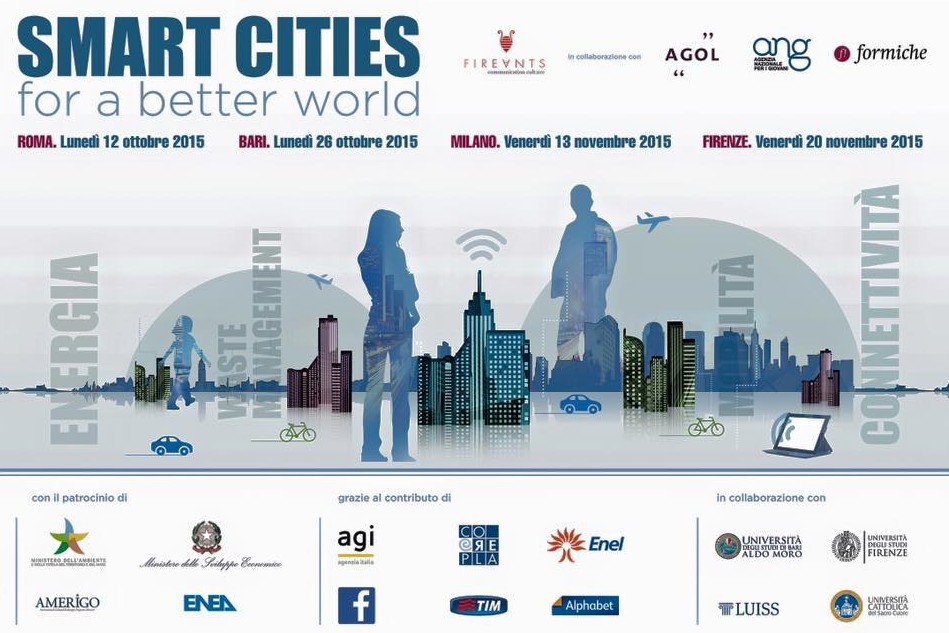
On October 12, LUISS University will host the first “Smart Cities Roadshow“,
organized by Formiche and Agol, in collaboration with the National Agency for
Youths, as well as several universities, institutions and firms.
These partners will work together to help young students to become the next
generation of leaders; they will teach students to be smarter and more
intelligent citizens of the community.

These are challenges that we can only overcome together through collective awareness
and strong participation. The day will begin at 9:30 am, and Professor Christian Iaione
will be one of the distinguished guests, along with Giampiero Gallo (Economic Advisor
to the Prime Minister Matteo Renzi and a professor at the University of Florence),
Simona Vicari (State Secretary at the Ministry of Economic Development with
responsibility for Smart City and President of the Task Force of the Ministry on
Smart Cities), Andrea Costa (project manager of EXPO 2015 Telecom Italia),
Laura Bononcini (Head of Public Policy at Facebook Italy) and many others.
In the afternoon the group will engage in stimulating co-design activities, where
students can consult with experts in the field. The round-tables will be organized
with policy makers, enterprises and experts to discuss a possible national policy
on the development of smart collaborative cities.
These activities will be featured by experts of the various branches: Ilaria Potito
(Head of Working Capital Operations at Telecom Italian), Mauro Annunziato
(Smart City and Coordinator of Eco enterprise ENEA) and Ugo Barbara (Head
New Media editors AGI).The event will end at 17:30.
We look forward to your participation!
If you want to participate register at this link.

by Federica Maranesi | Oct 8, 2015 | The Urban Media Lab
A great Italian entrepreneur used to say: “The term utopia is the easiest way to sell off what you don’t want to, you don’t have the skill for or have the courage to do. A dream seems just a dream until you start somewhere and only then it becomes a purpose, which is something infinitely greater.” Purpose has begun to materialize from dreams with the upcoming 1st IASC (International Association for the Study of the Commons) Thematic Conference on the Urban Commons. Not long ago, the Urban Commons were just a thought, something indefinite and impalpable. Well, now we are at the crucial moment when scholars, researchers, policymakers, practitioners and social innovators are ready to join a one-of-a-kind committee, which creates a unique opportunity to conceptualize and develop the idea of the “urban commons”.
The IASC Conference, named “ The City as a Commons: Reconceiving Urban Space, Common Goods And City Governance” is organized by LabGov in collaboration with Fordham University of New York and the International Center on Democracy and Democratization (ICEDD) of the LUISS University of Rome. The conference will take place in Bologna on 6-7 November 2015 and will be co-chaired by LabGov coordinator Prof. Christian Iaione (UniMarconi University and LUISS Guido Carli) and by Prof. Sheila Foster (Fordham University), a scholar who pioneered the conception of the urban commons. The International Scientific Review Committee is composed by leading scholars in the field of urban commons, such as Tine De Moor (Utrecht University), Insa Theesfeld (Martin-Luther-Universität), Richard Burdett (London School of Economics), Paola Cannavò (Università della Calabria), Christian Borch (Copenhagen Business School), Leonardo Morlino (LUISS Guido Carli) and Ivana Pais (Università Cattolica del Sacro Cuore). Keynote speeches will be delivered by Tine De Moor (Utrecht University), Richard Sennett (London School of Economics, New York University), Silke Helfrich and Michel Bauwens (both from Commons Strategies Group).
This unique conference and this prestigious committee mean something. They are signs that we are no longer talking about something that exists only in words or in theory. Indeed, the Urban Commons are already a reality. A reality, which has not been created by professors at school, but something that people—citizens— have made possible. The social innovation, the citizen’s participation, and the sharing economy have been applied to different fields of our life and are concretely creating new standards and paradigms of welfare, commons based cities, urban economy, and forms of governance. The 1st IASC Thematic Conference on the Urban Commons, will bring out questions, methodologies, and disciplinary approaches necessary to more concretely implement the challenges of urban commons in different fields. Urban Commons are not a utopia, and are even more than a purpose. They are something real. Something happening.
Do not miss the deadlines:
- By October 9th, presenters should confirm attendance by registering and paying the conference fee through the conference website and paper presenters should register here.
- Auditors should register with this form, by October 25th
Follow also LabGov’s Facebook and Twitter. The official hashtag of the conference: #commonscities
Stay tuned!

by Marina Bassi | Oct 5, 2015 | The Urban Media Lab
FROM 9th TO 10th OCTOBER, THE EVENT “LE GIORNATE DI BERTINORO PER L’ECONOMIA CIVILE” WILL BE HELD IN BERTINORO, IN THE CEUB – VIA FRANGIPANE, 6.
 Every year, in early October, on the hill of Bertinoro, the protagonists of the academic world, the Social Economy and Volunteers, and institutions meet with a community of students and young social entrepreneurs, to think and talk about the issues of Civil Economy. Since fifteen years, Le Giornate di Bertinoro have represented a laboratory for the analysis and the comparison of future challenges of the third sector with the aim of developing a paradigm of Development and Sociability.
The meeting has been promoted by AICCON. It is the Research Center sponsored by the University of Bologna, the cooperative movement and by many public and private organizations, operating in the Social Economy. The Association aims to encourage, support and organize activities to promote the culture of solidarity, with a focus on ideals, attitudes and activities of Cooperatives and Non Profit Organizations.
 The Economics of Cohesion will be the focus of this year. It will shine the spotlight and spark a debate on new production of social value, the governance of the Commons, the Social Impact Assessment and on the long-awaited reform of the Third Sector. Plenary sessions and round tables will alternate in a well-established format during this year edition of the #GdBLab – Giornate di Bertinoro Laboratory. Professor Iaione – coordinator of LabGov – will attend the event, addressing the issue of the #Commons. LabGov is dealing with this issue, especially in expectation of the 1st IASC Conference on urban commons.
Today, tissue regeneration and social levels of social cohesion of communities also pass through the economy (economic cohesion) and the identification of new mechanisms of production value. Cohesion becomes, therefore, a fundamental element for the competitiveness of the territories and, consequently, for the local business fabric. To rebuild the bonds of trust, a fundamental element for the proper functioning of economic and social institutions, it is necessary to restart from the repositioning of the economic discourse on the Commons (environment, water, land, knowledge, biodiversity, culture and identity), because their characteristics require a mode of management that is based on sharing practices. In particular, based on the sharing economy, the cooperative represents the role model, because it is able to guarantee inclusive governance structures that organize the offer and, at the same time, pay attention to the demand side, intercepting the needs of the communities in which those goods are placed.
_____________________
L’Economia della Coesione – Le Giornate di Bertinoro per l’Economia Civile
Anche quest’anno, i prossimi 9-10 Ottobre, avrà luogo a Bertinoro l’evento Le Giornate di Bertinoro per l’Economia Civile, nel CEUB – Centro Universitario Residenziale Bertinoro, in Via Frangipane 6. L’Economia della Coesione sarà il tema centrale che quest’anno accenderà i riflettori e il dibattito sui nuovi meccanismi di produzione del valore sociale, sulla governance dei Beni Comuni, sulla Valutazione dell’impatto sociale e sulla tanto attesa Riforma del Terzo settore.

by Marina Bassi | Aug 9, 2015 | The Urban Media Lab
The 1st IASC (International Association for the Study of the Commons) Thematic Conference on urban commons is approaching. The call for abstracts is out until Aug 10th at 12:00 AM PT. The Conference title unveils the complexity and the ambition of an event that wishes to gather for two days the most prominent scholars and practitioners on urban commons, social innovation, sharing economy, to talk about “The City as a Commons: Reconceiving Urban Space, Common Goods And City Governance”. The Conference is organized by LabGov – LABoratory for the GOVernance of Commons, a partnership between the Urban Law Center of Fordham University and the International Center on Democracy and Democratization (ICEDD) of the LUISS University of Rome (http://www.labgov.it/the-city-as-a-commons-the-first-international-conference-on-urban-commons/). It will take place in Bologna on November 6-7, 2015. One of the track of the Conference concerns the Democratic Innovation and how governance of the urban commons could influence it. This is why we decided to interview one of the most prominent international scholars on democratic theory, Professor Nadia Urbinati.
On July the 5th, the Greek citizens went to the polls for the referendum announced by their Prime Minister, Alexis Tsipras. Greek people were asked to reply to a hard question, which then raised countless debates and opinions starting from the decision whether accept, or not, the austerity policies and economic measures proposed by the European Union and international creditors, to solve the issues about the Greek debt.
Many scholars, professors, writers and academics put the stress on the important fact that Greece is the cradle of democracy, the country where were born the most important historical thinkers of democracy.
Nadia Urbinati is one of those we are referring to. She is “Kyriakos Tsakopoulos Professor of Political Theory and Hellenic Studies” at the Department of Political Science of the Columbia University, she is also a political theorist who specializes in modern and contemporary political thought and the democratic and anti-democratic traditions. She co-chaired the Columbia University Faculty Seminar on Political and Social Thought and founded and chaired the Workshop on Politics, Religion and Human Rights.
The day before the Greek referendum, the Italian newspaper “La Repubblica” published an interesting article written by professor Urbinati. The title of the article is Greece and the European democracy myth which briefly but effectively analyses the history of democracy and the development of the political thought around this myth.
Some LabGov editors seized the opportunity and had the chance to build up a dialogue with professor Nadia Urbinati, trying to investigate the intersections between LabGov projects and the academic thought of professor Urbinati:
1) The twenty-first century seems to be identified as “urban century”. Can you create a model of urban democracy in Greece, in Italy, in Europe, or in the world? What features should you get?
Aristotle writes in the collection of the Greek constitutions that there are urban democracies and countryside democracies. However, a good democracy is mostly urban. Democracy, historically speaking, had its roots and developed in urban areas. Cooperation among people is essential to achieve it, regular exchanges are needed. These features are all better achieved in a urban environment. It is even possible to say, that democracy is the best form of an urban policy.
In ancient Greece or during the American or French revolution, participation was limited and fluctuant. Ephialte and Pericles created daily indemnities to allow people to participate. Today the situation is completely different, and there is the co-existence of two apparently opposite trends: on the one hand, physicality is no longer necessary in order to share in power, (the social media allow us to participate without “being there”); but on the other hand, politics lost credibility and attraction at least at the national level. Yet we witness the rise to a re-discover of “locality” and as we know democracy lives in small spaces better than in large ones, closer to us better than far from us.
2) The twenty-first century seems to have also another feature, a prefix. The one of the Latin “cum” or the Anglo-Saxon “CO-“. There are many debate on co-operation, co-working, co-design of the commons (i.e. “beni comuni”), the regained centrality of the community, the importance of communication, the knowledge economy, etc. In Bologna, Mantua, Battipaglia, Palermo, Rome – as well as in other Italian and foreign cities – are emerging examples underlining the need for the community to get involved in public life through public actions and in daily collaboration of citizens. For example, in Battipaglia there is a process of collaborative planning, which puts around the same table to co-design services: citizens, institutions, businesses, civil society organizations, schools and universities. The main goal is to propose a new approach to the city’s development through a fostered channel of both citizens and institutions. In Bologna, we recently celebrated the first year of the Regulation on the collaboration between citizens and Public Administration for the care and regeneration of urban commons (i.e. “Regolamento sulla collaborazione per la cura e rigenerazione dei beni comuni urbani“). In Mantua, it has been built a platform of collaborative governance for a development centered on local culture and knowledge. What kind of role can these experiments have in the broader process of rethinking the local democracy? Could – a model of this kind – be the right approach to give Mediterranean countries back the role of “cradle of democracy”?
The founding fathers had this intuition. Altiero Spinelli thought of the unification starting from the local not only the national. Subsidiarity tells us that what can be solved at the local level, should not be solved at the national level. Take the issue of immigration, which is wrongly always thought as a national problem. However, it is in each municipality that lies the seeds of a possible solution: we should involve marginalized people; there are many things they can do, and many sector in which they can play a big role as participant. But in order to do so, a strong local community is needed.
3) Greece, and even more its citizens need to work in order to reactivate their economy: how can an investment in democratic innovations turn into a positive economic investment for the welfare of the local community?
Let’s think of the referendum recently held in Greece; it did not turn out to be what many believed it ought to, but at least it was a strong statement by the Greek people. Most of us had no idea of the meaning of public debt (who owns what to whom?). We need a stronger Europe, with less bias by Norther States against Mediterranean States. And above all we would need bright leaders and with strong European belief. In the US, when the State of California when bankrupt, Washington took the lead of a process of economic regeneration — we have to do the same in Europe too. Innovations, even democratic ones, may have a positive impact on our life; and so we would need to invest in our community, and unleash all their potentiality. Cooperation is the only way forward.
4) According to Professor François Garçon, author of Knowing Switzerland, the debt crisis reflected the indifference of the sovereign people. Greece, which has already taken a first step through a referendum, towards a model of direct democracy on economic and financial choices, could now explore new ways to regain possession of their relays and by doing so revive the economy itself, starting from small urban and regional economies. What is your opinion on that?
On an European dimension: we can and we must criticize the actual governance in Europe. The member states have no equal power and have no equivalence among them. There is not a European demos capable of expressing beyond the states. Treaties are no longer enough, especially in a time of economic crisis. The whole European construction was allowed by very lucky circumstances, like economic growth and reconstruction after WW2. Unfortunately, today’s circumstances are dramatically different. We must return to strengthen the local even more than the national if we want to have a political EU. The state should be an enabler of this change, and lately a partner.
5) How would it be possible, for local community inspired by the Rules of Bologna to interact with each other, and so give their contribution in the creation of democratic and horizontal network of local communities? Can they really change democratic and economic premises
It is a matter of education. Legality begins in interpersonal relationships, and cooperation is already a sign of education. American pragmatist thinkers had understood that for the management of a public good coordination was necessary to make everyone fell responsible. We often use the wrong words. For example the word “owner” is improper. We use the word for understanding reasons, but we rarely “own” something; we rather “borrow” or “share”. The key to success is to set good rules so as to make all the people who are involved in some communal enterprise feel they are partners on a equal foot.

by Benedetta Gillio | Jul 26, 2015 | Commons Press, The Urban Media Lab
The European Union Committee of the Regions, the EU’s Assembly of Regional and Local Representatives, has launched an initiative to open at the EU level the discussion on what is known as “sharing economy” and/or “collaborative economy“. The name itself and the scope is under scrutiny. Several EU institutions are working on similar if not identical subjects, using different label such as collaborative economy, circular economy or commons-based economy.
Benedetta Brighenti, Vice Mayor of Castelnuovo Rangone, will act as political rapporteur and Christian Iaione, LabGov director, will act as technical expert appointed by the Committee to carry out the consultation process with stakeholders and later the actual drafting of the CoR opinion.
Many European, national and local policymakers, public officials, scholars and practitioners from all over Europe willing to contribute to the CoR opinion drafting process will be involved in the launch of a new platform on sharing/collaborative economy.
The final version of the opinion is going to be approved on December 3.4, 2015. By the end of August, Brighenti and Iaione will deliver the draft opinion on which the consultation process will be carried out. The main moments of the consultation process are going to be held in Berlin at the CoR ECON Commission meeting on September 28, 2015, in Rome at LUISS University within a conference on the Smart Collaborative City on October 12, 2015, and The City as a Commons conference in Bologna on November 6-7, 2015, Milan on November 9-10 at SharItaly.
Brighenti and Iaione are willing to meet and involve as many public officials, practitioners, operators and scholars as possible in the discussion and will be available to hold deep dives, hangouts or workshops in other European cities that are willing to organize them.
Find below the working document that paves the way for the CoR opinion:
COR-2015-02698-00-00-DT-TRA-EN
COR-2015-02698-00-00-DT-TRA-ES
COR-2015-02698-00-00-DT-TRA-NL
COR-2015-02698-00-00-DT-TRA-FR
COR-2015-02698-00-00-DT-TRA-DE
COR-2015-02698-00-00-DT-TRA-HR
COR-2015-02698-00-00-DT-TRA-RO
COR-2015-02698-00-00-DT-TRA-BG
COR-2015-02698-00-00-DT-TRA-SL
COR-2015-02698-00-00-DT-TRA-SK
COR-2015-02698-00-00-DT-TRA-PL
COR-2015-02698-00-00-DT-TRA-MT
COR-2015-02698-00-00-DT-TRA-LV
COR-2015-02698-00-00-DT-TRA-HU
COR-2015-02698-00-00-DT-TRA-ET
COR-2015-02698-00-00-DT-TRA-CS
COR-2015-02698-00-00-DT-TRA-FI
COR-2015-02698-00-00-DT-TRA-EL
COR-2015-02698-00-00-DT-TRA-DA
COR-2015-02698-00-00-DT-TRA-PT
—————————-
Il Comitato delle regioni ha appena lanciato una iniziativa per aprire o riaprire la discussione su un nuovo paradigma sociale, economico e istituzionale che viene definito economia della condivisione, e che include, si integra o sovrappone ad altre forme di nuova economia come l’economia collaborativa, l’economia circolare, l’economia dei beni comuni.
COR-2015-02698-00-00-DT-TRA-IT_sharing economy


