by Chiara De Angelis | Dec 4, 2017 | The Urban Media Lab
On Tuesday, December 5th, Milan will host the national AUDIS convention “Rigenerare la rigenerazione” (regenerating regeneration): a moment of confrontation on the new ASTRID’s proposals to overcome the obstacles that are restraining a widespread urban regeneration process all over Italy.
From 9.30 AM to 1.30 PM, in Fondazione Caseilla, AUDIS and its hosts will try to answer three fundamental question:
- What exactly is the role of urban regeneration for the development of the country? What are its economic and social consequences and are they strong enough to justify an effort from the cultural, administrative and economic point of view?
- What are the strongest brakes that are slowing down and sometimes preventing its implementation? What are the main roadblocks involving both Public Administration and private sector?
- Is it possible now to draw some guidelines in order to loosen the main knots?
LabGov’s co-founder prof Christian Iaione is going to attend the event during the session dedicated to AUDIS’ proposals.
The full program of the event is available here: http://www.audis.it/index.html?pg=10&sub=14&id=538&y=2017
Martedì 5 gennaio si terrà il convegno nazionale AUDIS, dedicato alla rigenerazione urbana e alle proposte per ripartire e riavviare il processo iniziando dal superamento dei maggiori ostacoli incontrati in Italia nella pubblica amministrazione e nel settore privato

by Chiara De Angelis | Mar 31, 2017 | The Urban Media Lab
The City of Turin is currently hosting the fifth edition of the Biennale Democrazia, a cultural event promoted by the City of Turin and by the Fondazione per la Cultura Torino, with the aim of spreading a culture of democracy that is able to result in democratic practices. The 2017 edition is fully dedicated to the concept of emergency, to the uses and abuses of this term, and to all the things that this word hides and shows.
The theme of this fifth edition is articulated in five thematic routes:
- State of necessity
- Society of uncertainty
- New beginnings
- Focus_Questions to Europe
- Focus_The city that changes
LabGov, with its co-founder prof. Christian Iaione, will attend the Biennale Democrazia on Saturday, April 1st, during the panel “Storie di beni comuni” (“Stories of Commons”), coordinated by Alessandra Quarta and attended by Gianluca Cantisani and Roberto Covolo as well. The panel is organized in collaboration with the “Servizio Arredo Urbano, Rigenerazione urbana e Integrazione della Città di Torino” within the framework of the CO-CITY project.
The three speakers are going to investigate the new models of urban welfare and of community co-production. Some of the most significative experiences in Italy are going to be analyzed, in order to show how with the co-management of commons, innovative government tools and paths can be activated.
The program of the Biennale Democrazia is available here: http://biennaledemocrazia.it/programma-bd-2017/
Dal 29 marzo al 2 aprile la città di Torino ospita la Biennale Democrazia, giunta alla sua quinta edizione e quest’anno dedicata al tema dell’emergenza, agli usi e agli abusi di questo termine così usato negli ultimi anni, e a tutto ciò che la parola nasconde e manifesta.
Il prof. Iaione, co-fondatore di LabGov, parteciperà insieme a Gianluca Cantisani e Roberto Covolo, il primo aprile alle ore 11.00 al panel “Storie di beni comuni”, moderato da Alessandra Quarta e organizzato in collaborazione con il Servizio Arredo Urbano, Rigenerazione urbana e Integrazione della Città di Torino, nell’ambito del progetto CO-CITY. Durante il panel verranno investigati nuovi modelli di welfare urnano e di co-produzione di comunità. Saranno analizzate alcune delle esperienze più significative in Italia, per dimostrare come con la co-gestione dei beni comuni possano essere attivati strumenti e percorsi di governo innovativi.
Il programma completo della Biennale Democrazia è disponibile qui: http://biennaledemocrazia.it/programma-bd-2017/
by Cristiano Gatti | Jan 13, 2017 | The Urban Media Lab
 In urban development, gentrification is a very important process that can transform the city, both socially and economically. Gentrification process in urban areas has several positive aspects (buildings are renovated and beautified, there are more jobs opportunities, more retail and service business, etc.) but also some negatives ones such as the loss of affordable housing and public assets (including parks, park buildings, former schools, library buildings, community gardens, etc.) and city-owned vacant lots are in the crosshairs of developers. This is the case of the Lower East Side in NYC that it is now one of the hottest real estate markets in Manhattan.
According to Susan Lerner, executive director of Common Cause New York, the state chapter of the national civic engagement and government accountability organization, in urban development, communities play the role of underdog, on the contrary, the government and real estate developers run the show (especially the latter).
So, it is important to analyze what set of organizing tools community-led organizations have built to help grassroots groups compete with private real estate developers when it comes to determining the future of publicly owned assets across the city.
An interesting example is given by Community Development Project at the Urban Justice Center, a group that provides legal, participatory research and policy support to strengthen the work of grassroots and community-based groups in New York City to dismantle racial, economic and social oppression and 596 Acres, an organization that builds tools to help neighbors see vacant lots as opportunities and create needed green spaces that become focal points for community organizing and civic engagement. These groups, in collaboration with Common Cause New York, are working on a huge project, named NYCommons.
According to the website, NYCommons is basically a new online map and database of all the public assets that helps New Yorkers impact decisions about public land and buildings in their neighborhoods and provides some type of potential real estate development opportunity. According to this statement, it’s hard to define precisely what it includes, but Paula Segal, founder of 596 Acres claims that, if it is true that in cities most of infrastructure and assets are shared (the subways, the roads, the sidewalks, the water, housing, etc.) so, the platform goes on and on to the point where privately owned property can start to seem like the real outlier.
This idea was born about three or four years ago, Mrs. Lerner says, when NYCommons partners started to see a pattern in the organizing around the future of public assets (i.e. a proposed soccer stadium in Queens, the Midtown Library in Manhattan and the main Brooklyn Public Library Branch). They “started thinking about the fact that all of these separate challenges had similar underlying policy issues that have to do with how does government think about commonly owned, shared assets.” In fact, although residents were spending a lot of time and energy, often they didn’t received benefits from these proposals involving public assets.
At the same time, there was some movement: 596 Acres supported some grassroots groups that organized around 36 former publicly owned vacant lots, which turned in declared permanent parks at the end of 2015. In addition to this, 596 Acres has developed a number of tools and created resources around city-owned vacant land: we are talking about Living Lots NYC and Urban Reviewer. The former is an online map and database that provides a useful platform for organizers to connect and maintain records of organizing activity around each lot, the latter is a catalogue of over 150 urban renewal plans that NYC adopted to get federal funding for making way for new public and private development.
In accordance with that, the specific purpose of NYCommons is indeed to create an expanded tool set to serve grassroots organizing around the broader universe of public assets in NYC. They decided to start by asking people in 10 neighborhoods and they finally found a great deal of interest for sharing best practices and connecting with others doing similar work. For testing their job, NYCommons chose three neighborhoods for pilot including the Sara D. Roosevelt Park in Lower East Side. This park presents a very strong story of citizen empowerment and, over time, that participation has contributed to the creation of Sara D. Roosevelt Park Community Coalition (SDRPC) with the aim to bring “together local stakeholders who seek to foster community-based stewardship by providing a voice for all who love the park and the communities it serves”.
Kathleen Webster, long-term resident on Manhattan’s Lower East Side and president of the SDRPC affirms that documentation, workshop facilitation and other resources to begin developing a tool kit provided by NYCommons were very helpful as a draft basis from which to go. The fact that all pilot sites will continue to shape the final NYCommons tool kit and the online platform and this pushes other sites to upload their data into the platform is the strenght of this project. Organizing track records provide vital talking points for future hearings and op-eds and community meetings.
In conclusion, the words of Mrs. Lerner are suitable to describe the characteristics of this projects: “Hopefully NYCommons can provide an entrée into a fairly sophisticated, experienced, citywide network of groups who are all thinking along the same lines, putting pressure on government to be responsive, with a similar vocabulary and set of expectations about public assets serving the public”.
———————————————————————————————————————————————————————————-
NYCommons è solo l’ultimo degli strumenti forniti ai gruppi grassroots di New York che lavorano per garantire ai cittadini la libera fruizione di spazi pubblici con un alto valore sociale. Nello specifico, si tratta di una mappa e un database online continuamente aggiornati secondo la dinamica bottom-up per mappare gli assets pubblici di NYC.

by Caterina Gianni | Oct 25, 2016 | Storytelling 2016-2017
The second day of co-working session, held on October the 15th begun with Eloisa Susanna’s general outlook about other  active projects, similar to #coRome, spread all over Italy.Eloisa,a young architect,rapidly commemorated the G124 project,launched by Renzo Piano in which great relevance is given to peripheral areas and the imperative need of maintenance trough micro-surgical interventions,this is what the Otranto project of 1979 was about.In general,this procedure implies two fundamental principles:first of all it has to be interest-based,secondly it has to be performed through a collaborative process that consist in framing and contextualizing the city of Rome and its surrounding territory,focusing on those areas that constitute a patrimonial identity.
Than,Claudio Gnessi explained the explosive role of the Ecomuseo Casino Ad Duas  Lauros (www.ecomuseocasilino.it). This institution owns much to the “comunità di eredità” which actively engaged in several partecipative laboratories,with the common goal to define the space in which cultural and natural sites have previously been identified.The actual plan is focused in Tor Pignattara,a neighborhood where around 130 cultural resources were mapped,thanks to the fruitful work of a social network composed by inhabitants of that neighborhood but also public and private actors.It is important to underline the social consequence brought by this initiative:cooperation was promoted among different religious and cultural realities,unified by a shared interest and motivated by common moral values.
Right after the Labgovers productively engaged in a workshop that consisted in reporting on a widespread map four different topic developed with the aid of expert mentors and of Alessandra and Urio, the co-founders of the newborn Community for the Public Park of Centocelle.The participants were divided into four groups,namely:Mobility, Accessibility, Potentialities and Public Services.
 The first group,”mobility”,identified which public transport are easily available both from the center and the outskirt of Rome:the main one are the “trenino laziale” and the tram “19”.Than the participants focused over the potentialities that the park could offer if,in one hand,the pedestrian accessibility was open on both sides of the park’s perimeter and,on the other side,the bicycle route,know as GRAB, could pass trough the park instead of in its proximity.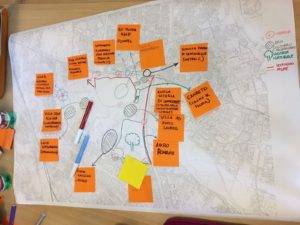
The second group,”accessibility”,listed more accurately all the potential resources that the park could make available.Surprisingly the V Municipal seems to be blessed by so many cultural sites that could re-animate the entire area from a touristic perspective,but also for the sole purpose of embellish the neighborhood.
 A third group ,”potentialities”,brought to light many critical matters such as security and sanitary issues,in fact the park has several abusive occupied zone,not omitting the wasted paper and rubbish that pollutes the park everywhere.
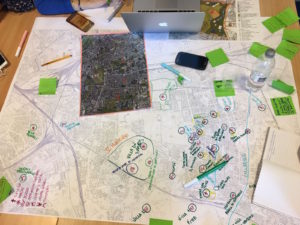 The fourth group;”public services”,classified and mapped all the accessible public services around the PaC zone,such as churches, schools,parks,cultural attractions,theaters and cinemas.-
As it emerges from the images,the V Municipality has extraordinary potentialities,however,due to its marginalized position,its shabby’s first appearance,and the elevate conglomeration of immigrants and religious identities, its efficiency is completely unexploited and its integrity is gradually decreasing and deteriorating running the risk to fall in the oblivion.
 The meeting ended up with Stefania Favorito’s speech over the importance of the park from an archaeological point of view,the park is surrounded by historical sites such as the Villa Ad Duas Lauros,il Forte Casino,la Villa della Piscina,la Vecchio Osteria,all dated back from the republican era until the XIX century,plus the natural resources of l’Agro Romano,il Canneto,l’Agri-Fauna and the whole park of Centocelle.It is important to be mature the awareness to understand what this park does symbolize for the cohabitants of the V Municipality, how this zone reflects their feeling of social marginalization and how this project give them the possibility to join a community in which moral and civic values are promoted and cooperation constantly active.( http://parcocentostelle.net )

by Caterina Gianni | Oct 25, 2016 | Storytelling 2016-2017
On October the 14th, LabGov started the first co-working session in which Paola Santoro, an expert designer, exposed the “hero’s journey” having as protagonists Alessandra and Urio: the spokespersons of the raising Community of the Public Park of Centocelle. This is the #Co-Rome project (www.co-roma.it): an audacious initiative in which achievements and failures characterized the essence of the challenge.
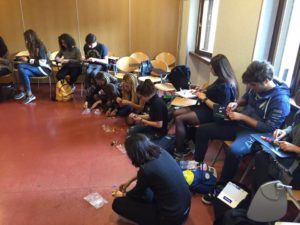 The core topic of the meeting was to understand,also through creative games, what is “la facilitazione dei beni comuni”, more specifically how LabGov assisted the community as mentors, not imposing themselves as superior entities capable of solving problems, rather as an enterprising group that can offer them all the means to improve the environmental situation of a public park, with the common goal to fill-in the gap between the community’s unsatisfied social reality and the dreamed one. This “green” forgotten area, that at a first glance might appear as common as any other park in Rome, deep inside has embedded all the shared values that gradually arose once that a touch-point between the park’s users and the object used was fixed.


