by Chiara Fratalia | May 30, 2016 | The Urban Media Lab

Money savings and personal satisfaction produced by urban gardening have allowed people to rethink chicken breeding in a “more local” way: in many US and Canada cities people can grow their own hens in their backyard, just as they would do with tomatoes or salad in their kitchen garden.
This tendency was accelerated by the outbreak of salmonella in 2010, that led to the nationwide recall of 500 millions store-bought eggs, thus driving down the perception of their being risk-free; and now it has become a way to have a larger control on the food we eat everyday, while cutting energy use and fuel emissions for the trasportation of eggs from farms to cities.
Julie Simpson, president of the pro-chicken group Urban Chicken Advocates of Nashville, in an e-mail to the New York Times says: “It simply made sense to me to have a few chicken in my backyard. I was concerned about where my food was coming from, and having backyard hens was one small thing I can control”.
Buying chicks is easy and cheap, so most of the potential problems depend on having too many chickens in too little space. For this reason, some cities, such as Nashville and Portland, have approved motions that allow urban hen breeding, but with a limitation in the number of hens, calculated in reason of the land extension. These limitations found the approval of Pamela Geisel, director of the statewide Master Gardener Program run by the University of California Cooperative Extension, that says they “can help chicken keepers be better chicken keepers”, allowing them to avoid bigger risks.
Hens breeding it’s not just collecting fresh eggs for your breakfast, but it is a heavy daily effort to keep them clean and healthy, and for some people it’s not just worth the effort. But not for Ms. Geisel: “I love my chickens. They’re my pet” she says about her six backyard hens. “And homegrown eggs”, she added, “are so much better and tastier than store-bought”.
These eggs are not only tastier and healthier: they are far more enviroment-friendly and sustainable. In facts, eggs are in the top ten products with higher carbon footprints: the production and distribution in supermarkets of 1 kilo of eggs produces an average of 4.8 kg of greenhouse gases, that is the equivalent of 11 car miles. Also, more than half of the emissions (2.7 kg) are made only in the transportation phase, that is completely eliminated in case of urban breeding.
Not only an increase in food security and a decrease in damaging emissions: domestic chicken breeding is likely to be free from the ethical dilemma produced by intensive industrial farming. The domestic breeder is likely to develop some sort of an affection for his/her pet chickens and hens, and will probably avoid brutal practices such as the detention in barren battery cages, or the genetical selection.
In the broader framework of a local program that endorses community gardening and urban farming, these practices could significantly cut down greenhouse gases emission, by operating a substantial reduction in the need of goods transportation. Moreover, urban farms and community gardens could also work as carbon sinks: in facts plants (especially the evergreen ones) absorb atmospheric carbon dioxide (CO2) and release breathable oxygen (O2) through photosynthesis, thus relieving the carbon accumulation that is innate in urban areas.
In addition, plants absorbe and remove particulate matter, the result of the burning of fossil fuels in vehicles and power stations, classified by the WHO as one of the most dangerous carcinogenes. Given this statement, is easy to say that this cleaning action carried out by community gardens could reduce mortality rates in urban areas. To give an example of plants effectiveness in pollution abatement, Bradley Rowe in his essay states that “just one square meter of uncut grass on a city roof is needed to offset the annual particulate matter emissions of a car“.
Gwan-Gyu Lee, Hyun-Woo Lee and Jung-Hwan Lee have shown in their essay that the spreading of urban agriculture in Seoul, one of the most advanced cities in terms of collaborative and sustainable governance of the commons, has reduced the greenhouse gases emission by a rate of 11,668 tons per year. This value is the equivalent of the CO2 emissions for 1155 persons on the annual basis of 10.1 tons of CO2 emissions per capita (2007 data), and it has been achieved with a urban agriculture area of just 51.17 square kilometers, which is about half the extension of rooftops in New York City.
_______________________________________________
L’allevamento domestico di galline e polli è una pratica sempre più diffusa negli Stati Uniti, che permette di controllare maggiormente il cibo che mangiamo ed eliminare problemi etici come i trattamenti abominevoli subiti dagli animali negli allevamenti intensivi. Nel quadro più ampio di un programma di incentivo all’urban farming e al community gardening, queste pratiche potrebbero avere un impatto significativo sulla riduzione del carbon footprint e sulle emissioni di gas serra, per la gran parte dovute al trasporto delle merci dai luoghi di produzione ai supermercati.

by Diletta Di Marco | Feb 8, 2016 | The Urban Media Lab
An Ecomuseum is a dynamic way in which communities preserve, interpret, and manage their heritage for a sustainable development. An Ecomuseum is based on a community agreement. Introduced by the French museologist Hugues de Varine in 1971, the word ecomuseum has often been misused and the definition of an ecomuseum is still a controversial matter for contemporary museology.Many museologists sought to define the distinctive features of ecomuseums, listing their characteristics.Following a complexity approach, in recent definitions, ecomuseums are more properly defined by what they do rather than by what they are.[1]
The ecomuseum phenomenon has grown dramatically over the years, with no one ecomuseum model but rather an entire philosophy that has been adapted and molded for use in a variety of situations. As many more ecomuseums are established across the world the idea has been growing and the changes in the approach towards the philosophy are reflected in the reactions of the communities involved. In recent time particular significance is the rise in ecomuseology in India, China, Taiwan, Japan, Thailand, Vietnam and Cambodia, with significant increase in Italy, Poland, the Czech Republic and Turkey.Ecomuseums are an important medium through which a community can take control of its heritage and enable new approaches to make meaning out of conserving its local distinctiveness.
The Urban Ecomuseum Casilino “Ad duas Lauros” is located inside the Centocelle park, on via Casilina. In this urban reality, in the east of Rome and within G.R.A., there are various types of landscapes:
- The archaeological landscape that goes from the Mausoleo di Sant’Elena to the Catacombe di SS. Marcellino e Pietro, from Villa Imperiale di Centocelle inside the Parco Archeologico, to Villa Gordiani, through the Acquedotto Alessandrino and the Terme di Largo Irpinia.
- The landscape of spirituality ,this heritage is in fact part of the historic path of the Via Francigena that crossed Europe to reach the main cultural centers of Christianity
- The agricultural landscape of the Roman countryside with houses, towers, fields and pastoral areas.
- The natural landscape created by the presence of green areas
The Ecomuseum is an intangible infrastructure that brings together these landscapes, bridging them through extraordinary walking and cycling paths, which link together realities anciently connected by these modern views, in order to attract tourists to that area from all over the world.
For decades, urban planning in Rome does not take into account the needs of residents, but only those of profit and speculation, the Ecomuseum is now a new model of “development”. A new way to see the city.It promotes urban planning that incorporates the particularities with territorial wealth to use them to the fullest way, an urbanism that has as its main topic of community health. An easy and effective city, a citizen-friendly neighborhood where livabilityis the central theme.


by Diletta Di Marco | Dec 2, 2015 | The Urban Media Lab
“Collaborare è Bologna” is a project of the City of Bologna, managed with the Bologna Urban Center and various partners to promote a “culture of collaboration” with continuous and consistent community involvement,and to make technologies, resources, spaces, knowledge, skills and information more accessible. In this framework, on 19 May 2014, the Municipality of Bologna approved the “Regulations on the collaboration between citizens and the Administration”, for the treatment and regeneration of the commons. This is an instruction manual for a collaborative dialogue between the public, private and community spheres, a tool that seeks to simplify and promote forms of collaboration in the management of the commons, implementing the principle of subsidiarity provided for by the Constitution in its 118 article.
The project is divided into three sub-projects, designed by listening the citizens and letting them cooperate with associations, institutions, firms and interest groups:
> Fare_insieme: projects for the treatment of public spaces (i.e islands for underground waste collection, new lighting and upgrading of the main public spaces of the center, projects for cleaning the urban spaces, contrasting graphic vandalism, teaching citizens the shared care of open spaces).
> Vivere_insieme: projects with an innovative approach on many issues. Starting from mobility, for a city in which citizens are moving on foot, by bike and on public transport until the creation of projects in areas with specific problems (Pilastro and Bolognina are the interested zones).
> Crescere_insieme: projects in which public places become collaborative spaces and engines of economic development. The project provides a digital network infrastructure in step with Europe, to promote Bologna as a City of Food and renew the relationship between the university and the city.
From October 22 to December 3, 2015 a series of meetings will take place in different neighborhoods and with an online consultation for the citizens to define the priorities of the city.
The path was created in order to strengthen the collaborative ties and develop priorities, to implement the energy of the city and the ability of citizens to collaborate.
The Municipality is organizing six meetings, one for each district to activate a digital platform where citizens, schools, businesses and associations of Bologna will contribute to the emergence of the urban commons and draw a map of the urban regeneration projects and future actions. The aim is to design together a view of the commons to implement the available European funds, with the support of the regional and municipal authorities.
The round tables are organized with the direct participation of the citizens; the focus is on discovering the priorities of citizens and neighborhoods. Which are the places that need special attention?
Each meeting tries to answer to practical questions, and the participation of Neighborhood Presidents and the Mayor is an unique opportunity to present the measures already implemented and funded (relative to the district headquarters of the meeting) with a strong focus on the regeneration projects in progress and current demographic changes.
Each meeting is built on working groups, and for two hours all present citizens can intervene and bring out, area by area, problems and potential solutions.
The project “collaborare è Bologna” is organized by the city of Bologna with the collaboration of the Neighborhoods, Urban Center Bologna, ASP – Company Public Services for the person, IES – School Education Institution and the Institution for Social Inclusion and Community. The official hashtag is #collaborarebologna— search it on Social Media. For more information, write an email to gestionecomunita@comune.bologna.it. The next meeting’s programme of December 3rd is already online on the website: www.urbancenterbologna.it. Change begins with participation, and participation begins with you!


by Diletta Di Marco | Oct 14, 2015 | EducationLabs
On 16 and 17 October, Labgov will present the first co-working session for Labgov 2016.
This two-day workshop is based on the proposal to imagine Rome in an innovative way.
The project CO-ROMA is focused on the idea that a city should learn to share, collaborate and cooperate with the institutions, the civil society, universities and all the possible stakeholders in order to create a collaborative community, that wants to improve the quality of life and save the Italian cognitive and cultural heritage.
The programme of this first co-working-day will be structured into four working groups, which will be: urban design; communication; community organization through service design, and sustainability.
The most competent experts in every field will hold the round tables; they will transfer their know-how to the neo-labgovers, and they will imagine all together this transformation for Rome.
Several forces are already present in this new collaborative city: active citizens, voluntary associations, schools, urban gardens, co-working spaces, fab-labs, business leaders, and professionals for the common good.
Moreover, on Saturday morning at 9.00 am, the 2016 Labgov students will work for the first time in the garden, with our technical partner for horticulture, Zappata Romana. It will be a fantastic weekend, full of experiences and adventures. The detailed programme will be published as soon as possible.
For further information, please write to our official address.
by Diletta Di Marco | Oct 7, 2015 | EducationLabs
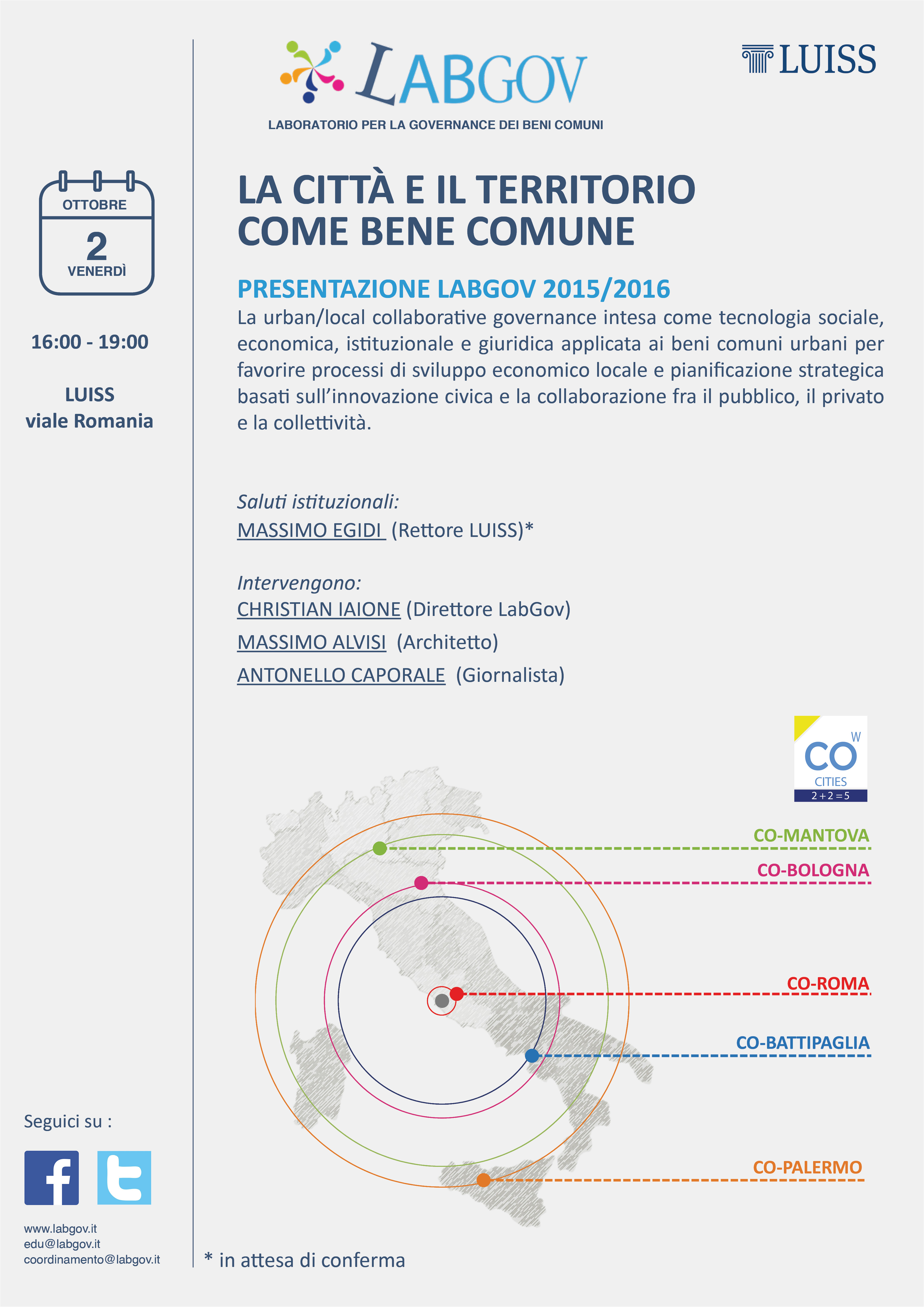
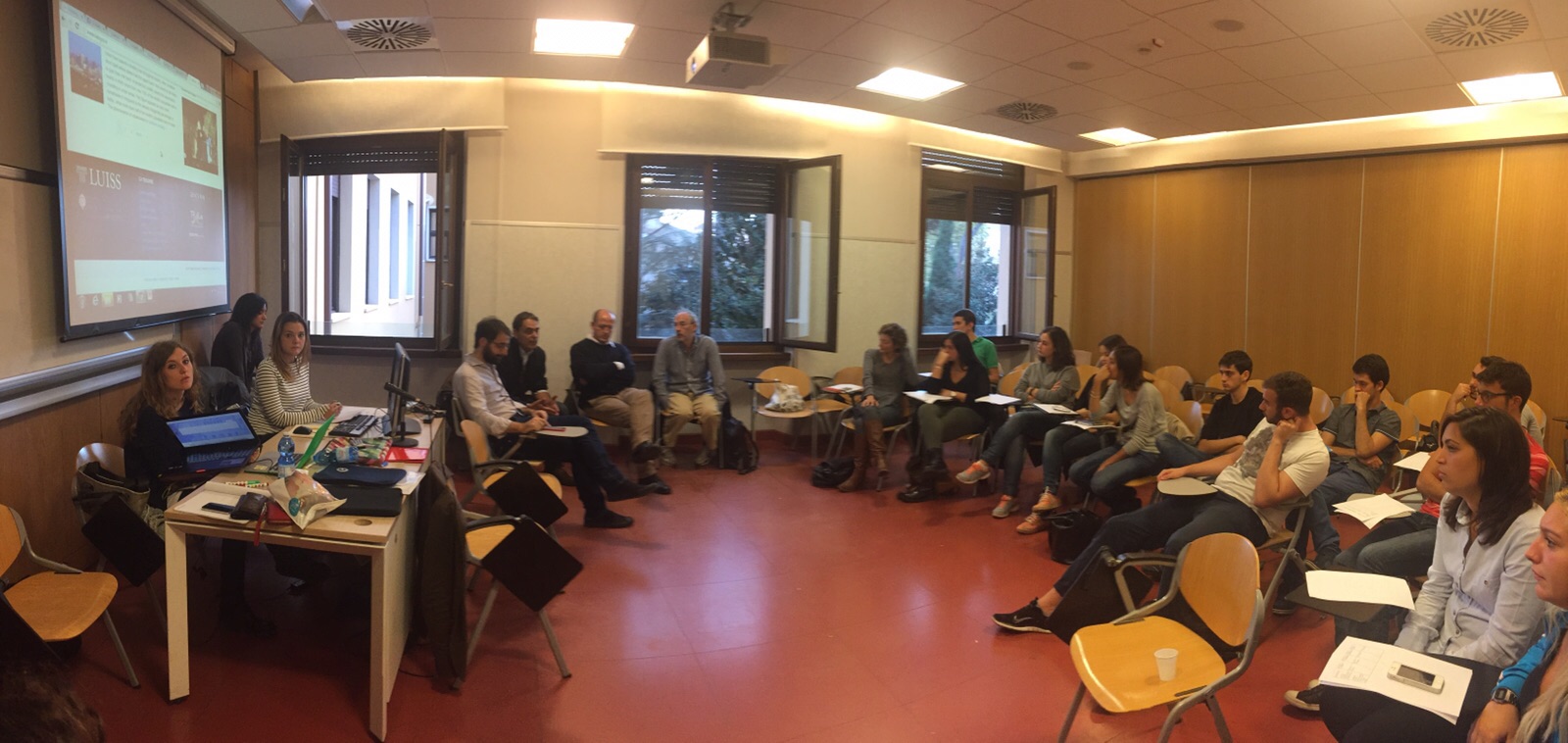
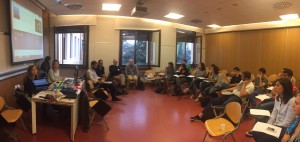
October 2nd we launched LabGov once again for the new academic year 2015/2016! On our first afternoon of the year, full of emotions and debates, we started with a very ambitious and challenging project. In the presence of the new LabGovers (Law, Economics, and Political Science students)several professors, staff members and illustrious experts had the chance to work together, listen to the inspiring words of one another’s previous experiences and imagine a new project for this year. We expect great ambition and willpower, as well as excellent results to share!
The meeting was attended by the Rector of the University Massimo Egidi, the famous Architect Massimo Alvisi and other partners of LabGov, including Luca D’Eusebio for Zappata Romana, Luca Parisio, Serena Baldari and Antonello Caporale. During the afternoon, the new program for the year was introduced by the name of CO-Rome, a project that involves the study of Rome as a city in which we try to build an innovative institutional future, with different and better views . The five souls of the collaborative governance (social innovation, public authorities, schools/universities, businesses, organized civil society) will work together to re-design our own city, making it more economically sustainable.
The goal of LabGov is to form new professional figures: “the practitioners of the commons.” These are people who are able to work in government, in business and in societies. They employ and enhance the resources, ideas, energy, skills and talents of these businesses and societies, which are widespread in the community and in the territories.
Autonomy, accountability, transparency and international openness are the values that make LabGov an incubator of innovative ideas built to establish a new economic and institutional paradigm.
The objects of analysis and experimentation will be as follows: collaborative urban and local governance; and economic, institutional and legal technology applied to the commons (urban, industrial, environmental, cultural, cognitive, digital, etc.). These objects promote processes of local economic development and strategic planning, based on innovation and civic collaboration between the public, private and community.
We will start with an initial mapping phase with a careful reading of the territory and its forms of collaboration. We will then have two phases of design and a follow-up.
As we have already done before, we will apply the CO-Cities approach, based on a strong partnership between institutions, the private sector and the community with significant help on the research side by the academic field.
This year, the co-design will be the fundamental instrument to create a prototype for effective governance and to identify tools based on the needs and characteristics of this city. We have to create a governance tool for the city of Rome that is suitable to the city’s peculiarities. This is our challenge: CO-Roma! In our research, we indentified different areas for testing urban cooperation, which are located on the outskirts of Rome: Garbatella neighborhood, the Appia Antica Park, a high school in Ostia and the V Municipality (Prenestino-Centocelle).
They represent four different types of urban commons to regenerate and invest in. This year, the Lab will focus on a very stimulating challenge for the City. A very stimulating journey cha in the City with many allies, partners and friends who will provide insightful advice to prototype a Commons-based collaborative governance for Rome. The Laboratory stays open to contributions, help and advice. The fourth edition of the Lab will take place in two phases. The former phase will focus on the workshops (October 2/2015, November 13/2015, February 26/2016 and April 8/2016). The latter phase will include co-working sessions (16/17 October 2015, 20/21 November 2015, 04/05 March 2016 and 15/-16 April 2016).
During the project, students will also engage in the field. They will cultivate the garden within LUISS University, a real testing ground of governance. In these 100 hours of pure innovation, together we will discover new stimulating and exciting forms of cooperation! For any information please write to our official account.