
by Stefano Speranza | Mar 17, 2015 | The Urban Media Lab
 A very nice and recommendable initiative about urban regeneration in Italy is the project “Bari per Bene”, adopted by the municipality of Bari.
It was a particular San Valentine’s day this year in Bari, because during that day the project has started. An “act of love” dedicated to the whole town. An act proposed by the administration to the citizens, who will be involved in an experimental process that has started from the “Madonnella” neighbourhood.
The main goal of the project, as it is stated on the official web page of the project, is to make the city more beautiful to enjoy, having guaranteed cleanliness and decency.
The local administration won’t be alone. Actually, in this process will be involved not only the citizens, but also the districts, and all the branches of the local administration, together with the local police.
“Bari per Bene” starts from Madonnella neighborhood for two main reasons.
First of all, because it is one of the most popular districts and secondly, because it is well defined and this could lead to a plausible test of the efficacy of the experimentation. Later on, the project will cross all the neighborhoods following the same procedures, thanks to the help and the warnings of the citizens (thanks to the establishment of a toll-free number and the creation of an application for smartphone).
What is worth to underline is the structure of the project, which is organized in three phases and follows a clear and well-structured timeline chart.
In particular, the first month (February 14th – March 16th) has been dedicated to monitoring and to raise-the-awareness activities on field, through the active collaboration among citizens and the neighbourhood’s administration.
The second phase, that will last until April 15th, will include important activities such as collecting and managing the feedback through the analysis of the data collected from the monitoring activities. Then, the programme of the experimentation will be updated.
Lastly, in April, a press conference will be hold, during which this part of the project will be closed and will be presented the next district to which “Bari per Bene” will move.
On January 31st, the Mayor Antonio Decaro wrote on his facebook profile:
“Dear friend citizens, our city is mainly made of respectable people. But often we see events characterized by incivility that contribute to make Bari uglier, dirtier and less healthy. We, as administration, can do more in order to guarantee cleaning, decency and livableness. But without you, this is a lost battle.
With the project “Bari per Bene”, I propose you an agreement in which we, the Administration, undertake to enforce the public services for cleanliness. At the same time, I ask you to cooperate with us following the rules and reporting who does not.
Public spaces belong to everyone, and to protect them from negligence and neglect is a duty. Actually, it is a challenge that will bring together all the people who love our city, Bari.”
E’ stato avviato lo scorso 14 Febbraio il progetto “Bari per Bene”, con il quale il Comune del capoluogo pugliese sta coinvolgendo i cittadini nella cura degli spazi comuni in una lotta contro il degrado e l’incuranza degli stessi.
Oggi il progetto sta attraversando la seconda fase nel quartiere Madonnella. Dal 15 Aprile in poi scopriremo i successivi quartieri nei quali il progetto continuerà a coinvolgere i residenti, i quali verranno sempre affiancati dall’amministrazione locale, dalla Polizia Municipale e dall’AMIU.

by Marina Bassi | Mar 6, 2015 | The Urban Media Lab
On March 9th, 2015 in Sala della Promoteca at Palazzo Senatorio (Capitol Hill in Rome) the Legal Affairs Department of the City of Rome will host the conference “Aesthetics, preservation and development of the territory reflections for a new urban approach“. The conference will start at 3PM and LabGov will be present with its coordinator, Christian Iaione.
The purpose of this conference is to stimulate a new thinking and to achieve a sustainable approach that could (re)design the traditional rules of urban planning and land use. The conference aims at opening a debate on the conciliation between the preservation of the existing aesthetic and the use of new tools and technologies for the development and regeneration of urban areas and rural areas.
In recent years, the scarcity of resources and the emergence of new challenges, according to the model of “negotiated planning”, forced local authorities to introduce innovative forms of dialogue with the private sector.
During the conference, experts will deal with issues such as Negotiation and administrative power, urban negotiation and Participation and Legality.
Christian Iaione – LabGov coordinator – will participate at the round table, bringing the experiences developed in Bologna with the Regulation on public collaboration for urban commons, in Mantova with the Pact of collaborative governance, and Battipaglia with the City Urban Plan as a Pact of Collaboration for Legality and Land Use.
________________________________________________________
Un nuovo approccio alla pianificazione urbana? Se ne parla il 9 marzo in Campidoglio!
Lunedì 9 marzo ci sarà il Convegno Estetica, Preservazione e sviluppo del territorio: riflessioni per un nuovo approccio urbano. Il Convegno avrà luogo in Sala della Promoteca del Palazzo Senatorio (in Campidoglio) a partire dalle ore 15.00.
Lo scopo del Convegno sarà quello di stimolare il pensiero al fine di (ri)disegnare le regole tradizionali in favore di una nuova pianificazione urbana, preservando la bellezza e la storia del territorio.

by Francesca Spigarolo | Mar 4, 2015 | The Urban Media Lab
Under the viaduct is a project aiming at recovering the Viadotto dei Presidenti, an infrastructure located in the North- Eastern periphery of Rome, whose construction was abandoned more than 10 years ago and has never been completed.
The requalification and rethinking of this area is only a part of a much broader project on which the group G124 (http://renzopianog124.com/) , created and guided by the architect and senator Renzo Piano, is working. The G124 has started his first year of activity by selecting three suburban areas of three Italian cities in which to intervene, and has then developed a strategy to regenerate the abandoned space and give it back to the community.
The young architects composing the group share the view of Renzo Piano on the importance of recovering the peripheries , transforming them into spaces that can have their own beauty and dignity. The growth of our cities ought to be implosive rather than explosive, the brown fields must be reconverted into green fields and the abandoned areas must be redesigned, so that they can acquire a new life and become an aggregation center for the local community. This is what Renzo Piano calls rammendo(patching), meaning the process of connecting fragments of the city between which there is no dialogue and building a structure that will be not only urban but also social.
What has been done in Rome through the project Under the Viaduct is the perfect application of this principle. After an accurate observation of the area the members of G124 managed to get in contact with the local community ad to involve it in the rethinking process, through the cooperation with several associations active on the territory, such as Greenapsi and Interazioni Urban and LabGov itself. The priority was given to the ideas of the citizens, reflecting their real necessities, and the population played an active role in the design and development of the final project.
The co-working activity has revealed the existence of a wide group of people living in the neighborhood who are interested in cooperating and are willing to put their energies into the construction of a shared space for the community. Their participation is fundamental, because it is only through the citizens’ engagement that the new space can be maintained and managed, being thus sustainable.
Today, even though part of the project still has to be completed, we can already see the transformation that has begun. The area under the viaduct, which for years was inaccessible, is now an open space where people of every age and kind can meet to take part in the numerous activities which are organized, ranging from games for the children, laboratories of recycle and reuse, photography exhibitions and live concerts.
Finally, the collaboration born between LabGov and the G124 Team has been the starting point of the new project started in Battipaglia , in the province of Salerno. For the architect Massimo Alvisi, coordinator of G124, the task of drawing up the guidelines and strategic planning policies of the city of Battipaglia, putting the basis for the future preparation of the urbanistic plan. LabGov participates in the project giving its experience in the design of the city as a commons, through co-design processes and the method of the collaborative governance of the commons.
__________________________________
Progetto SottoIlViadotto – Rigenerazione urbana nata grazie alla collaborazione con G124 di Renzo Piano diventa esempio da seguire!
Sottoilviadotto è un progetto che aspira a trasformare il Viadotto dei Presidenti, una struttura abbandonata situata in una zona periferica nel nord-est di Roma, in un luogo di collaborazione e partecipazione cittadina. Sottoilviadotto si inscrive in un progetto più grande, che non si limita alla realtà romana ma coinvolge diverse città italiane, e nasce dal lavoro del gruppo G124, creato e guidato dall’architetto e Senatore a vita Renzo Piano. Alla base di questo programma c’è la visone condivisa dal gruppo sulla necessità di recuperare le aree periferiche più degradate, che rappresentano la sfida maggiore per il futuro della città. Il ripensamento di questi spazi non può essere portato avanti unicamente da un gruppo di architetti, ma deve vedere il coinvolgimento della collettività dei cittadini e deve essere il risultato di un processo di cooperazione e compartecipazione dei diversi attori locali. La collaborazione tra LabGov e G124 continua. Massimo Alvisi, coordinatore di G124,è stato incaricato di delineare le linee guida per il futuro piano urbanistico di Battipaglia, cittadina vicino Salerno. LabGov collabora al progetto fornendo la sua esperienza nella progettazione della città intesa come bene comune, tramite processi di co-progettazione e con il metodo della governance collaborativa dei beni comuni.
Per saperne di più: www.renzopianog124.com

by Marina Bassi | Feb 28, 2015 | The Urban Media Lab
The next 2nd and 3rd March the TUTUR final conference will take place in Rome. In these two days, the experiences from around Europe and Italy will be presented in the conference room of Palazzo Taverna in the III District of Rome.
TUTUR is a pilot project financed by the URBACT program , which aims at developing a policy instrument to allow and support temporary uses of abandoned and under-used properties by opening up to new models of experimentation. The project foresees the implementation of this practice in Rome, in Itay, and Alba Iulia, in Romania, based on the good practice of Bremen: the ZwischenZeitZentrale . It activates many buildings and supports the City Administration in the urban planning long-term plans.
Temporary use is a planning tool effectively bringing together various stakeholders: it engages an important number of municipal and private economic development agencies and property owners, as well as cultural organizations, to elaborate potential uses of existing infrastructure and resources.
LabGov collaborated in the local support group of TUTUR during the event Under the viaduct . The project, that has been one of the activities of G124 – a working group supported by Renzo Piano, concerned the regeneration and temporary use of the area placed under the Viaduct of the Presidents, in the Nuovo Salario quarter of Rome. Moreover, Professor Iaione – coordinator of LabGov – partecipated in the roundtable at the Conference Il mercato al centro , together with experts and local public officers, bringing the experience of the LUISS Community Garden and CO- Mantova.
During the two-day event, the partners will deal with different topics such as “markets as reactivator of neighbourhoods and short food chain distribution”; “European good practices in terms of temporary reuse”; “Theory of Cohesion policy”.
There will be – among all speakers who will come – Emily Berwyn an experienced project designer and manager for programmes that utilise vacant space to support community initiatives, social and creative entrepreneurialism and facilitate placemaking; Stephanie Raab, who advises companies, property managers, local governments and owners in project development and with regard to funding opportunities, inter alia, within the commercial vacancy projects and accompanied project developments in the cultural sector accounts.
Program of two-day event and more information could be find here: http://tutur.eu/wp-content/uploads/2015/02/URBACT_TUTUR_Conference_EN2.pdf
_____________________________________
TUTUR – Conferenza finale
I prossimi 2 e 3 marzo si terrà a Roma la conferenza finale del progetto TUTUR. Durante l’incontro, che avrà luogo presso il Palazzo Taverna ( III Municipio di Roma), saranno presentate esperienze italiane e europee in materia di uso temporaneo dei siti dismessi come strumento di rigenerazione urbana.
TUTUR è un progetto pilota europeo che ha come obiettivo lo sviluppo di uno strumento normativo per permettere e promuovere l’utilizzo temporaneo di edifici abbandonati, snellendone il processo burocratico ed aprendo a nuovi modelli di sperimentazione. Il progetto vede coinvolto il Comune di Roma, di Brema e di Alba Iulia (Romania); il modello è proprio uno strumento della città tedesca, lo ZwischenZeitZentrale, che ha promosso il riutilizzo temporaneo di molti immobili abbandonati.
Per maggiori informazioni sul progetto e sul programma : http://tutur.eu/wp-content/uploads/2015/02/URBACT_TUTUR_Conference_IT1.pdf

by Edoardo De Stefani | Feb 14, 2015 | The Urban Media Lab
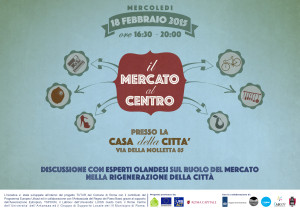 On the 18th of February there will be an interesting meeting at the Casa della Città in Rome, entitled “Il mercato al centro” (The market at the centre) and organized within the activities of the TUTUR project. The meeting aims at searching and questioning what will be the role of the market in the urban regeneration of the neighborhood. It will be present local and Dutch experts, such as Francesca Miazzo, Pinar Balat and Paul Alexander de Graaf. LabGov is partner of the project and it will partecipate at the meeting for contributing at the debate on urban regeneration bringing the experience of Bologna, Mantova and Rome. Prof. Christian Iaione, Coordinator of LabGov will partecipate in the roundtable together experts and local public officers.
TUTUR – Temporary use as a tool for urban regeneration – is a planning tool developed to bring together a wide number of stakeholders for advancing projects of urban regeneration. In particular, the potential uses of existing resources and infrastructures are developed with a specific regard to the revitalization of neighborhoods. As happened for the temporary use requalification of the area placed under the “Viaduct of the Presidents” in Rome, TUTUR aims at facilitating and promoting the reactivation of unused public assets.
In line with this philosophy, the project of Viale Adriatico Market was born with the objective of reanimating the urban network, from the perspective of environmental quality and services to citizens.
The Urban Transformation Assesorate of the City of Rome is the Leading Partner of the project, given the great importance of urban regeneration for the future development strategy of the city. For this reason, on 2 February 2015 there were presented several projects for the regeneration of the “Viale Adriatico Market”, developed by the students of the UARK Rome centre and with the support of TUTUR.
There are in fact a wide range of public owned spaces that need to be placed in a renovated planning scheme, in order to serve the demands and opportunities of that specific physical capital.
Thanks to the support of the residents of the area and of experts and professionals like those from LabGov and Farmingthecity, it was possible to open a panel discussion for identifying the best ideas for the Viale Adriatico Market.
The input received will serve as a basis to operationalize the intervention on the market that will take place on 20-22 March 2015.
For further info visit the link
Forthcoming event at:link
_________________________________
Il 2 Febbraio sono stati presentati a Roma i progetti per il rilancio del mercato di Viale Adriatico sviluppati dagli studenti americani del UARK Rome centre con il gruppo di supporto locale del progetto TUTUR, alla presenza di esperti locali ed internazionali di rigenerazione urbana, tra i quali LabGov e Farmingthecity.
Grazie al supporto delle idee sviluppate dallo UARK Roma Centre, TUTUR mira a ricostruire l’esperienza del “mercato al centro” con l’obiettivo di implementare una strategia di rigenerazione di spazi pubblici mal utilizzati o sottosviluppati. E’ importante riuscire a ricostituire un utilizzo comunitario di beni pubblici, data la crescente necessità di confrontarsi con le sfide di rivitalizzazione dei quartieri.
Gli input ricevuti durante l’incontro sono altresì preziosi per confrontarsi nuovamente sul progetto di rinnovamento.
Per seguire i prossimi eventi o per ulteriori informazioni => link

