by Edoardo De Stefani | Feb 10, 2015 | The Urban Media Lab
NexT SNIA Viscosa is an open call for attracting ideas, talents and competences for the regeneration of an ex-industrial area in the City of Rieti.
The underlying idea is not about selecting the best project or about competition among ideas, rather the working method of collaboration and co-design becomes an objective itself.
All local and international stakeholders are called to work in a transversal and interdisciplinary manner on the themes of social innovation and urban requalification.
The participative structure of the call makes possible to include all those local stakeholders that are interested in building a new narrative of the territory.
The project of regeneration becomes a transparent experiment of social co-designing and it gives the possibility to be part of the think-tank together with professionals and changemakers.
The project promoters are the Municipality of Rieti, Rena, Monte dei Paschi di Siena and Snark for the technical support.
To participate, please visit > link
Further info at > Link
_ _ _ _ _ _ _ _ _ _ _ _ _ _ _ _ _ _ _ _ _ _ _
Presentato il bando internazionale NexT Snia Viscosa: un’opportunità di rilancio per Rieti
Giovedì 29 gennaio, presso il cinema Moderno, l’associazione RENA, il Comune di Rieti e Banca Monte dei Paschi di Siena hanno lanciato il bando internazionale “NexT Snia Viscosa”, sulla base di un importante progetto di riqualificazione di un ex area industriale del territorio laziale.
L’idea del bando è quella di raccogliere la sfida di una rigenerazione urbana di aree produttive dismesse, attraverso l’utilizzo di strumenti di innovazione sociale e tecniche di co-progettazione. L’idea principale è quella di mettere insieme un gruppo di professionisti ed innovatori sociali, nonché di persone che abbiano competenze di analisi, progettazione e di racconto dell’area.
Individuare una direzione progettuale richiede infatti un approccio trasversale che coinvolga allo stesso tempo cittadini e operatori del territorio, in modo da comprendere quali siano le reali motivazioni ed esigenze del cambiamento.
Il bando mira quindi a raccogliere idee per la riqualificazione dell’ex Snia Viscosa e ad attirare manifestazioni di interesse, da parte di tutti quei soggetti interessati, siano essi attori locali, nazionali o internazionali impegnati su tematiche di progettazione ed innovazione sociale.
Il percorso prevede una fase di ricerca, ascolto ed osservazione -sulla base di un approccio di comunicazione e partecipazione trasparente alla città e agli stakeholders coinvolti- ed infine un vero e proprio processo di co-progettazione e formulazione progettuale.
Per rispondere alla call, si rimanda al link seguente : link
Ulteriori informazioni su: link

by Edoardo De Stefani | Dec 24, 2014 | The Urban Media Lab
The G124 is a working group lead by the visionary architect and Senator Renzo Piano that works for the re-qualification of the peripheries.
The idea to set up a Lab for the requalification of the urban texture was born as a response to the mounting necessity to restore the ghost spaces of the cities, in particular the old industrial districts. The renaissance of the peripheries is not only an architectural phenomenon, as it involves functions that are far beyond the physicality of spaces.
Indeed, periphery is often a synonymous of identity, but at the same time it demonstrated during the last decades to be so fragile and disconnected from the city.
The Master plan by Renzo Piano for the regeneration of the maxi area of the old industrial district FALK in the city of Milan, intends to mend the “collective conscience” and to establish a new canon of urban architecture, as well as new roles for spaces: In order to contribute to the spirit of the community, it is necessary to rethink the physiognomy of spaces and to assign them the value of melting pot of the collective identity.
The imaginative vision of the working team goes far beyond the boundary of current times, since the project envision a new architecture and new functions for “the city that will be”.
In this sense, there is the awareness that we need to set up today a social construction yard for building the physical innovations of tomorrow.
The terrain is fertile for the inception of a model of active school, that become a sort of educational lab with flexible spaces and instruments that facilitate a collaborative approach to knowledge.
The urban renaissance must be fertilized with structures that are able to sustain collaboration and positive networking; at the same time, it becomes crucial to conquer those abandoned spaces for transforming them into shipyards of social innovation. Let’s think for example to the common gardening or to the quarter Laboratories (LDQ).
Moreover, we shall protect the fragility of our cities by conferring responsibilities to the new generation, by giving them adequate public structures as well as the possibility to invent new jobs.
For this reason, we believe that the project lead by the Renzo Piano Building Workshop will be a prominent example in the area of urban regeneration, especially regarding schools, their educational system and their role in the neighborhood, as they are simply the most important and prolonged space of collective rendezvous.
Image copyright by: RPBW

by Edoardo De Stefani | Nov 12, 2014 | Luiss LabGov 2014-2015
We already talked about urban regeneration, as something that goes hand in hand with the structuring of the urban network and its spaces.
Without any doubt, the territory is full of qualities and resources that are not only physical assets.
However since there is no power without control, regeneration is also about participation and governance.
We are used to imagine the urban environment as something populated by a collection of independent individuals and rational decision makers, which make choices as a consequence of an opportunistic calculation.
Fortunately there are actors and situations that prove that such assumption is biased: indeed there is a crescent flow of urban stakeholders that are guided and inspired by a model of deliberative democracy, which resides in the right to participate to a collective decision by influencing the content.
To make it simple, we strongly believe that the discourse is nowadays oriented toward a community development, whereas the dominant paradigm becomes the collaborative governance.
In this sense, the urban resources have to be filled with a technological content, the social one, which shall permit active participation by citizens and cooperation with institutions, administrations, corporations, associations and universities.
The real value added is the latent potential of people, not their hyper individualization.
Certainly, the discourse cannot omit a range of issues that have to be prioritized: economic sustainability, availability of assets and mapping of resources, urban architecture and the relationship with institutional actors.
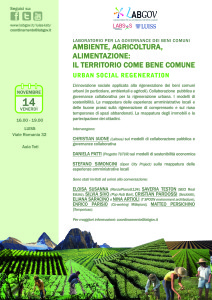
On 14th November at 16.00 in LUISS Guido Carli University, we will have the chance to meet several experts and to launch a debate upon the urban social regeneration.
With the participation of Daniela Patti (project TUTUR) and Stefano Simoncini (Open city project), LabGov will have the pleasure to host the conference; the objective is to transform the meeting into a co-working session and to promote the dialogue between all the participants.
We aim at creating a concrete and usable output for all the presents.
Further info about participants and program at :

by Alessandra Feola | Oct 10, 2014 | The Urban Media Lab
On the next 11th and 12th of October LabGov will participate in the event organized by the Renzo Piano’s G124 working group.
Saturday 11th and Sunday 12th will be presented in Rome the initiatives for the regeneration and temporary use of the area placed under the Viaduct of the Presidents, in the Nuovo Salario quarter of Rome. This viaduct, which extends from the periphery of the Capital, was built some decades ago for a urban railway that has never been terminated and is nowadays in decay. The project is part of the activities of G124, a working group supported by Renzo Piano, the famous Italian architect and Italian senator since 2013, is coordinated by Arch. Massimo Alvisi and aims at redesigning the urban peripheries and the city of the future. The project managers of the initiatives are two young and talented architects Eloisa Susanna and Francesco Lorenzi. The two day initiatives will be dedicated to the presentation of the project to the neighborhood, slightly before the comprehensive presentation that is currently scheduled for the end of November at the Italian Parliament.
Saturday the Serpentara Station will be reactivated and the community will finally be able to enjoy an ecological space with grass and childrens’ playground. the social lunch -called “Public spaces as a commons” – will be an important moment for all the citizens, who can freely access the facility. The project is realized in collaboration with Greenapsi Associazione Viadotto dei Presidenti, Associazione Interazioni Urbane and the local community. Nonetheless without the collaboration of the special partner “Roma Capitale” administration, it wouldn’t be possible to organize the event. Thus it is crucial to recognize the importance of the collaboration that was set among the different actors and partners.
LabGov will be present during the activities for supporting the participatory design of the space. The organized workshop will be starting at 3:30 pm till 5:30 pm and it will consist in a speech of Christian Iaione, coordinator of LabGov and professor of Public Law, that will illustrate how is it possible to realize a collaborative governance of a public space; Finally there will be time for a co-design session , namely “Under the Viaduct” , for involving the community in the design thinking activity aimed at redefining the future of this space.
Locandina Evento 11-12 ottobre 2014

