
by Francesca Spigarolo | Mar 6, 2017 | The Urban Media Lab
During the last decade, Community Land Trust has been welcomed in many European countries by grassroots movements and policy makers alike as a valuable response to the increasing difficulties that a large portion of the population encountered to get access to decent and affordable housing. When trying to enter the housing market, people often face two obstacles. First, expensive private rent and even more high-priced individual private ownership have become out of reach for those who lack the financial power to afford it; secondly, the supply and quality of social housing has proven unable to meet the demand of a growing number of low-income people who seek access to it[1]. In spite of the lack of a long-term stable framework for the affordable housing sector in Europe,[2] a whole range of piece-meal solutions aimed at increasing the supply of affordable housing have been put in place through both public policy interventions at a State and regional level, and the activism of not-for-profit housing cooperatives, housing associations, and self-organized groups of people.
Especially concerned with the long-term affordability of housing for low- or moderate-income people, Community Land Trust has gained ascendancy among those solutions that are capable of responding to the pitfalls of the housing market and has consequently known an unprecedented spread throughout Europe during the last decade. Community Land Trust (also known by its acronym CLT) is a land ownership scheme capable of fostering housing long-term affordability while at the same time allowing the broad participation of the community involved[3]. Community Land Trust arrived on the scene in the United States in the late 1960s as an outgrowth of the Southern Civil Rights Movement and was originally used as a mechanism for African-American farmers to gain access to agricultural land[4]. Since then, CLT has steadily grown in importance across the United States, so far as it has been employed in urban and rural areas as a means to provide an alternative to low- and moderate- income people for affordable housing and neighborhood revitalization[5]. According to the National Community Land Trust Network (NCLTN), which represents the major association for CLTs in the United States[6], there were in 2011 “a total of 246 CLTs in the network with coverage in 45 states and probably about 6,000 homes in the land trusts’ hands across the country”[7].
Community Land Trust is a membership-based, non-profit organization chartered to hold and manage land in trust for the benefit of a given community. These three main elements – land, trust and community – are the core of the CLT model. As to the first element, land is held in trust by the CLT for the benefit of the community. Actually, the CLT acquires land through purchase or donation with an intention to retain title in perpetuity and to remove the land from the speculative market[8]. While permanently retaining title to the land, the CLT enters into long-term agreements with prospective low- or moderate-income residents, which are thus given ownership of buildings and improvements on the land. The result is a split between the ownership of land and improvements. As to the element of trust, stewardship or “trusteeship”[9] of the land for the long term is ensured by the CLT in different ways. Firstly, the ground lease set out a range of mutually agreed restrictions between the CLT and residents, such as resale-price, buyer-eligibility, occupancy, and use restrictions, which ensure that homes remain affordable for future buyers over time. Secondly, the CLT does not disappear once homes are eventually sold by leaseholders; on the contrary, CLT may retain an option to repurchase the buildings located on the land when residents wish to sell them and, in the event a resident defaults on her mortgage, the CLT may have a right to step in to prevent foreclosure[10]. As to the third element – community – the democratic governance structure of the CLT reflects the idea that CLT operates within a given community (a single neighborhood or an entire city) and that all members of the community should have a degree of control over the way the land is managed. First of all, membership of the CLT is open to anyone living within the boundaries of the community and not only to residents, each group having the responsibility of electing one third of the governing body. Moreover, the board of trustees – normally called Board of Directors – is tripartite and includes representatives of (i) residents of the trust-owned land, (ii) members of the community who do not lease land from the CLT, and (iii) other people who are meant to represent the public interest, such as public officials and non-profit organizations and funders.
The CLT model, including all the features described above, has been given legal recognition into the federal Housing and Community Development Act of 1992, where it is defined as
“a community housing development organization […]
(1) that is not sponsored by a for-profit organization;
(2) that is established to carry out the activities under paragraph (3);
(3) that:
(A) acquires parcels of land, held in perpetuity, primarily for conveyance under long-term ground leases;
(B) transfers ownership of any structural improvements located on such leased parcels to the lessees; and
(C) retains a preemptive option to purchase any such structural improvement at a price determined by formula that is designed to ensure that the improvement remains affordable to low- and moderate-income families in perpetuity;
(4) whose corporate membership is open to any adult resident of a particular geographic area specified in the bylaws of the organization; and
(5) whose board of directors:
(A) includes a majority of members who are elected by the corporate membership; and
(B) is composed of equal numbers of
(i) lessees pursuant to paragraph (3)(B);
(ii) corporate members who are not lessee, and
(iii) any other category of persons described in the bylaws of the organization”[11].
Since then, CLTs have steadily spread throughout the United States. The expansion of the CLT movement has been pushed by different factors. First, non-profit organizations have committed themselves to help groups to identify and reclaim vacant land and turning it into a community resource, as is the case for 596 Acres. Secondly, CLT has been increasingly welcomed by local administrations as a valuable response to the shortfalls of the public housing market. An example of this is the Request for Expressions of Interest (RFEI) recently issued by the New York City Department of Housing Preservation and Development (HPD), whose objective is to identify qualified groups who are interested in forming a CLT[12]. The formal recognition of CLT by legislation, the growth of a national CLT network, along with the increased attention of public authorities, have also favored the diffusion of the CLT model outside the United States. Along these lines, both groups and local authorities in several European countries have attempted to adapt the CLT model to national contexts and promote its use, being attracted by its ability to preserve long-term housing affordability while triggering neighborhood revitalization, both of which are much-needed in large European urban centers.
[1] For a thorough analysis of the situation of the housing market and related policy development in each of the European member States, see The State of Housing in the EU 2015, Housing Europe, the European Federation for Public, Cooperative and Social Housing
Brussels, available for download at http://www.housingeurope.eu/resource-468/the-state-of-housing-in-the-eu-2015 (last accessed on December 26th, 2016).
[2] This is one of the key findings of « The State of Housing in the EU 2015 ». A summary of the report is available for download at http://www.housingeurope.eu/resource-468/the-state-of-housing-in-the-eu-2015 (last accessed on December 27th, 2016).
[3] Its first advocates described CLT as “a social mechanism which has as its purpose the resolution of the fundamental questions of allocation, continuity and exchange”: The Community Land Trust. A guide to a New Model of Land Tenure in America, International Independence Institute, Center for Community Economic Development, 1972 (reprint 2007). In the book, the basic structure of CLT is also carefully explained.
[4] J. E. Davis, Origins and Evolution of the Community Land Trust in the United States, in J. E. Davis (ed.), The Community Land Trust Reader, The Lincoln Institute of Land Policy, Cambridge, Massachusetts, 2010, p. 3-47.
[5] According to Abramovitz, the reasons for the increased emphasis on affordability in the US are to be linked to “the massive number of low- and moderate-income rental units built under various subsidy programs in the late 1960s and early 1970s that have been in danger of being lost as affordable housing through mortgage prepayment. […] In addition, the rapid housing price inflation experienced in many parts of the country during the 1980s further strained the ability of the private housing market to sustain an adequate supply of affordable units”: D. M. Abramowitz, Community Land Trusts and Ground Leases, in 1 J. Affordable Hous. & Cmty. Dev. L. 5 1991-1992, p. 5.
[6] Information about the CLT network in the United States are available at http://cltnetwork.org
[7] See S. Soifer, “Community Land Trust”, in The Encyclopedia of Housing, 2012, p. 2.
[8] “A Community Land Trust takes land off the speculative market and places it in a regional, membership-based, non-profit corporation”: The Community Land Trust Handbook, Institute for Community Economics, 1983.
[9] J. E. Davis, Origins and Evolution of the Community Land Trust in the United States, cit., p. 18-19.
[10] For details concerning the functioning of CLT, see the CLT Technical Manual, available at http://cltnetwork.org/2011-clt-technical-manual/.
[11]See Housing and Community Development Act of 1992.
[12] http://www1.nyc.gov/site/hpd/developers/request-for-proposals/CLT-RFEI.page
Fabiana Bettini, Postdoctoral Researcher, Sciences Po Law School, Paris
This article is drawn from a broader research conducted in the framework of the ERC-funded project “INCLUSIVE” (2014-2019) led by Professor Séverine Dusollier and hosted by the Sciences Po Law School, Paris
——————————————————————
Nell’ultimo decennio il modello del Community Land Trust (CLT), sviluppatosi negli Stati Uniti, ha iniziato a diffondersi in Europa grazie all’impegno della società civile e di diverse amministrazioni e policy makers. I CLT offrono una valida risposta alle crescenti difficoltà che una un’ampia porzione della popolazione incontra nell’individuare soluzioni abitative vivibili ed economicamente accessibili.

by Ornella Martinello | Jul 22, 2016 | The Urban Media Lab
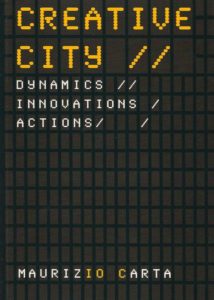 Maurizio Carta, Architect, PhD in Urban and Regional Planning, Full Professor of urban and regional planning at the Department of Architecture at the University of Palermo and advisor for a number of public national and international bodies, is the author of “Creative City – Dynamics, Innovations and Actions“. In his work, Carta tries to condensate his studies on urban regenation based on culture, innovation and creativity. The result is a review of the most innovative processes of urban regeneration undertaken across Europe, an “atlas of urban, landscape and architectural projects”.
Evocative and inspiring is the quote by Irish playwright George Bernard Shaw which the author decided to open the book with:
“Some men see thing as they are and say, ‘Why?’. I dream of thing that never were and say, ‘Why not?'”
Admittedly, the book is the outcome of a “trip” across current best and most innovative urban practices and a hopeful insight into the future of territorial bounds, communities and cities. The wide set of maps, data and figures that complement the analysis not only helps to better figure out how cities are evolving nowadays in Europe; they also give a strong evidence of the fact that the future will undeniably lie in a kind of city that is creative, culture-oriented and sustainable. In Carta’s words:
“The city of the future will be a city of culture, a city generating new culture: the creative cities of the twenty-first century will be capable of competing on the international scenario by optimizing and promoting their own individual cultural identities, attracting a class of creative and generating new sustainable futures.”
The author concisely depicts the world of the future. But he also gives us the instruments we need to build it, or, as he defines them, the “four keywords” which the “creative city manifesto” is based on and which should guild city-makers:
– VISION, the city of the future is forward-looking;
– MISSION, the city of the future is responsible towards its citizens and their needs;
– OUTPUT, the city of the future is productive and effective;
– FUTURE, the city of the future is culturally and environmentally sustainable, able to enhance its citizens’ wellbeing without compromising future generations’ one.
As a matter of fact, these concepts recur repeatedly throughout all the three parts which the book is divided, namely:
I – Creative cities: an Action-Oriented Manifesto;
II – Towards a new polycentric competitiveness;
III – The fluid city – experiments in 13 cities around Europe.
What markedly emerges from the review of those 13 citites (Amsterdam, Barcelona, Bilbao, Bordeaux, Genova, Hamburg, Lyon, Lisboa, Marseille, Newcastle, Palermo, Rotterdam, and Valencia) is a call to act now in order to make our future richer. As Carta puts it, “the twenty-first century is without doubt set to be the ‘age of cities'”. The present and future lie in the local dimension. That is where territorial specificities are respected and promoted and where new forms of political participation can be experimented.
In order to make our cities “desirable places to inhabit”, we cannot but recognize the crucial role governance plays in determining the quality of the outcomes of urban regeneration and how working on ownership, inclusiveness, participatory practices and cooperation leads to a better and long-lasting enhancement of the local dimension, re-building a sense of citizenship through culture and knowledge.
—
Il famoso drammaturgo irlandese George Bernard Shaw scrisse: “Vedi cose che esistono e ti chiedi “perché”? Ma io sogno cose non ancora esistite e chiedo “perché no”?”.
Attraverso una rassegna dei progetti più creativi ed innovativi messi in atto in 13 città europee, l’architetto italiano esperto di rigenerazione urbana Maurizio Carta traccia i contorni della città del futuro: visionaria, produttiva, sostenibile, creativa.
by Cristiano Gatti | May 9, 2016 | The Urban Media Lab
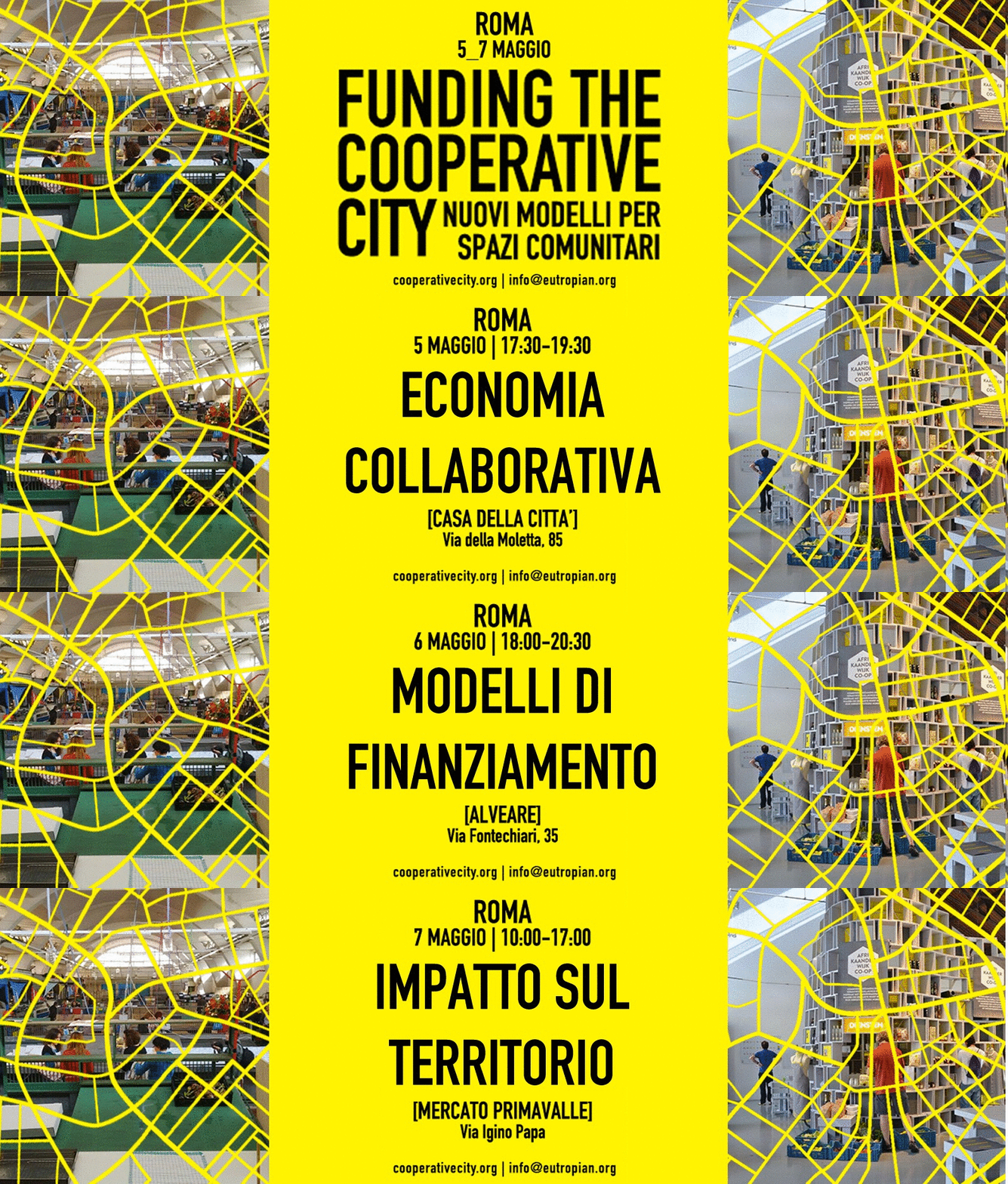
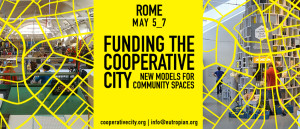 Community financing in collaboration with the Administration. This was the theme of the first event in the three-day long workshop “Funding the Cooperative City – Rome” Nuovi modelli per spazi comunitari, which took place in Rome (@Casa della Città) on 5th May.
In front of the audience, Daniela Patti, Managing Director of Eutropian GmbH in Vienna and Founder of Eutropian association in Rome, introduced local and international speakers:
- Annet van Otterloo, Afrikaanderwijk Cooperative, Rotterdam
- Stefania De Masi, Cascina Roccafranca, Turin
- Jeroen Laven, ZoHo – Stipo, Rotterdam
- Christian Iaione, LabGov Luiss, Rome
- Massimo Allulli, Area Studi ANCI
- Angelo Melpignano, WithYouWeDo Crowdfunding di TIM
Afrikaanderwijk Cooperative and Freehouse bring existing workspaces, entrepreneurs, producers, social organizations and the market together. They promote sustainable local production, knowledge, cultural development and entrepreneurship based on shared responsibility and participation. The primary purpose is for people in the Afrikaander district to reclaim the right to develop their own neighbourhood.
Afrikaanderwijk Cooperative and Freehouse are working in Rotterdam-Zuid’s Afrikaander district to create a stronger and wealthier area for residents and businesses. In order for the Afrikaander district not become the victim of the expansion of the creative city, Freehouse set up small-scale projects to regenerate the districts and its market from within. In collaboration with residents, artists, and fashion designer Freehouse created a workshop for making and designing clothes, a communal kitchen area and a shop selling local products and offering small-scale delivery services. Another crucial element is the Afrikaander Market, which has been in decline for several years because it is not possible to combine products and services on the same stall. With over 300 acts of civil disobedience, they found a solution: red carpet fashion shows presented the work of young local designers and alongside items available on the market. In addition, the one-sided market assortment was expanded with local quality products. At the present, they offer over 48 jobs and various internship to the community.
Fondazione Cascina Roccafranca, founded by Turin municipality and participated by associations and informal groups is an innovative, social and cultural civic centre designed to citizen participation. It is a “container” that provides service: such as an accommodation centre, advice shops, a restaurant and a cafeteria that contribute to economic sustainability. There is also an Eco-museum and activities about ethical consumption, courses (theatre, dance, painting, diction …) reading groups, cinema clubs, foreign language courses, after-school programs, etc. Both the Foundation and other actors organize the activities and the services.
There are 100 courses involving over 3500 people, not only from the neighbourhood but also from the entire city. Actually, 40 volunteers and 20 specialists work in the Foundation. Through the improvement of relationship among different ages, cultures and actors, the Foundation wants to encourage citizens to be a part of their community and to work not only for their private needs but also for the commons. To do this, it is necessary to focus on citizen rights, social cohesion and new models of cooperation (especially PPP).
Zo-Ho is Rotterdam’s makers’ quarter. In 2013, owner Havensteder, Stipo and Municipality cooperated and decided to develop the area in a gradual process called slow urbanism. The area has been the opportunity to redevelop itself for 10 years. Havensteder offered tenants the chance to use and develop their property in an appropriate manner. The municipality provided spaces for experimentation and invested in social strategy and public spaces. Tenants found suitable neighbours and provided frameworks for the development of buildings and public spaces. Thus, users of the area, companies, organizations, inhabitants, and visitors can get involved with the development plans.
Two examples of improving Zo-Ho at eye level are Restaurant Gare du Nord (a successful organic vegan restaurant in a former train wagon on a derelict building site. The staff came from the neighbourhood) and residents from the Noord district starting an area cooperation to improve their district in an economic sustainable way. Zo-Ho become an experimenting and prototyping area and the success of the project persuaded other people to join the district.
LabGov Luiss is a place of experimentation, created to train the “experts in the governance of urban commons”. The goal is to create a new institutional and economic system based on the model of “civic collaboration”, “collaborative governance of the commons” and “circular subsidiarity”, according to which public institutions shall favor all citizens (individuals or in associative forms). In order to achieve social and institutional regeneration, it is necessary to create collaborative relationships between citizens, administrations and businesses to share the scarce resources and to take care of the commons, whether tangible or intangible, in urban and local community.
Prof. Iaione talked about the experiences of Pilastro, Co-Bologna and Co-Roma underlining some key points. First, the scheme of experimentation concerns reproducing institutions in the street (it is a matter of co-design; the results are new forms of social institutions). Then, it is a tension between social norms and formal rules because bureaucracy doesn’t work in the same direction (public procurement is different from co-design) but it is necessary a collaborative approach between internal and external actors to agglomerate knowledge. LabGov’s work is an experimental research on the field; it is natural that there are problems and imperfections in the process because we are in a transition from dualistic to cooperative paradigm. The city could be seen as a laboratory. There is not one solution, it’s a process.
Area Studi ANCI is a part of Cittalia – Fondazione Anci Ricerche and it is a network dedicated to research and study activities on issues of major interest for Italian Municipalities. The Foundation initially got involved in environmental, institutional and innovation programs and then focus on welfare, social inclusion, local governance, public and urban policies. The mission of Cittalia is to support Italian cities and Municipalities in facing the challenges of a changing society, so that they can develop effective public policies and improve their capacity to plan, manage and assess their actions.
Regarding the state of art of the co-city, Dr. Allulli agrees with the previous speaker. He talked about three assumptions: city rulers intend Co-city as a mere replacement of the role of PA (it is not correct because Co-city is more). The second assumption concerns the lack of understanding between politicians and social innovators because the former talks about money, the latter about legitimization, spaces and resources. Then he affirms that, although the contradictory situation, Italy is a land of pioneers: a lot of PA are changing their mind, they think in term of resources not only money. According to this, good news are the crowdfunding growing experience, participatory budgeting and exchanging best practices.
WithYouWeDO is a TIM’s Social Responsibility Enterprise programme. It is a crowdfunding platform, c’est-à-dire a method of web funding by large numbers of people, or crowds, with the goal of raising funds, even of small amounts, to finance projects placed on a platform/website. This platform is available for the non-profit sector and the public. WithYouWeDo promotes and supports the funding of initiatives, ideas and projects in the following areas:
- Social Innovation: from innovative projects for solidarity to building new models for integration.
- Spreading Digital Culture: schools, art and literature, from protecting heritage to innovation in the expression of creativity.
- Environmental Protection: everything that relates to environmental sustainability.
The platform includes two types of support:
- Reward Based Crowdfunding is form of fundraising to support a project in exchange for non-monetary recognition or reward on achieving the objective set out at the start of the campaign.
- Donation Based Crowdfunding on the other hand is a way of donating to support a given idea or campaign, without receiving anything in return: a sort of ‘intellectual investment’.
An example of this, it is Mappina.
In conclusion, we can affirm that this event has been an opportunity to discover citizen spaces and new economic models for community-led urban development with initiatives from Italy and Europe.
–
Funding the Cooperative City – Rome è stata un’occasione per conoscere nuovi modelli economici per uno sviluppo urbano promossi dalla cittadinanza con iniziative italiane e straniere. In particolare, l’evento del 5 maggio intitolato “Finanziamento di comunità in collaborazione con l’Amministrazione” si è caratterizzato come una chiacchierata tra esperienze italiane (LabGov e Cascina Roccafranca), internazionali (Afrikaanderwijk Cooperative e Zo-Ho) e contributi tecnici (Area Studi ANCI e WithTouWeDo).

by Ornella Martinello | Apr 28, 2016 | The Urban Media Lab
On May 5-7 Rome will host “Funding the Cooperative City. New models for community spaces“. The workshop is organized by Eutropian, a planning, policy and research organization helping urban regeneration processes, together with many institutional and private partners. The event aims at discovering new economic models for community-led urban development through experiences and initiatives from Italy and Europe.
Christian Iaione, LabGov founder and director, professor of Public Law at LUISS University, Rome and member of the International Association for the Study of the Commons, will intervene during the first session held on Thursday on “Community financing in collaboration with the Administration“, in dialogue with Stefania De Masi (Cascina Roccafranca, Turin), Annet van Otterloo (Afrikaanderwijk Cooperative, Rotterdam), Jeroen Laven (ZoHo – Stipo, Rotterdam), Massimo Allulli (Area Studi ANCI), Angelo Melpignano (WithYouWeDo Telecom Crowdfunding).
The next two day the two sessions will cover the following themes: “Self-organized financing and management of local resources” and “Workshop on territorial impact“.
Here is the program of the event.
More about Eutropian in our previous article.
—–
Dal 5 al 7 Maggio, Roma ospiterà “Funding the Cooperative City. New models for community spaces“, workshop organizzato da Eutropian al fine di scoprire, attraverso la condivisione di esperienze italiane ed europee, nuovi modelli economici che sostengano lo sviluppo urbano ad opera della comunità.
Qui il programma dell’evento.

by Cristiano Gatti | Apr 26, 2016 | The Urban Media Lab
 UrbanMeta represents a large part of the Venetian civil society and stakeholders of the building sector. This network includes economic groups, professionals, universities, trade unions, builders and environmentalists. These actors have decided to be a part of a worktable to face the issues of the government of the area and the land consumption in a multi-disciplinary approach that allows achieving a sustainable growth through urban regeneration processes.
UrbanMeta’s vision is explained by the manifesto “Un Patto per un programma regionale di strategie politiche di Rigenerazione Urbana Sostenibile – Obiettivi e valori per le città venete del futuro” in which it is said that the launch of urban regeneration innovative policies is fundamental and urgent for the cultural, economic, politic and social growth of the Region. In the report, urban regeneration projects aim to:
- Stop the expansion of new building;
- Connect urban areas with rural ones;
- Encourage the use of urban planning and rethinking administrative practices;
- Promote mixité, equity and social inclusion;
- Stimulate citizen participation;
- Innovate building practices;
- Simplify legislation and procedures.
According to this plan, UrbanMeta undertakes to build an integrated system of communication among stakeholders, became the local pivot in this sector, examine the possibilities given by the EU financing programmes and train experts in urban regeneration system. Then, stakeholders ask the Veneto Region to target EU funds at regeneration programmes, to work in Conferenza Stato-Regioni to promote a national legislation and to adopt a regional law on this matter.
UrbanMeta is not the only project in this field, another one is Eutropian. According to the website, it is “a planning, policy and research organisation helping urban regeneration processes”. They offer assistance to municipalities, NGOs and community groups, policy development and fundraising, cooperation and communication activities. Their specialization concerns “urban regeneration, cultural development, community participation, local economic development and social innovation”. Eutropian offer, also, a multi-disciplinary approach (such as UrbanMeta) that allows activating urban unused resources with the help of experts and citizen knowledge. The main difference with UrbanMeta is about the dimension: Eutropian operates at world level whereas UrbanMeta at local one. This international know-how follows different tiers:
- Environmental Planning: open spaces in urban areas are more than just recreational purposes: they can lead economic local growth in a natural environment. It is possible to bring together offer and demand to a balanced solution for both sides;
- Urban Regeneration: it relates to the involvement of human and financial capital to reuse abandoned industrials sites, cinemas or schools. Regeneration might be the way to discover the potential of the city;
- Cultural Development: the identity and the meaning of a city is done by a “permanent yet constantly changing culture”.
- Smart City: ICT is a tool that can improve our lives, on the condition that it is used wisely. A multi-disciplinary approach is fundamental to reach energy efficiency in buildings, smart grids, digital platform, etc.
To develop local cohesion, Eutropian offers different services: fundraising, international cooperation, project management, participatory planning, policy development and communication.
UrbanMeta and Eutropian’s community-led approach is surely an innovative perspective to face the problem of urban regeneration but there could be some issues.
“Capacity building for community-led regeneration. Facilitating or frustrating public engagement?” by Paul O’Hare is a study of community organization, operating within a UK neighbourhood, supported by an “infrastructure organization”, namely Community Empowerment Network (CEN), a local authority and community and voluntary sector.
According to the author of the paper, the engagement of communities is a revered and integral aspect of governance processes. On the other hand, statutory initiatives raise serious issues although they provide opportunities and support for engagement with the inhabitants of local communities. Moreover, “there was a lack of clarity regarding the definition of “capacity building” but, in broad terms, it refers to the practical support provided to communities to contribute to governance as equal partner, or to enable the wider community to engage in the opportunities provided by economic and social regeneration” (Diamond and Liddle, 2005).
Theoretically, capacity building holds the potential to help communities understand decision-making processes, to communicate more effectively at differing tiers of governance, to take decision, and to eventually “manage their own destinies” (Schuftan, 1996, p. 261). In this case, the focus is turned toward organizational and managerial capacity of local communities to assume responsibility leading regeneration programmes. In practice, capacity building takes a variety of forms, namely, the provision of practical support and the development of skills and structures (Diamond and Liddle, 2005, p.148). A range of agencies, i.d. CENs, may build this capacity: here, CENs, primarily established to help local communities pursue the UK Government’s Neighbourhood, play a supporting, coordinating, representative, policymaking and developmental role for other voluntary and community organization.
This research shows many problems such as:
- Groups can become preoccupied with top-down forms of fiscal and operational accountability rather than bottom-up forms of accountability;
- Partnership established may in fact be manipulated in a variety of manners and to a range of ends (Rowe, 2006):;
- Dilemma of institutionalization;
- Restrictions upon activity of actors are enacted through regulation, incentivisation and surveillance (Richards and Smith, 2002);
- Governance becomes more complex;
- Groups engaged in activities for which they receive payment from the state may neglect the important function of campaigning (result of coercion, self-censorship, lack of time, etc.);
- Funders can be more interested in how money is spent than in the merits of projects;
- Given that the group was spending public money, there were a set of “absolutely legitimate formalities they have to cover” and local government becomes a manifestation of centralised control;
- The group is entirely formed by volunteers that lack the capacity to address problems as and when they arise, so they depend upon the CEN to take care of such issues.
In conclusion, according to this article, we discover that community organisations may develop a significant degree of dependency upon facilitators such as CENs. Thus, there is the risk that capacity becomes something developed rather than built in a linear style. Furthermore, the external initiatives can restrict the autonomy of the community-based groups. These outcomes are very important because they give us the opportunity to understand community-led approach vulnerabilities and a try to improve this policy.
———————————————————————————
L’approccio community-led alle pratiche di riqualificazione urbana riscuote un grande successo nelle odierne esperienze di settore. Riprova di questo, sono il network UrbanMeta e l’associazione Eutropian, che seppur in modo diverso, lavorano nel campo della riqualificazione urbana mantenendo salto il riferimento al coinvolgimento della comunità. Il community-led approach, però, mostra però alcune problematicità che si sostanziano principalmente nella dipendenza degli attori locali nei confronti dei facilitatori pubblici.


