
by Alessandra Pirera | May 2, 2018 | The Urban Media Lab
The Heritage Walk through the neighbourhoods in the South-East suburbs of Rome during a one day event to enjoy the city experiencing civic collaboration practices

The EDU@LabGov academic year 2017-2018 – the LUISS Educational Lab is the urban clinic for students to experiment on the field the urban commons theories and collaboration practices – is coming to an end and, for the third year, the labgovers will be committed to a one day experience of civic collaboration and cultural and environmental heritage regeneration of urban commons in the South-East of the city of Rome.
On Saturday, 5th May 2018, the Third Civic Collaboration Day and the RomaSudfEst will represent a unique opportunity to meet, discuss and spread a message of environmental, economic and social sustainability.
A programme full of activities – open to participants of all ages – will engage a variety of local actors and urban stakeholders in living different places and public spaces of the entire district, experiencing new practices of civic collaboration, and pushing forward the local public debate.
The Civic Collaboration Day will start at 9 a.m. in the Degli Acquedotti Park (Don Bosco neighbourhood) and from there will cross through the neighbourhoods of Torre Spaccata, Tor Sapienza, Centocelle and Alessandrino; in each of them are scheduled different activities and events organized by associations and active citizens in collaboration with public and knowledge institutions, as Municipio V, Rome Municipality, ENEA and LUISS University.
The initiative is one of the outputs of the work carried on by EDU@LabGov in different urban experimentation sites in the framework of Co-Roma, a project aimed at building an integrated model of urban smart district based on the development of new co-economies: economies with a circular, social, supportive and collaborative nature and on an active and cohesive citizenship.
Amongst the many activities scheduled during the day:
>> At 10.30 a.m., in the green area next to the Rugantino Library (Torre Spaccata), the labgovers – together with the students of the Master in Landscape Architecture of La Sapienza University of Rome – will bring the University outside its doors by setting up the third satellite of the University’s community garden #ortoLUISS and leading a horticulture lab for children.
>> At 3 p.m. in the Centocelle Park – which, for the first two years, has been the centre of the Co-Roma project – will take place different activities for kids about urban mobility, together with a series of heritage walks (organized by the Comunità Parco Pubblico di Centocelle Odv), as defined by the Faro Convention framework, to discover together and showcase to all the participants the beauty of several archaeological and cultural resources of the district.
>> The Collaboration Day will close at FusoLab (Centocelle) at 19.30 with the RomaSudfEst where many people from the district and from the whole city will gather to celebrate with the music the conclusion of this important collective moment.
Click here to download the full programme of the event
by Chiara De Angelis | Mar 9, 2018 | The Urban Media Lab
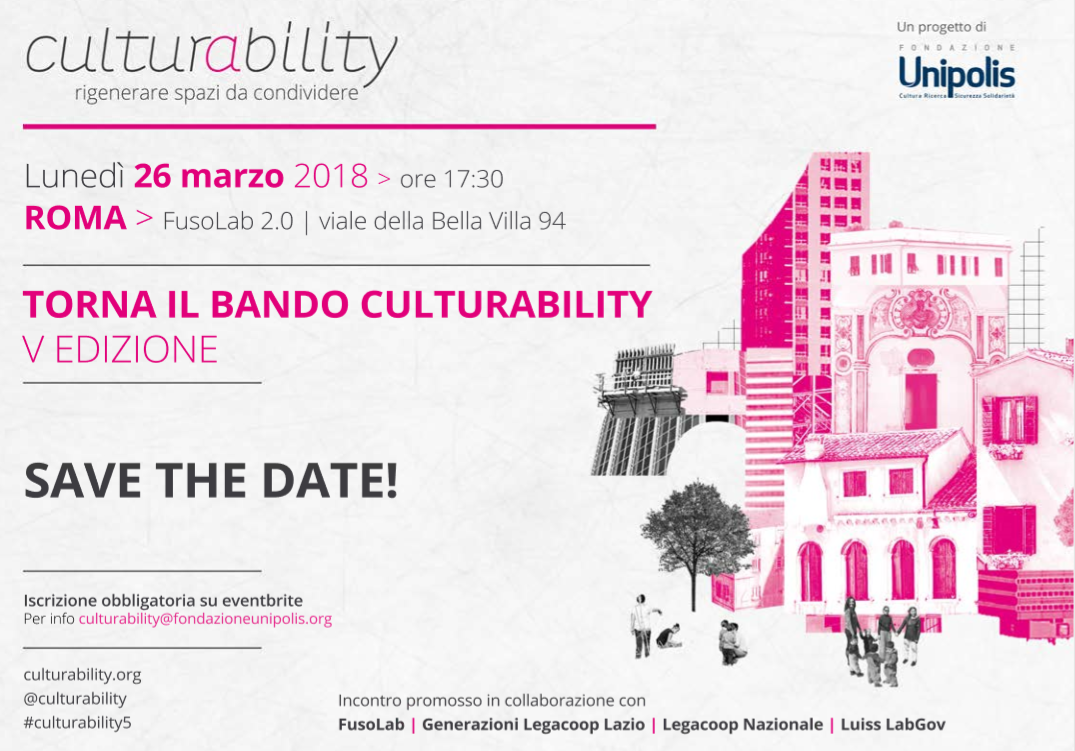
Culturability – regenerating spaces to share is starting its tour with the aim of presenting the 2018 call promoted by Fondazione Unipolis in ten italian cities.
On Monday, March 26th, at 5.30 PM, the call we be presented in Rome at Fusolab2.0 (Viale della Bella Villa 94, Rome), in collaboration with LabGov – LABoratory for the GOVernance of the City as a Commons and Legacoop Nazionale.
During the event, the participants will be able to go through and deepen all the details of the call and ask question at a general or more specific level. It will also be an occasion to talk about the themes linked to the initiative – culture, social innovation and cohesion, collaboration and sustainability.
Fondazione Unipolis allocates for this call 450.000 euro for innovative cultural projects with a high social impact, aimed at regenerating and giving new life to abandoned spaces, buildings or ex industrial sites. 15 selected projects will have the opportunity of participating to a training path in June and July. In September, an evaluation committee will select between those the 6 finalists, that will receive 50.000 euro each and will continue the mentoring activity. The remaining 150.000 euros will be used to realize the training activities for the teams’ empowerment, for reimburses and support programmes.
Participants must register on Eventbrite to book a seat: http://bit.ly/2FqFKEF.
The call will be open until April, 20th. The call is open for NGO, private entreprises operating in the cultural field and informal teams with a majority of under 35 members. Projects must be sent online through the dedicated section on the website. For more information, please visit the official website https://culturability.org/
The initiative is in partnership with MIBACT (whose General Direction for Art, Contemporary Architecture and Urban Suburbs makes available economic resources for the sixth winning project, one more respect to the last call), Avanzi/Make a Cube³ and Fondazione Fitzcarraldo.
Culturability sta iniziando il tour 2018 per presentare il suo quinto bando, promosso da Fondazione Unipolis, in in dieci città italiane.
Il 26 marzo alle 17.30 la call sarà presentata a Roma presso Fusolab2.0, in collaborazione con LabGov e Legacoop Nazionale.
Nel corso dell’incontro sarà possibile approfondire tutti i dettagli della call e fare domande di carattere generale o legate alla propria idea. La serata sarà anche un’occasione per confrontarsi sulle tematiche al centro dell’iniziativa – cultura, innovazione e coesione sociale, collaborazione, sostenibilità – assieme agli ospiti presenti.
La Fondazione Unipolis stanzia 450 mila euro per progetti culturali innovativi ad alto impatto sociale finalizzati a rigenerare e dare nuova vita a spazi, edifici, ex siti industriali, abbandonati o sottoutilizzati. Fra le proposte pervenute, ne saranno selezionate 15 che avranno l’opportunità di partecipare a un percorso di formazione nei mesi di giugno e luglio. Tra queste, nel mese di settembre, una Commissione di Valutazione selezionerà i 6 progetti finalisti che riceveranno 50 mila euro ciascuno e continueranno l’attività di accompagnamento e mentoring. Gli altri 150 mila euro stanziati saranno utilizzati per realizzare le attività di formazione e accompagnamento per l’empowerment dei team, rimborsi spese per partecipare ai programmi di supporto.
Iscrizione obbligatoria su eventbrite a questo link: http://bit.ly/2FqFKEF
La call è aperta dal 22 febbraio alle ore 13 del 20 aprile 2018. Al bando possono partecipare organizzazioni no profit, imprese private che operano in campo culturale ricercando un impatto sociale e team informali con prevalenza di under 35. I progetti dovranno essere inviati online tramite la sezione dedicata del sito Culturability.
L’iniziativa si avvale della collaborazione del MIBACT (la cui Direzione Generale Arte e Architettura Contemporanee e Periferie Urbane ha messo a disposizione le risorse economiche per finanziare un sesto progetto vincitore, uno in più rispetto allo scroso anno), e della partnership con Avanzi/Make a Cube³ e Fondazione Fitzcarraldo.

by Chiara De Angelis | Feb 21, 2018 | The Urban Media Lab
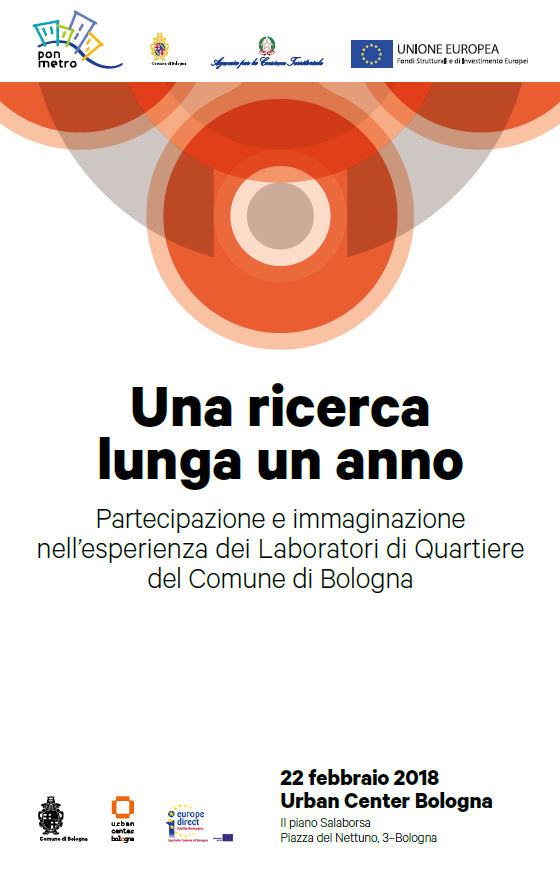
On Thursday, February 22nd, the Bologna Urban Center is going to host the seminary “A one-year-long research: participation and imagination in the experience of Bologna’s Disctrict Labs“, organized by Ces.co.com in collaboration with Bologna Urban Center and Bologna Municipality,
During the seminary experts, local administrators and academics will show the achieved results and will open a debate on social innovation, urban regeneration, participatory democracy and community entrepreneurship: an asset of themes that are crossing the bolognese experience through the hard work of Civic Imagination.
The seminary will end with a focus on the involvement of migrant citizens, with the aim of thinking about new methods of active citizenship.
The event will start with an institutional welcome from Matteo Lepore (Comune di Bologna) and Mirko degli Espositi (Bologna University).
The first session will be conducted by Roberta Paltrinieri (Ces.co.com, Università di Bologna) and will host contributions from Giovanni Allegretti (Università di Coimbra, Portogallo), Andrea Boeri (Università di Bologna), Christian Iaione (LUISS-LabGov’s co-founder), Vincenza Pellegrino (Università di Parma). Conclusions by Giovanni Ginocchini (Urban Center Bologna).
The second session will be introducted by Lucia Fresa (Comune di Bologna), will be conducted by Giulia Allegrini (Alma Mater Studiorum – Università di Bologna), Bernardo Venturi (Agenzia per il Peacebuiliding) and will host contributions by Pierluigi Musarò (Alma Mater Studiorum – Università di Bologna), Stefania Paolazzi (URBAN CENTER BOLOGNA). Conclusions by Dino Cocchianella (Comune di Bologna Iperbole Rete Civica)
The full program is available here: http://www.urbancenterbologna.it/42-urbancenter/1679-una-ricerca-lunga-un-anno-partecipazione-e-immaginazione-nell-esperienza-dei-laboratori-di-quartiere-del-comune-di-bologna
Giovedì 22 febbraio 2018 dalle ore 10.15 la sala Atelier dell’Urban Center di Bologna ospiterà il seminario “Una ricerca lunga un anno. Partecipazione e immaginazione nell’esperienza dei Laboratori di Quartiere del Comune di Bologna”

by Chiara De Angelis | Feb 21, 2018 | The Urban Media Lab
On Thursday, February 22nd, and Friday 23rd, the Sapienza University of Rome is going to host “Smart Park a Centocelle“: two days of workshop all dedicated to the Centocelle Archeological Park, an area that is currently hosting an experimental project of urban regeneration from a “Smart” perspective, conducted by ENEA in collaboration with LUISS LabGov.
The workshop is organized in the context of the Lab of Environmental Desing from the degree course in Landscape Architecture, coordinated by Prof. Arch. Alessandra Battisti in collaboration with Ing. Mauro Annunziato from ENEA, and will be structured as following:
Thursday, February 22nd
- h 9.00: Institutional Welcome – Prof. Laura Ricci
- Introduction
- Prof. Alessandra Battisti (La Sapienza)
- Ing. Mauro Annunziato (ENEA)
- h 10.00: ENEA’s projects: Smart Cities & Smart Communities – Arch. Claudia Meloni (ENEA)
- h 10.30: Enabling Technologies for Smart Cities – Arch. Sabrina Romano (ENEA)
- h 11.00: Analysis of the urban climate and mitigation scenarios in Piazza dei Mirti – Michele Zinzi (ENEA)
- h 11.30: Co-Cities methodology for urban co-governance – Chiara Prevete and Chiara De Angelis (LabGov)
- h 14.00: workshop
Friday, February 23rd
- h 9.00: workshop
- h 14.30: presentation of the results
- h 16.30: open discussion on the results with LabGov’s co-founder Prof. Christian Iaione and community members
- Conclusions
The full program can be found here: http://www.architettura.uniroma1.it/sites/sf01/files/allegati_notizie/Workshop%20Centocelle.pdf

by Fabiana Bettini | Sep 6, 2017 | The Urban Media Lab

Granby Community Land Trust (Credits © Ronnie Hughes)
In most European countries long-term housing affordability and neighbourhood revitalisation are emerging as crucial concerns in the current housing political and policy agenda. Local authorities in several European cities have started to recognise the importance of supporting and funding collaborative housing projects as a strategy to meet the unsatisfied demand of social housing accommodation and to reinforce community empowerment. In particular, the Community Land Trust model has started to draw the attention of local and national authorities, for it is capable of both ensuring housing affordability and promoting urban regeneration.
As already described in a previous article, Community Land Trust is a membership-based, non-profit organisation chartered to hold and manage land in trust for the benefit of a given community. The main feature of the CLT model is the possibility to realise a split in the ownership of land and improvements. The CLT retains title to the land and permanently removes it from the market, while entering into long-term agreements with prospective low- or moderate-income residents, who become the owners of the improvements. In addition, the existence of a tripartite board of directors, which includes representatives of residents, members of the CLT community, and members of the public, ensure a democratic governance of the CLT.
In the United States, CLTs have a long history. One of the oldest and most acclaimed CLT in the US, the Dudley Street Neighborhood Initiative in Boston, dates back to 1984, and hundreds of others have been built throughout the country since then. Recently, the New York City Department of Housing Preservation and Development (HPD) has issued a Request for Expressions of Interest (RFEI) to identify qualified groups who are interested in forming a CLT, thus showing an increased attention by local policymakers.
In Europe, the CLT model has already gained recognition in several countries, both at a grassroots and legal level, often in collaboration with local or central governments. This is the case for England and Wales, where the Housing & Regeneration Act 2008 has legally recognised CLT and defined it as a corporate body whose main goal is to acquire and manage land for the benefit of the local community[1]. Following the formal introduction of CLT into the English legal landscape, a National CLT Network was established in 2010 and it then became an officially registered charity in 2014. The Network “provides funding, resources, training and advice for CLTs and works with Government, local authorities, lenders and funders to establish the best conditions for CLTs to grow and flourish”[2]. According to the National CLT Network, there are almost 70 CLTs in England and Wales, although the level of accomplishment of the projects varies substantially. Among them, the London CLT dates back to 2007 and is probably the most renowned and iconic example of CLT in England.
 CLT projects in England and Wales (Credit © National CLT Network)
Although the implementation of the CLT model is recent, a supportive political agenda, the lobbying by the CLT network, and a property law tradition that is common to the UK and the US, have helped it to take roots and flourish throughout England and Wales.
By contrast, the implementation of the CLT model in civil law countries has been less straightforward. Despite a considerable amount of support from grassroots movements, a different conception of property law and the consequent absence of proper legal structures for CLT have slowed down its process of recognition. Among civil law countries, Belgium has offered the first example of implementation of a CLT in continental Europe. The Ecluse project in Brussels, inaugurated in September 2015, is the outcome of an intense collaboration and exchange between local associations, citizens, and the Brussels government. In particular, the strong support by the Brussels government and the legal recognition of the CLT Bruxelles (CLTB) in the Brussels Housing Code in 2012 (as a non-profit association and a public utility foundation) represented the crucial stage for the implementation of the CLT model in the region[3]. In particular, in the framework of the Alliance Habitat regional governmental plan for increasing the social housing stock, the Brussels government have allocated 2 million euros per year to CLTB for the 2014-2017 period. Actually, in addition to L’Ecluse project, CLTB has planned to complete three other projects (Arc-en-Ciel, Le Nid, and Lumière du Nord) by the end of 2018, while three more have just got started in the past few years (Rue Liedts, Transvaal, and Tivoli). Three other projects are currently under study and evaluation.
 CLT projects in Brussels (Credits © Community Land Trust Bruxelles – Brussel)
In the wake of the successful implementation of CLTs in England and Brussels, the interest for the CLT model has risen in France. At the end of 2013, the association Community Land Trust France “Pour un foncier solidaire” was created to promote the principles and values of CLT, and to adapt them to the French context, while at the same time increasing awareness among groups and landowners[4]. Since then, CLT France has regularly taken part in the working group headed by the Ministère du logement et de l’habitat, and contributed to the adoption of new legal structures to implement CLT in France.
 (Credits © Community Land Trust France – Pour un foncier solidaire)
On the basis of the results of this consultation phase, the Loi ALUR 2014 introduced the Organismes de foncier solidaire (OFS) in the Code de l’urbanisme[5]. OFS are non-profit organisms whose activity is totally or partially devoted to the acquisition and management of improved or unimproved building land, and whose main goal is to provide affordable collective housing and related services to be rented out or sold to income-qualified people. Since the main feature of the OFS, which are based on the CLT model, is a split in the ownership of land and improvements, the adoption of a new type of lease was supported by CLTF, and finally approved by an ordonnance in July 2016[6]. The legal discipline of the bail reel solidaire (BRS), which is meant to be primarily used by the OFS, is now included in the Code de la construction et de l’habitation (CCH)[7]. Very recently, a series of decrees have provided a more detailed regulatory framework for the practical operation of OFS[8] and BRS[9], so removing the remaining obstacles to the implementation of CLT in France. Following these substantial changes in the French legal landscape, CLT projects are likely to flourish in the coming years.
References
[1] More precisely, CLT is defined in Part 2, Chapter 1 of the Housing and Regeneration Act 2008 (c. 17).
[2] http://www.communitylandtrusts.org.uk/about-the-network/what-we-do.
[3] https://communitylandtrust.wordpress.com/notre-histoire/
[4] Cfr the press release issued after the association was created, available at http://www.communitylandtrust.fr/clt-en-france–c1/creation-de-l-association-clt-france–66
[5] Cfr article L. 329-1, Code de l’urbanisme.
[6] Ordonnance n° 2016-985 du 20 juillet 2016, art 1er-2°.
[7] CCH, articles L. 255-1 to L. 255-19.
[8] Cfr Décret n°2016-1215 du 12 septembre 2016 and décret n°2017-1037 du 10 mai 2017.
[9] Cfr Décret n° 2017-1038 du 10 mai 2017.
Nell’ultimo decennio il modello americano del Community Land Trust ha attecchito e si è diffuso in numerosi paesi europei grazie all’introduzione di nuovi strumenti giuridici, al supporto delle associazioni CLT e al finanziamento dei governi locali e centrali. In Inghilterra e in Galles, dove il CLT è stato introdotto nell’Housing and Regeneration Act 2008, si contano circa 70 progetti coordinati da un forte network nazionale. In Belgio, nella regione di Bruxelles, l’associazione CLT Bruxelles ha ottenuto cospicui finanziamenti dal governo locale e può vantare la realizzazione del primo CLT dell’Europa continentale, oltre a una decina di ulteriori progetti in fase di completamento e di studio. In Francia, grazie alle pressioni esercitate dall’associazione CLT France, una serie di importanti riforme ha recentemente introdotto nuovi strumenti giuridici, quali organismes de foncier solidaire e bail réel solidaire, che mirano a facilitare l’introduzione del modello.


