
In a remote coastal village in Tunisia, a group of women farmers is revitalizing barren land by combining traditional water management techniques with solar-powered drip irrigation.
In a dry valley in Ghana, young agricultural entrepreneurs are using mobile apps to connect producers with nearby markets, bypassing inefficient distribution systems and bureaucratic obstacles. Across the Afro-Mediterranean region, innovation is emerging as a vital resource, developed from within the communities rather than imposed from outside.
These stories are not isolated incidents; they reflect a new approach to experimentation in response to climate disruption.
Innovation is not always born in labs or boardrooms. Sometimes, it grows from dry soil, whispered through community radio, and irrigated by tradition.
Regulatory voids as a space for experimentation and innovation for sustainability
Much of the global development conversation focuses on scaling solutions. But what if the real opportunity lies in scaling the conditions that allow local experimentation to emerge?
In our forthcoming paper, “From Gap to Opportunity: Regulatory Voids as Spaces for Experimentation and Innovation for Sustainability” (IJPL Special Issue, expected publication in fall 2025), co-authored with Dr Anna Berti Suman and Adaeze Oluchi Ashaheme, we explore this argument.
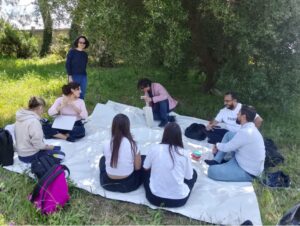
Instead of viewing regulatory voids as failures of governance, we see them as opportunities for experimentation. In these unregulated or poorly regulated areas, communities, innovators, and civil society actors can develop new models of sustainability.
A regulatory void is not a vacuum; it’s an invitation to imagine something different.
Especially in rural or climate-affected regions, these gaps provide the space for new legal, economic, and technological practices to emerge. These innovations can be community-driven and tailored to local ecosystems.
Collective Entrepreneurship in Action
One driver of this transformation is collective entrepreneurship – not the lone innovator myth, but groups of actors pooling resources, knowledge, and legitimacy to co-create solutions.
In southern Italy, farming cooperatives are turning unused land into biodiverse food forests.
In northern Kenya, communities are co-developing livestock insurance platforms with tech partners.
In Lebanon, informal seed networks are rebuilding local food systems amid state collapse.
These are not pilot projects; they are governance experiments. They are thriving not despite weak regulation, but because of the freedom it offers.
Innovation as a Right
The proposed idea of “right to innovate through experimentalism”, a concept that democratises innovation and moves beyond access to participation.
Innovation should not remain the privilege of Silicon Valley or formal R&D labs. Vulnerable communities must have the agency to define problems, prototype solutions, and help shape the very rules that govern innovation.
This involves access to funding and infrastructure, participatory legal and policy design, and recognition of non-Western knowledge systems.
A truly just innovation system includes the wisdom of the margins.
DFIs Need to Step Up?
Turning grassroots experimentation into systemic transformation requires allies and strategic engagement from key institutions.
Development Finance Institutions (DFIs) need to step up and start funding early-stage, community-led experiments, not only scalable ventures.
International organisations like the Food and Agriculture Organisation, the International Fund for Agricultural Development, and the World Food Program may embed experimental governance into climate adaptation and food security programs. They could also push national policymakers to build adaptive legal frameworks that enable safe, inclusive experimentation.
Universities and research labs should play a decisive role by technically supporting and training local entrepreneurs in these field experiments on technological, economic, legal and policy aspects.
What Comes Next?
As LabGov tries to demonstrate theoretically, empirically and practically, innovation is a critical tool for co-governance building and benefit-sharing development. It focuses on supporting regulatory experimentation in the fields of food, water, and energy nexus to tackle the climate transition in a just and democratic way.
Furthermore, innovation needs to be the result of the cooperation of multi-stakeholder partnerships across different geographical areas and to transform academic insights into practical tools for community-led development.
Innovation is the result of a co-creation process, and benefits must be shared among all those who participate in the co-creation.
The future of development is polycentric. It’s going to be more and more the result of co-governance building for sustainable innovation, local ecosystems and regulatory experimentalism that will empower vulnerable individuals, social groups and communities. This is already happening in too-long-forgotten corners of the world.