
by Ornella Martinello | Jul 22, 2016 | The Urban Media Lab
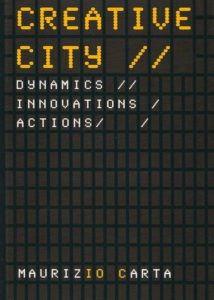 Maurizio Carta, Architect, PhD in Urban and Regional Planning, Full Professor of urban and regional planning at the Department of Architecture at the University of Palermo and advisor for a number of public national and international bodies, is the author of “Creative City – Dynamics, Innovations and Actions“. In his work, Carta tries to condensate his studies on urban regenation based on culture, innovation and creativity. The result is a review of the most innovative processes of urban regeneration undertaken across Europe, an “atlas of urban, landscape and architectural projects”.
Evocative and inspiring is the quote by Irish playwright George Bernard Shaw which the author decided to open the book with:
“Some men see thing as they are and say, ‘Why?’. I dream of thing that never were and say, ‘Why not?'”
Admittedly, the book is the outcome of a “trip” across current best and most innovative urban practices and a hopeful insight into the future of territorial bounds, communities and cities. The wide set of maps, data and figures that complement the analysis not only helps to better figure out how cities are evolving nowadays in Europe; they also give a strong evidence of the fact that the future will undeniably lie in a kind of city that is creative, culture-oriented and sustainable. In Carta’s words:
“The city of the future will be a city of culture, a city generating new culture: the creative cities of the twenty-first century will be capable of competing on the international scenario by optimizing and promoting their own individual cultural identities, attracting a class of creative and generating new sustainable futures.”
The author concisely depicts the world of the future. But he also gives us the instruments we need to build it, or, as he defines them, the “four keywords” which the “creative city manifesto” is based on and which should guild city-makers:
– VISION, the city of the future is forward-looking;
– MISSION, the city of the future is responsible towards its citizens and their needs;
– OUTPUT, the city of the future is productive and effective;
– FUTURE, the city of the future is culturally and environmentally sustainable, able to enhance its citizens’ wellbeing without compromising future generations’ one.
As a matter of fact, these concepts recur repeatedly throughout all the three parts which the book is divided, namely:
I – Creative cities: an Action-Oriented Manifesto;
II – Towards a new polycentric competitiveness;
III – The fluid city – experiments in 13 cities around Europe.
What markedly emerges from the review of those 13 citites (Amsterdam, Barcelona, Bilbao, Bordeaux, Genova, Hamburg, Lyon, Lisboa, Marseille, Newcastle, Palermo, Rotterdam, and Valencia) is a call to act now in order to make our future richer. As Carta puts it, “the twenty-first century is without doubt set to be the ‘age of cities'”. The present and future lie in the local dimension. That is where territorial specificities are respected and promoted and where new forms of political participation can be experimented.
In order to make our cities “desirable places to inhabit”, we cannot but recognize the crucial role governance plays in determining the quality of the outcomes of urban regeneration and how working on ownership, inclusiveness, participatory practices and cooperation leads to a better and long-lasting enhancement of the local dimension, re-building a sense of citizenship through culture and knowledge.
—
Il famoso drammaturgo irlandese George Bernard Shaw scrisse: “Vedi cose che esistono e ti chiedi “perché”? Ma io sogno cose non ancora esistite e chiedo “perché no”?”.
Attraverso una rassegna dei progetti più creativi ed innovativi messi in atto in 13 città europee, l’architetto italiano esperto di rigenerazione urbana Maurizio Carta traccia i contorni della città del futuro: visionaria, produttiva, sostenibile, creativa.
by Ornella Martinello | Jul 11, 2016 | The Urban Media Lab
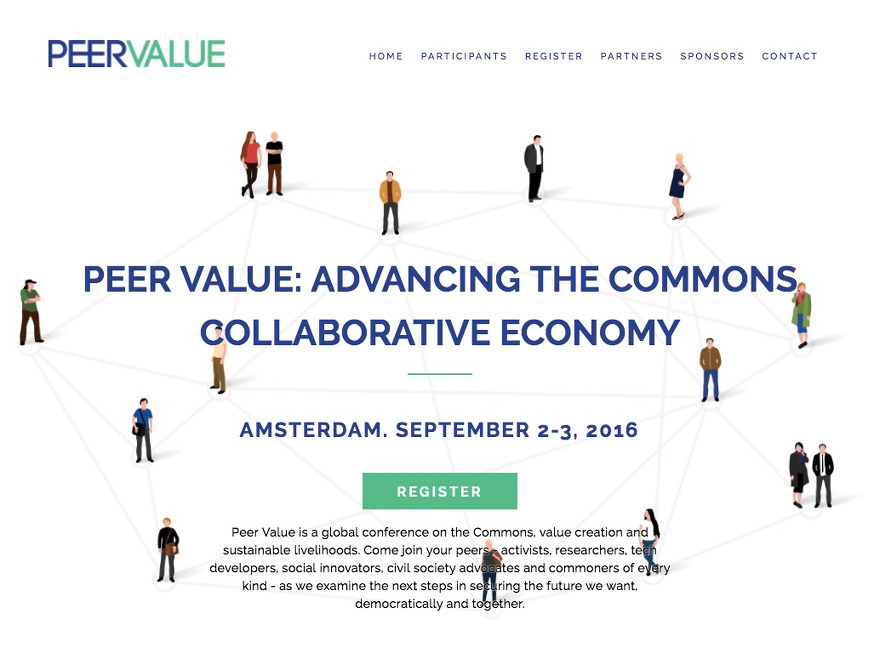
Join LabGov in Amsterdam at the “Peer Value: Advancing the Commons Collaborative Economy” Conference.
The event will take place next September 2-3, 2016, hosted by the city of Amsterdam, in collaboration with P2P Value, Wikimedia, CSG, Shareable and Ouishare. Its aim is to address the world of the commons on a global scale, to share ideas and offer innovative insights through a mixture of conversations and action plans.
 The event will cover three broad topics:
- P2P: Inclusive Politics, Activism and Law for the Commons;
- Decentralized Tech and Beyond: Global Design, Local Production;
- From Platform to Open Cooperativism.
Participants will offer ground-breaking viable solutions trying to answer to the following question in an open debate:
- What are the conditions that encourage communities to work as peers, creating commons?
- What are the best practices communities can adopt to safeguard their resilience?
- Decentralization – why is it important, and how is it implemented and maintained?
- How can the working methodologies honed by well-established digital communities act as transitional guidelines for sustainable “material” manufacturing?
- What about social innovation and livelihoods – how does contributory and open accounting work with the systems of value creation found in CBPP?
- How can civil society participate in recommending policy proposals that support CBPP for governments at the local, regional, national – even global – levels?
Registration are now open via this link.
For further information visit the event website.
Registrati ora alla conferenza “Peer Value: Advancing the Commons Collaborative Economy” e raggiungi LabGov ad Amsterdam i prossimi 2 e 3 settembre! Parleremo di commons, cooperazione e condivisione!

by Ornella Martinello | Jul 4, 2016 | The Urban Media Lab
If we had to name the current crossroad of studies and events about the commons, we could not but think about Utrecht. In the past few weeks, LabGov attended the Symposium “Cooperation in the field” hosted by the city university and IASC dinner debate there. But there is good news: we will walk our road to Utrecht again!
As anticipated in our previous post, IASC dinner debate was the occasion to launch the XVI IASC Biennal Conference, which will take place in Utrecht from the 10th to the 14th of July, 2017.

The event will be jointly hosted by the “Institutions for Collective action” research team of Utrecht University together with the latter’s strategic theme “Institutions for Open Societies” research team.
600 academics, practitioners and stakeholders in the field of the commons, common-pool resources and cooperatives will gather to exchange their idea about the main theme of the conference, i.e. “Practicing the commons: Self-governance, cooperation, and institutional change“.
The event will represent an outstanding chance to meet, expose and connect. Attendants will have the opportunity to share practices and learn from each other’s experiences. They will also have the chance to focus on the developments of common-pool resources and cooperatives in the Netherlands through public events and field trips.
Debates will cover 8 topics:
- Recipes for resilient cooperation
- Issues of exclusion and control in the formation, defense and governance of commons
- The impact of the commons
- Methods and models to study the commons
- Polycentric governance of global resources
- Crisis on the commons?
- Commons and the city
- Corporations, governments and commons
A call for contributions is open until October 15th, 2016 on these topics.
Up to now, three high-level scholars confirmed their presence:
Saskia Sassen, Robert S. Lynd Professor of Sociology and Chair of the Committee on Global Thought, Columbia University.
Juan Camilo Cárdenas, Professor at the Universidad de los Andes in Colombia. The focus of his work lies with the analysis and design of institutions (rules of the game) that promote cooperation among individuals and the solution of social dilemmas in the most fair, efficient, equitable, democratic and sustainable manner possible.
Jane Humphriesk, Professor of Economic History and a Fellow of All Souls College Oxford.
Tine de Moor – IASC President and Full Professor of ‘Institutions for Collective Action in Historical Perspective’ at the Department of Social and Economic History, Utrecht University – explained the importance of this conference and its aim:
With this conference, we aim to consolidate and expand the important work of the IASC on the study of the commons, both in academia as well as ‘in the field’. As previous conferences have shown, commons are important worldwide, both in the present as well as in the past. Especially in Europe, due to the increased privatization of public goods and the impact of the economic crisis over the past few years, commons and other forms of institutions for collective action have received increasing attention from both academia as form society itself; Europe even seems to experience a new ‘wave of collective action’ in virtually every sector of society: new forms of institutions for collective action pop up in energy, care, infrastructure and food (see for example the results of recent surveys by our research team ‘Institutions for Collective Action’).
[..] We intend to demonstrate that the knowledge brought together within the IASC by scholars and practitioners dealing with the commons from developing countries can be a great source of inspiration for current western developments, in terms of resource management.
IASC is waiting for you! Registrations will be open from February 2017.
For further information visit the official event webpage.
Se dovessimo scegliere il centro nevralgico dello scambio di idee, esperienze e buone pratiche in materia di beni comuni, oggi non potremmo non pensare ad Utrecht. Ci siamo stati spesso nelle scorse settimane. Ci torneremo tra il 10 e il 14 luglio del prossimo anno per la sedicesima edizione della Biennal IASC Conference. Si parlerà di commons e cooperazione alla presenza di esperti di alto livello, in una cornice mozzafiato.

by Ornella Martinello | Jun 21, 2016 | The Urban Media Lab
 Next Thursday, June 23rd, Utrecht University will host the Symposium “Cooperation in the field”. It will be the opportunity for international researchers, experts and students to gather and share their respective ideas and practical experiences on cooperative practices. The event is part of the strategic thematic series on “Institutions for Open Societies”.
Professor Tine de Moor, Full Professor ‘Institutions for Collective Action in Historical Perspective’, Department of Social and Economic History, Utrecht University will moderate the sessions.
Among the excellent speakers are:
- Ruth Meinzen-Dick, senior research fellow at IFPRI, coordinator of the CGIAR program on Collective Action and Property Rights (CAPRi) as well as leader of IFPRI’s Gender Task Force, also co-leading work on strengthening women’s assets.
- Marco A. Janssen, professor at the School of Sustainability of Arizona State University and director of the Center for Behavior, Institutions, and the Environment of ASU.
- Hans Groeneveld, Associate Director Cooperative & Control at Rabobank and distinguished professor at TIAS School for Business and Society.
- Wilbert van den Bosch, consultant on cooperatives for NCR, The Dutch Council for Cooperatives.
- Christian Iaione, Associate Professor of Public Law at the University of Guglielmo Marconi studios in Rome , fellow at the Urban Law Center of Fordham University and governance of the commons professor at the LUISS Guido Carli under LabGov – Laboratory program for governance of common goods .
To register click here.
For further information visit the official webpage of the event.
Giovedì 23 Giugno LabGov sarà a Utrecht con il Professor Iaione per parlare di cooperazione e innovazione sociale.

by Ornella Martinello | Jun 14, 2016 | The Urban Media Lab
With adoption of the Amsterdam Pact on May 30th, EU leaders showed their full endorsement of the need to attach considerations at the urban dimension to EU decision-making. As we pointed out in our previous article on the topic (We are already on our way to Amsterdam: Countdown to the new EU Urban Agenda), the Amsterdam Pact aims at enhancing new forms of multilevel cooperation in the management of EU funds in four pilot sectors: housing, air quality, integration of migrants and refugees, urban poverty. The real breakthrough is represented by its working method, which champions partnerships on urban-salient issues across multiple levels of government. It is the symbolic beginning of a new process, signalling how sensitive this issue has become for EU policy-makers. By now, reflecting on citizens’ needs at the urban level has become a cornerstone in EU policy-making. EU institutions are demonstrating their leadership and willingness to dialogue with stakeholders on such topics.
 Brussels has become a hub to share ideas and experiences and to inspire innovative solutions to the most pressing urban challenges. Here, the European Commission will host the 10th edition of the European Development Days, one of the major conferences dedicated to the issue which will be held on 15th and 16th of June. Among the co-organizers are: ALDA European Association for Local Democracy, Smart Villages Initiatives, The Hague Academy for Local Governance, UN-HABITAT, and UCLG, United Cities and Local Governments. The agenda will focus on the status of implementation of the 2030 Agenda and the Sustainable Development Goals. Within the five main themes (People, Planet, Prosperity, Peace, Partnership) a considerable number of parallel sessions will be in fact devoted to urban-related sub-topics: “Inclusive, sustainable and resilient cities”, “Circular economy”, and “Inclusive and peaceful societies”). Here our selection:
15 June 2016
Time to think urban (09.30-10.45)
City-to-city cooperation: Municipal climate partnerships (09.30-10.45)
Move towards sustainable lifestyle for the people and the planet (09.30-10.45)
My city, my right: Towards inclusive and equitable urban spaces for women (14.00-15.30)
Towards a circular economy for sustainable consumption and production (16.00 – 17.30)
Localising the Sustainable Development Goals: Owning the global development agenda (16.00 – 17.15)
New cooperation models for cities in the age of the Sustainable Development Goals (17.45 – 19.00)
16 June 2016
Mobilising innovative finance for resilient and sustainable cities (13.00 – 14.15)
Local action to address fragility and protracted displacement (14.30 – 16.00)
Urban Now: City Life in Congo (14.45 – 16.00)
Most of the sessions will be available online via streaming.
For the complete agenda and further information visit the link.
Con l’adozione del Patto di Amsterdam lo scorso 30 maggio, i leader europei hanno confermato come la dimensione urbana sia ormai elemento cardine per la formulazione di politiche efficaci a più livelli. Il tema sarà uno dei principali discussi durante gli European Development Days che si terranno il 15 e 16 luglio a Bruxelles alla presenza di personalità di spicco, dal Segretario Generale ONU, Ban Ki-Moon al Vice-Presidente della Commissione Europea, Federica Mogherini.

 Maurizio Carta, Architect, PhD in Urban and Regional Planning, Full Professor of urban and regional planning at the Department of Architecture at the University of Palermo and advisor for a number of public national and international bodies, is the author of “Creative City – Dynamics, Innovations and Actions“. In his work, Carta tries to condensate his studies on urban regenation based on culture, innovation and creativity. The result is a review of the most innovative processes of urban regeneration undertaken across Europe, an “atlas of urban, landscape and architectural projects”.

