by Maria Elena Santagati | Dec 3, 2015 | The Urban Media Lab

In 2015 the famous initiative of European Capitals of Culture celebrates its 30th anniversary!
Conceived by the Greek Ministry of Culture Melina Mercouri in 1983, this European action has evolved over the years, becoming an international festive event but also an important opportunity to promote local and regional development.
The importance of citizenship dimension has emerged over time and it is highlighted also by Decision No 445/2014/Eu of the European Parliament and of the Council of 16 April 2014 establishing a Union action for the European Capitals of Culture for the years 2020 to 2033 and repealing Decision No 1622/2006/EC[1], which states that one of ECOC general objectives is “to safeguard and promote the diversity of cultures in Europe and to highlight the common features they share as well as to increase citizens’ sense of belonging to a common cultural area”; among the specific objectives, we could also find “to widen access to and participation in culture”.
The involvement of citizens has thus become a crucial issue in the ECOC project, in terms of local political commitment, audiences and participants engagement, volunteering, activities for specific target groups. That is more and more encouraging “a stronger commitment towards more closely-defined and locally-sensitive vision statements”[2].
Therefore, balancing local, European and international dimensions is a central challenge for the European Capitals of Culture candidacy process, which should also foster a wide range of impacts, among which the social ones related to public engagement and impacts on individuals and communities.
As a matter of fact, “City and citizens” is one of the two evaluation criteria (the other one is the European Dimension), since the cultural programme should foster the participation of citizens (living in the city, in its surroundings and abroad) as well as be a part of a long term development strategy.
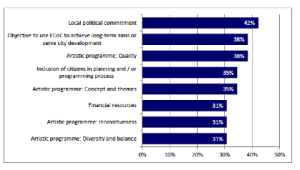
As figure 1 shows, local political commitment and the inclusion of citizens in planning and/or programming process appeared to be among the most important strengths of successful bids in 2001-2012 period.
Figure 1: % of successful bid cities demonstrating particular strengths (2001-2012)
Source: European Capitals of culture: success strategies and long term effects, European Union, 2013[3]
To this end, among the most successful examples we could mention the most recent Capitals such as Marseille 2013, which ensured a high level of citizens’ involvement, who could also co-create cultural events, Kosice 2013, Riga 2014 but also Liverpool 2008, Linz 2009, Essen for the Rhur 2009, Pecs 2010, Turku 2011, Tallinn 2011.
For the new 2020-2033 period, candidate cities should ensure that ECOC is included in a wider cultural strategy able to produce a sustainable legacy at cultural, social and economic level. The citizenship dimension has been strengthened and included in the “outreach” category. According to already mentioned Decision No 445/2014/Eu, the following factors shall be assessed for this purpose:
(a) the involvement of the local population and civil society in the preparation of the application and the implementation of the action;
(b) the creation of new and sustainable opportunities for a wide range of citizens to attend or participate in cultural activities, in particular young people, volunteers and the marginalised and disadvantaged, including minorities, with special attention being given to persons with disabilities and the elderly as regards the accessibility of those activities;
(c) the overall strategy for audience development, and in particular the link with education and the participation of schools.
[1] http://eur-lex.europa.eu/legal-content/EN/TXT/?uri=uriserv:OJ.L_.2014.132.01.0001.01.ENG
[2] http://ec.europa.eu/programmes/creative-europe/actions/documents/30-years-brochure_en.pdf
[3] http://www.europarl.europa.eu/RegData/etudes/etudes/join/2013/513985/IPOL-CULT_ET%282013%29513985_EN.pdf

by Maria Elena Santagati | Oct 30, 2015 | The Urban Media Lab

Co-creation, cooperation, participatory governance, cross-fertilization, audience development, etc. are key issues on the current debate on cultural policy and management. In this field, participation can take many forms at different levels, such as policy formulation and implementation, management, production and artistic creation. A wide range of projects, documents and practices illustrate an important shift in the role of citizens, consumers, communities and spectators in this field.
Ecology of culture: community engagement, co-creation and cross-fertilization was the title of the 23rd annual conference of ENCATC-European network of cultural administration training centres, which took place in Lecce on 21-23 October 2015. The keynote speaker John Holden, Visiting Professor at City University of London and Honorary Professor, University of Hong Kong, presented his report on the ecology of culture, entitled “the complex interdependencies that shape the demand for and production of arts and cultural offerings” (Markussen, 2011). According to him, culture should be analysed from an ecological point of view, as an eco-system rather than a simple economic sector. Discussions, exchanges and papers of young researchers from 34 different countries clearly show how participation is becoming a crucial issue in many ongoing practices in the cultural sector, and indicates that this requires further analysis.
At the European level, some key documents and projects point out this new participatory trend.
The Council conclusions on the participatory governance of cultural heritage (2014) constitute an important recognition of cultural heritage as a “shared resource” and of participatory governance as an opportunity “to foster democratic participation, sustainability and social cohesion and to face the social, political and demographic challenges of today”.
An interesting Mapping of practices in the EU Member States on Participatory governance of cultural heritage has also been conducted and published in June 2015 by the EENC-European Expert Network on Culture, in the context of the OMC Working groups on cultural heritage established by the Work Plan for culture 2015-2018. A variety of case studies concerning participatory practices from different European countries has been analyzed, including both top-down and bottom-up projects. Among these are the Italian project of CO-Bologna, Cities as common goods by LabGov, and the Italian case of La Paranza, an experience of participatory governance of the Paleochristian Catacombs in the city of Naples, by a group of young people from Rione Sanità, a disadvantaged neighbourhood in the city centre.
At the same time, many European projects are experimenting with news forms of participation. For example, ADESTE– Audience DEveloper: Skills and Training in Europe aims to develop new kinds of relationships with citizens, through the new profile of “Audience developer” in the fields of arts and culture. Or the project BeSpectACTive! promotes the active involvement of spectators in the contemporary performing arts. Two other interesting projects focus on the communities in the field of archaeology (NEARCH project) or museums (Creative museum).
In Italy, an interesting discussion on the topic of participatory governance of cultural heritage took place during ArtLab, Fondazione Fitzcarraldo’s annual meeting on cultural management (Lecce, 23-26 September 2015) in a dedicated session, where prof. Christian Iaione, LabGov coordinator, focused on the fundamental requirements for participatory governance.
Beyond rhetoric, real challenges are linked to the effectiveness of participation practices in the cultural field in terms of democratization, empowerment, capabilities development and, of course, sustainability. Experiment in progress, stay tuned!
———————————————————————————————
Il 21-23 Ottobre si è tenuta a Lecce la 23° conferenza dell’ENCATC “European network of cultural administration training centers. Il titolo della conferenza “Ecology of culture: community engagement, co-creation and cross-fertilzation” è in linea che con i nuovi progetti di politiche pubbliche che comprendono e considerano il cittadino parte attiva della società.
A livello Europeo sono tanti i progetti che si stanno sviluppando in questa direzione come Co-Bologna di Labgov, il progetto BeSpectACTive, and ADESTE.

