
by Alessandra Feola | Apr 3, 2014 | Luiss LabGov 2013-2014

MEETING MINUTES, March, 14th 2014
The meeting was held at LUISS Guido Carli University and hosts Dino Amenduni, New Media consultant of Proforma (www.proformaweb.it), a political communication Agency from Bari. He also writes a blog for Finegil-Gruppo Espresso and he is also a social media marketing and political communication trainer (www.slideshare.net/doonie).
14.00 – 15.15 – Presentation
15.15 – 16.15 Simulation
16.15 – 16.45 Brainstorming
PRESENTATION
“The end of the world is when we stop having trust” (Madeleine Quellette Michalska).
Dino Amenduni showed Censis Data on Italians’ media diet (data on who votes, how we votes, our sources of information). From 2007 to 2013 the percentage of Italians watching TV has increased, with a current average of more than 4 hours a day (we can speak about a real television dependence).
On the contrary there was a decrease of almost all newspapers’ readers and at this decrease in number does not correspond an increase of views on news websites. Where are the readers gone? The answer is “on social networks”. Therefore it becomes essential for senders to know how to communicate effectively and directly on social networks because, differently from the press, in them there is no intermediation.
Furthermore, Censis Data shows that exist a digital divide but also a press divide, which is the divide between people that have never stopped reading newspapers and people that have never read one. Italians who read newspapers are usually over 65 years old and this data must be considered when we chose the way we are going to communicate during the electoral campaign. About 37 million people today use the internet. In this scenario, it is possible to speak about digital natives (those who are born in the internet era), digital adults (those who experienced the birth of the internet) and predigitals (those who didn’t experience the digital era or do not accept it). Nowadays organizing a campaign only on a single communication level it’s unthinkable: a lot of young people use the Internet to keep informed, whereas mature people still read newspapers.
What the Italians do with the Internet? They look for information, watch movies, buy items, carry out civic activities (less frequently). The number of Italians looking for information through the web is increasing. What does this imply? Why the digital age causes difficulties for the printed newspaper? The main risk for newspapers is the loss of readers caused by the fact that they can be anachronistic, like in the case of the Costa Concordia. The recovery of the cruise ship finished at 4:30 a.m and, while the new media covered it in real time, the newspapers were 24 hours late.
Consequences of newspaper sales plummeting consist in a loss of jobs for journalists and a decreased of the possibility to do investigative journalism. Moreover, there is not a corresponding increase in online newspapers readers. So, the role of social networks is now crucial because:
– readers of online articles are directly proportional to the advertisement of the piece on the social networks;
– if online articles are not competitive, they lose readers;
– readers are attracted by emotional approaches: web journalists need to exploit this feature in order not to lose readers.
The concept of information on Facebook is variable, the sources are out of user’s reach and this implies that authoritative contents and gossip can have the same space. The importance of Twitter is less that Facebook one: twitter has 1/6 of users of the ones of Facebook. In other countries differences are far less sensible. In Italy Facebook has primarily a ‘communication’ purpose; Twitter a ‘relationship’ one. Twitter is more used when you want to communicate to elites (politician and journalists) and consequently you want to reach traditional media, whereas Facebook is more used to establish a direct contact with a much wider audience without intermediation.
Significant online interaction BUGS:
– Online reputation is important
– You have to consider young/adult divide
– Functional analphabetism: among OCSE member states, Italy is the country with the highest number of functional analphabets (twice the number of the state in second position)
Case study: Greenpeace
The strength point of Greenpeace actions is that it has no permanent allies or enemies and it has two important consequences: independence and equidistance.
Greenpeace’s most important campaigns are:
– KitKat advertising;
– Save the Artic;
– Fashion duel;
– Io non vi voto (I don’t vote for you);
– Greenpeace vs. Enel (Brindisi)
Considering the first one advertising, the campaign shows a well known Nestlé’s product, the KitKat. Through a very strong and ironic language the campaign is able to communicate the damage that the production of such goods implies, that is the deforestation in Indonesia. Nestlè’s request of removing the video produced the so-called Streisand effect: the effect was contrary to the intentions of the company because in this way an increasing number of people have watched the video due to the fact that was “prohibited”.
SIMULATION
The aim of the simulation was to organize in groups a communication campaign to publicize the Regulation of Bologna between citizens and Public Administration.
GROUP I
Proposal: The first group proposed a communication campaign based on a video and some posters that rise awareness on cooperation between citizens and Public Administration publicizing a contest of ideas about the regeneration of the commons. #comepossoesserciutile? (#howcanIhelpme?)
Problems: Dino Amenduni pointed out that is important to coordinate the different channels if there is a single campaign. The campaign should be recognizable even when different communication channels are used so videos posters must make sense even when viewed separately.
GROUP II
Proposal: The second group proposed the campaign “TUTELACURI” based on two different posters, a video and a Facebook campaign: the first with the superposition of commons like a statue with a human body with the aim to humanize culture and to promote the adoption of a city common.
Problems: Amenduni pointed out the difficulties of the difficulty of carrying out a campaign on too many media with too different languages. The risk is to confuse people who could be not able to attribute them to the same campaign.
GROUP III
Proposal: Masterchef (“this cannot be eaten” – “this is unlivable”). The campaign was based on posters that compare food, something familiar to all, to culture and common goods. The aim was to highlight how food, that no one would want to eat, must be similar to degraded commons that anyone would like to live or have.
GROUP IV
Proposal: ReinventiAMO Bologna
Problems: not fully developed, the idea must be completed with some other elements.
GROUP V
Proposal: LetuemaniperBologna (YourHandsForBologna) Main Slogan + Specific Slogan.
Problems: the message must be more easily understood and there must be a description of the common.
GROUP VI
Problems: need for efficacy increase, the commons must be allocated, the length of the campaign must be expanded.
SIMULATION CONCLUSION
INSTRUCTIONS FOR USE: a message is more easily understood through simple and frequent words and you can not base a campaign only on negative aspects or on what does not work: the positive effects of the proposed activity must be always underscored.
by Lucia Mosca | Apr 2, 2014 | EducationLabs, Luiss LabGov 2013-2014
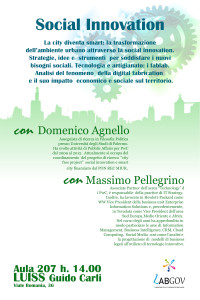 On April 04th 2014, at Luiss – Guido Carli, Viale Romania, 32: Meeting with Domenico Agnello and Massimo Pellegrino
The speakers will talk about Social Innovation: the smart cities. From urban ecosystem to strategies on how satisfying people needs, from FabLab to the social and economic impact of digital fabrications.
Domenico Agnello previously worked for the Pubblic Affairs area in PwC – PricewaterhouseCoopers. Now he is the coordinator of the research project called “City free project” social innovation and smart city.
Massimo Pellegrino is Associated Partner in the “Technology” area of PwC and he is in charge of practice of IT Strategy.
Labgov is waiting for you!

by Lucia Mosca | Mar 27, 2014 | Luiss LabGov 2013-2014
 MEETING MINUTES, March, 7th 2014
The meeting was held at LUISS Guido Carli, Viale Romania 32. The purpose was to get to know the artist, engineer and hacker Salvatore Iaconesi and Oriana Persico with their andinternet portal available at www.artisopensource.net.
As reported on the homepage, AOS is an international informal network exploring the mutation of human beings with the wide and ubiquitous accessibility and availability of digital technologies and networks.
We move across arts and sciences, using technology, communication, performance, art and design, to instantiate emotional actions and processes that are able to expose the dynamics of our contemporary world.
We do this in academic, artistic, business and activist domains and, actually, we are focused on moving fluidly among each of these spaces. The portal was born in 2013 with a technical, digital and technological intent. We can refer to it also as a multidisciplinary network of interaction among architects, artists or scientists.
Comparison with LabGov: as a matter of fact, the aforementioned laboratory activity is an example of place where “you can do something with talent”. It is an out-and-out principle of (wiki)subsidiarity – shared digital infrastructure.
How do societies change with technology? – The starting axiom is that technologies are omnipresent ; having acknowledged this, we can thus affirm that their change affects inter-individual relationships.
How do we perceive change? – According to Iaconesi, art can be considered as sensor of contemporaneity (a good artist cannot avoid being contemporary, because as a detector he “senses” things from his perspective. Artists = Scientists).
AOS’s point of view – there currently are many criticisms to technology. Specifically, obscurity, incompleteness, ignorance. Example: open data. The main characteristics of these tools should be set as follows:
- Accessibility
- Completeness
- Celerity
- Formality
The four main characteristics should coexist following the principle of transparency. But the bug is very evident: they cannot, right now, exist simultaneously because, for example, completeness and celerity in finding info represent a paradoxical pair!
What is missing from freedom and accessibility? – Desire. This, more than anything else, originates complete knowledge and has a pivotal position among the sharing network.
Field Example: INCAUTIOUS PORN
It is a fake agency aimed at collecting from all pornography websites the comments of the users who left their phone numbers or email addresses. The agency would have then created paintings with those data and sold hem for 50€. In very few weeks, more than 400.000 users tried to access to the info of the website (for 10€) in order to remove their name from the database (for 1000€).
→ in reality it was a scientific research to demonstrate the perception that individuals have of their own privacy and security.
→ the aim of the research was to present a kit of privacy protection to the administrative offices of the White House.
HUMAN ECOSYSTEMS – it is a family of real-time system capturing information from social networks to visualize the human geography of cities, across space, time and relations. We can talk of Human Ecosystems as “compasses” that detect the feelings of the users who interact. They serve as guidance on maps that make us perceive what kind of role everyone is covering at a given moment. It has been identified several role, such as the Influencer, the Hub, the Bridge, the Simple Node.
– ECM1 space – the Cultural Ecosystem of the city of Rome: Space
– ECM1 time – the Cultural Ecosystem of the city of Rome: Time
What is the aim of those ecosystems? – with this modality, you create named places that are places shared by a community, where you create linguistic contexts decoded for the users as a bottom up approach . After the presentation, professor Arena, professor Iaione and the class have been wondering about the effects that an hypothetical human ecosystem could have on the topic of “care of the commons”. Specifically, professor Arena stated that “supposing we are a municipality in which a community takes care of those commons, is it possible to detect who are the leaders and/or the experts – they may or may not coincide, according to the degree of personality and influence on a group”.
Professor Iaione admitted that the open source model that seemed so futuristic as a mean of interaction is instead at disposal of every national and international position, except citizens that as first users of the service are totally unaware!
Finally Salvatore Iaconesi presented a model of shared activity, focusing on the LAB, an out-and-out knowledge incubator to
– learn how to communicate
– learn how to do (urban) research
– learn how to use the model as an art catalyzer
– learn how to cooperate
– learn how to organize.
To make the model real are necessary three subject of actuation:
– local administration (public subject)
– research (guarantee of the public space)
– museum (LAB – universities with a territorial interest).

by Lucia Mosca | Mar 11, 2014 | EducationLabs, Luiss LabGov 2013-2014

March 14st 2014, at Luiss – Guido Carli, Viale Romania, 32: Meeting whit Dino Amenduni
Dino Amenduni is new media Manager and consultant on political comunication for Proforma Agency.
He collaborates with the local newspaper of Espresso Group and with Bari’s Repubblica.
Amenduni worked for political campaign of Michele Emiliano (2009), Nichi Vendola (2010), Debora Serracchiani (2013) and Matteo Renzi (2013). He is a volunteer in International Festival of Journalism in Perugia.
Labgov is waiting for you!

by Lucia Mosca | Mar 8, 2014 | Luiss LabGov 2013-2014
 MEETING MINUTES, FEBRUARY 28th 2014
The second meeting of the new cycle of seminars of LabGov was held at LUISS – Guido Carli, Viale Romania, 32. The agenda focused on the presentation of the “Regulation on collaboration between citizens and the Administration for the care and regeneration of urban commons”, presented on February 22nd in Bologna. Prof. Gregorio Arena, President of Labsus – Laboratory for subsidiarity, explained how the Regulation is actually the first case in Italy to incorporate concretely the principle of horizontal subsidiarity, as advocated by Art. 118 of the Italian Constitution.
An initial focus has gone immediately to the question: why a regulation rather than a law? As it is explained, there might be in the near future some sort of regional laws governing such matters; however the risk of the so-called institutional bricolage has to be avoided – which often leads to the limitation of the autonomous initiative, rather than to its promotion. Historically, moreover, the need for intermediate organizations has always been registered in each social system – let’s just think of the Corporations in the Middle Ages, or to the encyclical Quadragesimo Anno issued by Pope Pius XI (1931) which called for the administrative decentralization and for the fragmentation of the services provided by the Public sector.
The discussion then moved on the choice between local administrations and the state administration for what concerns the protection of citizens’ activities: after an exchange of views on this issue, it has come to the conclusion that it is the case for the local government to ensure and support these activities in the first place. It is not only the internal debate at the meeting that suggests us this type of approach to the topic: the jurist Sabino Cassese, at the end of the 80s, noted that the 70% of the total amount of resources used for the functioning of the Italian system is monopolized by the services provided by municipalities; in addition to that, the reform of Title V of the Italian Constitution in 2001 represents a further example of this thesis.
The Municipality of Bologna was taken as an example of the fact that Italy is an incubator of priceless public goods and of cities of rare beauty. Today we live in a time of (re-)discovery of such assets. The arcades of Bologna are a good example: they have all the necessary features to be defined by UNESCO as world heritage, as long as someone decides to take care of their maintenance. To date, only 60 owners in the area were successfully mobilized in this way. Why? Due to lack of information and training. In this respect, Donato Di Memmo, currently Head of Administrative Simplification, Institutional Affairs, Decentralization and Metropolitan Cities in the municipality of Bologna, in the June of last year, ‘put down’ a first but articulated Memorandum of Understanding between citizens and the Administration.
What do we mean by the term ‘administration’? An evergreen distinction (Giannini, 1961): Administration as activity and Administration as organization. When we speak of Administration as an organization, we mean a redundant system – in the sense that it has influence – on the functions and activities of the very same Administration; if the administrative organization is hierarchical, the activities of popular initiative will suffer, because they are perceived as secondary. Instead, Art. 98 par. 1 of the Italian Constitution: ‘Public employees are at the exclusive service of the Nation.’ establish a different concept of Administration. It is possible to highlight three major observations: 1) the meaning of public employees listed above assume a paternalistic meaning – which sees citizens as ‘passive’ subjects in providing care and protection; 2) service is here understood as in the civil servant case of Anglo-Saxon derivation, according to which the public employee can not and must not be in a higher position with respect to the citizens; 3) in the final analysis, the term Nation – and not Republic, as is the case of many other articles of the Italian Constitution – has to be intended not as an aggregation of institutions, but as a defined territory to preserve and defend. Once concluded the debate which covered differences and relations between citizens and the Administration according to the Italian Constitution, as well as in the everyday life, we moved to investigate the Regulation on collaboration between citizens and the Administration for the care and regeneration of urban commons’ specifically, by giving some definitions.
– URBAN COMMONS – are those which, if enriched, enrich all, if impoverished, impoverish all: it is the case of goods that are, tangible, intangible and digital that citizens and the Administration, through participatory and deliberative procedures, acknowledge to be functional to the well-being of individuals and of the collectivity. Pursuant to Art. 118 last paragraph of the Italian Constitution, the citizens share the responsibility with the administration (defined as responsiveness – ability to respond) of the regeneration of these goods in order to improve the collective use;
– MEASURES OF CARE: interventions aimed at the protection, preservation and maintenance of the urban commons to ensure and improve their usability and quality – an element that is reactive and proactive in protecting the urban commons;
– MEASURES OF REGENERATION: interventions aimed at the recovery, transformation and innovation of the commons, as a part of social, economic, technological and environmental processes, broad and integrated, which have an impact on improving the quality of life in the city.
CHAPTER I – GENERAL PROVISIONS contains a series of precise and accurate ‘rules’ to which the regulation is harmonized – namely the Constitution, general rules, municipal statute and local rules – and emphasizes the ultimate purpose of the interaction between citizens and Administration: collaboration. Something that can be easily derived, following three principles of the text: freedom, responsibility, and solidarity.

by Lucia Mosca | Mar 8, 2014 | Luiss LabGov 2013-2014

The first meeting of the new cycle of seminars takes is held at LUISS – Guido Carli, Viale Romania, 32. The agenda focused on the presentation of the new cycle of seminars, terms and conditions for the participation to the new cycle, later followed by the presentation of the working group (organizational framework) and the division into categories (mainly cross-sectional): RESEARCH AND DEVELOPMENT, COMMUNICATION and ORGANIZATION.
Prof. Christian Iaione introduced the main concepts and theoretical tools –the new cycle of seminar will deal with starting from the definition of commons. In economic terms commons different from public goods – which non-excludable and non-rival. Commons are both rival and non excludable. But in political and legal terms they are both public and private goods that need to be preserved to ensure their usability for the wealth of everyone and future generations. More precisely, taking the cue from the book ‘Italy of the Commons’, edited by Gregorio Arena and Christian Iaione, we can intend commons as social things – they have a social function or are the result of social processes; natural and man-made assets – i.e goods that are unique or exceptional in terms of high quality; and also, but not only resources – as soon as they become productive inputs for social processes.
What is the trigger that makes us talk today of common goods and the need to protect them? Over the years there has been a gradual decline in the capacity of production, care, safeguard, regeneration, control and supervision by local institutions and also, in some instances, by private institutions or subjects. The consequence of this regulatory slippage, resulted in the deterioration of commons, material and immaterial assets that are essential to the wealth of individals and communities.
What are the solutions?
STRATEGIES: SPECTRUM:
– PRIVATIZATION
– CENTRALIZATION THROUGH PUBLIC INSTITUTIONS
– COOPERATIVE SELF-ORGANIZATION OF COMMONS
Is there space for a fourth strategy?
Possibility of interaction between community, public and private sector through the so-called principle of horizontal subsidiarity which demands public institutions to favour the autonomous initiative of citizens, single or associated, to carry out activities of general interest.
How do we call it?
LOCAL GOVERNANCE OF THE COMMONS (through formalized rules and public-private-commons partnerships);

