by Chiara De Angelis | Feb 7, 2017 | Storytelling 2016-2017
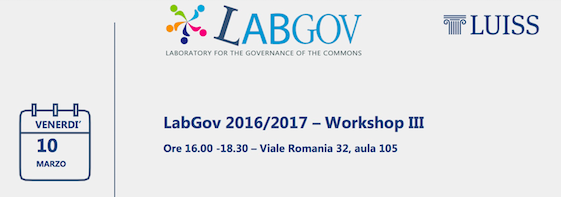
On Friday, March 10th, LabGov EDU 2016/2017 will host in its workshop two experts of commons at an international level: professor Sheila Foster, co-director of the Fordham Urban Law Center and co-founder of LabGov, and Maria Rosaria Marella, professor of private law at Perugia University.
Professor Foster will focus on “The City as a Commons”, the relation between commons and urban context, with a speech on pooling and generating common goods in undeserved neighborhoods, while Professor Marella is going to focus on use and property in urban spaces.
After the two panels, labgovers and LabGov’s experts will have time to discuss with Professor Foster and Professor Marella about the thematics related to urban commons.

Venerdì 10 marzo si terrà il workshop che aprirà la seconda sessione di attività di LabGov Edu. Interverranno due esperte internazionali nell’ambito dei beni comuni, la professoressa Sheila Foster e la professoressa Maria Rosaria Marella.
Sheila Foster è professoressa alla Fordham University e cofondatrice di LabGov; il suo intervento si collocherà nella cornice del percorso di apprendimento che i Labgovers stanno portando avanti sui beni comuni, e in particolare sulla relazione tra il contesto urbano e i beni comuni (“the City as a commons”); la professoressa inoltre racconterà le esperienze di New York in tale ambito. La professoressa Marella, ordinaria di diritto privato all’Università di Perugia, focalizzerà la sua attenzione sui beni comuni come paradigma che va oltre i concetti di pubblico e privato; inoltre parlerà agli studenti dell’uso e della proprietà nello spazio urbano.
Quella del 10 marzo è la prima data della serie di appuntamenti del secondo semestre, che vedrà i LabGovers impegnati in workshop teorici, co-working pratici e attività nel territorio della città. Continua dunque il percorso del Laboratorio nell’università, dopo una prima sessione densa di incontri con esperti di beni comuni, giornalisti urbani, architetti e urbanisti e attività di rigenerazione urbana. Dopo questa data l’appuntamento sarà per la terza sessione di co-working, il 17 e 18 marzo.
by Chiara De Angelis | Nov 14, 2016 | Storytelling 2016-2017
Friday 11th November,2016, the labgovers have taken part in the third session of co-working guided by the advices of professor Paola Santoro.
The session started with the report concerning the on-the-spot- investigations made by the students the 8th and 10th of November at the archaeological park of Centocelle and its surroundings. Their impressions and considerations were different, and this was also due to the fact that some people belonging to associations active in the area appeared to be hostile to the actions of Labgov. Despite these episodes, the students agreed on the fact that there is a clear feeling of uneasiness and resignation regarding the Park and its neighbourhood.
Following this report made by the students, Paola Santoro taught them how to use the Value Proposition Canvas, a tool extremely useful in the field of facilitation of common goods. The following task for the students in fact, was targeting the needs, the fears, the wants and the substitutes connected to the park, and placing them inside the model. Despite the difficulties found in the choice of the best category to fit each concept, the results have been quite similar across the different groups. The session concluded focusing on the activities of the following day, which would have been devoted to find solutions for the many problems of the area.

by Chiara De Angelis | Oct 31, 2016 | Storytelling 2016-2017
After a workshop, an intense session of co-working, and some work on field in the community garden, the labgovers are ready for the second workshop of this year. On Friday, November 4th, from 4 to 6.30 PM, an interesting workshop will be held by Simone D’Antonio, italian journalist and communicator, and responsible for the activities of the Italian URBACT National Dissemination Point.
Simone will focus on the impact that european projects dedicated to the cities, like Urbact, and global initiatives on cities, like Habitat III, have on the new possible narrations of urban phenomena.

Read the report of the first workshop here (September 30th): http://www.labgov.it/2016/10/12/let-the-work-begin/
Read the report of the first co-working session here (October 14th-15th): http://www.labgov.it/2016/10/25/the-heros-journey-projected-in-every-day-life/ and here: http://www.labgov.it/2016/10/25/from-storytelling-to-active-engagement-lets-co-work-together/

by Chiara De Angelis | Oct 5, 2016 | The Urban Media Lab
An other important workshop in Centocelle, in the framework of the CO-Roma project, will be held on Wednesday, October 5th, in the hall of Rome’s V Municipio. The representatives of the various associations active on the territory will meet to discuss the creation of a cooperative of community that reunites all of them to manage together the redevelopment of the PAC (Archeological Park of Centocelle).
The workshop will be held only two days after a meeting (held on Monday, October 3rd) where the representatives of the associations counted themselves and started clarifying the priorities that have to be solved soon. The key focus of the path that we have undertaken together has not changed: the n.1 priority is to bring people back to the park, and to let it become usable again. But in order to achieve this objective, there are two issues that have to be solved soon: ensuring both a safe environment and the restoration of the activities that revolve around the park.
The participants focused around the identification of a small, but complex, action to be developed in a quadrant of the park: an action that could both solve an existing problem and test them as a collaborating team. Once that the quadrant was identified, thanks to the facilitation of Paola Santoro, the team listed the stakeholders that have to be involved in the process and the activities that can be proposed to them.
More info about the CO-Roma project are available here: http://co-roma.it/

by Chiara Fratalia | May 3, 2016 | The Urban Media Lab
 Saturday, May 7th, 2016 from 10:00 to 16:00 the one-day event “Insieme per il bene comune – dalla terra al cielo” will be held in Rome at the “Isola Felice”, garden, next to the Church of St. Felice da Cantalice in the Centocelle district. It is a civic maintenance and urban mending initiative that closes the non-formal education program of LUISS LabGov 2015/2016.
It will be a feast day in the name of civic collaboration, organized by LUISS LabGov together with Associazione 100 e a capo, with the support of Municipio V as part of the Co-Rome process.
During the event, a community garden will be built in the San Felice garden, using materials found and prepared by the students of LUISS LabGov education program.It will be managed by Associazione 100 e a capo, an association of parents and grandparents of the primary school Cecconi in Centocelle that will take care of it within a green space adopted a few months ago and thus subtracted to abandonment and degradation.
There will be creative activities and workshops such as filling the bins to embellish the green area, followed by a walk and/or bike ride within the Centocelle Park.
The goal is to disseminate good practices in order to protect the environment and the beauty of Rome, through the promotion of civic use and care of urban commons. LUISS students, assisted by an interdisciplinary pool of landscapers and street architects, social media managers, lawyers of the community, services designers and triple sustainability experts have also worked on a medium/long-term strategy to generate jobs and solidarity starting from Centocelle commons.
Going outside the university buildings in order to create the first “urban collaborative garden” is just the first step to test new solutions and grow the collaboration between the five top actors at the city level: citizens, institutions, companies, schools and associations.
The new community garden, the first powerful initiative in a suburb in Rome, is just the beginning of a journey that has as an additional objective in leading to the creation of a new institutional form of community for the governance of the commons, which are essential to the well-being of neighborhoods, such as the Centocelle Park.
The new LUISS community garden that symbolizes the “seed” that, beginning from the existing collaborative resources, wants to give birth to a new institutional form of active community that has a chance to give its contribute in re-writing and drawing on a daily basis the rules of social coexistence and urban economic development in the management of services, activities, neighborhoods and city commons, along with public institutions.
The ultimate purpose of the Co-Roma_Roma collabora! – this is the name that LUISS students gave to the whole project – it is to develop, design and test a strategy for the governance of the commons suitable to shape “the city and the territory of Rome as commons.”
Representatives from the University LUISS Guido Carli, local institutions, associations and neighborhood committees will intervene.
For more information write to:
edu@labgov.it
—————————————————————————————————
Sabato 7 Maggio 2016 dalle ore 10:00 alle ore 16:00 si terrà a Roma presso “l’Isola Felice”, giardino attiguo alla Chiesa di San Felice da Cantalice nel quartiere Centocelle, una giornata – evento ‘‘Insieme per il bene comune – dalla terra al cielo”, operazione di manutenzione civica e rammendo urbano conclusiva del programma di educazione non formale LUISS LabGov 2015/2016.
Sarà una giornata di festa all’insegna della collaborazione civica organizzata da Luiss LabGov e Associazione 100 e a capo con il supporto del Municipio V nell’ambito del processo Co-Roma.
Nel corso della giornata verrà costruito nel Giardino San Felice un orto condiviso, con materiali reperiti e preparati dagli studenti del laboratorio educativo Luiss LabGov. L’orto condiviso verrà gestito dall’Associazione 100 e a capo, un’associazione di genitori e nonni della scuola primaria Cecconi di Centocelle, che se ne prenderà cura all’interno di uno spazio verde adottato da qualche mese e sottratto quindi all’abbandono e al degrado.
Si svolgeranno laboratori ludico-creativi come il riempimento dei cassoni per abbellire l’area verde; seguirà una passeggiata a piedi e/o in bicicletta all’interno del Parco di Centocelle.
L’obiettivo è quello di diffondere una buona prassi a tutela dell’ambiente e della bellezza di Roma attraverso la promozione di forme di uso civico e cura dei beni comuni urbani. Gli studenti Luiss assistiti da un pool interdisciplinare di paesaggisti e architetti di strada, social media managers, giuristi di comunità, designers dei servizi ed esperti di tripla sostenibilità hanno lavorato anche ad una strategia di medio-lungo termine per generare lavoro e solidarietà a partire dai beni comuni del quartiere Centocelle. Uscire dall’università per creare il primo “giardino di collaborazione urbana” è solo il primo passo per sperimentare nuove soluzioni e ‘‘coltivare’’ la collaborazione tra cinque fondamentali attori della città: i cittadini, le istituzioni, le imprese, le scuole e l’associazionismo.
L’installazione dell’orto condiviso, prima importante operazione in una periferia romana, è solo l’inizio di un percorso che ha come ulteriore obiettivo quello di portare alla costituzione di una nuova istituzione di comunità per la gestione di beni comuni fondamentale per il benessere del quartiere come il Parco di Centocelle. Dall’orto Luiss, nasce un nuovo orto che simbolicamente rappresenta il ‘‘seme’’ che, partendo dalle risorse collaborative esistenti, vuole dare vita ad una nuova istituzione di comunità, una comunità attiva che abbia la possibilità di contribuire a riscrivere e disegnare quotidianamente le regole della convivenza sociale e lo sviluppo economico urbano nella gestione di servizi, attività, quartieri e beni della città insieme con le istituzioni pubbliche.
Lo scopo ultimo del processo Co-Roma_Roma collabora!, questo il nome che gli studenti Luiss hanno dato all’intero progetto, è quello di elaborare, disegnare e sperimentare una strategia di governance dei beni comuni idonea a configurare “la città e il territorio di Roma come beni comuni”.
Interverranno rappresentanti dell’Università LUISS Guido Carli le Istituzioni locali, le associazioni e i comitati di quartiere.
Per ulteriori informazioni scrivere a :
edu@labgov.it


