by Chiara De Angelis | Jan 10, 2018 | The Urban Media Lab
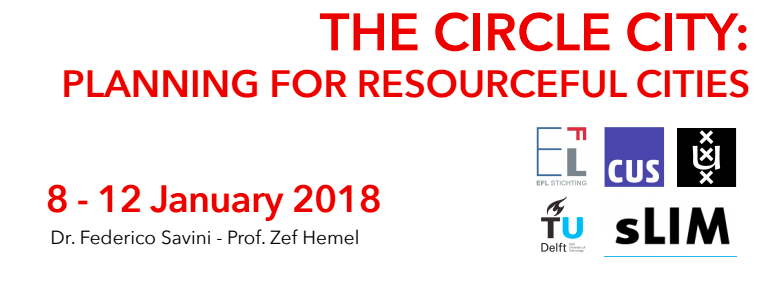
From January 8 to 12, Amsterdam is going to host “The Circle City: planning for resourceful cities“, a 5-days event aimed at exploring the impact and practice of the principles of circularity in developing urban areas, housing and public space.
The 2018 edition of the Studio will be focused on trying to address and answer some of the principal question about the principle of circularity. How can cities reuse their resources to provide for housing, public spaces and urban qualities? How can planning reduce the environmental impact of urban development? What type of policies and projects can we design in make urban space more adaptive to energy, waste and water resources?
The format of the Studio combines critical scholarship, policy making and case study analysis in the context of Amsterdam Region. It is organized around 4 topics:
- Circular flows and urban change: introduction to circularity – panel held on January 8th by Prof. Herbert Girardet;
- Spatial fabrics of closed loops development – panel held on January 10th by Paul Jansen and Jeremy Croes;
- Social reciprocity or sharing costs: privatisation or commoning in localities – panel held on January 11 by LabGov’s co-founder, prof Christian Iaione;
- The politics of the circular democracy – panel held on January 12 by Prof Erik Swyngedouw.
On January 13 the Studio will host the final presentations of student projects, attending experts Marjolein Brasz and Andre Struker.
On Wednesday 10th, the Studio will open a public debate at Pakhuis de Zwijger at 19.30, looking at the political challenges of circular economic development related to urban democracy, urban regeneration and economic growth together with international discussants:
The full program of the event is available here: http://urbanstudies.uva.nl/binaries/content/assets/subsites/centre-for-urban-studies/masterstudio-2018/flyer-the-circle-city-uva.pdf?3023756958198.
Watch the livestream of the public debate here: https://dezwijger.nl/programma/all-waste-is-a-resource/

by Alessia Palladino | Dec 29, 2017 | The Urban Media Lab
The 12th International Human Rights Researchers’ Workshop, The Sharing Economy: Markets and Human Rights, will take place on January 8 and 9, 2018 at the College of Law and Business, 26 Ben Gurion street, Ramat Gan, Tel Aviv.
The Conference will deepen many issues of the Sharing economy, dealing with both competition and social concerns. It will be articulated into many Panels, dealing with:
- Problems and concerns of the sharing economy;
- Public Interests and Human Rights;
- Crowdfunding;
- Discrimination in the sharing economy;
- Sharing economy and Urban Environment;
- Obligations and Competitions;
Professor Christian Iaione will be a keynote speaker on January 9, from 11.30 a.m. to 1.00 p.m. His speech will be about Pooling and Tech justice, proposing a Human right – based approach to the Sharing economy.
The complete programme is available here: http://www.clb.ac.il/uploads/8-9_1_2018.pdf
A Tel Aviv si terrà la 12th International Human Rights Researchers’ Workshop in data 8 – 9 Gennaio 2018, intitolata The Sharing Economy: Markets and Human Rights. Il Professor Christian Iaione parteciperà il 9 Gennaio con una dissertazione su Pooling and Tech justice.

by Alessia Palladino | Aug 21, 2017 | The Urban Media Lab
The advent of online platforms and new technologies is breaking down traditional axes of both social interaction and commercial power, shifting the structure of traditional services[1]. The platform revolution is radically transforming an array of many sectors, like transportation, accommodations and personal services[2]. It can be considered as a pervasive innovation, which facilitates direct interactions between users and gives rise to the emergence of different needs related to data- driven trends. Services provided are often more convenient – because of the lower costs – and flexible than traditional ones.
An emblematic example falls, as well, in the field of transportation. The technical feasibility provides innovative solutions to the challenges of life, especially in crowded urban areas. Thanks to GPS-based navigation combined with real-time traffic information and mobile platforms, individuals are able to optimize their routing and schedule choices. In addiction, new methods of payment are changing the collection of user fees too[3]. Sharing economy firms, therefore, represent a reaction against the frictions of urban life exploiting such exacerbation, in order to fulfill demand for appropriate services.
Furthermore, technological progress has led the development of apps for taxi service (such as MyTaxi), but it has also allowed to flourish a non professional alternative kind of transportation as Uber, the current market leader.
As a result, these businesses interact with the traditional models, sometimes competing directly against[4], raising unfair competition concerns (as UberPop case). Italian market evolution leverages regulatory challenges due to the anachronistic legislation of non-scheduled transportation, dating from 1992. It strictly regulates only taxi and private hire vehicles, which are subject to various regulations by states and municipalities. The market has strong barriers to entry, because of the requirement of licenses as necessary condition to access and operate; moreover, local regulations too impose other limitations, as the number of taxicabs that can be registered or the place vehicles can have a ride.
Since 2015 both the Transportation Regulation Authority and the Competition Authority has been sending signals that change is welcome, calling for a review of existing regulation, in order to remove or adapt those rules unable to correct market failures, but avoiding any qualification of new transportation services provided.
In 2015, indeed, the Transportation Regulation Authority suggested some proposal reform of the legal framework in order to include technological mobility services, even adding a new kind of transportation service, a so-called tertium genus, due to the conceptual difficulty in applying underlying rules.
Recently, the Competition Authority sent to the Parliament and the Government a report (AS1354), aimed at creating a level playing field; for this reason, the Authority suggested to:
- encourage equivalence of taxi and other non-scheduled kinds of transportation;
- guarantee the entry of new technological mobility services, which changed the whole mobility paradigm and made the legal framework outdate;
- identify appropriate tools to balance the market opening for taxi discharging public service obligations.
Finally, last August 4th, 2017 the Italian Parliament approved the Annual Law upon market and competition (Legge annuale per il mercato e la concorrenza n. 124/2017). It is the result of a longer path, started in 2015, which has experienced many changes during the time. Actually, the final text, consisting of only one article but 192 paragraphs, contains a number of important corrections compared to the original version, submitted by the Government on April 3rd, 2015. The law deals with many issues, as insurance, forensics, transportation, energy. It foresees provisions aimed at removing regulatory obstacles to the opening up of markets, promoting competition and safeguarding consumers, also in accordance with the EU principles on freedom of movement, competition and market access, as well as European competition policy.
Pursuant to clauses from 179 through 182, the Government is delegated to adopt a legislative decree for the reformation of non-line public service, in order to guarantee the development of sustainable mobility and smart cities by the next year.
In this regard, the new regulation must be aligned with guiding principles and criteria listed at clause 179, in order to:
- guarantee complementary and supplementary – to scheduled public one – transportation for all citizens;
- adapt the provision of services to new forms of mobility using technology platforms for interconnection of passengers and drivers;
- promote competition and stimulate higher quality standards;
- ensure consumer protection in the enjoyment of the service, guaranteeing more consciousness for the offer choosen;
- harmonize the regional and local authorities’ issues, defining common standards;
- adapt the sanctioning system for administrative violations identifying effective, dissuasive and proportionate penalties according to the gravity of the violation, also in order to counteract the phenomenon of abuse, requiring the power to impose administrative sanctions on local authorities in order to avoid overlapping.
Following provisions contain procedural details of the whole rulemaking process.
Even if there is not a clear stance on the way regulatory bodies should proceed, due to physiological vagueness of delegation criteria, it could represent the first concrete reaction upon the question of how to handle new market entrants.
Neverthless, the rulemaking process could seem to be arduous. It induces to reflect upon many points, as the qualification of the legal nature of innovative transportation services, the range of regulation and consequences in terms of price fixing. It should provide an appropriate solution to the ongoing problem of striking the right balance between competing priorities, such as market access and preservation of sustainable mobility.
Consequently, many other issues – not expressly mentioned – should be addressed and taken into account, as Big Data management, collection and, above all, disclosure.
Furthermore, the diversification of transportation supply must not result in the reduction of quality, or even in the increase of pollution and road congestion[5]. In this regard, it would be necessary to reflect upon the best approach able to face the complexity of urban transport systems, in order to break in a new culture for urban mobility, comply to EU legislation too.
Il progresso tecnologico ha inciso profondamente sul settore del trasporto urbano non di linea, modificando le esigenze dell’utenza e la gestione delle risorse e mostrandone l’obsolescenza normativa. La recente legge 124/2017 rappresenta pertanto un’occasione per rivisitare l’intero sistema.
[1] Motala, M., The “Taxi-cab Problem” Revisited: Law and Ubernomics in the Sharing Economy, 33:2 Banking and Finance Law Review (2016) at 468.
[2] Davidson, Nestor M., Infranca, John J., The Sharing Economy as an Urban Phenomenon, 34 Yale L. & Pol’y Rev. 215 (2016)
[3] Meyer G., Shaheen S., Disrupting Mobility. Impacts of Sharing Economy and Innovative Transportation on Cities, Springer (2017).
[4] Holloway C., Uber unsettled: how existing taxicab regulations fail to address transportation network companies and why local regulators should embrace Uber, Lyft, and comparable innovators, 16 Wake Forest J. Bus. & Intell. Prop. L. 20 (2015).
[5] Iaione C., The tragedy of urban roads: Saving Cities from Choking, Calling on Citizens to Combat Climate Change, 37 Fordham Urb. L.J. 889 (2009).

by Monica Bernardi | Aug 21, 2017 | The Urban Media Lab
The conference “Contemporary Urban Policy – European Perspective” will take place at the University of Economics in Katowice, 12-13 October 2017, thanks to the organization of the Department of Spatial and Environmental Economics.
The focus will be on urban policy, urban governance and collaborative planning. The meeting will bring together academics, policymakers and practitioners to better understand the ideas of participatory approach to urban development and discuss new concepts such as urban commons, cooperative cities and sharing cities. The meeting will be also an opportunity to integrate academics and discuss future research projects in the field of urban and regional studies. There are 7 conference themes to which researchers interested in exchanging ideas and results on urban studies are invited to participate:
- Urban policy – theory and practice
- Collaborative planning in cities
- Urban and metropolitan governance
- Urban Commons and city as a commons
- Sharing economy, circular economy, and urban development
- Urban regeneration strategies, tools, and projects
- Urban laboratories and experimental economics in urban studies
The call for paper has been until August 30 to collect abstract on these themes. All reviewed and accepted papers will be published on “STUDIA REGIONALIA”, “JOURNAL OF ECONOMICS AND MANAGEMENT” and other peer-reviewed publications.
Professor Christian Iaione, LabGov Faculty Director, will take part in the conference as a keynote speaker.
For more information and the program see the official website: www.ue.katowice.pl/ure.
*****
Un’altra importante occasione per discutere di #urbancommons e #sharingcities: il 12 e 13 ottobre 2017 a Katowice (Polonia), presso la University of Economics, il Dipartimento di Economia Spaziale e Ambientale organizza la 4th International Conference on Urban and Regional Economics. La conferenza, dal titolo “Contemporary Urban Policy – European Perspective”, si concentrerà sui temi delle #urbanpolitics, #urbangovernance e #collaborativeplanning. Fino al 30 agosto è possibile inviare il proprio abstract su uno dei 7 temi proposti. Maggiori informazioni al sito www.ue.katowice.pl/ure.

by Alessia Palladino | Jul 14, 2017 | The Urban Media Lab
Last May Advocate General Szpunar gave his first opinion about the right qualification of the service provided by Uber.
Uber is a peer-to-peer mobile ride-sharing platform which has received tremendous attention in recent years[1]. Anyone having a smartphone equipped with the Uber application (i.e. the App) can get a ride in the cities where the App takes place.
Thanks to GPS technologies, the App recognises the location of the user, then finds available drivers who are nearby. It notifies the acceptance to the user and displays the driver’s profile.
It also estimates the price of the ride, according to the destination of the user, automatically charged to the bank card which the user is required to enter when signing up. In order to improve the service, the App has a ratings function too, both for drivers and passengers.
Uber has launched many services during the time, but the service going by the name UberPop is the one that has raised the most heated debates. This App allows nonprofessional private drivers to transport passengers using their own vehicles, arising concerns in many European countries where licenses or authorisation are required.
In 2014, indeed, a professional organisation representing taxi drivers in the city of Barcelona (i.e. Elite Taxi), brought an action before the Juzgado de lo Mercantil n° 3 de Barcelona against Uber Systems Spain SL (i.e. Uber Spain), because of its unfair competition towards Elite Taxi’s drivers. Namely, Elite Taxi argued that:
- The city of Barcelona requires licenses and authorisations under the regulations on taxi service;
- Neither Uber Spain nor its drivers owned them; for this reason, the company wasn’t entitled to provide the UberPop service and it was just engaged in an unfair competition.
Since several provisions of EU law were involved, the Spanish judge decided to refer some question to the Court of Justice, concerning whether platform services may be qualified as information society services (I.S.S.) or falls into the transport field.
The distinction has important legal consequences: if these services fell into the transport field, Uber wouldn’t benefit from Directive 2006/123/EC principles of the freedom to provide services, and the 2015 Digital Single Market Strategy for Europe ( Digital Strategy ); on the contrary, it would be regulated by the law of each Member State.
The Advocate General’s opinion represents the first legal solution about Uber, even if it doesn’t bind the Court.
The opinion is very interesting because it qualifies Uber as a composite service: it isn’t provided, over all, by electronic means. However, it could be included among I.S.S. if two conditions were satisfied:
- The economic indipendency of non-electronic supply from electronic services;
- The whole service should be supplied by the provider, who has to exercise, as an alternative, a strong influence over service delivery conditions.
On the contrary, the service offered by Uber doesn’t satisfy either of those two conditions. Moreover, the platform gives sense to the drivers activity, which couldn’t be considered as indipendent as required by the first condition stated above. Indeed, benefits are essentially provided by Uber itself.
Drivers aren’t free to fix prices per ride and other economical assets, because Uber:
- imposes them many conditions about the way of pursuing their activity;
- determines the price of the service and places where there could be a high volume of trips;
- exerts indirect control over the quality of their work, thanks to the rating and feedback of the users;
- rewards drivers who accumulate a large number of trips.
For this reason, the service offered by Uber could’t be simply classified as an information society one, but as an on – demand urban transport, because of the organisation and management of the whole comprehensive system.
Consequently, the platform’s activity is subject – according to Article 91 TFEU – to the conditions of each Member State, about the way non-resident carriers may operate transport services.
Recently the Advocate General Spuznar has again dealt with the development of the App in France. In this new opinion he has referred to his previous one, about Uber Spain as a transport service. This qualification would exclude the applicability of the Directive 98/34/EC too.
In conclusion, France might prohibit and punish the illegal exercise of a transport activity carried out by the App UberPop without having to notify the Commission of the draft law in advance. The exclusion of any obligation to notify the draft law would operate, in his opinion, even if the activity was considered as an I.S.S. by the Court of Justice.
These opinions are aligned with other initiatives of the EU institutions, aimed to both the encouragement of the collaborative economy and its development in a responsible manner. This was the belief of the Commission, published in a Communication on 2 June 2016. It underlined the importance of collaborative economy as a contribution to jobs and economic growth in the EU.
The European Court of Justice’s determination is considered crucial because it will greatly affect the growth and future of Europe’s sharing economy[2]. Furthermore, it should be unrealistic the qualification of Uber as a simple I.S.S.: users who log onto the app seek to book a ride, nor merely to browse “the number of Uber drivers with red cars”[3].
Even if the Opinion does not bind the Court, which decides in full independence, it indicates a legal solution, which is necessary due to many legal concerns involved, such as competition, consumer protection, privacy, security, public services, labor and tax law.
[1] Z. Li, Y. Hong, Z. Zhang, Do Ride-sharing Services affect Transport Congestion? An Empirical Study of Uber Entry, available at http://dx.doi.org/10.2139/ssrn.2838043.
[2] A. Alexander De Masi, Uber: Europe’s Backseat Driver for the Sharing Economy, Creighton International and Comparative Law Journal 7/ 2016, at 73.
[3] R. Elaine Elliott, Sharing App or Regulation Hack(ney)?: Defining Uber Technologies, Inc., 41 Journal of Corporation Law 2016.
Il debutto dell’App UberPop nel contesto europeo ha permesso a chiunque di aspirare alla professione di autista. Proponendosi come un servizio dalle caratteristiche ibride, ha incontrato le resistenze dei tassisti, rendendosi oggetto di numerosi contenziosi in sede civile nonché di rinvii pregiudiziali alla Corte di Giustizia.


