We live in an era of great and rapid changes. Many of these changes are positive, many others are not. We live in an era in which climate change is not an incoming threat, but rather a critical issue that is showing its full negative impact in these days. The effects are all there to see and probably, as some scientist are arguing, the Coronavirus outbreak is somehow connected to the disruption of local ecosystems. Climate change will have (and is actually having) irreversible effects on behalf of the world economy and structure. Moreover, it is estimated that global warming will reduce real GDP per capita by 7.22% by 2100.
Source: Burke, Hsiang, and Miguel (2015); authors’ calculations.
Note: Country-level estimates for GCP per capita in 2100. Figure assumes RCP 8.5, which corresponds to roughly 3.2°C to 5.4°C of warming. GCP loss is associated with the warming from a baseline of 1980-2010 average temperatures. As explained in Burke, Hsiang, and Miguel (2015), estimates include growth-rate effects over the period through 2100.
But luckily there are not only negative effects. It is expected that the society and the economic system will change, and so it will the job market. It is estimated that 75 million jobs may be lost as companies shift to more automation. But where is the positive aspect of this shift? A change in the job market not only means loss of some employees, but also around 133 million new jobs that may emerge by 2022 (World Economic Forum’s “The Future of Jobs Report”). As far as climate change and global warming are concerned, it is estimated that green economy will create 24 million new jobs (ILO-UN, World Employment and Social Outlook 2018).
The question now is: are we ready to face all these challenges and changes?
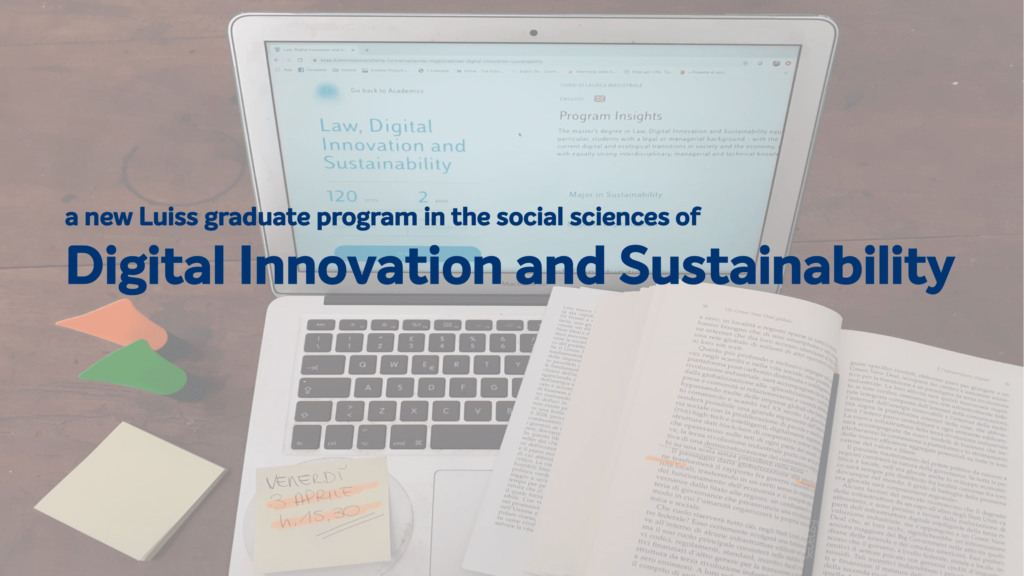
Luiss university, responds to these shift launching a Master’s Degree in Law, Digital Innovation and Sustainability (LDIS), an English-language graduate course in the social sciences (law, management, finance and policy) of digitalization and sustainability, created to prepare students to incoming changes and to train the next generation to face the above mentioned challenges.
The LDIS Master’s Degree program creates job opportunities by forging professional figures equipped with the right tools to address digital transformation and ecological transition, promoting employment opportunities and traineeship as Innovation Managers or Sustainability Managers with strong risk management and legal analysis skills. Here you can find an article on how lawyer CEOs might influence firm decision making more broadly — and whether they differ from CEOs without a law degree. The study shows that Firms run by CEOs with legal expertise were associated with much less corporate litigation. Compared with the average company, lawyer-run firms experienced 16% to 74% less litigation, depending on the litigation type.
These are professionals who work for large organizations in the coordination of integrated business units who manage digital or social innovation processes with transdisciplinary abilities in system thinking, lateral thinking and risk management. However, the course content not only drives attention to the management background, but also to the legal skills promoting the role of legal innovation designers and risk managers, in other words, experts in the legal design and coding of new rules/norms of human coexistence in a phase of digital, technological, ecological and social transition who contribute to define risk management strategies and risk analysis using legal design thinking and lateral thinking.
The Master’s Degree is designed to properly fit and adapt to student’s interests and career aspirations by granting the opportunity to select two possible Majors: one in Sustainability, through core courses in Management of Circular Economy, Green and Sustainable Finance, Regulatory innovation, and one in Digitalization with core courses in Management of Innovation & Entrepreneurship, Fintech, and Data Protection Law. In addition, the Master’s course foresees some Electives & Activities for all majors, more precisely three elective courses, a final project work (e.g. thesis, proof of concept, start-up creation and acceleration, new business unit, new financial investment, ets.), an internship at a large private or public organization and three Labs & Skills.
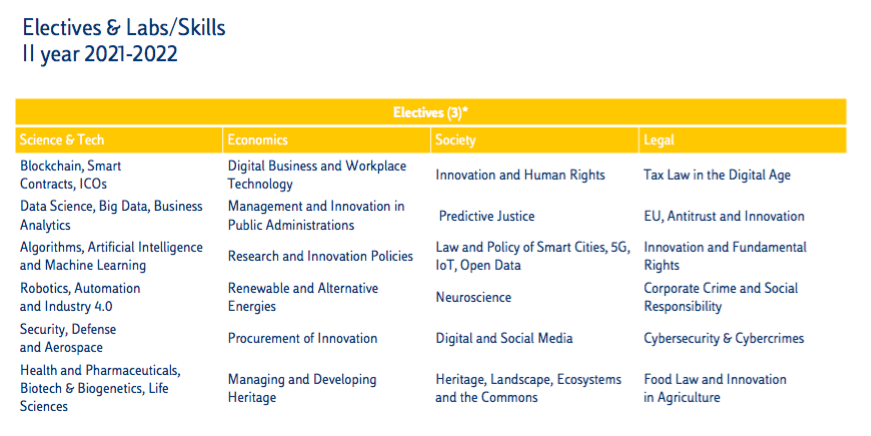
During the second year, the Lab&Skills will be centered on 4 different areas of interest: Science & Technology, Economics & Business, Society & Policy, Legal, and promote soft skills activities in computer programming, legal coding, legal clinics, negotiation, legal public speaking and legal writing, due diligence automation, fundraising Lab (Eu Projects & Project Management) legal entrepreneurship, legal design thinking, and data lab (Database & Empirical Research). Additionally, in order to train both theory and practice, the course aims to promote “engagement activities” with the support of corporate and institutional partners, internship agreements and international cooperation agreements (i.e. student exchanges, double & dual degrees). As it can be evident, the course not only aims to lay down theoretical basis, but above all, combines theoretical insights with practical activities so to acquire the synthesis of the “practical theory” and create jobs during the training.
Here you can find the international Faculty members of the LDIS Master’s Degree: Shelia Foster (Georgetown University), Séverine Dussolier (SciencesPo University), Helen Eenmaa (the University of Tartu), Sofia Ranchordas (University of Groningen), Daniel Armanios (Carnegie Mellon University), Giorgio Ventre (Università degli Studi di Napoli Federico II).
Here you can find the list of the Steering Committee of the LDIS Master’s Degree: Helèna Ravasini (Huawei), Benedetta Gillio (Arpinge e LabGov.city), Caterina Strippoli (ENEL Group), Andrea Buonomini (Ratp DEv), Enrico Salvatori (Qualcomm); Marco Tulliani (Cybertech).
If you wish to learn more you can visit this webpage and join us on Friday, April 3rd at 3:30 PM for the online presentation of the Master’s Degree in Law, Digital Innovation and Sustainability through a Webex meeting available at this link. You will be able to pose questions to Caterina Strippoli, Head of Intellectual Property of ENEL Group, and Christian Iaione, Director of the MSc in Law, Digital Innovation and Sustainability.
Una nuova laurea magistrale Luiss nelle scienze sociali dell’Innovazione Digitale e Sostenibilità
Viviamo in un’era di grandi e veloci cambiamenti, molti dei quali sono positivi, molti altri no. Il cambiamento climatico non è più una questione di futuro, è il presente. E i suoi effetti sono sotto gli occhi di tutti. L’ultimo in ordine cronologico, come sta affermando parte della comunità scientifica, sarebbe la sempre più frequente diffusione di epidemie o pandemie come quella del Covid-19 a cui stiamo assistendo in questi giorni e che risulta essere in qualche modo collegata alla distruzione degli ecosistemi locali. Il climate change avrà (e in parte sta già avendo) effetti sulla struttura della società e dell’economia globale. Si stima che il riscaldamento globale produrrà una riduzione generale del PIL di 7,22 punti percentuali entro il 2100.
Source: Burke, Hsiang, and Miguel (2015); authors’ calculations.
Note: Country-level estimates for GCP per capita in 2100. Figure assumes RCP 8.5, which corresponds to roughly 3.2°C to 5.4°C of warming. GCP loss is associated with the warming from a baseline of 1980-2010 average temperatures. As explained in Burke, Hsiang, and Miguel (2015), estimates include growth-rate effects over the period through 2100.
Ma fortunatamente i cambiamenti non saranno esclusivamente negativi. L’economia e la società in cui viviamo cambieranno, e così di pari passo anche il mercato del lavoro muterà. Si stima che all’incirca 75 milioni di professioni andranno perse con il passaggio delle industrie a una maggiore automazione. Dov’è la buona notizia? 133 milioni di nuove professioni potrebbero emergere entro il 2022 (World Economic Forum’s “The Future of Jobs Report”). Per quanto concerne il cambiamento climatico si stima invece che l’economia green genererà 24 milioni di nuovi lavori (ILO-UN, World Employment and Social Outlook 2018).
La domanda che ci poniamo è: siamo pronti ad affrontare queste sfide questi cambiamenti? L’Università Luiss Guido Carli risponde a tali cambiamenti lanciando una Laurea Magistrale in Innovazione Digitale e Sostenibilità (LDIS), un corso di laurea in lingua inglese nelle scienze sociali (legge, economia e politica) della digitalizzazione e della sostenibilità, creato per preparare gli studenti ai cambiamenti prossimi e nella formazione di una nuova classe dirigente, che si faccia trovare pronta per affrontare le sfide sopra citate. Al giorno d’oggi, è il mercato stesso che richiede un corso di laurea come LDIS.
Il programma di laurea magistrale LDIS crea opportunità di lavoro forgiando figure professionali dotate degli strumenti giusti per affrontare la trasformazione digitale e la transizione ecologica, promuovendo opportunità di lavoro e tirocinio come responsabili dell’innovazione o responsabili della sostenibilità con forti capacità di gestione del rischio e analisi giuridica. Qui puoi trovare un articolo su come i CEO degli avvocati potrebbero influenzare il processo decisionale in maniera più ampia e se differiscono dai CEO senza una laurea in legge. Lo studio mostra che le aziende gestite da amministratori delegati con esperienza legale erano associate a controversie societarie molto meno. Rispetto alla società media, le aziende gestite da avvocati hanno registrato un contenzioso dal 16% al 74% in meno, a seconda del tipo di controversia.
Si tratta di professionisti che lavorano per grandi organizzazioni nel coordinamento di unità aziendali integrate che gestiscono processi di innovazione digitale o sociale con capacità transdisciplinari nel pensiero di sistema, nel pensiero laterale e nella gestione dei rischi. Tuttavia, il contenuto del corso non solo attira l’attenzione sul background manageriale, ma anche sulle capacità legali che promuovono il ruolo dei progettisti dell’innovazione legale e dei gestori del rischio, in altre parole, esperti nella progettazione giuridica e nella codifica di nuove regole / norme di convivenza umana in una fase di transizione digitale, tecnologica, ecologica e sociale che contribuiscono a definire strategie di gestione del rischio e analisi del rischio utilizzando il pensiero del design legale e il pensiero laterale.
Il Master è progettato per adattarsi e adattarsi correttamente agli interessi degli studenti e alle aspirazioni di carriera, offrendo l’opportunità di selezionare due possibili majors: uno in Sostenibilità, attraverso corsi in Gestione dell’Economia Circolare, Finanza Green e Sostenibile, Innovazione Normativa e uno in Digitalizzazione con corsi in Gestione dell’innovazione e dell’Imprenditorialità, Fintech e Legge sulla Protezione dei Dati. Inoltre, il Master prevede alcuni corsi elettivi e attività per tutte le major, più precisamente tre corsi opzionali, un progetto finale (ad esempio tesi, proof of concept, creazione e accelerazione di start-up, nuova unità aziendale, nuovi investimenti finanziari, ecc. ), uno stage presso una grande organizzazione privata o pubblica e tre Labs & Skills.
Durante il secondo anno, il Lab & Skills sarà incentrato su 4 diverse aree di interesse: Scienza e Tecnologia, Economia e Commercio, Società e Politica, Legale, e promuoverà attività di soft skills in programmazione informatica, codifica legale, cliniche legali, negoziazione, legale pubblico parlare e scrivere legalmente, automazione della due diligence, raccolta fondi Lab (Eu Projects & Project Management) imprenditoria legale, pensiero di progettazione legale e data lab (Database & Empirical Research). Inoltre, al fine di formare sia la teoria che la pratica, il corso mira a promuovere le “attività di coinvolgimento” con il supporto di partner aziendali e istituzionali, accordi di tirocinio e accordi di cooperazione internazionale (ovvero scambi di studenti, doppia e doppia laurea). Come può essere evidente, il corso mira non solo a stabilire le basi teoriche, ma soprattutto, combina approfondimenti teorici con attività pratiche in modo da acquisire la sintesi della “teoria pratica” e creare posti di lavoro durante la formazione.
Qui puoi trovare la lista dei membri Internazionali della Facoltà di LDIS: Shelia Foster (Georgetown University), Séverine Dussolier (SciencesPo University), Helen Eenmaa (the University of Tartu), Sofia Ranchordas (University of Groningen), Daniel Armanios (Carnegie Mellon University), Giorgio Ventre (Università degli Studi di Napoli Federico II).
Qui puoi trovare la lista del Comitato d’indirizzo della Facoltà LDIS: Helèna Ravasini (Huawei), Benedetta Gillio (Arpinge e LabGov.city), Caterina Strippoli (ENEL Group), Andrea Buonomini (Ratp DEv), Enrico Salvatori (Qualcomm); Marco Tulliani (Cybertech).
Se desideri saperne di più, puoi visitare questa webpage e unirti a noi venerdì3 aprile alle 15:30 per la presentazione online del Master in Giurisprudenza, innovazione digitale e sostenibilità attraverso una riunione Webex disponibile a questo link. Potrai porre delle domande a Caterina Strippoli, head od Intellectual Property of ENEL Group, e Christian Iaione, Direttore del Master in Law, Digital Innovation and Sustainability.
MOTUS-E is the first Italian Association to bring together industries, the transport sector, the academia, consumer associations and opinion movements, to favor the transition towards a more sustainable model of mobility, in a context in which technologies and digital transformation play a crucial role.
LabGov’s strategic partner for various projects, MOTUS-E, has recently launched a call for papers and a best thesis award to prize the best research contribution in E-mobility. Both of the calls are open to everyone wishing to submit a paper, a research project or a thesis (discussed in years 2017-18-19), regardless of the country. Even papers already published in journals may be considered since there are no specific requirements on publication.
Universities, graduates, undergraduates, researchers and professionals are invited to present their own contribution about one of the clusters launched by MOTUS-E. The three selected papers and the winner of the Best Thesis Award will also have the opportunity to attend the MOTUS-E Event in Rome in 2020. The deadline for the submissions is 31st January and a Scientific Committee will evaluate the papers by 15th April. The papers can be submitted either in Italian or in English.
Find the more detailed rules, the application form and the topics through the following link: https://tree.it/motus-e-2020/
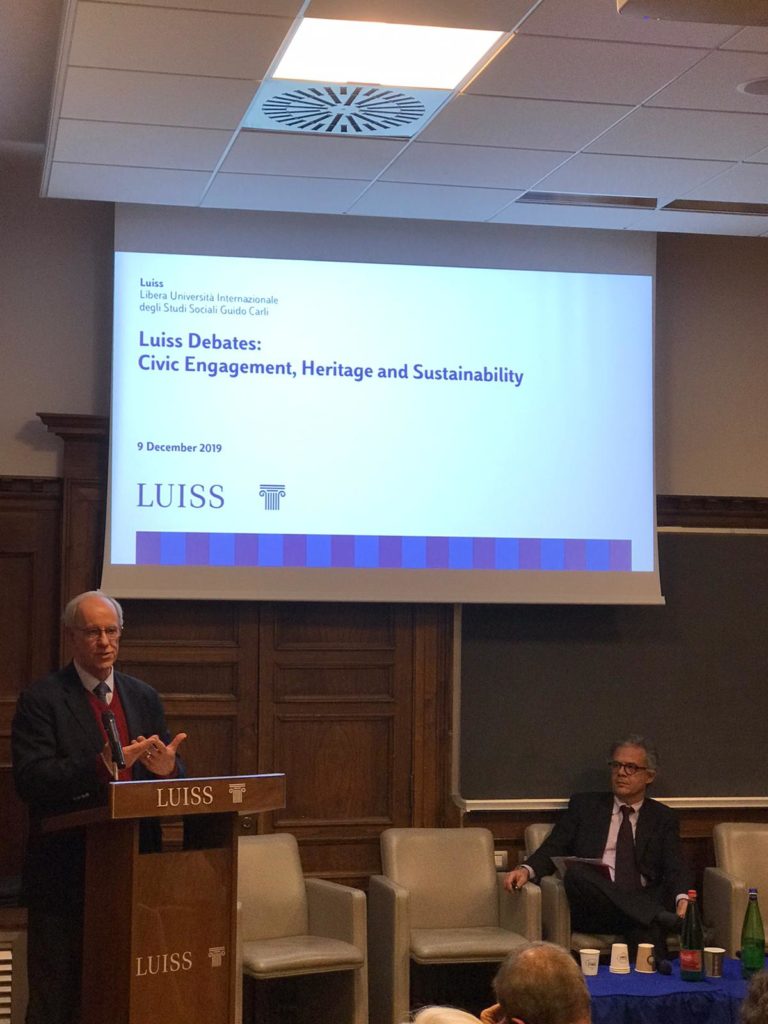
The Luiss viale Romania Campus hosted the Luiss Debate “Civic Engagement, Heritage and Sustainability” organized by the Luiss School of Law and Luiss LabGov.City in collaboration with the Roma Tre University Architecture Department and Eutropian.Org. The Debate was organized in the framework of the Third Consortium Meeting of the Horizon 2020 project “Open Heritage” (https://openheritage.eu/ ), that aims at creating sustainable models of heritage asset management by putting the idea of inclusive governance of cultural heritage sites together with development of heritage communities at its center (it involves an open definition of heritage, not limited to listed assets but also involving those buildings, complexes, and spaces that have a symbolic or practical significance for local or trans-local heritage communities). This means empowering the community in the processes of adaptive reuse. LabGov – Luiss is part of the project, thanks to its engaged research conducted in Rome.
Luiss Rector, Andrea Prencipe, opened the meeting underlining the importance of the three key words: Sustainability, a crucial theme in these days; Heritage, as Rome is the homeland of cultural heritage; and Civicness, as Luiss students must be Engaged and good Citizens before being professionals.
The Vice Dean of the Department of Law Antonio Punzi continued exposing how relevant are civic engagement, heritage and sustainability in innovating and updating the academic curricula of the Luiss Law Department, through the creation of a master degree in Law, Digital innovation and Sustainability.
The debate, moderated by Raffaele Bifulco (Professor of Constitutional law – Department of Law Luiss University) continued following the keynote speeches from national and international scholars and members of European institutions, an interesting discussion on civil engagement and sustainability as cross-cutting principles for the governance of cultural heritage. Among the participants, Erminia Sciacchitano, Eu Commision DG Culture Policy Officier and Chief Scientific Advisor EYCH 2018, exposed the new EU cultural policy framework underlining the crucial role of an Open Governance through the Urban Innovative Actions, an initiative of the EU that englobes all the pilot projects for sustainable urban development, launching the 5th call for proposals that will expire on December the 12th.
Mark Thatcher, Luiss Professor of Political Science, has deal with the link between identity and markets within the Eu Cultural Heritage. What he stated is that the “EU can create a cultural identity through markets, but markets are too technical and therefore lack of political participation and support”. In addition, he highlighted that, even though Europe is a young Union, this does not mean that a cohesive identity cannot be created. It is thus necessary to create a link between political identity and markets so to create a parallel european citizenship that does not overcome the national one.
Luisella Pavan Woolfe, on behalf of the Council of Europe, exposed “the role of the Faro Convention for the promotion of equality, inclusion, and development of local communities and minorities trough heritage”. The focus was on the relevance of the role played by a community itself. As a consequence, it is essential to work together in order to preserve and protect the Cultural Heritage for the present and future generations.
Moreoever, as underlined by Sandra Gizdulich, member of the Urban Agenda Partnership for Culture and Cultural Heritage and Italy Territorial Cohesion Agency, one cannot left behind the importance of preserving the quality of landscape. To do so, it is necessary to build a stronger environmental heritage. This is not an objective itself, but the greatest aim necessary to achieve social and ecological cohesion. She in facts added that as Urban Partnership on heritage they will launch an action on better regulation to apply the legal approach used by Turin, Bologna and Naples on commons.
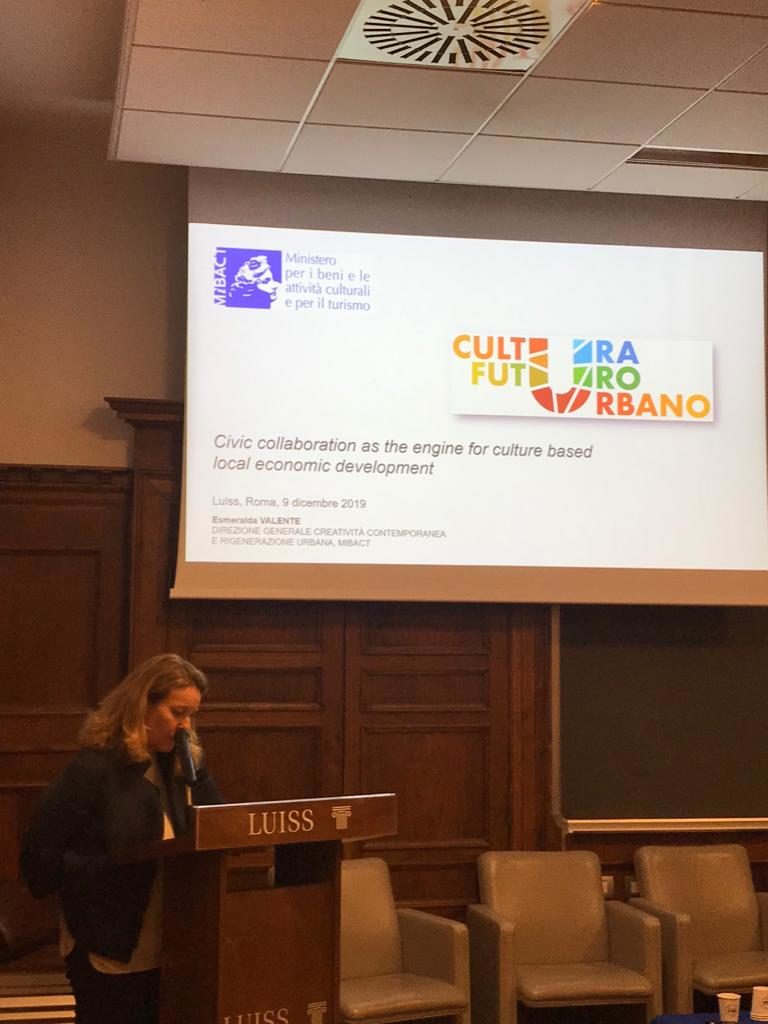
The debate continued with Esmeralda Valente (Contemporary creativity and Urban Regeneration Directorate – Italian Ministry of Culture) presenting “Cultura Futuro Urbano”, an innovative public policy based on promoting the adequate conditions for citizens to improve their creativity and human talent. This is, in her words, one of the most ambitious projects launched by MiBact and it has been created with the scientific support of LabGov.City and the Luiss Business School.
Not to leave behind the Cultural Heritage’s role when dealing with Archaeology, Peter G. Gould, from the University of Pennsylvania Museum of Archaeology and Anthropology and Professor of Archaeology at the American University of Rome, explained the success factors associated with economic development projects within communities adjacent to archaeological and heritage sites. Under his view, the success of community projects is linked to the mechanism community members use to govern their projects activities. He also cited the work of Elinor Ostrom and her attention to the polycentricity principle.
The Luiss Debate was concluded with the intervention of Giovanni Caudo, from the Roma Tre University’s Architecture Department and Elena De Nictolis post doc of the Department of Political Science. The Open Heritage project and the whole debate has shown that there is possible room for improving, thought the commons approach, trough better regulations, institutions and communities’ inclusion. All these realities are fundamental in creating a new regulatory framework, new policies, and in general an higher awareness and knowledge in managing the Cultural Heritage. The Debated ended with the greetings of Professor Iaione.
A public debate on “Civic Engagement, Heritage and Sustainability” will take place on December 9th 2019 at the LUISS University’s Viale Romania campus (find the details here) as a side event to the third Consortium Meeting of the Horizon2020 project “OpenHeritage.Eu”, a pioneering engaged and problem-based research project on community-led sustainability mechanisms for cultural heritage in cities, organized by Luiss LabGov.City and Roma 3 University Architecture from December 8th through December 10th.
The debate will host scholars, international, European and national public institutions to stimulate a discussion about civic engagement and sustainability (social, economic and environmental) as cross-cutting principles for cultural heritage governance and applied research to trigger sustainable development processes at the local level.
Program
Institutional greetings Andrea Prencipe Rector Luiss University Giovanni Lo Storto General Manager Luiss University Antonio Punzi Department of Law Vice Dean Luiss University
Moderator Raffaele Bifulco Department of Law Luiss University
Keynotes Erminia Sciacchitano EU Commission DG Culture Policy Officer and Chief Scientific Advisor European Year of Cultural Heritage 2018 “The EU Policy framework on participatory governance of cultural heritage” Mark Thatcher Professor of Political science Luiss University “European Cultural Heritage policy: identity and markets”
Panel discussion Nicola Borrelli General Director Urban Regeneration Italian Ministry of Culture “Civic Collaboration as the engine for culture based local economic development – the Italian Policy Culture Urban Future” Peter Gould American University of Rome “EmpoweringCommunities through Archaeology and Heritage” Luisella Pavan Woolfe (tbc) Council of Europe “The role of the Faro Convention for the promotion of equality, inclusion and development of local communities and minorities through heritage” Laura Colini (tbc) Urbact “Integrated urban development and cultural heritage” Sandra Gizdulich (tbc) Urban Agenda Partnership for Culture and Cultural Heritage and Italy Territorial Cohesion Agency “The key actions of the Urban Agenda on Culture”
Concluding remarks Giovanni Caudo Roma Tre University – Architecture Department
The Luiss debate will be focused on one side on the role of Universities and other knowledge institutions like cultural NGOs and independent research centers as problem-based and engaged institutions and on the other side on the role that participatory governance in the cultural sector can and should play according the Faro Convention on the Value of Cultural Heritage for society and EU policies on participatory governance of Cultural Heritage.
Universities and other knowledge institutions like cultural NGOs and independent research centers are playing a key role in disseminating civic engagement around cultural heritage to generate economic, environmental and social sustainability in cities, which become laboratories of democratic, institutional and economic innovations based on culture. It is indeed necessary that Universities start experimenting people-centered, place-based, innovative and integrated approaches that can maximize the social and economic benefits in urban areas.
This requires a participatory governance approach that includes a broad spectrum of stakeholders that work together on experimenting innovative forms of financing cultural activities and cultural heritage through public-community partnerships.
Under this approach Universities and other knowledge institutions like cultural NGOs and independent research centers can act as platforms that enable cooperation among public, private, social and civic actors to generate direct and indirect social benefits on marginalised communities and target low-income areas to trigger sustainable development processes. The prototyping of sustainability models supported by multi-stakeholder partnerships that interpret the role of the knowledge institutions as an enabling platform for these processes and that enhance the role of civic and non profit actors, but also the implementation of the Faro Convention and EU policies on participatory governance of culture, might represent an innovative strategy to achieve the sustainability objectives promoted by the Agenda 2030 and its SDGs (e.g. “SDG 11: Make cities and human settlements inclusive, safe, resilient and sustainable” under which target 11.4 calls for strengthening efforts to protect and safeguard the world’s cultural and natural heritage and “SDG 17: Revitalize the global partnership for sustainable development” under which target 17.17 encourages and promotes “effective public, public-private and civil society partnerships, building on the experience and resourcing strategies of partnerships”).
Read more about the program and the participants here.
The change that United Nation 2030 Agenda aims to create involves, among the others, Public Administrations. In this framework, the project CReIAMO PA operates to overcome the critical issues in the governance of environmental policies by accompanying the subjects involved in the changes and by combining the principles of protection and safeguard with those of development and competitiveness.
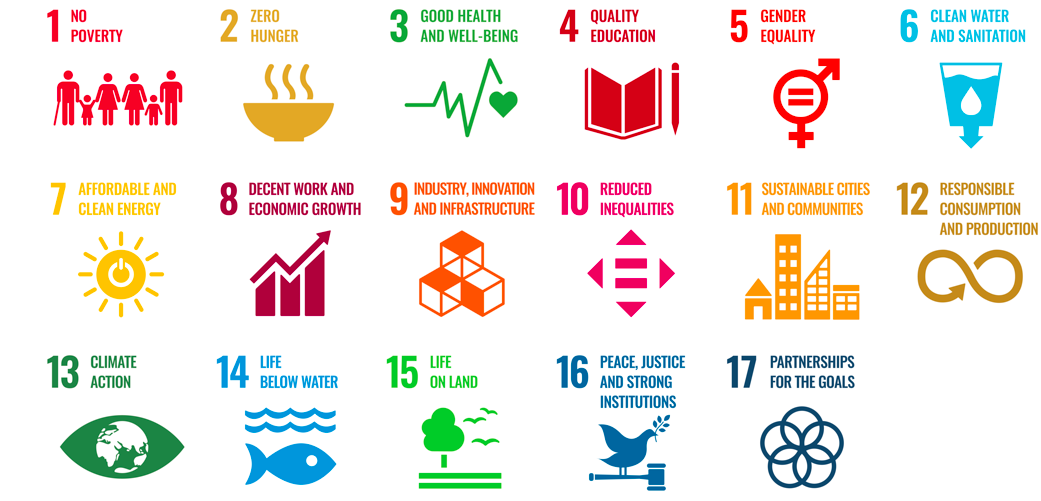
United Nation 2030 Agenda for Sustainable Development is an action program, signed by the 193 UN members, which includes 17 common objectives. They are set to be reached by 2030, aiming to solve crucial issues flowed from historical heritage and modern development. All these objectives, among which “sustainable cities and communities”, “gender equality” and “clean and accessible energy”, involve closely Regions and Metropolitan cities in Italy that so often are not able to cooperate in order to solve territorial problems. For this reason, Ministry of the Environment has developed a strategy that aims to address the issues related to strengthening administrative capacity, development of e-government and improving multilevel governance in order to overcome the fragmentation that exists today.
The CReIAMO PA Project is a part of this synergic action, that involves Italian Metropolitan Cities and Regions, with a view to increase technical skills in the following fields: project initiatives on environmental issues considered mandatory for Agenda, actions aimed at integrating specific assessment procedures, actions promoting Green Public Procurement (GPP). The GPP is an approach, promoted by European Commission, according to which Public Administrations integrate environmental criteria at all stages of purchasing processes, encouraging the diffusion of environmental technologies and the development of environmentally valid products. In this way, starting from Public Administration, the project seeks to create sustainable administrative bodies that are capable of making sustainable decisions for the benefit of territories.
Indeed, in the context of sustainability, a special care for coherence is necessary. An operator responsible for taking decision for a sustainable development of an area have to be conformed to the ideals on which it leads. The Ministry project aims to create a network of Regions and Cities, which the process of cooperating is able to speed up by conforming their territories to UN Agenda. CReIAMO PA offers to the involved parties, among which Public Administrations and other actors with environmental expertise, an opportunity to strengthen administrative and institutional capabilities as well as technical skills, aimed at improving PA management, multilevel governance and the ability to relate with stakeholders. The action plan provides training sessions alternated with on-the-job coaching. Moreover, more “systemic” actions are planned, with the purpose of enhancing the comparison between the territorial actors, that results in strengthening the planning and implementation of environmental policies. Consequently, Regions and Metropolitan Cities are expected to produce a sustainable strategy that looks forward, in the direction of circular economy and, which has a low impact on the territory and is made with education and all the other objectives of 2030 Agenda in mind.
The project is developed on 9 action lines that cover different objectives. In particular, Line 2 is finalized to support the integration of environmental sustainability objectives in administrative actions. The main purpose is to help the inclusion and the implementation of strategic system of 2030 Agenda at local and regional levels through a networking action that involves different levels of governance and non-institutional stakeholders that operate in the territory. Line 3 is about the expected results of the intervention. First, the integration of the agenda’s objectives needs to happen in national, regional and territorial policies, to give binding effect for the Agenda’s Sustainable Development Goals. Second, greater active involvement of central administrations in the process of implementing and monitoring of the 2030 Agenda is required for the sake of not restricting sustainable initiatives solely to the local level where they remain and stay simply as local best practices. Governmental and Ministerial levels must be reached. Finally, the objectives of the National Agenda 2030 implementation and national monitoring path should be shared with the Regions. Subsequently, it follows that in order to achieve the objectives set out, three areas of activity are addressed. – Involvement of central and regional institutions together with metropolitan areas and monitoring and reporting functions.
The National forum for Sustainable Development has been created by CReIAMO PA as a tool, to bring together and reunite, in the same space of confrontation, institutions and representatives of civil society. The purpose is to have a place where it is possible to bring out subjects and practices related with sustainability and to facilitate the meeting of public policies and social energies to be implemented in National Strategies for Sustainable Development (NSSD). The NSSD draws a blueprint focused on sustainability and it is a strategic framework for national and territorial policies. It involves the territory concerned and represents a road that each policymaker has to follow in the process of drafting the laws of future.
On 17th October, a meeting between Ministry of Environment and Metropolitan Cities took place in Rome. The meeting resulted in the development of a Strategy for Sustainable Development, for each Metropolitan City, which has to be compatible with the NSSD. The importance of creating a network was remarked in the meeting – the purpose of the network is to create a shared language, which reaches all the different levels in order to crate effective solutions. The method provided for both round tables open discussions and cooperation agreements. These agreements are fundamental because they mark an assumption of responsibility on stakeholders. An element of innovation is the characteristic that Ministry emphasised in the process of duplicating activities already in place. Indeed, the next step is to systematise these actions in the decision-making processes. Ultimately, all the pilot actions implemented by Metropolitan Cities have to respect the 13 URBACT criteria for an integrated pilot action in order to produce concrete sustainable results for an integrated society where all the actors work in harmony.
All in all, thanks to United Nations 2030 Agenda, the process of change is now involving several actors, starting from the highest levels of government, following the guidelines of senior experts such as URBACT. In this top-down process, where Institutions are working for putting us in condition to carry on the process they started, it is our responsibility to accept the invitation and suit their policies.