
Abstract
“Our future success is directly proportional to our ability to understand, adapt and integrate new technology into our work” (Sukant Ratnakar, 2011). Understanding the possibilities that innovative systematic solutions can offer society is the first key element in the process of promoting a circular economy. Circularity is an essential part of a wider transformation of the industry towards climate-neutrality and long-term competitiveness. Executed effectively, it can deliver substantial material savings throughout value chains and production processes, generate extra value, and unlock economic opportunities in several fields (European Commission, 2020). In contrast to a linear economy, in circular processes, the value and life-cycle of products are maintained as long as possible to minimize actual waste.
The construction sectors produce the largest amount of special waste in Italy. According to the last ISPRA (Istituto Superiore per la Protezione e la Ricerca Ambientale) report from 2018, construction special waste represents 42,5% (about 60,7 million tons) of the total amount accumulated in Italy in 2018. With Directive 98/2008/CE, the EU set a 70% target for recycling of construction. Quantities of wood waste in the Lombardy region reach nearly 1 million tons a year, adding up to 4,4 million tons of wood waste for Italy as a whole (BioReg, 2020). Given the long lifetime of construction and their impact on the environment, reusing these materials for new construction is vital to increase the life cycle of products, while decreasing material waste and saving raw materials. In the long run, this may contribute to rise self-sufficiency of selected raw materials used in production processes.
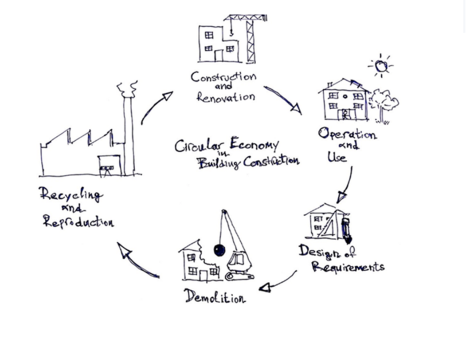
source: https://urbact.eu/transition-circular-economy-%E2%80%98%E2%80%99power%E2%80%99%E2%80%99-building-sector-towards-better-cities
Secondary raw materials still account for a small proportion of the materials used in the EU, which means that significant economic opportunities get lost. This is partly caused by the uncertainty of buyers who might have doubts about the quality of recycled materials as a basis for their production purposes. In reality, the potential for innovative solutions to produce high-quality standard products is immense. Recycling of materials and products is a key element in the transition towards a circular economy. New initiatives and platforms aim to improve standards of circularity by making waste recycling a community effort to insert it back into the economic cycle, create further value, and extend the life-cycles of products.
To protect the environment, firms, industries, plants and other entities all over the world have been implementing several solutions towards a transition of a zero-emissions-society. From 2015 numerous actions were taken concerning the goal fixed by the UN under the ‘2030 Agenda for Sustainable Development’ (SDG). SDGs serve as blueprints to achieve a better and more sustainable future.17 goals, 169 targets, 1034 events, 1221 publications, 5285 actions are an essential history’s part to tackle climate change and preserve our oceans and forests.
Small steps can sometimes do a lot. Decreasing CO2 emissions and reducing the global world temperature has been on the EU agenda for the entire 21st century. Ensuring sustainable consumption and production pattern as stipulated through Goal #12 of the UN SDGs can be promoted by efficient upcycling methods of waste. Our economy uses raw materials, either extracted domestically or imported. In a circular economy, raw materials are from virgin or secondary sources, therefore, new models are needed to optimize waste management and extend the life cycles of products. Speaking in practical terms, it is essential to recover the odds of not yet recycled wood (58.8% in EU in 2017).
New and innovative solutions in this field have had a tremendous impact on the environment, communities, and cities. Therefore, we would like to emphasize that some of Europe’s most interesting approaches to recycling and waste management have inspired our initiative and served as important examples of best practices on upcycling.
Rilegno, was founded in 1997, could be striking examples of modern management systems, focused on separate collection of waste. Over the last 20 years, the company is the ground stone of a mechanism that allows them to monitor the life cycle of wooden products from their first harvesting, over first use production for packing usages such as wooden packaging, pallets, or loading units, until it’s upcycling to serve as a new product and extend the woods life cycle. In detail, the firm manages to do so, through its simple but very effective supply chain strategy. Involved in the process are different companies, platform, and communities that all contribute to achieving a circular economy system from wood deforestation, usage, collection of wood waste, upcycling and regeneration method until the Research Center if Wood Packaging and Logistics (CRIL) evaluates upon the quality of the wooden packaging.
Even younger knowledge-intensive realities take the field. Waste Hero, just like LabGov.City, emerged right at campus. One of the students at Aarhus University recognized the need for more efficient and sustainable waste collection management, which eventually led to the foundation of Waste Hero. The Danish technology-driven method focuses on waste management and collection in a global scope by eliminating unnecessary pickups and collections to save costs and simultaneously lowering pollution. The founder’s technology-driven business model and strong skills in engineering and machine learning led to a successful company that promotes sustainable and community-driven waste management currently established in 11 cities and constantly growing.
One more practice that is worth mentioning is ISVE S.r.l. Italy. It has experience in innovation technologies since its foundation in 1977 and made it to its mission to develop collaborative solutions to improve wood, waste and recycling strategies. They have successfully established a large portfolio of customers to whom they offer design, construction and marketing of plants in the wood recycling or treatment sector. ISVE makes machines that optimize recycling processes from small grinders up to all kinds of industrial waste. Their network allows integrating structural processes that entirely serve the purpose of promoting the quality of recycled materials and the environment.
Through initiatives and technologies like these, member states in Europe have managed to reduce the Carbon footprint of regions by influential numbers that contribute to the Unions 2030 goals. In addition, the UN Sustainable Development targets create a platform to further integrate new solutions and corporate within sectors. A multidisciplinary approach when tackling the pressing issue of climate change has become increasingly vital in Europe. These EU and UN initiatives, therefore, offer a perfect arena for companies, scientists and entrepreneurs to compete in the race to jointly fight for the necessary change in actions.
This article has been written by the students of the Luiss new Msc in Law, Digital Innovation and Sustainability in the context of the class of Law and Policy of Innovation and Sustainability taught by Professor Christian Iaione. The cluster “Industry and Manufacturing” is composed of the following students: Simone Galvagno, Valentina Defrate, Clara Wrede, Margherita Perrone, Selen Erkenci and Tommaso Desiderato.
References
Bilitewski, B. J.Wagner, J. Reichenbach. J. (2018). Best Practice Municipal Waste. German Environmental Agency.
BioReg (2018). BioReg Project: Absorbing the Potential of Wood Waste in the EU Regions and Industrial Bio-based Ecosystems. Retrieved November 14, 2020 from http://bioreg.eu/.
Commission of the European Communities (2019). Communication from the Commission to the European Parliament, the European Council, the Council, the European Economic and Social Committee and the Committee of the Regions. The European Green Deal. Brussels: European Commission.
Commission of the European Communities (2020). Eurostat: Circular Economy. Brussels: European Commission.
Commission of the European Communities (2020): Demonstration of systematic solutions for the territorial deployment of the circular economy. Brussels: European Commission.
Feleki, E. (2020). Transition to circular economy: the “power” of the building sector towards better cities. Retrieved November 17, 2020 from https://urbact.eu/transition-circular-economy-%E2%80%98%E2%80%99power%E2%80%99%E2%80%99-building-sector-towards-better-cities.
ISVE Group. Competitive Sustainability. Italy. Retrieved November 10, 2020 from https://www.isve.com/it/.
Ratnakar, S. (2011). Open the Windows: To the World around You.
Rilegno. The wood of today is my world of tomorrow. Italy. Retrieved November 14, 2020 from http://www.rilegno.org/.
Total Wildland Fires and Acres (1926-2019). National Interagency Fire Center. Retrieved November 15, 2020 from https://www.nifc.gov/fireInfo/fireInfo_stats_totalFires.html.
Waste Hero. Netherlands. Retrieved November 15, 2020 from https://www.isve.com/it/contattaci/.