
by Anna Berti Suman | Dec 4, 2017 | The Urban Media Lab
Nowadays, we are experiencing a sharp and progressive decrease of oil and gas prices.[i] Nevertheless, irresponsible and only profit-driven extractive activities continue to expand and to impose their toxic footprint on the environment and the society. The extent to which these practices conflict with the sustainability goals stated at the international level is significant. Furthermore, initiatives from state authorities and international organizations often disregard local impacts on marginalized communities, which are frequently the most exposed to extractive exploitation. From the imperative of involving communities in making companies accountable for their bad practices, arose the idea of applying advanced technologies for enabling communities to detect environmental hazards, and safely spread alerts. [ii]
When discussing bottom-up monitoring, the case of Indigenous communities living in rural and remote areas must be made. These communities indeed are particularly threatened[iii] by expanding hydrocarbon and mining industries. In this context, environmental liabilities generated by extraction practices continue to create adverse environmental and public health impacts. As a response to this challenge, a series of ongoing initiatives have been launched by Digital Democracy, an US-based organization working at the intersection of human rights and technology with marginalized communities around the world.
It seems particularly worth of attention the approach that the organization adopted, as based on three steps. First, in the ‘Direct Implementation’ stage, the community training aimed at capacity building is carried out. Subsequently, the ‘Tool Building’ stage intervenes with the aim of co-creating technological solutions in response to community’s needs. All the tools created are made available under open-source format, and are suitable for use by other interested communities. Finally, in the ‘Local-to-Global Engagement’ the local initiative is scaled up by its presentation to the broader world community, through e.g. events, workshops, and tool-kits.
Particularly timely to exemplify community-driven solutions using technology[iv] is one of the Digital Democracy’s project implemented in the Ecuadorean Amazon Rainforest. The project analysed was aimed at combining drones’ monitoring of oil spills with a mobile reporting platform to allow Indigenous communities to safely report oil contamination alerts. Sparks for further research include the need to explore the level of people’s engagement, their acceptance and trust in the process, and the goals fulfilled by the people engaged in the intiative. In addition, the legal risks and criticisms hidden in the monitoring system should be evaluated, and possible ways to neutralize them inspected.
An analysis of this case suggests that community-based early-warning systems aimed at monitoring environmental liabilities could encourage the state and corporate actors to intervene more promptly and effectively to mitigate socio-environmental impacts of environmental hazards. Pushing this analysis further, one can affirm that technology brings the potential of achieving a transformative change by giving voice to those communities who are often silent victims. As Digital Democracy uses to proclaim, “empowerment from within, rather than involvement from outside actors” is the key. Ultimately, it seems worth to reflect on the potential that such projects have in creating bridges between remote communities and the outside world, enabling them to spread denounces and awareness on environmental liabilities. Yet it must be stressed that change does not come from the technology per se, but from how people use it. Therefore, a human-centred and ethical approach result in being crucial for making such monitoring technologies in the hands of Indigenous communities a positive, responsible and sustainable innovation.

Community Monitoring, from Digital Democracy
Il presente articolo discute una serie di iniziative vertenti intorno all’uso da parte di comunità indigene di strumenti di monitoraggio remoto, al fine di tracciare rischi derivanti da attività estrattive. L’attenzione si focalizza sulle comunità abitanti zone remote, spesso lontane dagli occhi dell’opinione pubblica. Tali popolazioni sono spesso le più esposte al rischio di abusi corporativi. In riposta all’esigenza di fronteggiare tali pericoli, un’organizzazione statunitense, Digital Democracy, ha deciso di affidare droni in mano a comunità interessate al fine di tracciare in maniera sicura cattive pratiche legate all’estrazione di idrocarburi. Un’iniziativa in particolare, realizzata nell’Amazzonia Ecuadoriana, viene discussa nell’articolo. In conclusione, si sviluppa una riflessione sul potenziale, ma anche le sfide, di simili iniziative volte alla co-creazione di soluzioni tecnologiche in risposta a rischi socio-ambientali.
[i] H. Halland et al., “The Extractive Industries Sector”, International Bank for Reconstruction and Development, The World Bank, 2015 (ISBN 978-1-4648-0492-2).
[ii] F. Danielsen et al., “Environmental monitoring: the scale and speed of implementation varies according to the degree of peoples involvement”, Journal of Applied Ecology, 2010.
[iii] E. Skinnider, “Effect, Issues and Challenges for Victims of Crimes that have a Significant Impact on the Environment”, International Centre for Criminal Law Reform and Criminal Justice Police, Vancouver, March 2013.
[iv] A. Kumar Pratihast et al., “Application of mobile devices for community based forest monitoring”, Sensing a Changing World, 2012. http://www.geo-informatie.nl/workshops/scw2/papers/Pratihastetal.pdf

by Anna Berti Suman | Oct 30, 2017 | The Urban Media Lab
When it comes to discussing the role of civil society in water management, the experience of the Italian “consorzi” (consortia) is worth of attention. Similar examples, representing the material implementation of the horizontal subsidiarity, result in being particularly successful in cases of small communities with a high degree of social cohesion. However, its applicability in medium to large contexts becomes more problematic[1] because, as “The Tragedy of the Commons” theory reminds[2], a shared power of a large group on water is likely to generate an uncontrolled exploitation of the resource. As a matter of fact, the wider becomes the community of reference, the least the inhabitants feel themselves bound by the limits necessary for a proper common governance of the resource and the more they are tempted to waste it. This risk makes often preferable solutions like the exclusive control of the State on water or privatization of the water system[3].
In this contribution, the “consortium approach” to water management is presented as a successful experience in the Italian scenario. The consortium model consists of the entrustment of the service to cooperatives where users directly participate. Although this approach has been limitedly adopted in Italy, it is growing in other European countries[4]. Efficient examples can be found in Holland – the Waterschapenn – and in Wales – for example, Welsh Water.
These solutions share the feature to be an alternative to the direct assumption of the water service’s responsibility by the State. The key advantage here identified is that the service is directly supervised by the citizens, which are incentivized to participate in water management.
For the Italian case, a relevant example is represented by the Consorzi di Bonifica and the Consorzi di sviluppo industriale. The first entities mainly operate in the agricultural sector, although there are hypothesis in which they have also the task to manage public services and to take care of water supply infrastructures. The second bodies are located in industrial areas and manage not only the industrial infrastructures, but also water treatment plants, acting in synergy with the authorities entrusted with the water service[5].
Specifically, it is noteworthy the experience of the small-sized municipalities in the northern part of Italy, where a solution neither private, nor public, but common has been adopted for water management. For example, in the Oltrepò Pavese, the 24 hamlets of Varzi have joined their efforts to govern the water service through a communitarian approach. A similar solution has been chosen by the communities of Mezzana Montaldo in the Alto Biellese and of Cerveno in the Alta Val Camonica. Furthermore, the experience of the Consorzio acque delta ferrarese (now transformed in a stock company under the name of C.A.D.F. Spa) is particularly timely as it represents an example of water management in common through a consortium created in reaction and opposition to the HERA model, the PPP dominant in the area.
These consortia fight to defend their autonomy; they are reluctant to give away their know-how and resources to the private market and resist to the pressure of political interests. Indeed, these consortia have to resist the centripetal pressure of the State which, for economic and logistical reasons, tend to consolidate them in a few ATOs (Ambiti Territoriali Ottimali), which arguably is the first step which will lead to the conferral of the ATO to private operators[6].
It could be affirmed that there are certain similarities between this communitarian approach and the approach adopted by the medieval municipalities in which the public goods, like the woods, the fields, the springs etc. were managed in common. This ancient solution might result in being an efficient alternative in a moment of public utilities’ crisis. An antique practice can be the answer to modern difficulties of the actual society.
Moreover, the consortium approach represents the fulfillment of Article 43 of the Italian Constitution which states that essential public services can be conferred to workers or users communities (the case here analyzed) in order to better represent the general interest. Nevertheless, numerous challenges hinder this approach, for example the scarcity of financial resources that make for the consortia hard to cover the service’s expenses.
In conclusion, it can be argued that these alternative solutions demonstrate that – in certain instances – a communitarian management of the water resource could be more efficient than a rigid assignment of property rights to private operators or to the State. Nevertheless, the outcome of the “in common solution” depends on the awareness of the relative community, on its willingness to participate, and on its capacity to respect common rules.
[1] Interview with Andrei Jouravlev at the Comisión Económica para América Latina y el Caribe – CEPAL.
[2] Hardin, G.. 1968. The Tragedy of the Commons. Science, New Series, Vol. 162, No. 3859, pp. 1243-1248. Available at http://www.geo.mtu.edu/~asmayer/rural_sustain/governance/Hardin%201968.pdf.
[3] Segerfeldt, F. 2011. Acqua in vendita? (2003), trad.it. Torino: IBL, p.52.
[4] Santi, F. 2011. Amministrazione e controlli. Società di persone. Imprese gestite da enti collettivi. Consorzi. Gruppi europei di interesse economico. Imprese Famigliari, Associazioni in partecipazione. Padova: Cedam.
[5] Massarutto, A. 2011. Privati dell’Acqua? Bologna: Il Mulino, p.115.
[6] Ambiti Territoriali Ottimali are territorial subdivisions for water management and were created by the Law “Galli” of 1994. Legge 5 gennaio 1994 n.36, G.U. n.14 del 19-1-1994.
Il presente articolo illustra l’esperienza dei consorzi italiani per la gestione del sistema idrico. La relazione di proporzionalità inversa tra la dimensione della comunità di riferimento e il grado di riuscita della gestione in comune della risorsa idrica viene discussa. Alcuni esempi in Europa ed in Italia di consorzi di gestione in comune dell’acqua vengono presentati. Segue una riflessione sulle sfide che il mercato e gli interessi politici presentano all’approccio comunitario. In conclusione, si auspica l’adozione e la preservazione di tale approccio, tuttavia tenendo presente il necessario sussistere di alcune condizioni, come per esempio la capacità della collettività di auto-porsi limiti e regole.
by Anna Berti Suman | Sep 22, 2017 | The Urban Media Lab

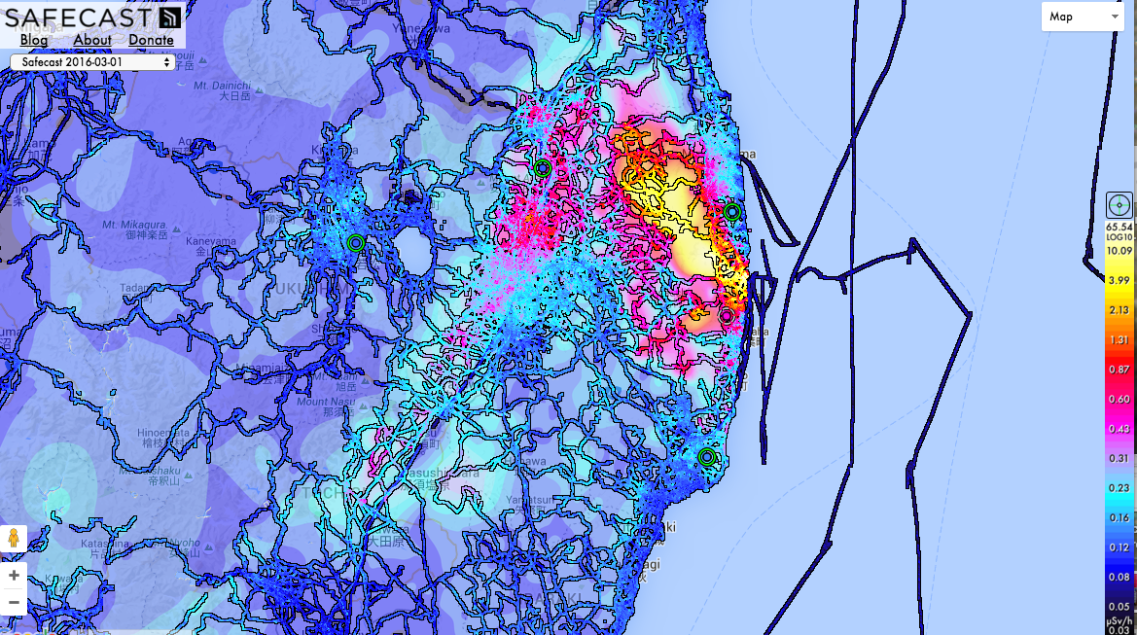
Credits: Image from the Safecast map (http://blog.safecast.org/maps)
It is nowadays plain that climate change, pollution and other environmental hazards directly and indirectly affect the physical, social, and psychological health of humans. This public and environmental health risk could be minimized with effective adaptation strategies and proper governance. People are increasingly becoming aware of the preventability of these risks, and push for a change in the way in which the risk is communicated and managed. When the institutional players responsible for taking action show a dominant attitude of inertia, lay citizens tend to react in defence of their right to an healthy environment and – in case of urban settings – their right to the city. This contribution focuses on how non-expert people take advantage of technology (in particular sensors and open access data infrastructures) to visualize, monitor, report and combat threats caused by environmental factors to public health. The practice is labeled as ‘Citizen Sensing’ standing for bottom-up initiated monitoring initiatives based on ICT, in general, and, in particular, on sensors.
The ‘Citizen Sense’ [1] project (2013 – 2017) states the following about Citizen Sensing: “Practices of monitoring and sensing environments have migrated to a number of everyday participatory applications, where users of smart phones and networked devices are able to engage with similar modes of environmental observation and data collection. Such ‘citizen sensing’ projects intend to democratize the collection and use of [..] sensor data in order to facilitate expanded citizen engagement in environmental [health] issue”.
From this statement, it can be inferred that Citizen Sensing is a practice of monitoring environmental (health) factors using smartphones and networked devices, which may foster citizen participation in tracking environmental (health) factors, including risks. The words ‘everyday participatory’, ‘democratize the (data) collection’ and ‘expanded citizen engagement’ may show a link with the underlying values that inform the governance of the commons. Citizen Sensing finds indeed its legitimacy and justification in the right the citizens have to the collective governance of the benefits and risks that have impact on their health and wellbeing. This goes from the co-governance of a park for the better living of a neighborhood, to the co-management of a risk (e.g. air pollution) which affects a certain community.

The potential of Citizen Sensing for an urban renaissance can be illustrated through an example regarding a well-known case. On 12 March 2011, a hydrogen explosion occurred in the Japanese Fukushima Daiichi nuclear power plant [2]. The residents of the area were advised to stay inside and avoid any contact with the surrounding environment, including breathing the outside air and drinking tap water. The population living in the surroundings of the plant was evacuated. A second explosion occurred on 14 March worsened the radiation level. Soon, the shortcomings of the government monitoring system emerged (Hemmi and Graham, 2014) [3]. The state system was indeed based on a network of fixed sensors that used models to calculate radiation levels. This meant that numerous locations could not have been checked, which caused anxiety and mistrust in the dwellers exposed to the risk of radiations. The state approach in this case is a clear example of the ‘linear’ way of governing environmental risks to public health by the institutional actors responsible for those risks (Fisher, 2017) [4]. Generally, the institutional approach is based on high quality monitoring equipment requiring a considerable expense and continuous labour, which often leads to low spatial and temporal resolution. Furthermore, this monitoring often leads to results which are not easily accessible by non-professional citizens, thus contributing to create a knowledge gap between those exposed to a certain risk and those having the recognized ‘expertise’ to address that risk. As registered in the Fukushima case, this approach is likely to cause a sense of public skepticism about how the institutions are facing a certain risk. This leads, on one side, to a disruptive tendency (criticizing and rejecting the established system of risk governance), but, on the other side, it constructively stimulates alternative ways for governing a risk, and a push for a co-governance of it.
In the case presented, the aforementioned tendency can be identified in an increase in the sales of radiation monitors purchased by citizens who wanted to measure their exposure to radiation. And they did not limit to that. They organize themselves in an organization, “Safecast” [5], devoted to open Citizen Science for the environment and, in particular, for radiation monitoring after the Fukushima accident. The web-based platform was established in 2011 by a group of volunteers with the aim to make publicly available accurate and trustworthy radiation information, with a view to complementing or substituting the insufficient official information. On the today still existing platform, the data are visualized using Google Fusion Tables to produce maps. Specifically, the Safecast Map depicts over 4,000,000 radiation data points. The map is fed with ad hoc data collected by citizens through low-cost radiation monitors. The data are licensed with a Creative Commons 0 license, which allows anyone anywhere in the world to use the data for any purpose. The trend from few, expensive, state-owned sensors to many, widespread, publicly-owned monitoring devices shows the need for an horizontal transparency, which entails even access to information and reliance on bottom-up produced knowledge. The success of the initiative demonstrates how technological innovation can play a key role in enabling collaboration and sustainability within and beyond the city, and can enhance co-governance of common resources as well as of common risks.
Cases like Safecast indicate the willingness of people to see their right to live in a healthy environment in action, and their commitment to have it enforced through the legal, social and even technological avenues available to them. Thorough research is needed on the influence of bottom-up citizen sensing on the governance of public/environmental health risks and on its acceptability from institutional stakeholders. There is a high demand for reflections on alternative/complementary ways to face today challenges and Citizen Sensing practices may be part of the answer. Despite its potential, Citizen Sensing will be often disputed on the basis of alleged deficits of legitimacy. Nevertheless, the values deriving from theories of urban co-governance, the principles supporting the right to a healthy environment and a conceivable right to the co-city/co-governed living environment may lay the foundations for contesting similar arguments.
Il presente articolo illustra il desiderio emergente del cittadino di fare uso dell’innovazione tecnologica (in particolare sensori e infrastrutture informatiche) al fine di visualizzare, controllare, riportare e combattere minacce causate da fattori ambientali alla salite umana. Tale pratica – qui definita come ‘Citizen Sensing’ – viene analizzata attraverso un caso studio, quello della piattaforma di monitoraggio dell’inquinamento nucleare creata da membri della società civile in risposta all’esplosione della centrale nucleare Giapponese Fukushima Daiichi. Il caso si presenta come occasione di riflessione sulla possibilità che iniziative di Citizen Sensing possano trovare legittimazione nei valori che informano la co-gestione dei beni comuni e, da ultimo, nel diritto del cittadino alla co-gestione della città e in generale dell’ambiente abitato. Tale co-gestione può interessare una risorsa condivisa, come ad esempio un parco, ma anche un rischio condiviso, come appunto l’inquinamento nucleare nel caso presentato.
[1] For a recent definition of Citizen sensing see the CitizenSense project: http://citizensense.net/about.
[2] To know more see http://www.world-nuclear.org/information-library/safety-and-security/safety-of-plants/fukushima-accident.aspx.
[3] Akiko Hemmi & Ian Graham (2014). “Hacker science versus closed science: building environmental monitoring infrastructure”. Information, Communication & Society, 17:7, 830-842, DOI: 10.1080/1369118X.2013.848918.
[4] Fisher, E. 2017. “Framing risk regulation: A critical reflection”. European Journal of Risk Regulation 4(2): 125-132. doi: 10.1017/S1867299X00003299.
[5] For the Safecast platform see https://blog.safecast.org/about/.


