by Chiara Fratalia | May 30, 2016 | The Urban Media Lab

Money savings and personal satisfaction produced by urban gardening have allowed people to rethink chicken breeding in a “more local” way: in many US and Canada cities people can grow their own hens in their backyard, just as they would do with tomatoes or salad in their kitchen garden.
This tendency was accelerated by the outbreak of salmonella in 2010, that led to the nationwide recall of 500 millions store-bought eggs, thus driving down the perception of their being risk-free; and now it has become a way to have a larger control on the food we eat everyday, while cutting energy use and fuel emissions for the trasportation of eggs from farms to cities.
Julie Simpson, president of the pro-chicken group Urban Chicken Advocates of Nashville, in an e-mail to the New York Times says: “It simply made sense to me to have a few chicken in my backyard. I was concerned about where my food was coming from, and having backyard hens was one small thing I can control”.
Buying chicks is easy and cheap, so most of the potential problems depend on having too many chickens in too little space. For this reason, some cities, such as Nashville and Portland, have approved motions that allow urban hen breeding, but with a limitation in the number of hens, calculated in reason of the land extension. These limitations found the approval of Pamela Geisel, director of the statewide Master Gardener Program run by the University of California Cooperative Extension, that says they “can help chicken keepers be better chicken keepers”, allowing them to avoid bigger risks.
Hens breeding it’s not just collecting fresh eggs for your breakfast, but it is a heavy daily effort to keep them clean and healthy, and for some people it’s not just worth the effort. But not for Ms. Geisel: “I love my chickens. They’re my pet” she says about her six backyard hens. “And homegrown eggs”, she added, “are so much better and tastier than store-bought”.
These eggs are not only tastier and healthier: they are far more enviroment-friendly and sustainable. In facts, eggs are in the top ten products with higher carbon footprints: the production and distribution in supermarkets of 1 kilo of eggs produces an average of 4.8 kg of greenhouse gases, that is the equivalent of 11 car miles. Also, more than half of the emissions (2.7 kg) are made only in the transportation phase, that is completely eliminated in case of urban breeding.
Not only an increase in food security and a decrease in damaging emissions: domestic chicken breeding is likely to be free from the ethical dilemma produced by intensive industrial farming. The domestic breeder is likely to develop some sort of an affection for his/her pet chickens and hens, and will probably avoid brutal practices such as the detention in barren battery cages, or the genetical selection.
In the broader framework of a local program that endorses community gardening and urban farming, these practices could significantly cut down greenhouse gases emission, by operating a substantial reduction in the need of goods transportation. Moreover, urban farms and community gardens could also work as carbon sinks: in facts plants (especially the evergreen ones) absorb atmospheric carbon dioxide (CO2) and release breathable oxygen (O2) through photosynthesis, thus relieving the carbon accumulation that is innate in urban areas.
In addition, plants absorbe and remove particulate matter, the result of the burning of fossil fuels in vehicles and power stations, classified by the WHO as one of the most dangerous carcinogenes. Given this statement, is easy to say that this cleaning action carried out by community gardens could reduce mortality rates in urban areas. To give an example of plants effectiveness in pollution abatement, Bradley Rowe in his essay states that “just one square meter of uncut grass on a city roof is needed to offset the annual particulate matter emissions of a car“.
Gwan-Gyu Lee, Hyun-Woo Lee and Jung-Hwan Lee have shown in their essay that the spreading of urban agriculture in Seoul, one of the most advanced cities in terms of collaborative and sustainable governance of the commons, has reduced the greenhouse gases emission by a rate of 11,668 tons per year. This value is the equivalent of the CO2 emissions for 1155 persons on the annual basis of 10.1 tons of CO2 emissions per capita (2007 data), and it has been achieved with a urban agriculture area of just 51.17 square kilometers, which is about half the extension of rooftops in New York City.
_______________________________________________
L’allevamento domestico di galline e polli è una pratica sempre più diffusa negli Stati Uniti, che permette di controllare maggiormente il cibo che mangiamo ed eliminare problemi etici come i trattamenti abominevoli subiti dagli animali negli allevamenti intensivi. Nel quadro più ampio di un programma di incentivo all’urban farming e al community gardening, queste pratiche potrebbero avere un impatto significativo sulla riduzione del carbon footprint e sulle emissioni di gas serra, per la gran parte dovute al trasporto delle merci dai luoghi di produzione ai supermercati.
by Chiara Fratalia | May 20, 2016 | The Urban Media Lab
Fulcro della sperimentazione tecnologica delle pratiche di condivisione, le città sono diventate il centro del dibattito sulle politiche pubbliche che riguardano la sharing economy. Città di tutto il mondo, come Seoul, Amsterdam e Londra, hanno cominciato a implementare programmi, legislazioni e regolamenti-quadro per supportare la sharing economy locale. Una di queste città è Milano, patria di Milan Sharing City, un progetto compreso nello Smart City Program.
Abbiamo recentemente avuto il piacere di intervistare Renato Galliano, supervisore di Milan’s Smart City e del progetto Sharing City. Gli abbiamo chiesto di parlarci delle origini di questo progetto, e ci ha anche fornito una prima valutazione dei suoi successi e dei suoi limiti, riguardanti anche argomenti di importanza fondamentale come la partecipazione e l’inclusione.
Questo articolo è il primo d una serie, co-prodotta da LabGov e Shareable, che vuole mettere in evidenza le politiche pubbliche che promuovono la sharing economy e la tutela dei beni comuni urbani.
Enjoy the interview!
“Monica Bernardi and Christian Iaione: How did Milan Sharing City begin?
Renato Galliano: The Smart City Division has always taken a keen interest in innovative processes, especially in the urban setting and, above all, in a period—like this—of economic paradigm change. We looked at the sharing economy as we [had] previously looked at other [developments], such as innovative spaces (ex. co-working) and the relationship between [startups] and traditional industry. Recognizing [the potential of the sharing economy to become] an important phenomenon from different points of view, in early 2014 we decided to accompany its development.
[At that time], there were already several groups working on the topic. Sharexpo and Sharitaly were the main ones. [Sharexpo encouraged] reflection on the potential of sharing economy to [mitigate] the extra load on the city that [Expo Milano] would bring. We engaged with all the actors involved an open and collaborative dialogue, to learn about their needs, goals and problems.
[Our] working method, based on a listening phase, followed by a participatory phase and, as a last stage, the delivery of [a public policy instrument], has been adopted also in other policy areas: in a macro way for the Smart City theme, involving big urban players such as universities, businesses and [voluntary and community organizations]; and also for specific phenomena like co-working.
[Regarding co-working], listening to the actors involved [encouraged] us to rethink our first idea of intervention. [Instead] of creating a public co-working [space, we decided to] support the existing structures, without becoming a player in opposition [to them]. We developed ad hoc public policies such as the Co-working Register and the coworking spaces’ voucher supply system.
The same path has been followed for the Sharing City. [During] the initial phases, we collaborated [with the public] on a draft document on the topic. [We brought the final document] to the City Council [pdf] for approval and published guidelines for the sharing economy [pdf], launching a series of collaborative tools. One example is the Register of the Sharing Economy’s Actors [pdf], [which includes a list of] experts and operators (to date more than 100), followed by other activities [brought to our attention] during consultation, such as: civic crowdfunding platforms; Co-HUB, a physical space to cultivate the culture of sharing and the collaborative economy; and a call from our social innovation incubator, FabriQ, for startups working in the field.
I’d like to underline that we worked on two levels: at the local level, as seen, but also on [the national and international] levels. [We liaised] with the EU Committee of the Regions, which was working on the Opinion on the Sharing Economy at the EU level. On the national level, we worked on a proposed national law on the sharing economy with, the Italian Inter-parliamentary group for innovation, Forum PA, and ANCI. [We also worked] with some international operators such as AirBnb to define specific agreements. However, I believe that public policy [should not aim] to lock the sharing economy within stringent regulatory frameworks, since it responds to a real need—social or economic—that goes beyond the policies adopted at local, national and international levels.
What unites Milan’s various sharing economy policies?
We framed the Sharing City project [within the larger] Smart City process. The latter is a transdisciplinary public policy, and the mandate is of coordination—not of realization. The topic of the smart city is [appreciated less for its] technological dimensions and more from the citizens’ perspective. Within this “human smart city”, the sharing economy represents a tool, among others, to improve the quality of life of city-dwellers and enterprises.
[It is essential that the] different divisions [working on the smart city] dialogue and work [together]. The real problem is related not to the content of the projects, but to the traditional, “siloed” approach of public administration. To overcome this attitude is not easy, but in Milan the entire smart city process has been conducted in a horizontal way, analyzing internally the city’s projects, in a multi-purpose approach and speaking with the individual directors.
What difficulties did you encounter in developing policy for the sharing economy?
The main difficulties are not related to the city itself but to the phenomenon. First of all, the issue of regulation of new unplanned activities that touch corporate interests stratified over the decades. For this reason we decided to work [beyond the] the local level, since some regulatory arrangements depend on national and EU [authorities].
Another general difficulty is connected to the extreme diversification of the sharing economy’s actors, from multinational corporations with international technological platforms to community experiences, such as Social Street, and non-economic exchange platforms of goods and services. The diverse actors hold dissimilar skills, competencies, backgrounds, and economic power, and sometimes don’t recognize themselves as part of the same phenomenon. The approach must be different [for each case], based on specific languages and features.
On the [other hand], the feedback from citizens has been excellent. The public administration’s intervention has been perceived in a positive, non-invasive way, as an accompanying relationship. The current difficulty is to switch from the city level to the metropolitan level. We would like the Register, for example, to take a metropolitan dimension to formally intercept actors and experiences outside of the city.
Which projects have been most successful?
Fifteen high-quality projects were selected through a call and incubated at FabriQ; among them, only two are experiencing some difficulties. [But keep in mind that] the municipality intervened more [at the level of] governance [than at] the projects level. We don’t [directly supervise the projects]. After [an understandably] difficult first phase, the local projects, like Social Street, are doing very well, and are involving a growing number of citizens. The big platforms, like AirBnb, could count on the flywheel effect of universal exposure and are thriving in the city. [Some projects face challenges] related to a series of obligations introduced to respond to real local needs (fees for use of public land, taxes for marketing, etc.).
In terms of projects initiated directly by the municipality, the civic crowdfunding [scheme] is receiving positive feedback. We chose the platform, Eppela, through a public call, instead of creating one by ourselves, and now we are evaluating the projects received [through it].
How would you rate Milan Sharing City’s record on participation and inclusion?
About participation: yes, our process is facilitating participation. It is a subject of interest for [those citizens working on responding to local needs]. These needs can be of an economic nature or related to community building. [In the former case, sharing projects] can produce income for someone or save them money; [regarding] the latter, [projects foster community] relations by encouraging residents’ participation. In addition, the participatory budgeting process, with one million Euros for each of the nine zones of the city, is clearly reinforcing this aspect.
[The issue of inclusion is more closely related to] the content of the projects. For some of them, the main goal is exactly the inclusion of vulnerable subjects; others have cross-cutting [goals]. In general, the topic of inclusion is defined more in terms of social innovation. Therefore, even social businesses’ projects, which aim to solve social problems and favor integration, are able to reduce social exclusion.
An example is the FabLab that will open soon in D’Azeglio Street: the project includes associations, the third sector, schools, other FabLabs, etc., in a logic of deep integration. Other projects that have a clear goal of including specific groups, such as NEET (addressed to young people not engaged in education, employment, or training), or OpenCare, can count on the active participation of FabLab.
The governance dimension is clearly crucial. What new relations and collaborations were established through the project?
The main governance tools that we use are the public calls and the Register, which are inclusive tools by design. They allow a phenomenon to emerge instead of selecting or evaluating the actors that are part of the phenomenon. For example, the Register is public and presents the description of each actor registered. We called them with specific [follow-up] questions [that helped initiate] new interconnections and relations.
In general, new relations are emerging, thanks to the call that allow us to enter into contact with subjects interested in the topic, or through the community’s projects, or in a direct way, as [with] AirBnb. The calls for the Co-HUB space, the crowdfunding platform, and the FabriQ incubator are all important governance tools that are opening new sets of relations.
Are any key actors missing from the Milan Sharing City process as it currently operates?
The entire traditional financial world is still not involved in this discourse. The reason, [I imagine], is that their internal rules do not allow financial institutions to [respond] quickly [to new economic phenomena]. This [affects] not only the sharing economy, but also the smart city discussion as a whole: banks are not able to finance smart city projects, unless they [fall into very specific categories], such as energy projects. In some cases, banks are unable to evaluate the market value of the new platforms, [especially] if they generate a low economic return (as with the platforms for the exchange of goods).
Paradoxically, the stock market [should be] able to assess the value of these platforms, since it doesn’t value only the [projects’] budgets, but also their potential for development, the involvement of other actors, and so on. At some point, the involvement of the financial world will become necessary; otherwise [these initiatives will suffer from a lack of funding].
What will happen to Milan Sharing City in the future, especially in view of the coming elections?
The phenomenon has started, and in my opinion it cannot be stopped. The future is uncertain; [soon we will hold] elections, and a lot will depend on the political approach of the new city government. But even if [the new government is] completely against the sharing economy, the phenomenon will keep going, since it responds to authentic needs. I hope the new City Council will add value to [what we’ve] built [over the past] five years. There are unequivocal figures about the position of Milan in terms of our focus on the smart city, the sharing economy, and social innovation, with awards and recognitions at national and European levels. It would be such a waste not to enhance this legacy and thus lose our competitiveness.
What are the next steps in the Milan Sharing City process?
After working on the emergence of the phenomenon and on the dialogue and agreements with new actors, the goal of the next five years, in my opinion, should be the setting-up of concrete but flexible structures through which the administration can directly dialogue with other stakeholders. Milan should adopt a kind of innovation agency to create new relations and partnerships, and [to address the city’s international standing].
[On the metropolitan level, it would be interesting to see emerge an authority who could] partner with the different municipalities, the chambers of commerce, the universities, and so on, aggregating all the different actors [in order] to promote innovation at all levels.”
Originally published by Shareable, here.

by Chiara Fratalia | May 13, 2016 | The Urban Media Lab
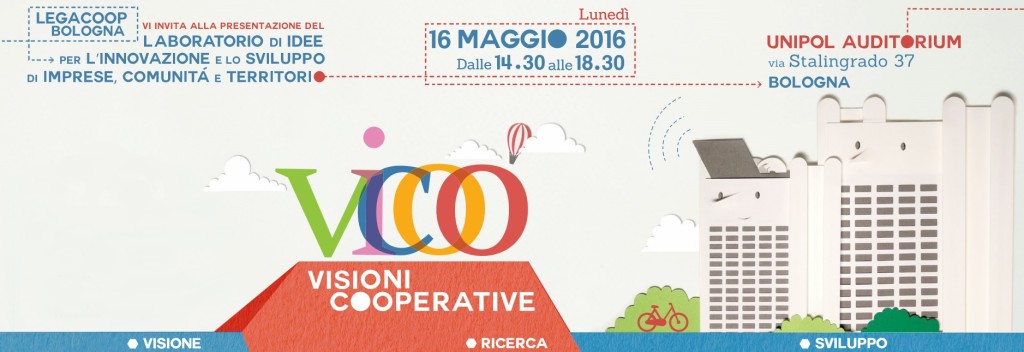
LabGov with professor Christian Iaione will take part in the ViCoo – Visioni Cooperative conference!
On the 16th May prof. Iaione will attend the presentation conference of ViCoo – Visioni Cooperative, the laboratory of ideas created by Legacoop Bologna to introduce new roads towards innovation for communities and territories elaborated with research centers and international and Italian universities. The event will be opened by Sarwanth Singh, member of the Advisory Board of the Leeds University Business School and founder of the research group on Mega Trends. Many researchers will intervene, those who work together with Legacoop Bologna to elaborate strategic trajectories and innovation proposals for the development and growth of territory cooperatives.
The conference follows other events on the same subject that occurred in the last month.
For instance, CUBO (Unipol Centre Bologna) on the 26th of April hosted a reflection on the development of suburbs and urban requalification, by means of a comparison between the experiences of Turin, Melpignano (Lecce), Naples and Bologna. This event was part of the program #PrimaveraPilastro2016, a series of events in the framework of a bigger project that aims at adding value to the Pilastro neighbourhood in Bologna by trying to build a cooperative community.
Another event on this subject was organized by Eutropian and took place in Rome on May 5-7, with the title “Funding the Cooperative City. New models for community spaces”. The event aimed at discovering new economic models for community-led urban development, through comparisons of experiences and initiatives in a debate that involved researchers coming from Italy and Europe.
LabGov coordinator, prof. Christian Iaione, has contributed to the research effort in finding new theoretical and practical frameworks to realize and promote the collaborative city model. He recently wrote an article, published on the American Journal of Economics and Sociology, in which he investigates if urban assets and resources can be transformed into sharing, collaborative, cooperative, commoning ecosystems that enable collective action for the commons.
Prof. Iaione underlines the important social functions carried out by urban spaces and community services: they encourage higher sense of belonging to the community, help to overcome political apathy, foster social cohesion, thus being crucial to a community’s well-being. He also states that urban commons are undergoing a deep crisis period, determined by the decline of public or collective spaces and citizen disaffection; urban public spaces are thus perceived as nobody’s places, rather than everybody’s places.
For this reason, it is necessary to rethink the governance of the commons: the quantitative and hierarchical, centralist approach to promoting urban space, typical of an exclusive public administration, must be replaced by a polycentric, qualitative, and relational concept of urban welfare and urban commons, which is urban co-governance.
He also proposes five design principles of a “commonsbased urban governance matrix”:
- introduction of urban commoning through regulation or a new group or organization;
- collaborative governance of sharing, possibly in conjunction with a collaborative economy based on a complementary currency system and local development agencies;
- social innovation as the basis of a shift from a traditional urban welfare system to a collaborative welfare system;
- radical transformation of the internal organization and work methodologies of urban bureaucracies into citizens enabling communities of service designers;
- establishment of a collaboration laboratory (Co-Lab), a living lab where collaboration takes place, is taught, and communicated.
Prof. Iaione discussed his paper in the 4th European Regional Meeting of IASC, that took place in Bern from the 10th to the 13th May with the following subject: “Commons in a ‘glocal’ world: global connections and local responses”. The article was debated in the B20 panel, which would like to examine the concept of Smart Cities in India, and contrast it with the advances that other countries made in redefining their concepts of urban commons.
For more information, see the ViCoo – Visioni Cooperative event program.
You can also read our previous articles on Pilastro2016, Rome Eutropian conference and Bern IASC conference.
_____________________________________
Il prof. Christian Iaione, coordinatore di LabGov, parteciperà alla conferenza di presentazione di ViCoo – Visioni Cooperative, un laboratorio di idee organizzato da Legacoop Bologna per esplorare nuove rotte verso l’innovazione di comunità e territori. L’evento ne segue altri sullo stesso argomento tenutisi nell’ultimo mese, come la conferenza CUBO #Pilastro2016, l’evento Eutropian a Roma e la 4a Conferenza Regionale Europea di IASC a Berna. Proprio in quest’ultimo evento il prof. Iaione ha presentato un importante articolo che propone i cinque pilastri fondanti per una corretta ridefinizione del concetto di governance dei beni comuni.