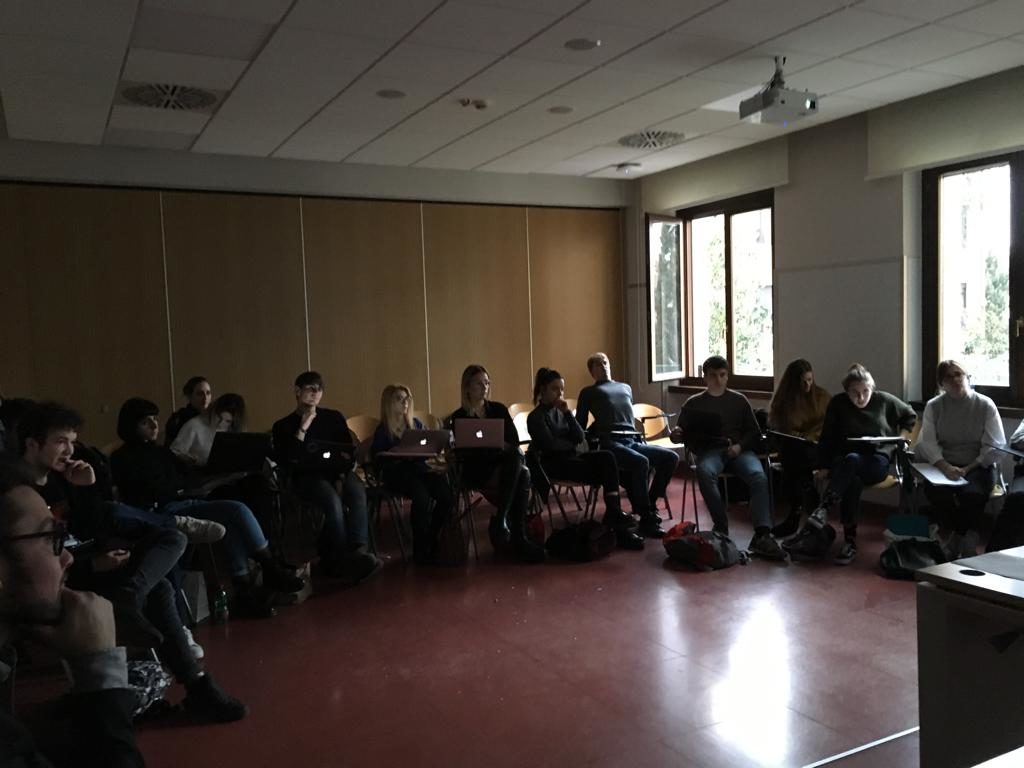
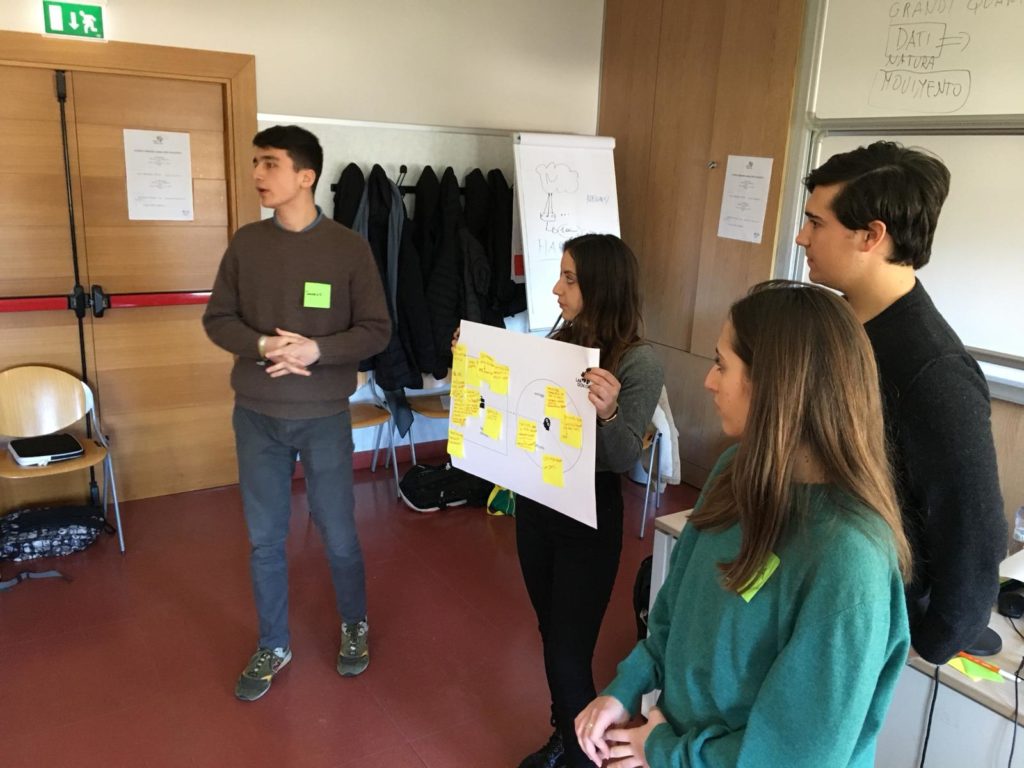
The process of the Edu@LabGov Urban Clinic’s action on the city/university territory continues with the Community Gardening session which took place last Saturday the 9th of March 2019 in the LUISS Community Garden from 10 am to 12 am.
Labgovers, at
first divided into three groups, started working to the construction of three prototypes
of their project, using waste/recycled. Following the project’s idea elaborated
during the Co-Working sessions in class, and also thanks to the advices of agronomist
and botanist, dr. Barbara Invernizzi, the students completed the structure with
fruitful outcomes.
These two
hours of Community Gardening represented the starting point of a process of
collaborative action which aims to concretize the principles of sustainability
and circular economy which are central for the Urban Clinic. Nevertheless, the self-construction
Lab is still a fundamental collaboration-gym to understand the importance of
respecting the timeline in a project.
The project
is not over yet: others two meetings are scheduled in the LUISS Community
Garden, one for the 23th of March and one for the 27th of
April.
Stay tuned!
Gli appuntamenti della
Clinica Urbana EDU@LabGov continuano con la seconda sessione di Community
Gardening che si è svolta lo scorso sabato 9 marzo 2019, presso l’#OrtoLUISS,
dalle 10:00 alle 12:00.
I LabGovers, dapprima
suddivisi in tre gruppi, hanno iniziato a lavorare alla realizzazione di tre prototipi
creati attraverso il riuso di materiali destinati allo scarto. Seguendo l’idea
progettuale frutto delle sessioni di Co-Working in aula, ed i consigli dell’agronoma
e botanica Barbara Invernizzi, gli studenti hanno completato lo scheletro della
struttura con ottimi risultati.
I principi della
collaborazione, la sostenibilità e l’economia circolare giocano un ruolo
cardine negli appuntamenti di community Gardening nell’orto universitario della
Luiss. Il laboratorio di autocostruzione (che si svolge in parte degli
appuntamenti di Community Gardening) continua ad essere una palestra di
collaborazione essenziale anche per comprendere l’importanza del saper
rispettare i tempi di una progettualità (allenando alla lentezza), e al fine di
raggiungere obiettivi comuni.
Il lavoro giungerà a conclusione
nel giro delle due prossime sessioni di Community Gardening, previste per il 23
marzo e il 27 aprile.
Save
the date: next Saturday, 9th March we will host the first EDU@LabGov
community gardening session in Luiss Community Garden from 10 am to 12am.
The
LabGovers will work with recycled materials in order to build a prototype that
they will install in Luiss and in the city of Rome. If you are interested in
following their work, follow our official social network!
During
the community gardening session, the LabGovers will put into practice what they are learning during the forms in the classroom
therefore it will represent ahead important footstep in the realization of
their project.
The assisted gardening is not only a didactic
moment but an activity of practical collaborative among the boundaries of the University
Luiss Guido Carli, that then the students will experiment on the field in the
city of Rome.
Stay tuned!
Save the date: Sabato 9 marzo si terrà
il primo community gardening della Clinica Urbana EDU@LabGov presso l’#OrtoLuiss
dalle 10:00 alle 12:00.
Durante la sessione di community
gardening i LabGovers, divisi dapprima in quattro gruppi sulle diverse aree di
lavoro, dovranno presentare i dati raccolti nel corso della settimana e
iniziare a dar forma al loro progetto. Inizieranno quindi un laboratorio di
auto-costruzione che, tramite l’utilizzo di materiali riciclati, li porterà a
realizzare un prototipo che installeranno nella città di Roma. Se volete
saperne di più rimanete connessi ai nostri account social ufficiali quel
giorno!
L’obiettivo
è mettere in pratica ciò che gli studenti stanno apprendendo durante i moduli
in aula, quindi rappresenterà un importante passo avanti nella realizzazione
della loro idea.
Il gardening assistito non è solo un
momento didattico ma un’attività di pratica collaborativa tra le mura
dell’Università Luiss Guido Carli, che poi gli studenti sperimenteranno sul
campo nella città di Roma.
Co-working session “Entrepreneurial lab” with Alessandro Piperno
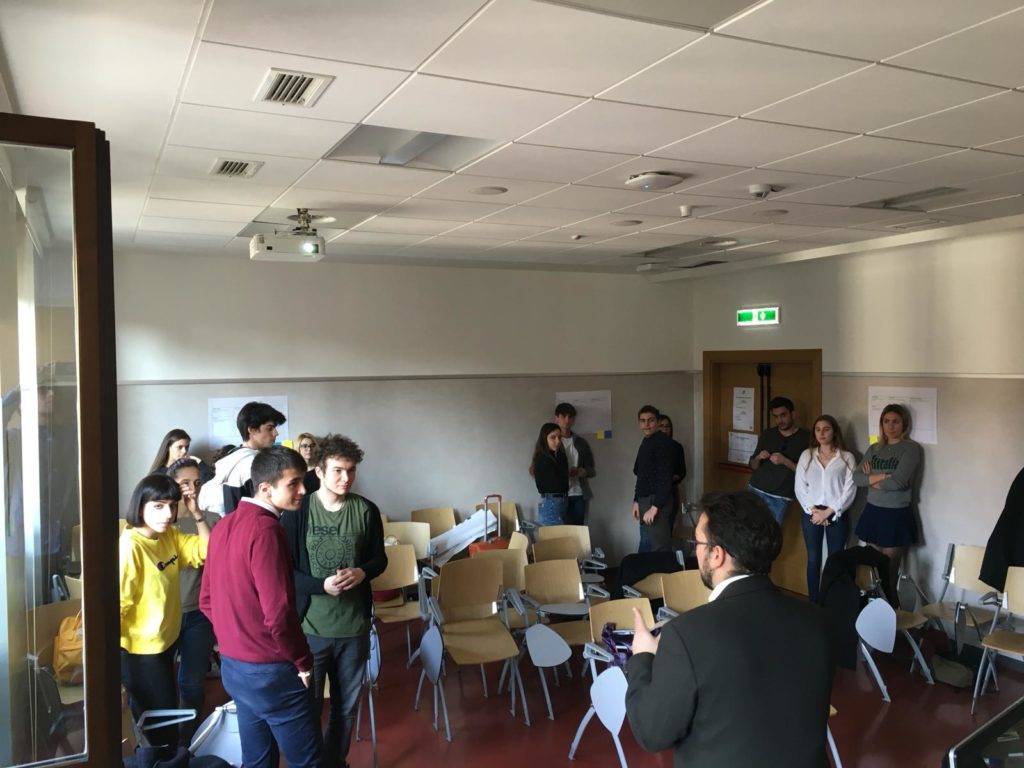
The Module II of the Urban Clinic of LabGov EDU 2019 continues with a Co-working session on March 2nd, “Entrepreneurial lab” facilitated by Alessandro Piperno (Phd student at the Department of Economics and Management of LUISS University).
The co-working session takes place in the LUISS Campus of Viale Romania and starts at 10 am with a recap on the project idea that the LabGovers (the students enrolled in the Urban Clinic) are incubating: a network of digital community gardens spread among city neighborhoods that among the other things provide contents on food, wellness and healthy lifestyle. The co-working session of the “Entrepreneurial lab” of March 2nd is focused on the design of the social business model of the entrepreneurial idea.
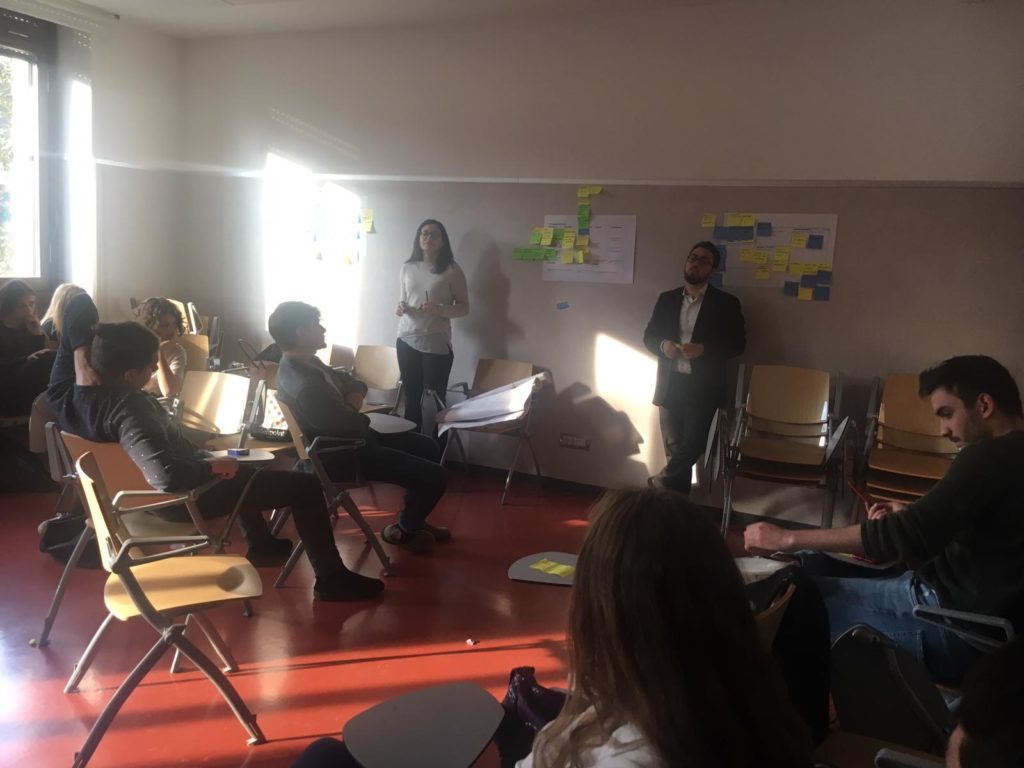
After an introduction on the main features of a social enterprise, an hybrid enterprise aimed at solving social challenges with a sustainable business model, the group worked on the identification and definition of the main services that the enterprise wants to offer. This phase of the co-working session leveraged on the work carried by the four LabGovers’ working groups in the period between the modules.
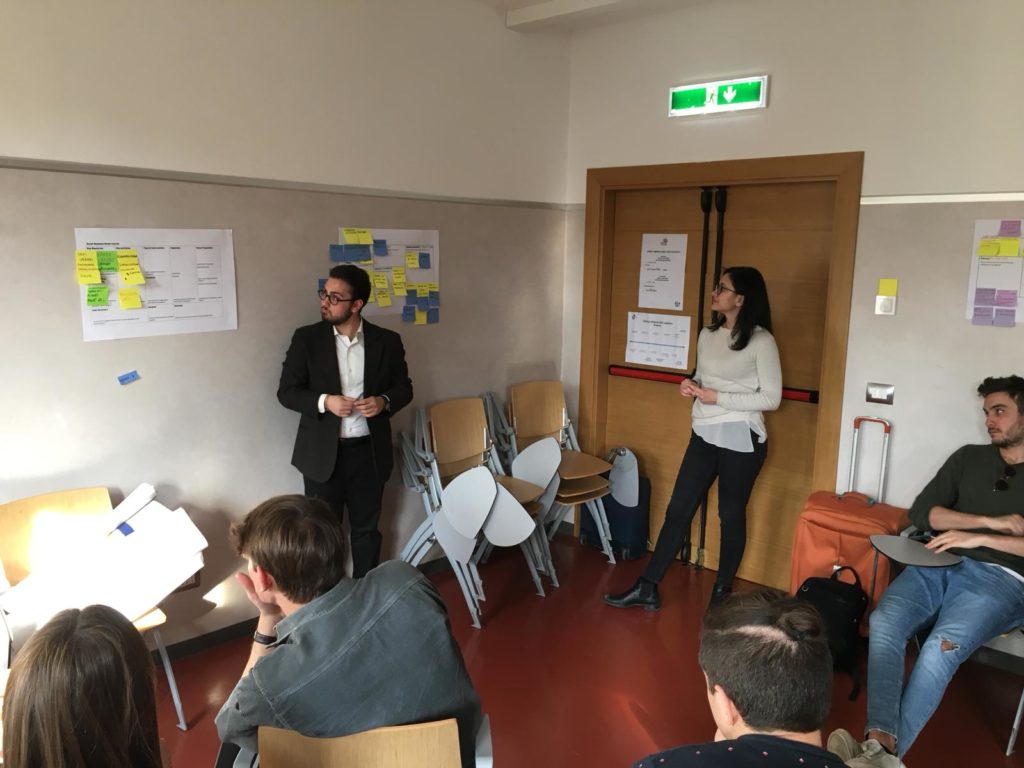
After the definition of the service, the LabGovers are divided into groups and worked on the social business model canvas, identifying its core elements: stakeholders; actions; resources; types of intervention; channels to distribute the service; beneficiaries of the action and targets; clients and users; revenues; costs.
Workshop “Social Business Modeling” with Professor Francesco Rullani, March first 2019
The second module of the Urban Clinic of LabGov EDU 2019 focuses his activities on social entrepreneurship. The module is composed by a workshop, carried out by Professor Francesco Rullani on the organization of social enterprises and social business modeling and a co-working session facilitated by Alessandro Piperno, an “Entrepreneurship Lab”.
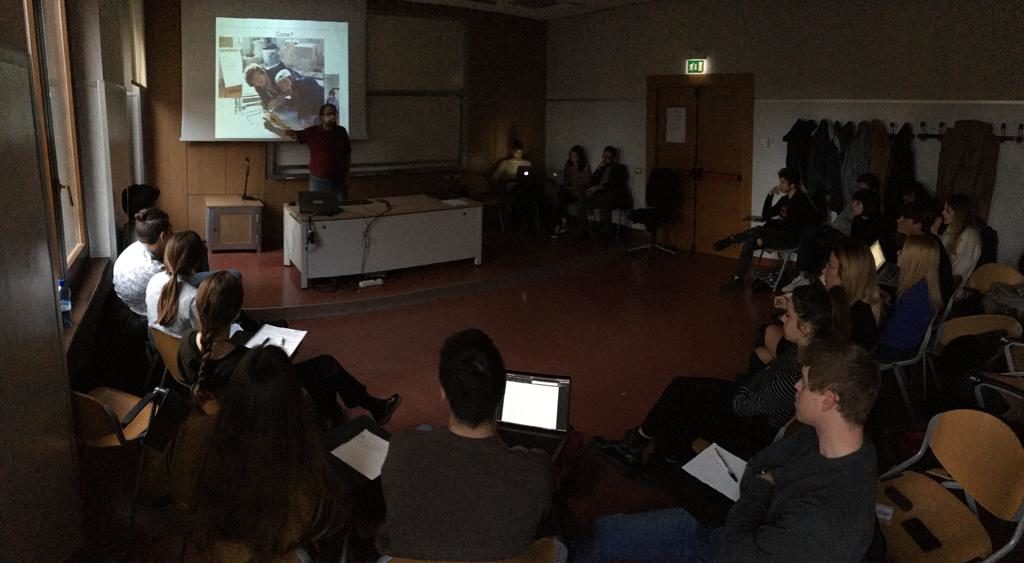
The workshop on social business modeling was hosted on March 1st 2019, at the LUISS campus of Viale Romania and consisted in a lecture by Francesco Rullani. Francesco Rullani is Assistant Professor in Entrepreneurship and Management of Innovation at LUISS Guido Carli in Rome (IT) and Coordinator of the ERSHub (the Hub for Ethics, Responsibility and Sustainability).
Professor Rullani
starts its presentation on “The Commons and Business models” with a discussion
on the major philosophic and journalistic work of the political philosopher Hannah
Arendt. Professor Rullani argues that the main message that we can take out of the
book Is that within a hierarchical regime there is a detachment between the task
that one must carry out (the order to be executed) and what one does to concretely
carry out the task. The banality of evil is represented by the fact that, within
the totalitarian regime, the approach of the people towards their actions was de-humanized.
The human dimension was banalized until it disappeared, and so was the
perception of the true meaning of the action.
The lecture
then moves towards Milgram experiment on human behavior that was carried out in
the aftermath of the Eichmann process in Jerusalem (1961) A social psychology
experiment conducted by Yale University psychologist Stanley Milgram, it
measured the willingness of study participants to obey an authority figure that
was instructing them to perform acts conflicting with their personal conscience,
for instance violent acts. They had to administer electric shocks to a subject
to which they were posing questions. For every wrong answer, the voltage of the
electric shock increased gradually, until they reached levels that would have
been fatal. The electric shocks were unreal (the learners were in fact Milgram’s
collaborators). The experiment highlighted the role played by obedience to
authority in a closed and hierarchical system.
The learning point is that life in social systems is filled with coercive systems that impose and nudge behaviors. And such systems are stronger than the community ties, because they have the capacity and the strength to absorb individuals’ responsibilities. The two main systems are the State and the Market.
Those systems solve their problems through bureaucracy (the State) and transactions (the Market). The systems are designed to reproduce mechanisms on which they are based and to expand their sphere of action. f you ask the bureaucracy to solve a problem, it will do it by producing procedures, while if you ask a community to solve a problem it will produce responsibilities. The social sector (in Italy, the third sectors) is mainly composed by communities regulated by systems based on responsibilities. Those systems solve their problems through bureaucracy (the State) and transactions (the Market). The systems are designed to reproduce mechanisms on which they are based and to expand their sphere of action. f you ask the bureaucracy to solve a problem, it will do it by producing procedures, while if you ask a community to solve a problem it will produce responsibilities. The social sector (in Italy, the third sectors) is mainly composed by communities regulated by systems based on responsibilities.
A key issue with the social sector is though economic sustainability. There is in fact often a tension between the creation of economic value and the normative foundations of such communities and this tension is one of the factor hampering the production of value in social enterprises. Other factors hampering the access to value production in social enterprises could be, for instance, the lack of access to credit warranty (which could be solved through the creation of collaborative and solidarity networks between social entrepreneurs) or the lack of skills. The social enterprises therefore often comes out with hybrid solutions, hybrid practices that allow them to use their productive capacity by integrating marginalized subjects and pursuing the social good. Example in Italy is the case of “Made in Carcere” (made in prison). The project consists in laboratories of construction with waste materials. In the labs, learning and facilitation to enable access to capital, skills and distribution for the access to the final market are provided. This is a case of a social enterprise that produce a positive impact both socially and environmentally by working against the sense of not being the creator of one’s life that affects an individual when she/he is in prison. By giving them access to such opportunity, they cease to be prisoners and begin to be workers responsible for what they produce and for what they do.
Co-working session “Idea Generation lab”, February 23 2019.
The first module of the Urban Clinic of LabGov EDU continued with the first co-working session, the “Idea Generation Lab”, that took place on Saturday February 23rd, 2019.
In the idea generation lab, the LabGov team facilitated the emersion of a shared project idea leveraging on the body of knowledge generated during the Opening day of the Urban Clinic, on the intersection between agricolture and technology as a tool to improve welfare in cities. The idea generation lab began with an inspirational speech by Raffaele Ciriani, President of the Italian Association of Apicultures and Barbara Invernizzi, landscape architect and expert in the facilitation of community gardens in complex urban environments. Barbara Invernizzi will accompany the LabGovers throughout a laboratory of self-construction of prototype a mobile beds garden (beginning on March 9).
The inspirational session was conducted by Raffaele Cirone, President of the Italian Federation of the Beekeepers. He has created two urban apiaries, in the center of Rome. One on the Rooftop of Confagricoltura building and the other in the a police station. The bees monitor the quality of the air and the urban environment. Such an interesting idea!
After the inspirational session, the facilitation session began and the team asked the LabGovers to identify keywords main issues that emerged from the opening day of the Urban Clinic. The keywords and main issues were then clusterized in macro-themes, on which the project will be build upon.
In the second part of the co-working session, the LabGov team introduced to the students the social value proposition canvas. The LabGovers were then split in four groups that worked on the social value proposition canvas separately. Then, in the plenary session, each group shared their work and the team synthesized the groups’ work and filled in a unified canvas. The project idea was therefore defined starting from the shared elements included in the groups’ work.
The LabGovers were ultimately divided in four groups, that will work on gathering the data and carrying out key tasks necessary to refine the project idea generated during the session and move towards the next co-working session: group 1) desk research 2) logistics and material for mobile garden tutorial 3) interviews on community garden (conducting interviews with representatives of community gardens in the city 4) guerrilla research (survey to LUISS students to validate the initial project idea with a first sample of respondents).
The first
workshop of the Urban Clinic LabGov EDU in Luiss University was dedicated to
urban planning. It took place in Luiss Campus on Friday 22nd February
2019.
Arch. Massimo
Alvisi from AlvisiKirimoto gave a lecture on this theme. He has started his
lecture by saying to the Labgovers that a very crucial and actual issue and at the
same time challenge for the cities is the shift that has to be done from
conceiving the differences from the city center to the peripheries. He has
affirmed that we have to try to imagine the periphery as a horizon, as a limit
to which to aim. We have, in his words, to reverse the common storytelling of
the peripheries, by making it a place where contamination and meetings happen.
He told the
Labgovers that sustainability means beauty and beauty is fragile. Italy is a
fragile beauty. It is for this reason that urban planning plays a key role in
fostering the sustainability of our cities. It does so by protecting the beauty
from its fragility.
Arch.
Alvisi has then focused his attention to his personal professional experience,
and has narrated to the Labgovers his work with the working group G124, created
by the Italian ‘archi-star’ Renzo Piano[1].
Renzo Piano gives his whole salary deriving from its role as an Italian congressman
to this project (in facts, the name derives from the name of the building where
G124 works, that is palazzo Giustiniani). The working group creates projects
aimed toimprove the peripheries’ architecture. With G124, Luiss and LabGov he
has realized the Co-Battipaglia project[2],
in southern Italy. In this project they have implemented a participated urban
planning and a process of co-created regeneration of the city.