
by Ieva Punyte | Jul 18, 2016 | The Urban Media Lab
On the 15th of July, Unipolis Foundation in collaboration with Fitzcarraldo Foundation and Make a Cube association organised a second mentoring workshop for the 15 finalists (the description of finalists see below, or at: http://culturability.org/notizie/finalisti-bando-culturability/) who have been selected from the “Culturability” call – an Italian national call to support innovative projects in cultural and creative fields to promote urban regeneration processes (see more about Culturability at: http://culturability.org/).

The third day of the workshop series was complemented by Urban Law professor at Fordham University Sheila Foster and LabGov coordinator, prof. Christian Iaione’s presentation as well as an interactive discussion with the audience. Scholars focused on bringing the attention of the 15 progressive cultural innovators to the idea of urban commons and, more specifically, addressing the collaborative governance of commons as the main target in the urban regeneration processes of today.
Coming from the school of thought on commons, Sheila Foster began with questions of what exactly an urban common is and what does it mean to the society and the city as a whole. “Urban commons are what city inhabitants share daily, in fact, these commons are of a deeply democratic nature, because they have an open access meaning that the usage of them is non-excludable”. From a property law perspective it is very important to distinguish urban commons from what is conventionally understood as common pool resources within the field of environmental law. Such distinction is necessary, because these commons differ in terms of their nature, characteristics and value that they create to the society, and hence this affects the character of their governance. “Urban commons are city spaces, such as squares, parks, abandoned or non-utilised buildings, streets, vacant lots, even cultural institutions, for instance, museums, and other urban open-access units – spaces of a truly common good nature”- addressed S. Foster. “These spaces are unique because they generate value, that is precisely of a social and cultural origin and a wide range of city actors have a stake or an interest in these urban commons. Thus, by preserving commons together, we can contribute to an inclusive and sustainable well-being co-creation by and for city inhabitants”.

On the other hand, scholar stressed that commons are not a simple concept in law or theory. “Commons are neither private nor public, it is something in between. Therefore, the question of governance of the commons is condemned to be a challenge from both practitioners and scholars’ viewpoints”. Having addressed the “Tragedy of Commons” (see H. Garrets), S. Foster emphasised that urban commons are not something that should be governed either by private or public, because these commons are not necessarily in threat of over-consumption or degradation like natural commons, as some scholars suggest. The opposite – open-access urban spaces, which increase multi-stakeholder usage, even enhance shared social, economic and environmental value and contribute to the so-called “Comedy of Commons” (see C. Rose). “The issue is that today every urban common is overly regulated, today nothing is an open access and non-excludable anymore and having mentioned the value of urban commons the re-opening and collaboratively governing urban commons is a highly valuable process for all stakeholders. The opening urban commons – contributes to the stimulation of a social value to the community. To add, the value of opening up the commons is directly linked to the production of culture, of housing. Commons are not about tragedy, rather about solidarity and shared value” – stressed S. Foster.
Christian Iaione took over the debate stressing that today there is a growing need to rethink economy, institutions and focus on the energy that the community possesses. “The community should recognise the value of commons. It is not the tangible commons that matter, it is the collaborative governance of commons and the value to the community that it produces”- said C. Iaione. Professor focusing on governance of commons stated that between the state and the market there is a room for experimentation and this is the space of commons that connect different stakeholders. So far, what the overly regulated cityscape has produced is scarcity and collaboration, or collective action, as stressed by E. Ostrom, yet in an urban context, is the way to introduce new approaches to governance and eliminate the problem of scarcity. Despite the fact that “[w]orking on commons requires constant experimentation, what we have accomplished thus far is writing the Regulation which is a strong step towards the recognition of urban commons at the city level and the introduction of collaborative urban governance”.

Lastly, by sharing experiences from the Parco Centocelle project in Rome and the project on #CollaboraToscana, C. Iaione emphasized that the governance of commons is an arrangement between 5 different actors (or “quintuple helix” model, see more about this in “City as a Commons“), where (1) the unorganized public (e.g. social innovators, active citizens, urban regenerators, urban innovators, etc.), (2) public authorities, (3) businesses, (4) civil society organisations, and (5) knowledge institutions (e.g. schools, universities, cultural institutions, etc.) work together to establish public-private-community partnerships and contribute to the preservation of the cultural heritage and the co-creation of the social as well as economic value.
Laboratory for Collaborative Governance of Urban Commons appreciates the energy and the ideas that 15 finalists of the Culturability Call possess. These finalists are promising examples of urban regeneration processes and therefore are strongly supported by LabGov.
The information about the finalists:
An initiative which regards culture in proposing a hybrid agricultural production system which creates a lively ecosystem. This, while restoring the role of not only agricultural production, but also of culture, contributes to the creation of welfare and strong community. This is a biological and social farmhouse of innovation and agriculture to improve the integration and employment, aggregation of space and the production of cultural places. It creates a sustainable local supply chain between farmers as well as it is a museum contributing to the regeneration of an area.
A non-profit organisation, founded by people who share a dream: to return the Cascina Sant’Ambrogio – an important place of agriculture and economy. This place regarded as poor and outdated due to the transformation of society is just an error of perspective. The Cascina is place rich in culture, memory and practices that need to be rethought by integrating them with the needs of present times. Citizens must not just be consumers and voters, but producers and active citizens able to concretely transform a portion of reality. This path does not come from nothing, but by a gradual emergence of the collective application that, with more and more insistently, asks sustainable and alternative lifestyles, as well as adequate opportunities.
- Caserma Archeologica + Art Sweet Art – San Sepolcro (Arezzo) | artsweetart.net
This is a platform of artists to display their works in private homes to visitants. A homeowner can choose an artist via the website artsweetart.it from those who have joined up to the initiative. After assessing the home, the artist decides what type of art work to display in the new location. The art has to fulfil both the customers’ needs (the house as a location, the artwork’s theme, etc.) as well as those of the artist (who is invited to carry out a piece of art which fully respects their artistic expression). The initial drafting phase is followed by the artist creating their work. The artist is hosted in the customers’ private home, an unprecedented experience which influences the creative process. During the artists’ stay, the organisers-together with the hosts’ family- promote the art in construction and facilitate workshops in schools, local cultural guides, gatherings with friends, etc.
The projects seeks to reform the system of support the cultural industry in Italy. It highlights the critical issues and illustrates the best solutions.
The project promotes different cultural tradition lines belonging to all Italian regions. Through musical concerts, plays, lectures and seminars, many of the popular culture heritages met within the framework of demonstrations made in Pisa, which due to its characteristics naturally prepares to host a dialogue between diverse communities and different cultures.
The project that seeks to create a network of people and spaces, such as, the abandoned buildings and underused of sites, with the objective of denunciation of situations of abandonment and then revaluation of the buildings by putting the spotlight on forgotten places, abandoned or fallen into disuse, showing its potential for reuse, it will foster a new collective interest in these spaces. This is a project that wants to revolutionise the way of seeing and understanding the assets disposed of a city, turning it into a resource.
This is a residence project that was born in a former industrial factory, able to provide hospitality for the whole year to travellers and tourists, and simultaneously transform into a school on urban regeneration: a “training of the mind” in the heart of central Italy, where two cities, Terni and Rieti meet. The idea is to experiment with new solutions and re-design territorial integration policy.
- LAB+: Piazza Gasparotto Urban Living Lab – Padova | copiu.it/lab
The project that focus on workers with different skills to meet, share ideas and expertise in urban regeneration practices. Gasparotto Square in a space of co-design living between citizens, private organisations and public institutions. To achieve this objective, the project makes the system a series of micro-actions of re-appropriation of public space: the urban expansion, construction of a weekly market of organic producers, involvement of local residents through the social theatre and community, realisation of works public art, use of storytelling and the creation of micro-community events.
- Mana Grika – Hub Culturale della Grecìa Salentina – Calimera (Lecce) | managrika.it
It is a Cultural Hub of the territory that will be made available to local communities to create initiatives with a strong cultural and social impact spaces. The main objectives are the territorial promotion and enhancement of the local culture through affiliated initiatives for social activation of communities and by creating a synergistic network among all organisations working in the area.
- MUFANT, MuseoLab del Fantastico e della Fantascienza di Torino – Torino | mufant.it
This is a project by a team of professionals and industry experts, academics, journalists and researchers who are aspired to imagine a world, in which people are aware that this is just one of the possible worlds. This is being accomplished by the multiple permanent or temporary exhibitions, performances, conferences, events, and such, in the MusueoLAB.
Piazza dei Colori is one of Co-Bologna “construction sites”, and the aim is to turn it into a collaborative district that could later include different realities from Croce dei Biacco and all the migrants that live there.
The project aims to put an end to the progressive abandonment and degradation of one of the most prestigious and representative testimonies of the assets of the industrial archaeology resulting from the old age epic mining of Sardinia, which UNESCO declared a universal value in 1997 . With the completion of the project they intend to preserve and make available the public buildings of great architectural value at the Sella Well located in the mining complex-Monteponi on the outskirts of the city of Iglesias. The work of protection and restoration of the industrial archaeological heritage will accompany the exhibition. The abundance and beauty of the available space will also allow to set up an area for conference activities with its audiovisual and multimedia equipment. With the completion of the project, as well as regeneration of the museum space, the site will be returned to the local community.
Station Chiaravalle project focuses on the regeneration of the unused gym of neighbourhood school and creation of a hybrid space in order to host a community hub: operational production based on cultural content, artistic home and an urban laboratory. Additionally, it reinterprets the disused railway line along the Vettabbia channel as space in transformation. Lastly, it activates a participatory observation with the local community and generates landscape projects and custody of places and common open spaces for the enjoyment of the area as a landscape for immersive experiences.
The project which has an aim to enter into the social and productive fabric of Rome and spread to further cities. It focuses to put in place cultural practices and job opportunities that would promote inclusion and integration of those individuals who are in need for help and solidarity. It is a job creation, but also the artistic expression, which can also become a source of income, are the ways in which we intend to intervene in the social and cultural fabric of Rome.
This is a non-profit organization active in the field of contemporary art and culture both at a local and international level. It produces and organises art exhibitions, theatre shows, publications, audio-visual works, training and residency programs with the aim to encourage artistic mobility and the promotion of artists on an international scale. It intends to invent original devices in order to promote projects and enable processes that mobilise unconventional strategies and plans of intervention in the artistic and cultural system. The members of the core working group are artists who chose not to limit their activities and their identities to “the creation of artworks”, but to work actively – and independently – for the activation of shared processes and the redefinition of the role of the artist in society. The project starts from an idea of hospitality and sharing to create a symbolic place where experience and the individual journey are set aside to make way for the development of a collective strategy. The network of people intertwined constitutes a network able to relate with institutions, questioning established practices and models, with the aim of generating concrete outcomes/results in the community.
LabGov congratulates all finalists and looks forward to new collaborations!
Secondary sources:
- Garrett, Hardin, (1968) The Tragedy of the Commons
- Iaione, Christian. (2016) “The CO-City: Sharing, Collaborating, Cooperating, and Commoning in the City.” American Journal of Economics and Sociology, 2: 415-55.
- Ostrom, E. (1990) “Governing The Commons: The Evolution of Institutions for Collective Action”, Journal of Natural Resources Policy Research, Volume 6, Issue 4, 235-252
- Rose, C. (1986) The Comedy of the Commons: Custom, Commerce and Inherently Public Property, 53

by Chiara De Angelis | Jul 3, 2016 | The Urban Media Lab
In June something interesting happened in Centocelle: LabGov organized two workshops with the local residents, with the aim of starting a collaborative process for taking care of the beautiful archeological park of Centocelle. The workshops were organized within the Co-Roma project, where LabGov is acting as a catalyst in the process of building collaborative practices for taking care of urban commons.
The first workshop took place on the 9th of June. The whole time was dedicated to the reciprocal knowledge in relation to the park. But what does it mean?
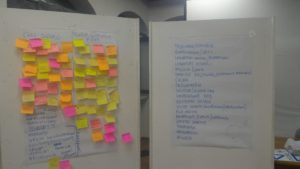
The participants were invited to write down on post-its several things: first the values they associate to the park, then their competences. By clustering the post-its, our service designer Paola Santoro helped them summarizing their knowledges and their needs too. This activity showed that the participants are animated by those values: beauty, participation, education, love for culture and sport, respect and legality.
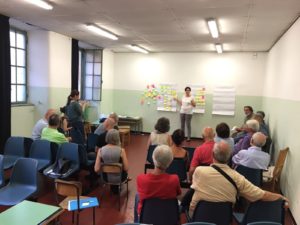 The second workshop took place on the 22nd of June. This time the laboratory focused on actions: the participants were invited to think about – and to write down on post-its, of course – the actions they daily do in the park, the obstacles they run into trying to perform those actions, and the opportunities deriving from them. After the identification of actions, obstacles and opportunity, Paola and the participants of the workshop negotiated the priorities od those things they thought to.
The negotiation has been the very first moment of collaboration and shared decision! It has been a start point for a collaborative process focused on common objectives.
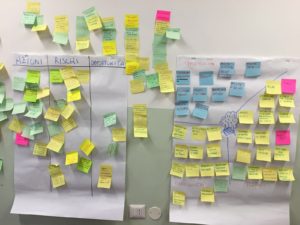
The third workshop will took place on the 4th July, at 5 PM in Villa de Sanctis, Centocelle. It will be the last appointment before the summer break. The laboratory will then restart in September, but the work on field will never stop!
Nell’ambito del progetto Co-Roma, LabGov ha organizzato, nel mese di giugno, due workshop nel quartiere di Centocelle, finalizzati alla costruzione di un percorso di collaborazione per la riqualificazione del parco archeologico del quartiere. I partecipanti dei workshop, grazie alla mediazione della nostra service designer Paola Santoro, hanno avuto modo di conoscersi, di dare linee guida valoriali al processo, e di individuare azioni opportunità e rischi legati alla fruibilità del parco. Il prossimo appuntamento, l’ultimo prima della pausa estiva, sarà il 4 luglio alle 17.00 presso Villa de Sanctis.
by Chiara Fratalia | Jun 29, 2016 | Commons Press
“La collaborazione civica per l’amministrazione, la governance e l’economia dei beni comuni” is an article written by LabGov coordinator, prof. Christian Iaione, and first published in L’Italia della Condivisione in 2015.
“In Italia i beni comuni sono ormai entrati nel lessico comune. La consapevolezza che gli italiani hanno maturato circa la rilevanza che rivestono e le criticità che presentano beni essenziali alla coesione sociale, tanto quanto allo sviluppo economico, è testimoniata dall’afflato partecipativo che ha caratterizzato i referendum del giugno 2011 su quelli che mediaticamente sono passati alla storia come i referendum per i “beni comuni”. Nella narrazione collettiva i beni comuni sono stati identificati nell’acqua, nell’ambiente e nella legalità. In realtà si trattava di quesiti referendari attinenti a “questioni domestiche” che non prendevano a riferimento la nozione scientifica invalsa a livello internazionale di “beni comuni” o “commons”. In molti hanno provato e provano a utilizzare ideologicamente questo concetto, producendo più danno che beneficio a chi cerca di studiare con metodo scientifico i beni comuni e forgiare gli strumenti tecnici necessari per fare dei beni comuni la base di ripensamento delle istituzioni sociali, economiche, politiche e amministrative. Ad ogni modo questa sensibilità generale verso i beni comuni non deve andare sprecata e per fare ciò occorre fermarsi a riflettere sulle forme e le condizioni di gestione, cura e tutela dei beni comuni. Il rischio è che l’espressione “beni comuni” divenga un’espressione di senso comune, ma priva di effettivo valore semantico e, soprattutto, di rigore scientifico, casella vuota che chiunque si sente legittimato a riempire con qualunque significato, vessillo ideologico inalberato da movimenti o manifesti più o meno condivisibili. Ma da dove si deve partire per gettare le fondamenta di una rigorosa e solida teoria scientifica dei beni comuni? Senza dubbio il primo problema da affrontare è quello definitorio. Quali sono i beni comuni? Quanti sono i beni comuni? Sul punto, in Italia si è sviluppata un’ampia e approfondita riflessione dogmatica su cosa debba ricomprendersi all’interno dell’orizzonte dei beni comuni volte a una ricostruzione giuridica del fenomeno dal punto di vista teorico o applicativo. Per costruire un solido paradigma teorico poggiante sulle fondamenta dei beni comuni occorre dotarsi anche di una nuova chiave di lettura del modello sociale ed economico oggi dominante e di infrastrutture giuridiche e amministrative a supporto di questo diverso metodo. In definitiva, lo studio dei beni comuni come categoria scientifica rappresenta una sfida intellettuale che richiede un metodo interdisciplinare, che deve per forza di cose partire dai risultati degli studi di Elinor Ostrom (insignita del Premio Nobel per l’economia nel 2009) e dei suoi allievi, senza però rinchiudersi in questo o quel recinto culturale o scientifico. Solo un simile sforzo intellettuale potrà candidarsi a fondare su basi solide e verificate dal punto di vista economico, giuridico e istituzionale, un nuovo paradigma, e quindi una società più giusta.”
If you are interested in this subject, please explore the full paper here.
by Chiara Fratalia | Jun 29, 2016 | Commons Press
“Città e beni comuni” is an article written by LabGov coordinator, prof. Christian Iaione, and first published as a chapter of L’Italia dei beni comuni, a book published in 2012 by Carocci and co-authored by prof. Iaione and Gregorio Arena.
“Dove va una persona se vive in una città, non ha la fortuna di possedere un giardino e sente il bisogno di immergersi in un ambiente naturale, usufruire di tutti i servizi che uno spazio verde può fornire come correre, leggere un libro su un prato all’aria aperta, respirare aria mediamente più pulita? Come può quella persona nutrire la propria sete di relazioni sociali e incontrare persone nuove, diverse, ricche di esperienze e culture che non possiede? Dove può coltivare il proprio senso di appartenenza a una comunità, contribuire ad arricchire la sua identità con le proprie capacità e passioni, partecipare delle sue tradizioni? Quali sono le infrastrutture e i servizi che accrescono la qualità della vita urbana, mettono la persona in condizione di condurre un’esistenza degna di essere vissuta o la rendono più libera di muoversi e le consentono di condividere o coltivare stili di vita più coerenti con la propria sensibilità individuale e con quella di chi vive nel medesimo spazio di vita? Cos’è che determina il maggiore o minore valore economico o semplicemente estetico di una comunità sotto il profilo immobiliare? Tutte queste domande trovano una sola, identica risposta. Si tratta degli spazi e servizi urbani di interesse comune. Essi soddisfano numerosi bisogni del vivere in città perché sono funzionali al benessere delle comunità, come all’esercizio individuale dei diritti di cittadinanza: qualità della vita e del lavoro, socialità, mobilità, svago, condivisione, senso di comunità, possibilità di coltivare capacità e passioni sono tutte cose che risentono immediatamente della maggiore o minore qualità delle infrastrutture di uso collettivo che una città è in grado di mettere a disposizione dei propri abitanti. Purtroppo, però, vivono oggi un momento di profonda crisi. Una crisi determinata da due fattori. Si tratta in primo luogo del deficit e del declino degli spazi pubblici o collettivi tanto nelle periferie, quanto nelle aree centrali, tanto nel momento della loro infrastrutturazione, quanto in quello della loro manutenzione. Il secondo fattore di crisi risiede, invece, nella graduale disaffezione e disattenzione dei cittadini verso gli spazi pubblici urbani che sono percepiti come luoghi di nessuno (o al più dell’ente pubblico locale), anziché luoghi di tutti in quanto spazi comuni. E questo atteggiamento di spoliazione di titolarità e responsabilità da parte dei cittadini consente l’aggressione indisturbata e impunita di questi beni da parte di chi non riesce ad apprezzarne l’importanza per la vivibilità urbana e la coesione sociale. Sul primo versante, vincoli sempre più stringenti ai bilanci degli enti locali, imposti dalla disciplina comunitaria in materia di patto di stabilità e derivanti dalla dimensione del debito pubblico italiano, oltre alla riduzione dei trasferimenti statali conseguente all’aggravamento dei conti pubblici italiani a seguito della crisi finanziaria del 2008, hanno indotto gli enti locali a ridurre il proprio intervento a favore dei bisogni della comunità locali. La riduzione delle risorse pubbliche non ha riguardato solo i servizi alla persona, ma sta incidendo fortemente anche sull’ambiente urbano e, in particolare, sugli spazi pubblici. La crescente penuria di risorse pubbliche fa il paio con un sempre più diffuso disinteresse dei cittadini, in particolare quelli di più giovane età, verso la preservazione, la cura e il mantenimento dei luoghi di vita e aggregazione dove si svolge la vita comunitaria. In maniera speculare stentano a svilupparsi e diffondersi forme di responsabilizzazione nella fruizione e nella gestione dei servizi pubblici locali. Molto probabilmente questa disaffezione trova origine anche in una scarsa opera di educazione alla cittadinanza da parte delle istituzioni ma anche delle singole famiglie e della scuola. Eppure, nella costruzione del benessere urbano è decisivo il coinvolgimento degli attori principali dell’ecosistema urbano, e cioè gli stessi cittadini che usano e vivono la città. La “città ideale” per Lefebvre è, infatti, «una continua opera degli abitanti, essi stessi mobili e resi mobili per e da questa opera. […] Il diritto alla città si manifesta come una forma superiore di diritti: diritti alla libertà, all’individualizzazione nella socializzazione, all’habitat, all’abitare»”.
If you are interested in this subject, please explore the full article here.
by Chiara Fratalia | May 20, 2016 | The Urban Media Lab
Fulcro della sperimentazione tecnologica delle pratiche di condivisione, le città sono diventate il centro del dibattito sulle politiche pubbliche che riguardano la sharing economy. Città di tutto il mondo, come Seoul, Amsterdam e Londra, hanno cominciato a implementare programmi, legislazioni e regolamenti-quadro per supportare la sharing economy locale. Una di queste città è Milano, patria di Milan Sharing City, un progetto compreso nello Smart City Program.
Abbiamo recentemente avuto il piacere di intervistare Renato Galliano, supervisore di Milan’s Smart City e del progetto Sharing City. Gli abbiamo chiesto di parlarci delle origini di questo progetto, e ci ha anche fornito una prima valutazione dei suoi successi e dei suoi limiti, riguardanti anche argomenti di importanza fondamentale come la partecipazione e l’inclusione.
Questo articolo è il primo d una serie, co-prodotta da LabGov e Shareable, che vuole mettere in evidenza le politiche pubbliche che promuovono la sharing economy e la tutela dei beni comuni urbani.
Enjoy the interview!
“Monica Bernardi and Christian Iaione: How did Milan Sharing City begin?
Renato Galliano: The Smart City Division has always taken a keen interest in innovative processes, especially in the urban setting and, above all, in a period—like this—of economic paradigm change. We looked at the sharing economy as we [had] previously looked at other [developments], such as innovative spaces (ex. co-working) and the relationship between [startups] and traditional industry. Recognizing [the potential of the sharing economy to become] an important phenomenon from different points of view, in early 2014 we decided to accompany its development.
[At that time], there were already several groups working on the topic. Sharexpo and Sharitaly were the main ones. [Sharexpo encouraged] reflection on the potential of sharing economy to [mitigate] the extra load on the city that [Expo Milano] would bring. We engaged with all the actors involved an open and collaborative dialogue, to learn about their needs, goals and problems.
[Our] working method, based on a listening phase, followed by a participatory phase and, as a last stage, the delivery of [a public policy instrument], has been adopted also in other policy areas: in a macro way for the Smart City theme, involving big urban players such as universities, businesses and [voluntary and community organizations]; and also for specific phenomena like co-working.
[Regarding co-working], listening to the actors involved [encouraged] us to rethink our first idea of intervention. [Instead] of creating a public co-working [space, we decided to] support the existing structures, without becoming a player in opposition [to them]. We developed ad hoc public policies such as the Co-working Register and the coworking spaces’ voucher supply system.
The same path has been followed for the Sharing City. [During] the initial phases, we collaborated [with the public] on a draft document on the topic. [We brought the final document] to the City Council [pdf] for approval and published guidelines for the sharing economy [pdf], launching a series of collaborative tools. One example is the Register of the Sharing Economy’s Actors [pdf], [which includes a list of] experts and operators (to date more than 100), followed by other activities [brought to our attention] during consultation, such as: civic crowdfunding platforms; Co-HUB, a physical space to cultivate the culture of sharing and the collaborative economy; and a call from our social innovation incubator, FabriQ, for startups working in the field.
I’d like to underline that we worked on two levels: at the local level, as seen, but also on [the national and international] levels. [We liaised] with the EU Committee of the Regions, which was working on the Opinion on the Sharing Economy at the EU level. On the national level, we worked on a proposed national law on the sharing economy with, the Italian Inter-parliamentary group for innovation, Forum PA, and ANCI. [We also worked] with some international operators such as AirBnb to define specific agreements. However, I believe that public policy [should not aim] to lock the sharing economy within stringent regulatory frameworks, since it responds to a real need—social or economic—that goes beyond the policies adopted at local, national and international levels.
What unites Milan’s various sharing economy policies?
We framed the Sharing City project [within the larger] Smart City process. The latter is a transdisciplinary public policy, and the mandate is of coordination—not of realization. The topic of the smart city is [appreciated less for its] technological dimensions and more from the citizens’ perspective. Within this “human smart city”, the sharing economy represents a tool, among others, to improve the quality of life of city-dwellers and enterprises.
[It is essential that the] different divisions [working on the smart city] dialogue and work [together]. The real problem is related not to the content of the projects, but to the traditional, “siloed” approach of public administration. To overcome this attitude is not easy, but in Milan the entire smart city process has been conducted in a horizontal way, analyzing internally the city’s projects, in a multi-purpose approach and speaking with the individual directors.
What difficulties did you encounter in developing policy for the sharing economy?
The main difficulties are not related to the city itself but to the phenomenon. First of all, the issue of regulation of new unplanned activities that touch corporate interests stratified over the decades. For this reason we decided to work [beyond the] the local level, since some regulatory arrangements depend on national and EU [authorities].
Another general difficulty is connected to the extreme diversification of the sharing economy’s actors, from multinational corporations with international technological platforms to community experiences, such as Social Street, and non-economic exchange platforms of goods and services. The diverse actors hold dissimilar skills, competencies, backgrounds, and economic power, and sometimes don’t recognize themselves as part of the same phenomenon. The approach must be different [for each case], based on specific languages and features.
On the [other hand], the feedback from citizens has been excellent. The public administration’s intervention has been perceived in a positive, non-invasive way, as an accompanying relationship. The current difficulty is to switch from the city level to the metropolitan level. We would like the Register, for example, to take a metropolitan dimension to formally intercept actors and experiences outside of the city.
Which projects have been most successful?
Fifteen high-quality projects were selected through a call and incubated at FabriQ; among them, only two are experiencing some difficulties. [But keep in mind that] the municipality intervened more [at the level of] governance [than at] the projects level. We don’t [directly supervise the projects]. After [an understandably] difficult first phase, the local projects, like Social Street, are doing very well, and are involving a growing number of citizens. The big platforms, like AirBnb, could count on the flywheel effect of universal exposure and are thriving in the city. [Some projects face challenges] related to a series of obligations introduced to respond to real local needs (fees for use of public land, taxes for marketing, etc.).
In terms of projects initiated directly by the municipality, the civic crowdfunding [scheme] is receiving positive feedback. We chose the platform, Eppela, through a public call, instead of creating one by ourselves, and now we are evaluating the projects received [through it].
How would you rate Milan Sharing City’s record on participation and inclusion?
About participation: yes, our process is facilitating participation. It is a subject of interest for [those citizens working on responding to local needs]. These needs can be of an economic nature or related to community building. [In the former case, sharing projects] can produce income for someone or save them money; [regarding] the latter, [projects foster community] relations by encouraging residents’ participation. In addition, the participatory budgeting process, with one million Euros for each of the nine zones of the city, is clearly reinforcing this aspect.
[The issue of inclusion is more closely related to] the content of the projects. For some of them, the main goal is exactly the inclusion of vulnerable subjects; others have cross-cutting [goals]. In general, the topic of inclusion is defined more in terms of social innovation. Therefore, even social businesses’ projects, which aim to solve social problems and favor integration, are able to reduce social exclusion.
An example is the FabLab that will open soon in D’Azeglio Street: the project includes associations, the third sector, schools, other FabLabs, etc., in a logic of deep integration. Other projects that have a clear goal of including specific groups, such as NEET (addressed to young people not engaged in education, employment, or training), or OpenCare, can count on the active participation of FabLab.
The governance dimension is clearly crucial. What new relations and collaborations were established through the project?
The main governance tools that we use are the public calls and the Register, which are inclusive tools by design. They allow a phenomenon to emerge instead of selecting or evaluating the actors that are part of the phenomenon. For example, the Register is public and presents the description of each actor registered. We called them with specific [follow-up] questions [that helped initiate] new interconnections and relations.
In general, new relations are emerging, thanks to the call that allow us to enter into contact with subjects interested in the topic, or through the community’s projects, or in a direct way, as [with] AirBnb. The calls for the Co-HUB space, the crowdfunding platform, and the FabriQ incubator are all important governance tools that are opening new sets of relations.
Are any key actors missing from the Milan Sharing City process as it currently operates?
The entire traditional financial world is still not involved in this discourse. The reason, [I imagine], is that their internal rules do not allow financial institutions to [respond] quickly [to new economic phenomena]. This [affects] not only the sharing economy, but also the smart city discussion as a whole: banks are not able to finance smart city projects, unless they [fall into very specific categories], such as energy projects. In some cases, banks are unable to evaluate the market value of the new platforms, [especially] if they generate a low economic return (as with the platforms for the exchange of goods).
Paradoxically, the stock market [should be] able to assess the value of these platforms, since it doesn’t value only the [projects’] budgets, but also their potential for development, the involvement of other actors, and so on. At some point, the involvement of the financial world will become necessary; otherwise [these initiatives will suffer from a lack of funding].
What will happen to Milan Sharing City in the future, especially in view of the coming elections?
The phenomenon has started, and in my opinion it cannot be stopped. The future is uncertain; [soon we will hold] elections, and a lot will depend on the political approach of the new city government. But even if [the new government is] completely against the sharing economy, the phenomenon will keep going, since it responds to authentic needs. I hope the new City Council will add value to [what we’ve] built [over the past] five years. There are unequivocal figures about the position of Milan in terms of our focus on the smart city, the sharing economy, and social innovation, with awards and recognitions at national and European levels. It would be such a waste not to enhance this legacy and thus lose our competitiveness.
What are the next steps in the Milan Sharing City process?
After working on the emergence of the phenomenon and on the dialogue and agreements with new actors, the goal of the next five years, in my opinion, should be the setting-up of concrete but flexible structures through which the administration can directly dialogue with other stakeholders. Milan should adopt a kind of innovation agency to create new relations and partnerships, and [to address the city’s international standing].
[On the metropolitan level, it would be interesting to see emerge an authority who could] partner with the different municipalities, the chambers of commerce, the universities, and so on, aggregating all the different actors [in order] to promote innovation at all levels.”
Originally published by Shareable, here.


