by Chiara Fratalia | May 18, 2016 | The Urban Media Lab

“L’intelligenza della città partecipata: competenze, risorse e regole per l’innovazione urbana” is the title of an event on collaborative governance and urban innovation that will take place in Rome on the 24th May 2016. This event was organized in the framework of the ForumPA 2016, that will also foster other events on the subjects of sustainability and sharing economy.
Digital skills and services, Resources and sustainability, Collaborative administration: these are the three subjects that will be discussed in the working groups, with the aim to move from single experiences and experiments to national proposals, to be addressed to the Government or to the Italian municipalities network.
Assessors, directors and experts will join the working groups.
The events will take place at Palazzo dei Congressi, Roma EUR, in Favignana Hall – CREATIVITY CCIAA ROMA- I° floor. Read the related ForumPA article here.
______________________________
Martedì 24 Maggio al Palazzo dei Congressi di Roma si terrà l’evento “L’intelligenza della città partecipata: competenze, risorse e regole per l’innovazione urbana”, nel quadro del ForumPA 2016. I Tavoli di Lavoro vedranno coinvolti assessori, dirigenti ed esperti, per discutere di amministrazione collaborativa delle città.

by Chiara Fratalia | May 13, 2016 | The Urban Media Lab
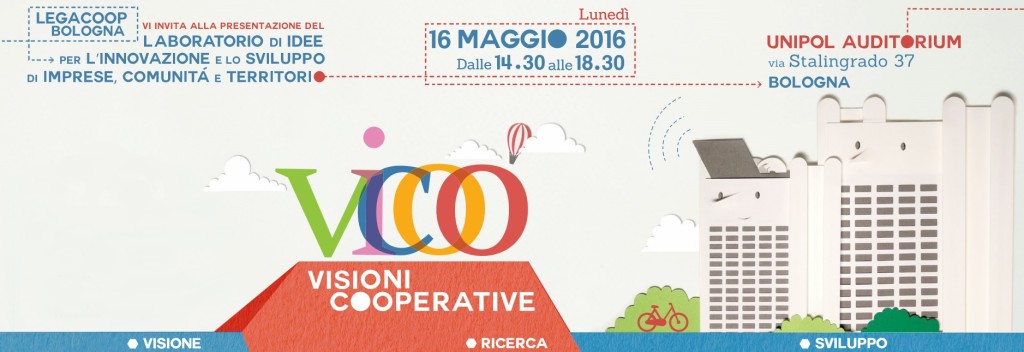
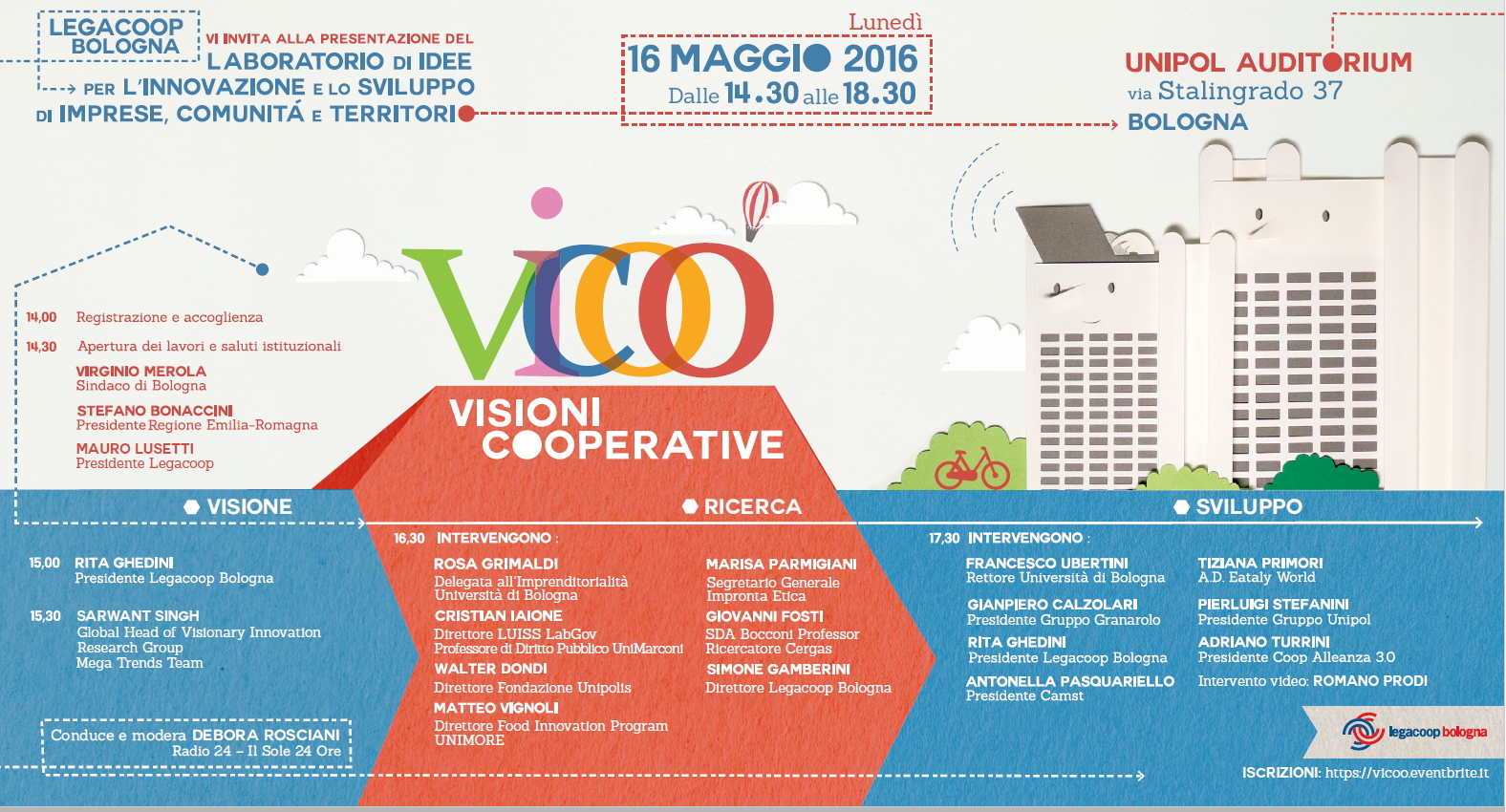
LabGov with professor Christian Iaione will take part in the ViCoo – Visioni Cooperative conference!
On the 16th May prof. Iaione will attend the presentation conference of ViCoo – Visioni Cooperative, the laboratory of ideas created by Legacoop Bologna to introduce new roads towards innovation for communities and territories elaborated with research centers and international and Italian universities. The event will be opened by Sarwanth Singh, member of the Advisory Board of the Leeds University Business School and founder of the research group on Mega Trends. Many researchers will intervene, those who work together with Legacoop Bologna to elaborate strategic trajectories and innovation proposals for the development and growth of territory cooperatives.
The conference follows other events on the same subject that occurred in the last month.
For instance, CUBO (Unipol Centre Bologna) on the 26th of April hosted a reflection on the development of suburbs and urban requalification, by means of a comparison between the experiences of Turin, Melpignano (Lecce), Naples and Bologna. This event was part of the program #PrimaveraPilastro2016, a series of events in the framework of a bigger project that aims at adding value to the Pilastro neighbourhood in Bologna by trying to build a cooperative community.
Another event on this subject was organized by Eutropian and took place in Rome on May 5-7, with the title “Funding the Cooperative City. New models for community spaces”. The event aimed at discovering new economic models for community-led urban development, through comparisons of experiences and initiatives in a debate that involved researchers coming from Italy and Europe.
LabGov coordinator, prof. Christian Iaione, has contributed to the research effort in finding new theoretical and practical frameworks to realize and promote the collaborative city model. He recently wrote an article, published on the American Journal of Economics and Sociology, in which he investigates if urban assets and resources can be transformed into sharing, collaborative, cooperative, commoning ecosystems that enable collective action for the commons.
Prof. Iaione underlines the important social functions carried out by urban spaces and community services: they encourage higher sense of belonging to the community, help to overcome political apathy, foster social cohesion, thus being crucial to a community’s well-being. He also states that urban commons are undergoing a deep crisis period, determined by the decline of public or collective spaces and citizen disaffection; urban public spaces are thus perceived as nobody’s places, rather than everybody’s places.
For this reason, it is necessary to rethink the governance of the commons: the quantitative and hierarchical, centralist approach to promoting urban space, typical of an exclusive public administration, must be replaced by a polycentric, qualitative, and relational concept of urban welfare and urban commons, which is urban co-governance.
He also proposes five design principles of a “commonsbased urban governance matrix”:
- introduction of urban commoning through regulation or a new group or organization;
- collaborative governance of sharing, possibly in conjunction with a collaborative economy based on a complementary currency system and local development agencies;
- social innovation as the basis of a shift from a traditional urban welfare system to a collaborative welfare system;
- radical transformation of the internal organization and work methodologies of urban bureaucracies into citizens enabling communities of service designers;
- establishment of a collaboration laboratory (Co-Lab), a living lab where collaboration takes place, is taught, and communicated.
Prof. Iaione discussed his paper in the 4th European Regional Meeting of IASC, that took place in Bern from the 10th to the 13th May with the following subject: “Commons in a ‘glocal’ world: global connections and local responses”. The article was debated in the B20 panel, which would like to examine the concept of Smart Cities in India, and contrast it with the advances that other countries made in redefining their concepts of urban commons.
For more information, see the ViCoo – Visioni Cooperative event program.
You can also read our previous articles on Pilastro2016, Rome Eutropian conference and Bern IASC conference.
_____________________________________
Il prof. Christian Iaione, coordinatore di LabGov, parteciperà alla conferenza di presentazione di ViCoo – Visioni Cooperative, un laboratorio di idee organizzato da Legacoop Bologna per esplorare nuove rotte verso l’innovazione di comunità e territori. L’evento ne segue altri sullo stesso argomento tenutisi nell’ultimo mese, come la conferenza CUBO #Pilastro2016, l’evento Eutropian a Roma e la 4a Conferenza Regionale Europea di IASC a Berna. Proprio in quest’ultimo evento il prof. Iaione ha presentato un importante articolo che propone i cinque pilastri fondanti per una corretta ridefinizione del concetto di governance dei beni comuni.

by Chiara Fratalia | Apr 27, 2016 | The Urban Media Lab

LabGov with professor Christian Iaione will take part in the next IASC conference!
The 4th European Regional Meeting of IASC will have place in Bern from the 10th to the 13th May with the following subject: “Commons in a ‘glocal’ world: global connections and local responses”. IASC (International Association for the Study of the Commons) was founded in 1989 to bring together multi-disciplinary researchers and policymakers, with the purpose of advancing the understanding and improving governance of common-pool resources.
This conference main goal is to provide a space to debate on the ongoing “glocal” processes, which are often not yet addressed in a systematic way. The conference aims at debating the impacts of external changes on the perception and evaluation of resources by actors related to the commons, and thus affecting the access to common-pool resources.
Since the importance of the conference subject, LabGov has decided to participate by submitting a paper in the B20 panel, which would like to examine the concept of Smart Cities in India, and contrast it with the advances that other countries made in redefining their concepts of urban commons.
The paper submitted by prof. Iaione, with the title “The Sharing, Collaborative, Cooperative City”, will be discussed within its panel on Wednesday 11th May. This paper aims at examining the concept of design elements of a smart city from people’s perspective, while generating a significant body of comparative empirical knowledge about sharing economies and their governance within global cities.
The conference will entirely take place in the Social Anthropology Institute of the University of Bern.
_________________________________
LabGov a Berna per discutere di beni comuni. Il coordinatore del gruppo, il prof. Christian Iaione, è autore di un paper che sarà discusso all’interno della Conferenza Regionale Europea di IASC, che si terrà a Berna tra il 10 e il 13 maggio. La conferenza ha lo scopo di analizzare come i processi “glocal” del nostro tempo influenzino la percezione e dunque la gestione dei beni comuni.

by Diletta Di Marco | Apr 25, 2016 | The Urban Media Lab
Wednesday, April 27, 2016 from 17:00 PM, the event “Per una nuova cultura della città: la periferia come bene comune”organized by Giovani per Roma Association will be held at Sala Quaroni , placed in via Ciro il Grande in Rome EUR. Professor Christian Iaione from LabGov will partecipate to discuss the role of urban common as the engine for the regeneration of the suburbs. The main theme of the conference is urban innovation: how current urban dimensions could represent challenges fostering original future models of governance? In fact, the idea that lies behind this new critical way to organize the city is to build together a robust yet innovative system and to rethink the spaces and services putting at the centre stage the role of the citizenship. Other crucial issues will be addressed: the respect for the environment, the enhancement of the territory and the quality of life.
The event will be opened by Andrea Santoro, President of Municipio Roma IX. The conference will be attended by the following experts: Massimo Alvisi from Alvisikirimoto+Partners, Francesco Marsico from Caritas Italia, Davide Lottieri as President of Campus Bio-Medico Spa, Maurizio Gubbiotti as Special Commissioner for RomaNatura, Roberto Setola as Founder of the Italian Association for experts in Critical Infrastructures, Nicola Ferrigni for LinkLab and Francesco Limone as Director of ELIS Corporate School.
Here the full program of the event.
To participate please send a message to: INFO@GIOVANIXROMA.ORG.

——————————————————————————————————————
Il 27 Aprile 2016 ore 17:00 LabGov prenderà parte grazie all’intervento del Professor Christian Iaione all’incontro “PER UNA NUOVA CULTURA DELLA CITTÀ: LA PERIFERIA COME BENE COMUNE”. L’evento avrà luogo presso la Sala Quaroni – Via Ciro il Grande, 16 – Sede EUR- Roma. Il tema principale dell’incontro sarà come le attuali dimensioni urbane pongono nuove sfide al futuro della città ed ai modelli di governo.A seguito del convegno verrà istituito un gruppo di lavoro multidisciplinare per la stesura di un documento programmatico per lo sviluppo e la valorizzazione del ruolo delle periferie nel contesto urbano e sociale di Roma Capitale. Per prendere parte al convegno scrivere a INFO@GIOVANIXROMA.ORG

by Staff | Dec 3, 2015 | The Urban Media Lab
“The City as a Commons” conference has produced a body of knowledge that can guide future research and policymaking on which we can build. Specifically, after some reflection, we came away from the conference with at least 10 lessons for the developing field of the urban commons:
1. There are many kinds of urban commons, some existing for many decades (e.g. housing cooperatives) and others just emerging. Social innovation is important for designing some types of urban commons and the conditions for commoning;
2. We must embrace the diversity of commons and commoning yet still be careful about what we call the commons; so more work is needed on analyzing what is an urban commons and what is not;
3. In addition to many resources being held or managed in common, in a collaborative fashion, the city itself must be considered a commons–both as an urban space and as a governing entity. The governance of the urban commons can be a framework to update political and bureaucratic decision-making processes at the city level;
4. The commons is an emerging framework for inclusiveness and equity in cities as the world is urbanizing and cities are the place where different cultures, classes and people come to live together, work together and grow together;
5. The role of technology is important for the commons, but technology is a means and not an end. It must enable and support the urban commons, and the ability of people to come together and collaborate in the interest of the community or communities;
6. Collective action for the urban commons should be enabling existing communities, stakeholders, and city inhabitants as much as creating new urban communities, formal and informal groups, movements, traditional stakeholders and social or collective organizations;
7. Urban commons need an “industrial plan” and new economic and/or social institutions to help transition some cities, and some areas within them, away from an old economic model to one that leverages the power of commoning and collaboration to support sustainable, flourishing as well as more inclusive, just and democratic communities;
8. The urban commons governance principle is not self-government, nor decentralization. It is rather distribution of powers among public, social, economic, knowledge and civic actors and therefore it implies a significant investment in the design of new forms of collaboration and partnerships among these actors;
9. Design principles for the urban commons should be written to reflect the design principles created by Elinor Ostrom, but adapting them to the challenges and characteristics of the more political, confrontational, and overregulated space which cities represent. The study of the commons in the city should be the focus of future research beyond the study of the urban commons. More attention should be put on experimentation, institutional diversity, spreading of social norms within urban contexts;
10. There should be safeguards against opportunistic, exploitative, and short-sighted behaviors, as well as escapist flights and utopian or ideological visions, in developing and sustaining the urban commons. A bottom-up, as well as a circular, approach is crucial for the urban commons and confirms Focault’s argument that power is “not something that is acquired, seized, or shared, something that one holds on to or allows to slip away; power is exercised from innumerable points, in the interplay of non egalitarian and mobile relations”.
This is just a tiny part of the huge body of knowledge generated by “The City as Commons” conference thanks to your support and cooperation. We look forward to building new advancements in the study of the urban commons hope that we can continue to partner with you towards this end.
———————————-
La conferenza “The City as a Commons” ha prodotto un patrimonio di conoscenza che negli anni a venire fungerà sicuramente da fonte di ispirazione per la ricerca e la formazione e dal quale si potrà partire per costruire nuove politiche pubbliche e immaginare nuovi strumenti di coesione sociale e sviluppo economico locale. I materiali per i quali gli autori presteranno il proprio consenso verranno resi gradualmente disponibili alla pagina: www.labgov.it/urbancommons/press/. Nello specifico, dopo alcune riflessioni svolte a valle della conferenza, abbiamo pensato di distillare “dieci lezioni sui beni comuni urbani”, consapevoli che si tratta solo di una possibile “mappa nautica” in un campo di studi con ancora enormi margini di esplorazione:
1. per commons (o beni comuni) devono intendersi anche e soprattutto le istituzioni abilitanti l’azione collettiva. Ci sono tipologie diverse di queste istituzioni, alcune esistono da molto tempo (ad es. le associazioni di volontariato, le cooperative), altre stanno emergendo solo adesso. L’innovazione sociale è un fattore importante per il design di alcune tipologie di istituzioni per i beni comuni urbani e per le condizioni che favoriscono il commoning (o collaborazione civica) a livello urbano;
2. dobbiamo abbracciare la diversità dei beni comuni, delle loro istituzioni e delle pratiche di commoning (o collaborazione civica) e porre molta attenzione quando definiamo i beni comuni: c’è bisogno, quindi di un approfondito lavoro di analisi per comprendere cosa è e cosa non è un bene comune urbano;
3. oltre alle sue risorse, da gestire con un approccio collaborativo, la città stessa deve essere considerata come un bene comune sia come spazio urbano, che come entità di governo. La governance dei beni comuni può essere un framework adeguato per aggiornare il processo decisionale politico e amministrativo a livello locale;
4. quello dei commons è un framework emergente che si sta affermando per migliorare l’inclusione e l’uguaglianza nelle città, tenuto conto del fatto che il mondo si sta urbanizzando e le città sono oggi quei luoghi dove culture, classi sociali, persone differenti si insediano per vivere, lavorare e crescere insieme;
5. il ruolo della tecnologia è importante per i beni comuni, ma la tecnologia è un mezzo e non un fine, il cui compito è abilitare e supportare i beni comuni urbani e la capacità delle persone di collaborare nell’interesse della comunità o, ancora meglio, delle comunità;
6. l’azione collettiva per i beni comuni urbani dovrebbe essere abilitante tanto per comunità, attori sociali, gruppi formali e informali, abitanti delle città preesistenti, quanto per nuove comunità urbane, nuovi gruppi formali e informali, nuove formazioni sociali e nuovi movimenti e attori e organizzazioni sociali o collettive;
7. i beni comuni urbani necessitano di un “piano industriale“ e di una nuova istituzione economica e sociale che aiuti la transizione di alcune città e di alcune aree urbane all’interno di esse da un vecchio modello economico ad un nuovo modello che faccia leva sul potere del commoning e della collaborazione civica per supportare comunità sostenibili, prospere nonché inclusive, eque e democratiche;
8. il principio generale di design della governance dei beni comuni urbani non è l’auto-governo, nè il decentramento. Il principio generale è piuttosto la distribuzione del potere tra attori pubblici, sociali, economici civici e cognitivi e pertanto implica un investimento significativo nel design di nuove forme di collaborazione e partenariato tra questi attori;
9. i principi di design per la governance dei beni comuni urbani o dei beni comuni nella città dovrebbero ispirarsi ai principi elaborati da Elinor Ostrom per il governo dei beni collettivi. Essi tuttavia vanno modulati e adattati alle sfide e alle caratteristiche di quello spazio politico, conflittuale e sovra-regolato che le città rappresentano. Lo studio dei beni comuni nella città, più che lo studio dei beni comuni urbani, dovrebbe essere uno dei focus verso i quali indirizzare le ricerche future. Si dovrebbe porre un’attenzione maggiore alla sperimentazione, alla diversità (o differenziazione) istituzionale, alla diffusione di norme sociali all’interno dei contesti urbani;
10. nello sviluppo e nel sostegno ai beni comuni urbani dovrebbero essere inserite delle clausole di salvaguardia contro comportamenti opportunistici, strumentali e di breve termine, così come si dovrebbero evitare fughe in avanti e costruzioni utopiche o ideologiche. Un approccio dal basso e circolare è cruciale per i beni comuni urbani e conferma la visione di Michel Foucalt, secondo il quale “il potere non è qualcosa che si acquista, si strappa o si condivide, qualcosa che si conserva o che si lascia sfuggire; il potere si esercita a partire da innumerevoli punti, e nel gioco di relazioni disuguali e mobili.